
Key takeaways
- →Name the job shape first: web API, data pipeline, ML service or automation are different labor markets with different prices and interviews.
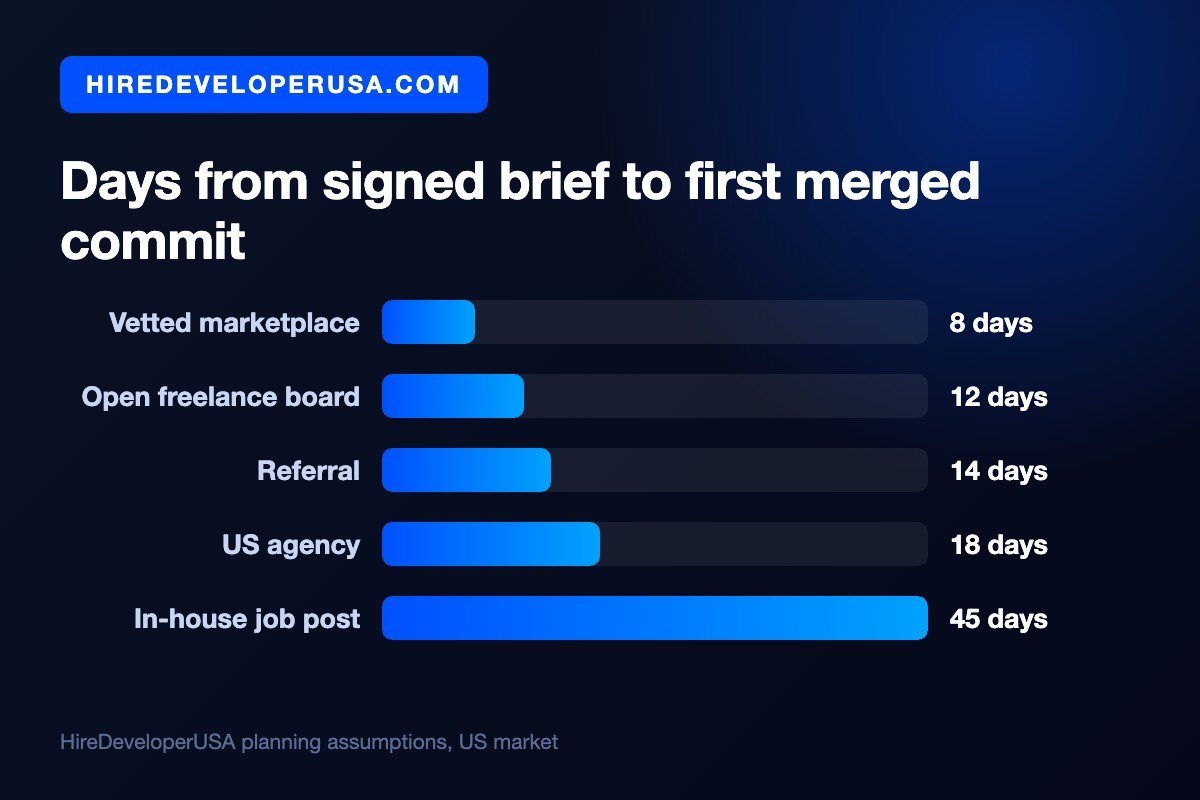
- →Plan about 8 days from brief to first commit through a vetted marketplace, 14 through a referral, 18 through a US agency and about 45 through an in-house job post.
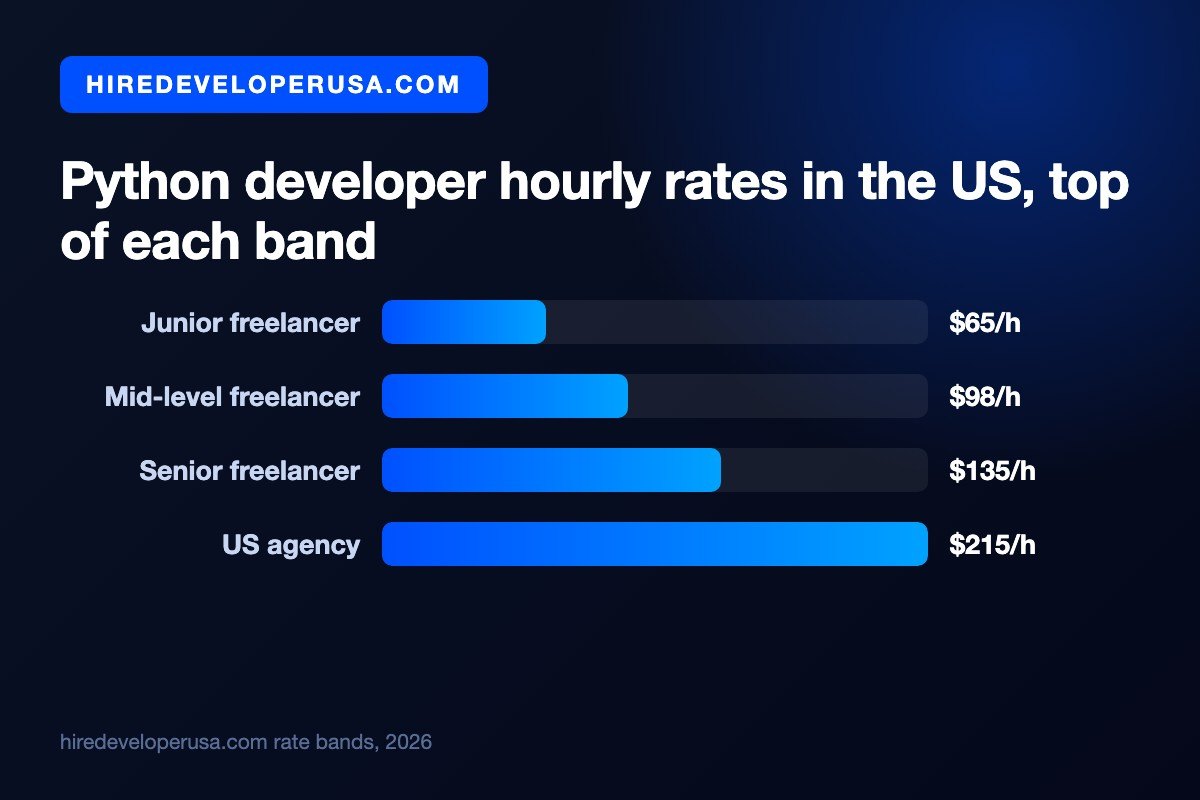
- →US Python freelancers bill $38 to $135 an hour by seniority, agencies $115 to $215, and full-time base salaries run $100,000 to $178,000 before loading.
- →Replace trivia with a 30-minute review of a real code sample: entry-point guard, single-purpose functions, type hints with a checker, idiom, and dependency hygiene. Four of five moves a candidate forward.
- →Pay for 10 to 15 hours on one real ticket, land it on staging, and review the pull request like production before signing anything longer.
To hire Python developers who actually ship, run three checklists in order: name the job shape you are buying (web API, data pipeline, ML service or automation), source from the channel that matches your deadline, then run every finalist through the remaining gates, a code-sample review, an hour of pairing, two reference questions and a paid trial, before you sign anything longer. In the US, vetted Python freelancers bill $38 to $135 an hour depending on seniority, agencies charge $115 to $215, and full-time base salaries run $100,000 to $178,000. A vetted marketplace gets you to a first merged commit in about eight days; an in-house job post takes around 45. The rest of this guide is the checklist itself: the sourcing table, the budget guardrails, and the five code habits that separate a senior Python engineer from a good resume.
Name which Python you are buying before you post anything
Python is four labor markets that happen to share a syntax. The engineer who builds a clean Django or FastAPI backend, the one who keeps a nightly pandas and Airflow pipeline honest, the one who serves a PyTorch model behind an API, and the one who automates a sales team's spreadsheets are hired from different pools, at different prices, with different interviews. Write down which one you need before the first call:
- Web and API work. Django, FastAPI or Flask, a relational database, authentication, background jobs. This is the deepest pool and the most competitive pricing.
- Data engineering. Pipelines, SQL, orchestration, data quality. Priced a tier higher because the same engineer is credible in a smaller, hotter market.
- ML and AI services. Model training or fine-tuning, inference APIs, LLM integrations. The top of the Python rate card, and the shape most often mis-hired.
- Automation and internal tools. Scripts that become systems: integrations, reporting, ops tooling. Often a mid-level engineer with strong habits beats a senior specialist here.
The most expensive mistake we see is hiring across shapes: a data scientist asked to build a customer-facing API, or a strong Django developer asked to productionize a model. Both people are good. Neither is the hire. Naming the shape is gate 1 of the checklist, and every later gate assumes it. Start from the shape, then read the Python developer profiles (or the data science profiles) with that shape in mind.
The sourcing checklist: five channels and what each one costs you in days
Python has one of the largest talent pools of any backend language in the US, which flips the usual problem. You will not struggle to find candidates; you will struggle to filter them. That changes what a channel is worth. A channel that pre-screens for you is worth more in Python than in a niche stack, and an open board where anyone can bid is worth less.
| Channel | Days to first commit | Typical US cost | Best for | Where it fails |
|---|---|---|---|---|
| Vetted marketplace | About 8 | $38 to $135 per hour, no placement fee | Deadlines, budget control, trying before committing | You still own the final technical call |
| Open freelance board | About 12 | Wide spread, often below $40 per hour | Small, fully specified tickets | Hundreds of bids, screening entirely on you |
| Community referral | About 14 | Market rate, often senior | Long-running products | Slow if your network is not in Python |
| US agency | About 18 | $115 to $215 per hour | Buyers who want a team plus a project manager | Bench swaps, junior hours at blended rates |
| In-house job post | About 45 | $100,000 to $178,000 base, plus recruiter fee if used | Core product you will maintain for years | Six weeks before any code, and the market prices in demand |
The days are planning numbers measured from a signed brief to a developer's first merged commit, not to a signed contract. Python-specific sourcing that works: local Python meetups and regional PyCon events, maintainers and contributors of the packages you already depend on, and the people who answer questions well in the public issue trackers of Django, FastAPI or pandas. Those people are visible through what they publish, which is a better screen than any resume.
Budget guardrails: what Python developers cost in the US and how to keep the number honest
On a vetted US marketplace, Python freelancers bill $38 to $65 an hour at junior level, $65 to $98 at mid-level and $98 to $135 at senior level. US agencies charge $115 to $215 an hour, and full-time base salaries run $100,000 to $178,000, with seniors from about $140,000 before benefits and payroll loading. Rates climb fastest where shapes overlap: a Python engineer who is also credible in data engineering or ML moves into those higher bands. Our freelance developer rate guide covers how those bands compare across stacks.
Three guardrails keep the number honest:
- Match seniority to the shape, not to your anxiety. A CRUD API with a well-defined schema is mid-level work. Anything that moves money, feeds a decision from a pipeline, or serves a model in production deserves senior hours. Paying senior rates for CRUD is the most common overspend; paying mid-level rates for a pipeline that finance relies on is the most common underspend.
- Ask who is actually on the ticket. Agency blended rates average a senior architect with junior implementers. Ask for the name and seniority of the engineer writing your code and price the engagement on that person.
- Budget in hours, not weeks. Weeks hide utilization. Hours force the scope conversation early.
A worked example: a 12-week FastAPI service at 30 hours a week is 360 hours. A mid-level freelancer at $80 an hour comes to $28,800; a senior at $115 comes to $41,400; an agency at $165 comes to $59,400. A full-time senior at $140,000 base with a 30 percent loading costs about $182,000 a year, or roughly $42,000 for the same 12 weeks, which is why a senior freelancer and an in-house hire cost nearly the same per quarter and the decision should turn on how long the work lasts, not on the hourly rate. For the full model, see our guide to the cost of hiring software developers.
Gate 2: the 30-minute code-sample review, habits one and two
Trivia about the GIL and decorators rewards people who studied for interviews. Reading 60 lines someone actually wrote rewards people who ship. Ask each finalist for a small sample they own: a script, a service module, a CLI tool, anything under a few hundred lines. Then check five habits. The first two are structural and take a minute to spot.
Habit 1: an entry-point guard and a main() function. Professional Python separates what a module defines from what it runs. A file that executes work at import time will run that work twice the moment someone imports it, which is a real production bug and a reliable junior tell. Look for if __name__ == "__main__": at the bottom, calling a main() that glues the pieces together. It is also self-documentation: a reader knows instantly which files are meant to be run and which are meant to be imported.
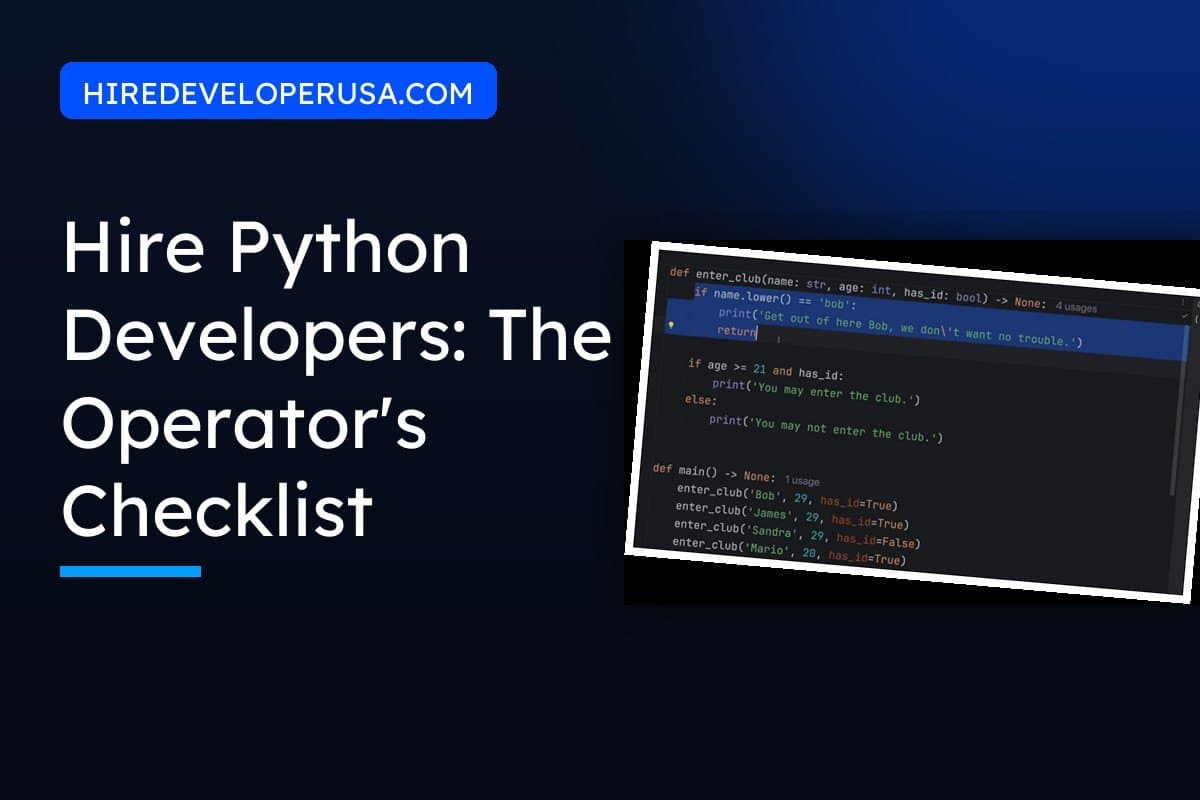
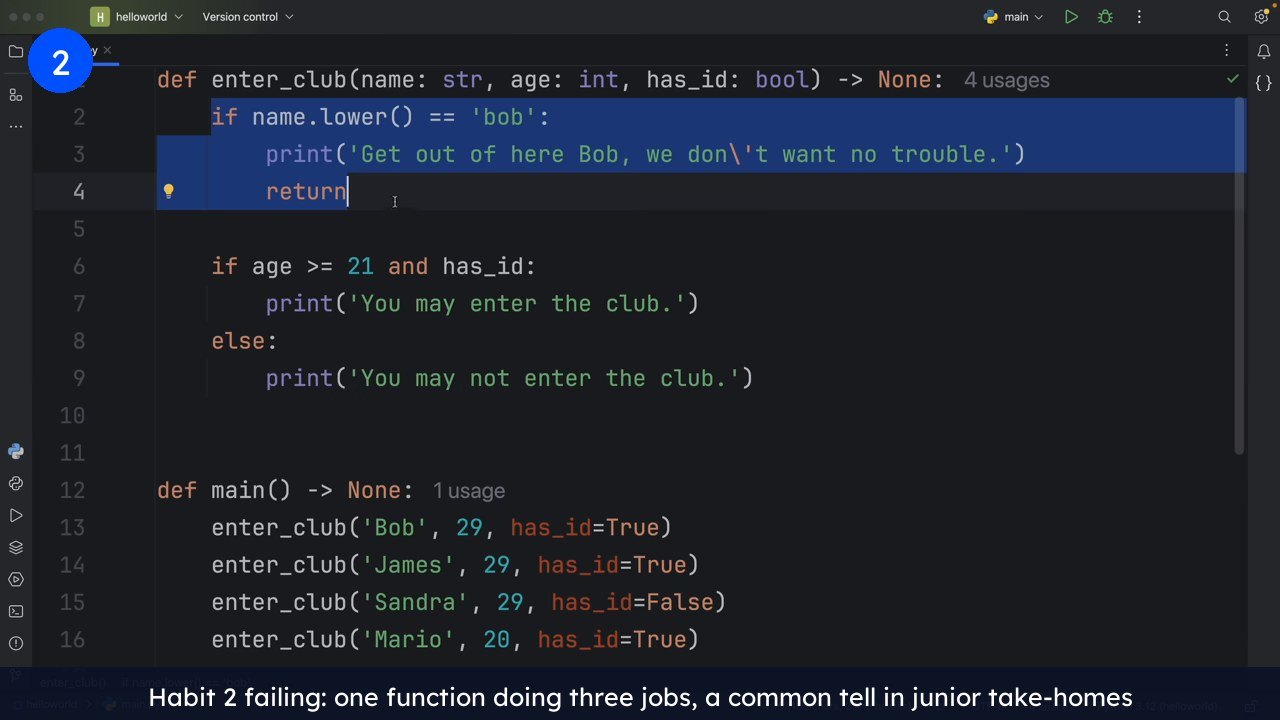
Habit 2: single-purpose functions. The sample below is the kind of thing a junior submits with pride: one function that checks a blacklist, validates an age and an ID, and prints the outcome. It works, every test case passes, and none of it can be reused or changed without touching everything else.
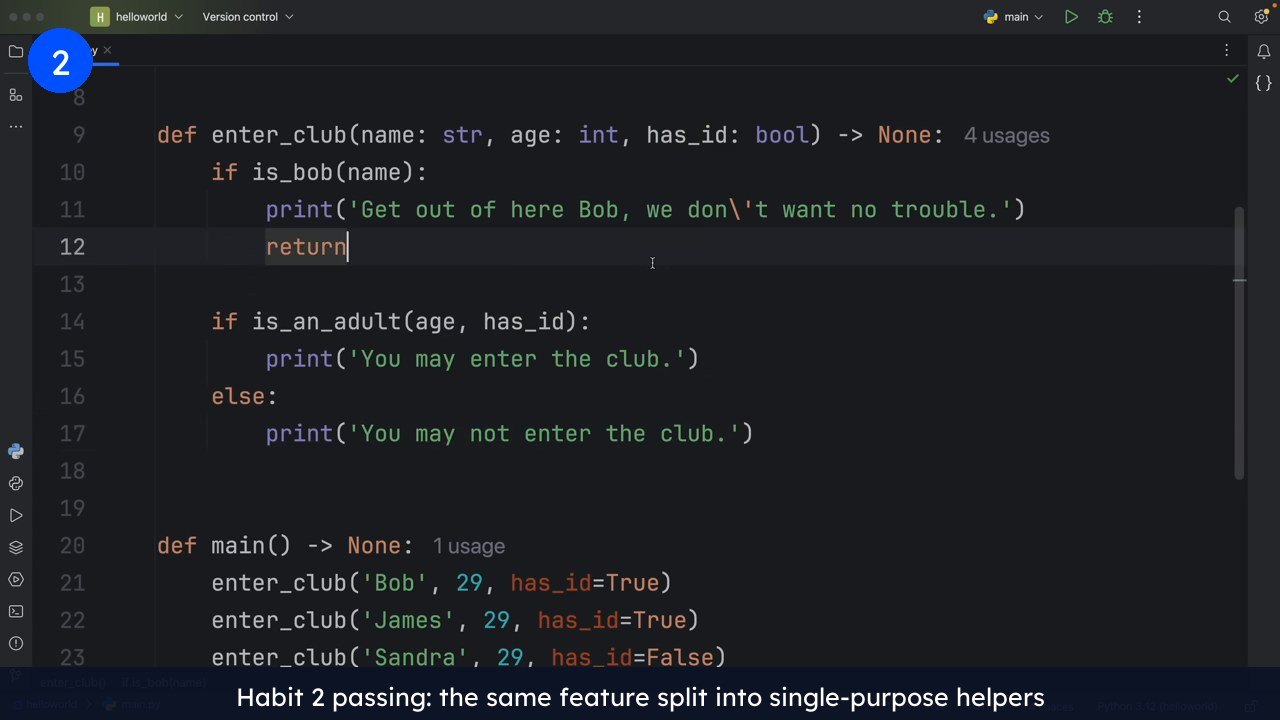
The senior version splits the same feature into an is_bob check and an is_an_adult check, each a two-line function with a typed signature, and the original function becomes a short sequence of calls. The behavior is identical. The difference is that the rule about who counts as an adult now lives in exactly one place, can be tested on its own, and can be changed by someone who has never seen the rest of the file. When a candidate's sample already looks like the second version, you are usually looking at someone who has maintained code, not just written it.
Gate 2 continued: habits three, four and five
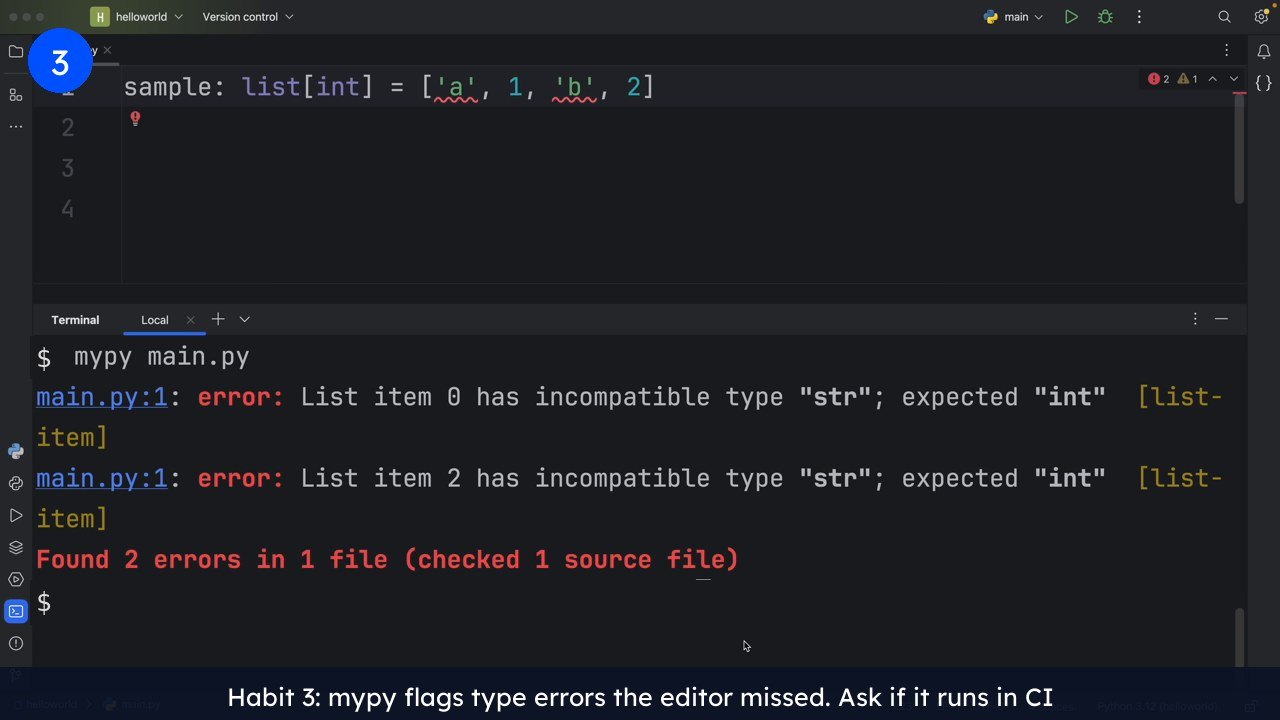
Habit 3: type annotations, and a type checker that runs. Python will happily accept a float where an integer was assumed, or a list of strings where integers were expected, and tell you nothing until production. Signatures like def upper_everything(elements: list[str]) -> list[str]: document the contract and let the editor catch misuse before the code runs. The editor is not enough on its own, though: some mismatches only surface when a static checker such as mypy or pyright runs over the file. Ask the candidate whether a type checker is part of their workflow and, ideally, whether it runs in CI. The answer sorts people quickly.
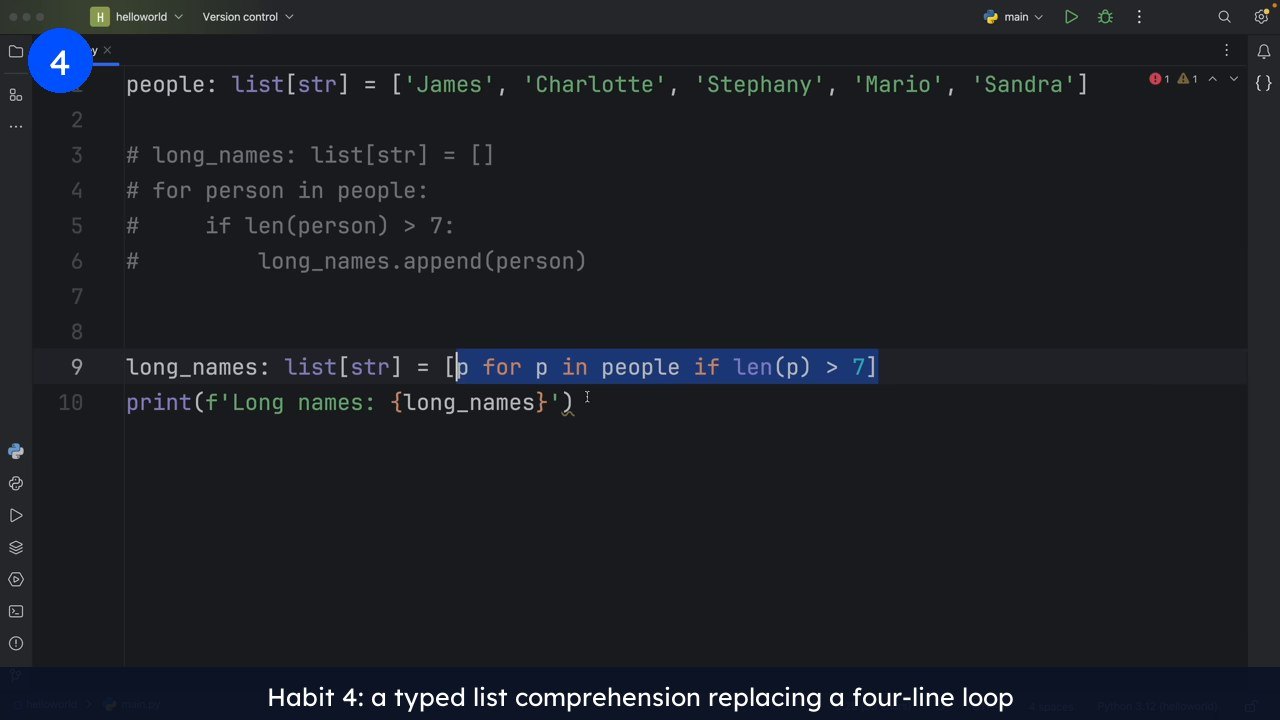
Habit 4: idiomatic constructs. A list comprehension that replaces a four-line append loop, a context manager around every file and connection, f-strings, and no bare except:. None of this is clever. All of it is what Python written by someone fluent looks like, and its absence is what Python written by someone who learned Java first looks like. Idiom is not decoration; it is how the next engineer on your team reads the code at speed.
Habit 5: dependency and test hygiene. A pinned requirements file or a lockfile, a virtual environment, a test folder that runs green, and a Python version stated somewhere. A sample with none of these was never meant to be run by anyone else, and your codebase will be run by other people.
Score it four out of five to move to the next gate. Anyone who passes all five in a sample they wrote unprompted is worth the senior band, whatever their years of experience say.
Gates 3 to 5: pairing, references and the paid trial
The code sample tells you how someone writes alone. The remaining gates tell you how they work with you, and they fit in one afternoon per finalist plus one paid week.
Gate 3: a 60-minute pairing session in your repository. Pick a real, small ticket from your backlog and share your screen. You are not scoring whether they finish. You are watching how they read unfamiliar code, whether they run the tests before changing anything, what questions they ask about the schema, and how they react when the first approach does not work. A senior engineer narrates their uncertainty; a weak one hides it.
Gate 4: reference questions that ask about shipping, not personality. Two questions do most of the work: what did this person ship, and who reviewed their pull requests? A reference who can name the feature and the reviewer is describing a real engineer. One who talks only about attitude is describing a pleasant colleague.
Gate 5: the paid trial, which is the real interview. Pay for 10 to 15 hours on one bounded ticket, in your repository, landed on your staging environment, and review the pull request exactly the way you would review production work. Our guide to reviewing a pull request covers what to look for. If the trial goes well, the onboarding checklist takes over from there.
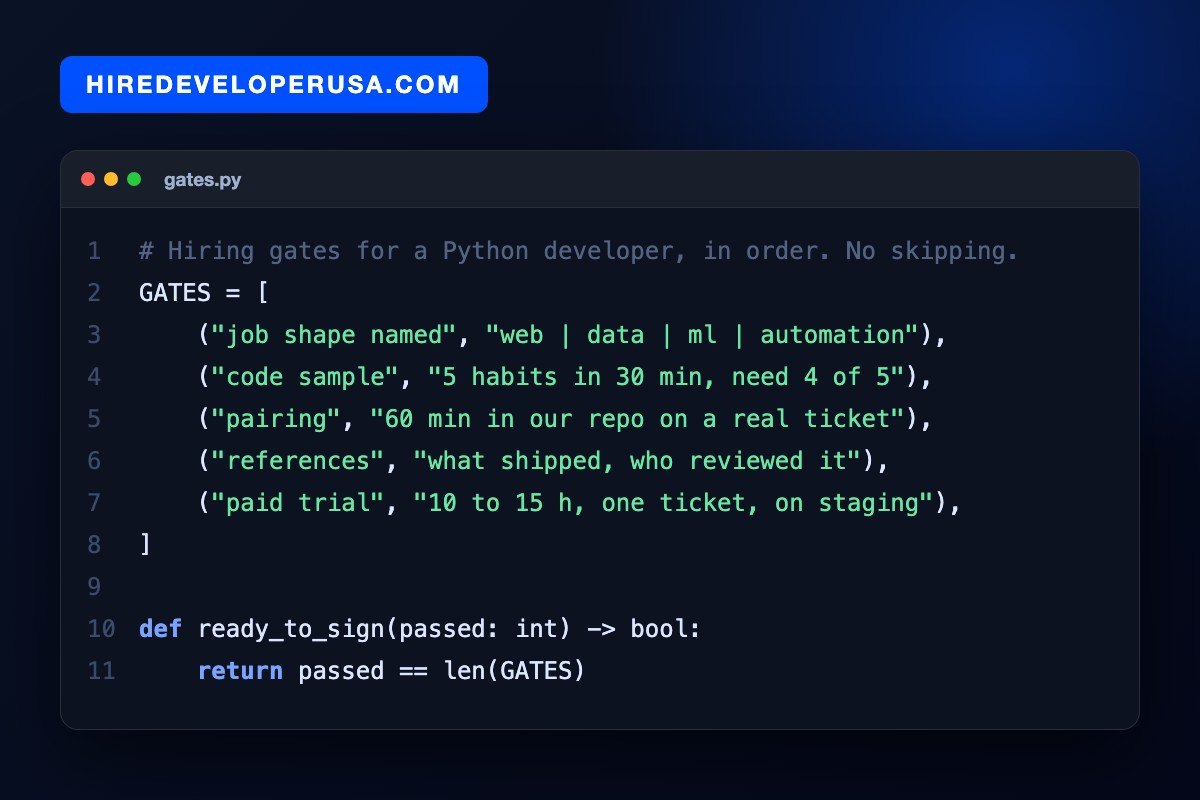
Sign only when all five are green. The whole point of gates is that a great interview does not buy a pass on the trial. Written down, the process fits in a dozen lines, and that is deliberate: a checklist you can read in ten seconds is one your team will actually run.
Six mistakes that cost Python buyers the most
Posting for a Python developer with no shape. You will receive applications from four different markets and interview all of them with the wrong questions. Name the shape in the title.
Confusing data science with software engineering. Notebook fluency and production fluency are different skills. If the deliverable is a service that other systems call, hire an engineer who has kept one running.
Screening a backend hire with algorithm puzzles. Whiteboard problems predict whiteboard performance. A Django or FastAPI role is predicted by the five habits above and by a pairing session in your own code.
Ignoring the Python version and dependency story. Ask which version the candidate ships on today and how they pin dependencies. A vague answer means your first month will be spent on an upgrade nobody budgeted.
Paying blended agency rates for junior hours. Ask for the name of the engineer on your ticket and price on that person, not on the rate card.
Skipping the paid trial because the interview went well. Fifteen paid hours is cheap insurance against a three-month mistake. Interviews are where people perform; trials are where they work.
What to do next
Write a one-page brief today that names the job shape, the Python version, the stack around it, and the first ticket a new engineer would take. Pick the channel that matches your deadline: a vetted marketplace if you need a first commit inside two weeks, a job post if this is the core product you will maintain for years. Then run the five gates in order and do not let a strong interview skip the trial. If you want to start from a shortlist that has already cleared the code-sample gate, browse our vetted Python developers or the FastAPI specialists and book a pairing session this week.
Frequently asked questions
How much does it cost to hire a Python developer in the US?
On a vetted marketplace, expect $38 to $65 an hour for a junior, $65 to $98 for a mid-level engineer and $98 to $135 for a senior. US agencies charge $115 to $215 an hour, and full-time base salaries run $100,000 to $178,000. Engineers who also cover data engineering or ML price at the top of those bands.
How long does it take to hire a Python developer?
Measured from a signed brief to a first merged commit, plan about 8 days through a vetted marketplace, 12 through an open freelance board, 14 through a referral, 18 through a US agency and about 45 through an in-house job post. Most of the calendar goes to sourcing, not interviewing.
What skills should I look for when hiring a Python developer?
Beyond the framework for your job shape, look at a real code sample for five habits: an entry-point guard with a main() function, single-purpose functions, type annotations backed by a checker such as mypy, idiomatic constructs like comprehensions and context managers, and pinned dependencies with tests. Then pair for an hour in your own repository.
Should I hire a Python freelancer, an agency or a full-time developer?
Choose by how long the work lasts. A senior freelancer and a full-time senior cost nearly the same per quarter once benefits are loaded, so a bounded project favors the freelancer and a product you will maintain for years favors the hire. Agencies make sense when you need a team and a project manager, provided you price on the engineer actually assigned.
Hire vetted talent