
Key takeaways
- →Vetted marketplace freelance developers cost $60 to $150 per hour in the US; agencies run $120 to $250 and open bidding platforms $25 to $60.
- →By seniority: junior $35 to $60, mid-level $60 to $100, senior $100 to $150, specialist $150 to $250 per hour.
- →An in-house engineer costs $60 to $125 per hour once a $95,000 to $200,000 salary is loaded with taxes, benefits and overhead.
- →A twelve-week, two-person MVP at mid-market rates budgets to about $71,070 including a 15 percent contingency.
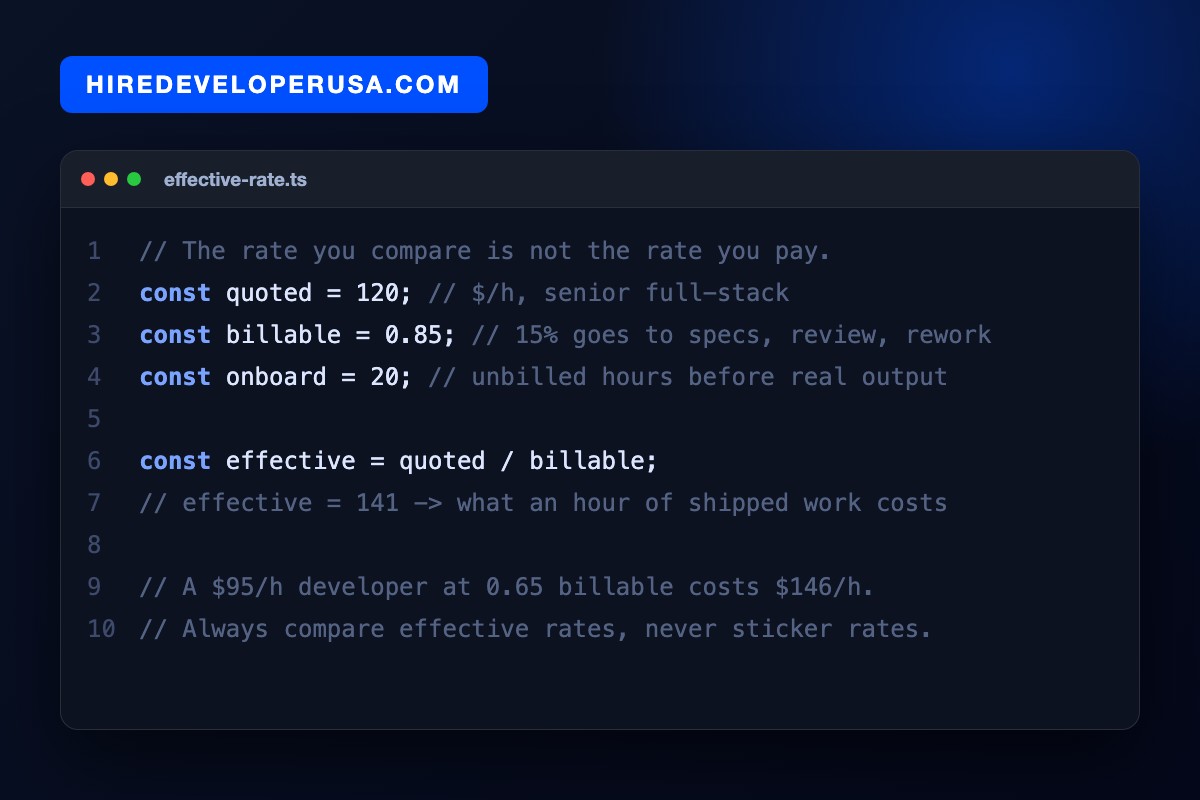
- →Compare effective rates, not sticker rates: a $120 per hour developer at 85 percent billable costs $141 per hour of shipped work.
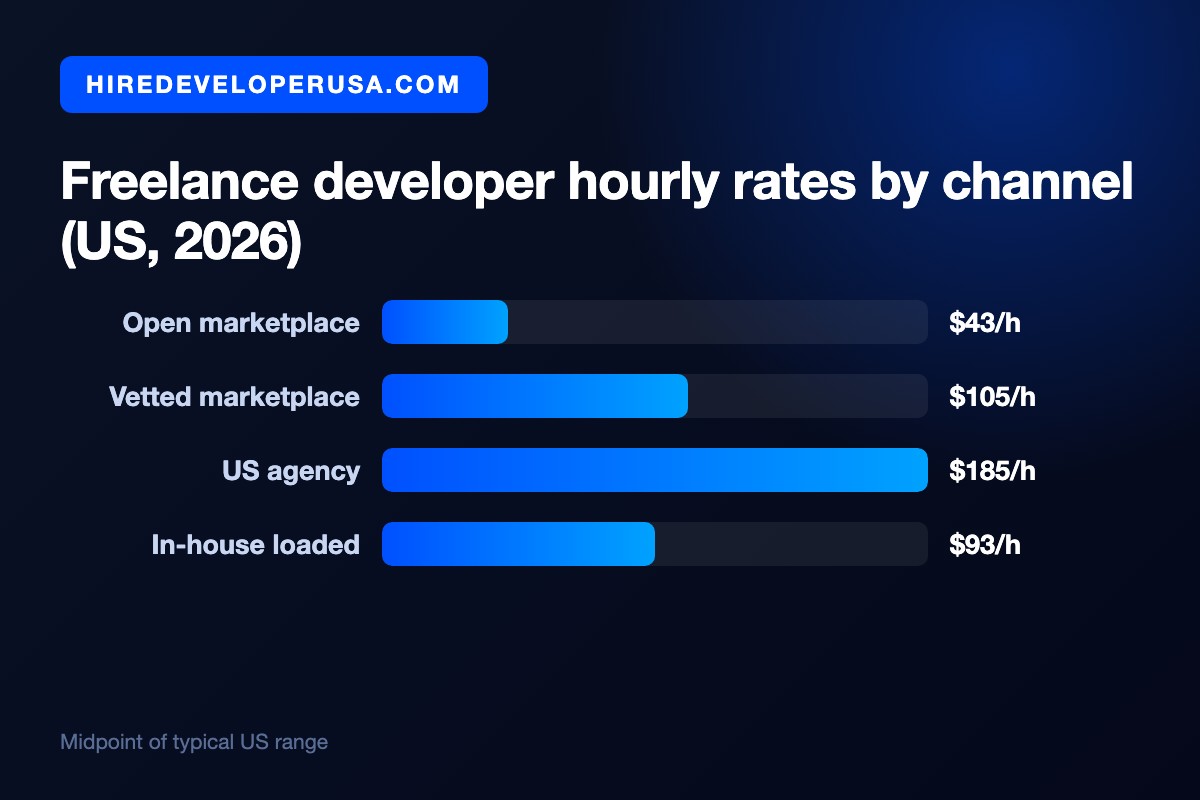
Freelance developer hourly rates in the US run $60 to $150 per hour through a vetted marketplace, $120 to $250 per hour through an agency, and $25 to $60 per hour on open bidding platforms where nobody has screened the candidate before you do. An independent senior working direct usually lands between $100 and $200. Those four bands cover almost every quote a US company will see in 2026, and the distance between them has less to do with how well someone writes code than most buyers assume.
What follows is the full picture: the rate by channel, the bands by seniority, the six things that actually move a quote, and a worked twelve-week budget so you can see where the money goes before you sign anything.
Freelance developer hourly rates at a glance
Rate is a function of channel first, person second. The same mid-level React developer costs you a different amount depending on how many layers sit between the two of you and who absorbs the risk if the engagement fails.
| Channel | Typical hourly rate | What the rate covers | Best for |
|---|---|---|---|
| Open bidding platform | $25 to $60 | Hours only. You run the screening, the contract and the risk. | Small scripts, isolated bug fixes |
| Vetted marketplace | $60 to $150 | Pre-screened developer, contract handling, a replacement if the match fails | Ongoing product work |
| Independent senior, direct | $100 to $200 | Deep expertise with no account layer. You manage the relationship. | One narrow, hard problem |
| US agency or studio | $120 to $250 | A team, a project manager, QA and delivery accountability | Fixed scope against a hard deadline |
| In-house equivalent | $60 to $125 loaded | Salary plus payroll taxes, benefits, equipment and overhead | Permanent core roles |
That last row is the one buyers skip, and it is the one that reframes everything else. A US software engineer salary sits between $95,000 and $200,000 depending on seniority and market. Load it with 25 to 40 percent for payroll taxes, benefits, equipment and overhead, divide by roughly 2,080 working hours, and the true in-house cost lands at $60 to $125 per hour. A freelancer at $110 an hour is not automatically the expensive option.
Rates by seniority: what each band actually buys
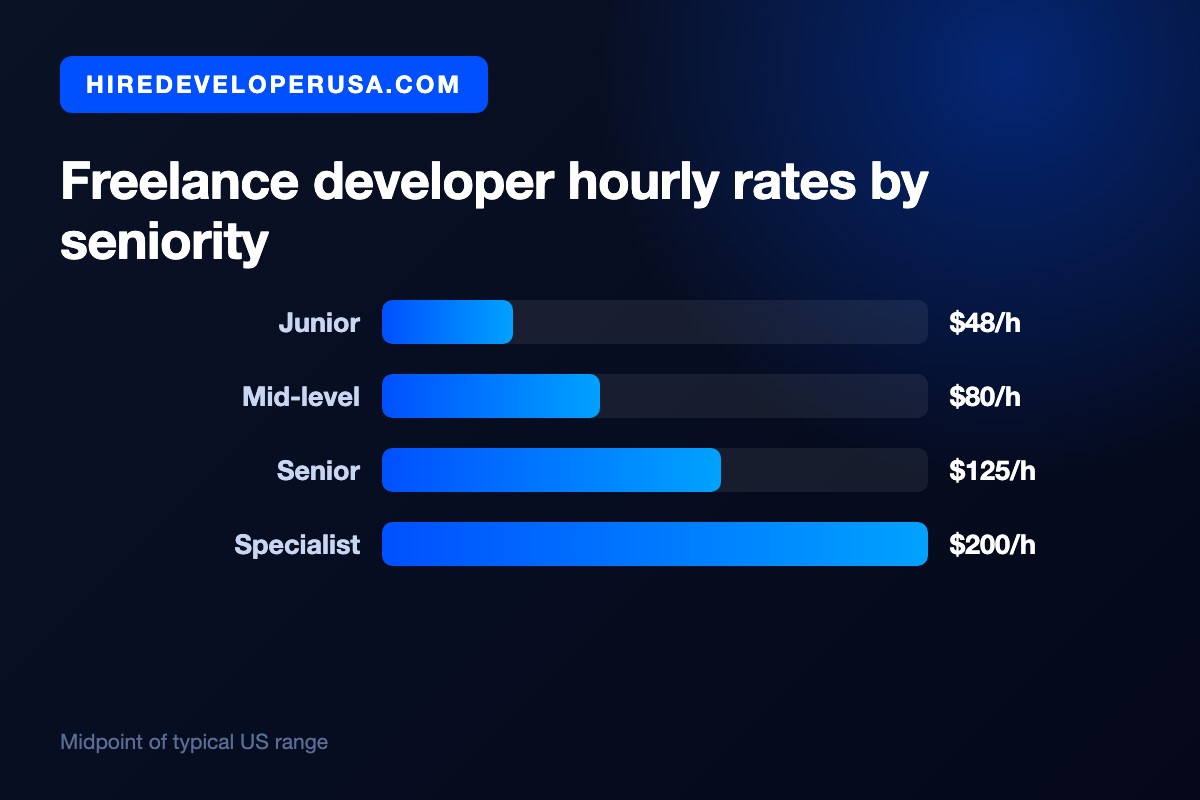
Inside the vetted marketplace channel, seniority is the single biggest lever. These are the bands US companies see most often, and what each one is genuinely capable of:
- Junior, roughly 0 to 2 years: $35 to $60 per hour. Executes a ticket that has already been specified and scoped. Needs code review and needs someone to have made the architectural decisions first.
- Mid-level, roughly 3 to 5 years: $60 to $100 per hour. Owns a feature end to end, from the data model to the deployed screen. This is the correct default for most product work.
- Senior, roughly 6 to 10 years: $100 to $150 per hour. Owns a system rather than a feature, makes tradeoffs you can live with in eighteen months, and unblocks everyone else on the project.
- Specialist or architect: $150 to $250 per hour. Applied machine learning, payment infrastructure, security, real-time systems, low-level performance work. This is scarcity pricing, not seniority pricing, and it does not fall just because the market softens.
Stack matters inside every band. Generic CRUD work in a crowded ecosystem prices at the bottom of the band; the same years of experience in a thin talent pool prices at the top. Our front-end developer rates and back-end developer rates pages break the spread down stack by stack.
Why two developers with the same stack quote $70 and $180
When two candidates with comparable resumes come back with quotes that differ by a factor of two and a half, one of these six things is almost always the reason:
- Scarcity of the skill. Thin talent pools price above thick ones regardless of difficulty. Supply sets the floor.
- Volume and commitment. A guaranteed 20 hours a week for six months is worth a discount. A five-hour engagement carries a premium precisely because it comes with no continuity and no follow-on work.
- Who carries the delivery risk. A fixed price with a warranty period means the developer absorbs the overrun. That transfer of risk is priced into the number, and it should be.
- Layers in the chain. Marketplace fees, agency margin and recruiter commissions all sit between the rate you pay and the rate the developer receives.
- Who absorbs onboarding. Some quotes include the ramp-up period. Some start the meter on day one of reading your codebase.
- Timezone overlap. Four hours of live overlap with your team is a real service, and it shows up in the rate.
None of these are negotiating tricks. They are the actual economics, and naming them out loud in the first call is the fastest way to find out whether a quote is defensible.
Hourly, fixed price or retainer: which one costs you less
The pricing model changes the total more often than the rate does.
Hourly is correct when the work is genuinely undefined: discovery, an audit, maintenance on a system nobody fully understands, or a backlog that will be reprioritized every sprint. You keep flexibility and you carry the overrun risk. Cap it with a weekly hour ceiling agreed in writing.
Fixed price is correct when the scope is genuinely nailed down, with a written deliverable list and explicit acceptance criteria. The implied hourly rate is usually 20 to 40 percent higher than the same developer would quote hourly, because they are pricing the risk of your scope moving. Your downside is capped in exchange. This only works if the requirements really are frozen. A fixed price against a vague brief is the most expensive arrangement in this article.
Retainer, meaning a reserved block such as 20 hours a week, buys guaranteed availability. It typically shaves 10 to 20 percent off the hourly rate because it gives the developer income stability. It is the best value model for work that runs longer than three months.
Whatever model you pick, compare effective rates rather than sticker rates. The number that matters is what one hour of shipped, reviewed, merged work costs you.
A worked budget: what a twelve-week MVP really costs
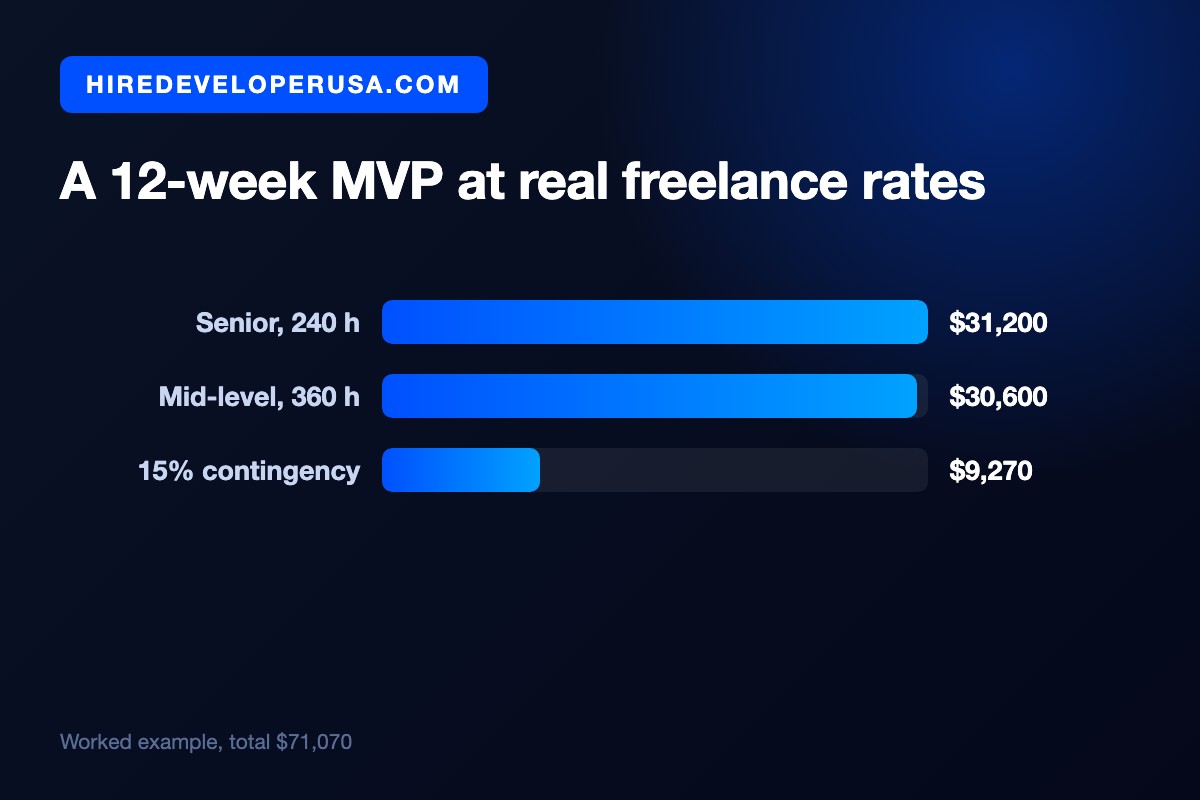
Abstract bands are hard to plan against, so here is a concrete build. A two-person team, twelve weeks, shipping a working product with authentication, a core workflow, payments and an admin view, at mid-market US marketplace rates:
| Role | Rate | Hours | Cost |
|---|---|---|---|
| Senior full-stack (architecture, backend, reviews) | $130/h | 240 (20 h/week) | $31,200 |
| Mid-level front-end (UI build, integrations) | $85/h | 360 (30 h/week) | $30,600 |
| Subtotal | 600 | $61,800 | |
| Contingency at 15 percent | $9,270 | ||
| Total | $71,070 |
Two comparisons make that number readable. The same 600 hours bought through a US agency at a mid-band $185 an hour comes to $111,000, and you get project management and QA inside that figure. Swapping the senior seat for a junior at $50 an hour drops it from $31,200 to $12,000, which looks like a $19,200 saving right up until you count the review load, the rework and the architectural decisions that now have nobody to make them.
The 15 percent contingency is not padding. Twelve-week builds move scope. Budget for it explicitly or you will pay for it as an uncomfortable conversation in week nine.
The costs that never appear on the invoice
Every rate comparison that only counts the hourly number is incomplete. These line items are real and they are yours:
- Ramp-up. Ten to twenty-five hours before a new developer produces output you would ship, longer on a mature codebase with thin documentation.
- Your own management time. Five to eight hours a week of specification, review and unblocking per active developer. That is your salary, spent on this project.
- Rework from vague briefs. The single largest avoidable cost in freelance engagements, and it is almost always the buyer's fault rather than the developer's.
- Bus factor. If one contractor is the only person who understands the system, their next rate increase is not really a negotiation.
- Compliance and paperwork. Contractor classification, a W-9 on file, and a 1099-NEC for any US contractor you pay $600 or more in a tax year. Get IP assignment into the contract before the first commit, not after the last one.
- Tooling seats. Repositories, cloud, design tools, monitoring and CI all cost per head.
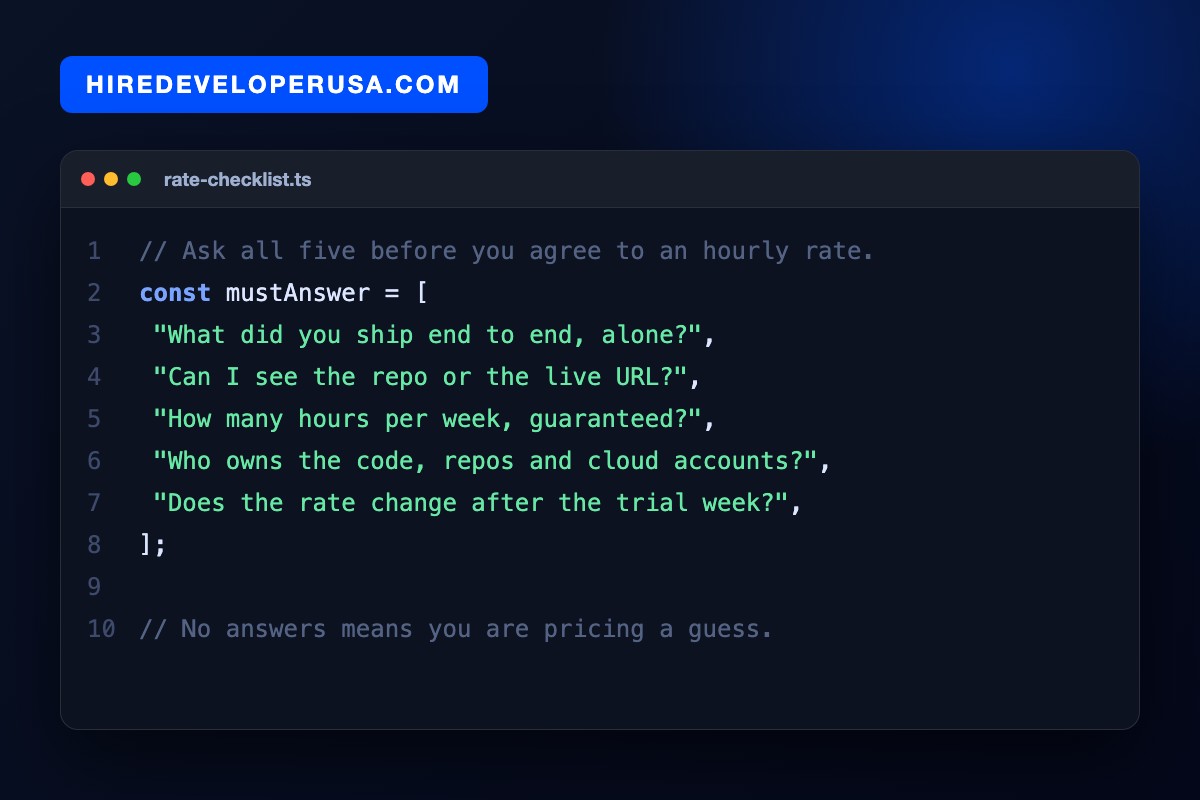
Before you agree to any rate, get the answers below in writing. A rate quoted without them is a guess wearing a dollar sign.
How to pay a fair rate without overpaying
Six practices that consistently land buyers inside the right band:
- Anchor on the band, not the first quote. Decide what the seniority and stack should cost before you hear a number, then treat the quote as evidence rather than as the answer.
- Buy a paid trial. Ten to twenty billed hours on a real ticket tells you more than four interviews, and it costs less than one bad month.
- Trade hours for rate. Guarantee volume and continuity, then ask for the discount you have just earned. Most developers will give 10 to 20 percent for a reserved block.
- Compare effective rates. Sticker rate divided by billable ratio, every time.
- Do not pay senior rates for junior work. Splitting a role into a senior seat for design and review and a mid-level seat for execution is how the worked budget above stays at $71,070.
- Write it down. Deliverables, acceptance criteria, weekly hour caps, warranty period, maintenance rate and IP assignment. All of it, before the work starts.
If you are still weighing freelance against a permanent hire, our savings calculator runs the loaded comparison on your own numbers, and our guide to what it costs to hire a software developer covers the in-house side in detail.
Where to go from here
Set your budget from the band, not from the cheapest quote in the inbox. For most US companies in 2026 that means $60 to $150 an hour for vetted freelance work, a mid-level developer at $60 to $100 as the default seat, and a senior at $100 to $150 for anyone who has to own architecture. Add 15 percent contingency, add your own management time, and compare that total against a loaded in-house cost of $60 to $125 an hour before you decide which model you actually want.
When you are ready to see real people against real rates, browse vetted React developers or tell us the role and we will come back with matched candidates and their rates inside 48 hours.
Frequently asked questions
What is a fair hourly rate for a freelance developer in the US in 2026?
For vetted freelance work, $60 to $150 per hour covers most engagements. A mid-level developer at $60 to $100 is the fair default for standard product work, and $100 to $150 is fair for a senior who owns architecture. Below $35 per hour in the US you are almost always paying for unscreened capacity that someone on your side will have to review.
Is a freelance developer cheaper than a full-time employee?
Often, but not for the reason people expect. A $95,000 to $200,000 US salary loaded with payroll taxes, benefits, equipment and overhead works out to $60 to $125 per hour. The freelance saving comes from paying only for the hours you actually need and skipping recruiting time, not from a lower headline number.
Should I pay hourly or a fixed price?
Pay hourly when the scope is genuinely open, and cap the weekly hours in writing. Pay a fixed price only when you have a frozen deliverable list and written acceptance criteria; expect the implied rate to be 20 to 40 percent higher because the developer is absorbing your overrun risk. A fixed price against a vague brief is the most expensive option available.
Why do some freelance developers charge $300 per hour or more?
Two reasons, both rational. Short engagements carry a premium because five hours of work brings no continuity and no follow-on revenue. And specialists in thin talent pools, such as applied machine learning, payment infrastructure or security, are priced by scarcity rather than by years of experience.
Hire vetted talent