
Key takeaways
- →Vetted marketplace developers cost $60 to $150 per hour in the US; agencies run $120 to $250 per hour.
- →An in-house engineer costs 25 to 40 percent more than base salary once benefits, taxes and overhead are loaded.
- →Seniority and stack scarcity move rates more than any other factor; scarce skills carry 20 to 40 percent premiums.
- →The biggest budget killers are bad hires, over-scoped projects and unpriced management time, not hourly rates.
- →Match the model to the situation: marketplace for speed and flexibility, agency for delivery ownership, in-house for long-term core product work.
Hiring a software developer in the US costs between $60 and $150 per hour through a vetted marketplace, $120 to $250 per hour through a development agency, and roughly $95,000 to $200,000 per year in base salary for an in-house engineer, before benefits and overhead. Freelance platforms can go lower, but you carry the vetting and management risk yourself.
Those ranges are wide because "a developer" is not one product. Seniority, technology stack, engagement model and how much risk you keep on your side of the table all move the number. This guide breaks the cost down the way a CFO would want it: what you pay, what you actually get, and where budgets quietly leak.
The short answer: cost by hiring model
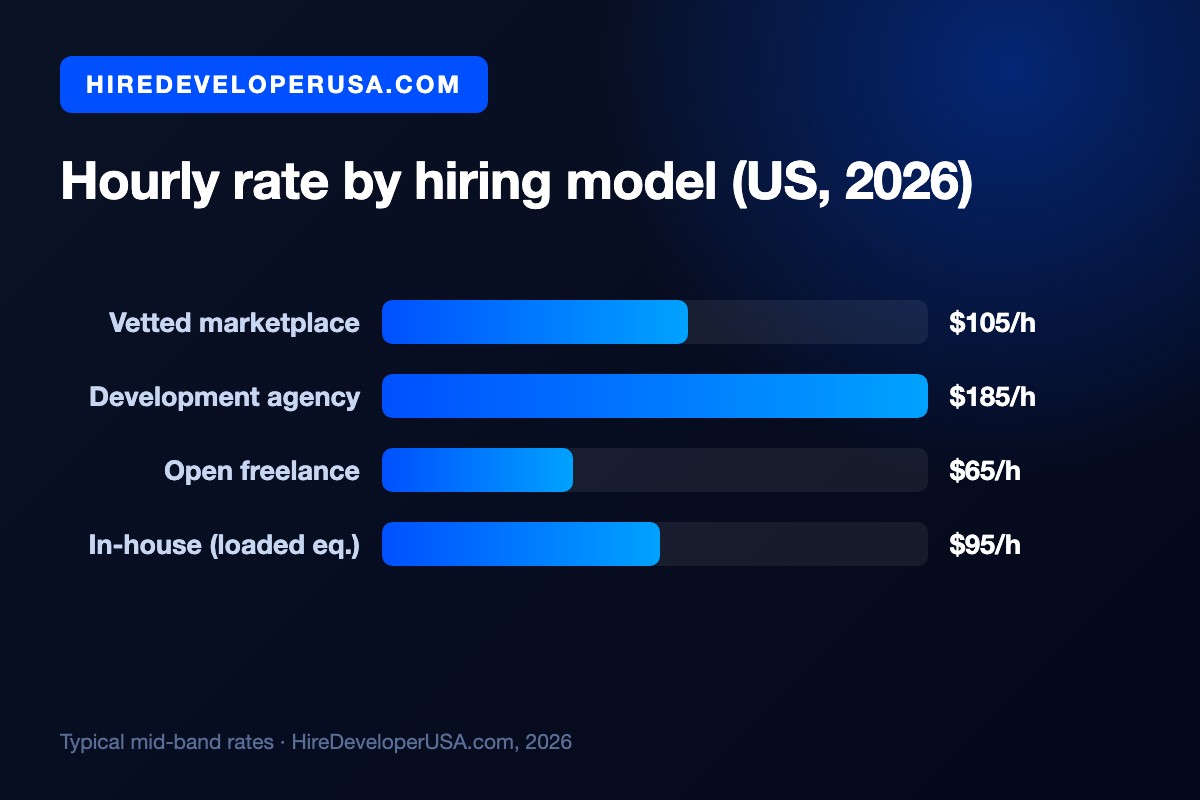
| Hiring model | Typical cost | Best for |
|---|---|---|
| Vetted marketplace | $60 – $150/hour | Fast start, pre-screened talent, no recruitment fee |
| Development agency | $120 – $250/hour | Full project delivery with management included |
| In-house full-time | $95,000 – $200,000/year base | Long-term product ownership |
| Open freelance platforms | $30 – $100/hour | Small scoped tasks, if you can vet and manage yourself |
The cheapest hourly rate is rarely the cheapest project. A $45-per-hour generalist who needs three attempts at a feature costs more than a $110-per-hour senior who ships it once, on time, with tests. Budget against outcomes, not rate cards. You can compare current bands for every major stack on our developer rates guides.
Rates by seniority: what each level actually buys
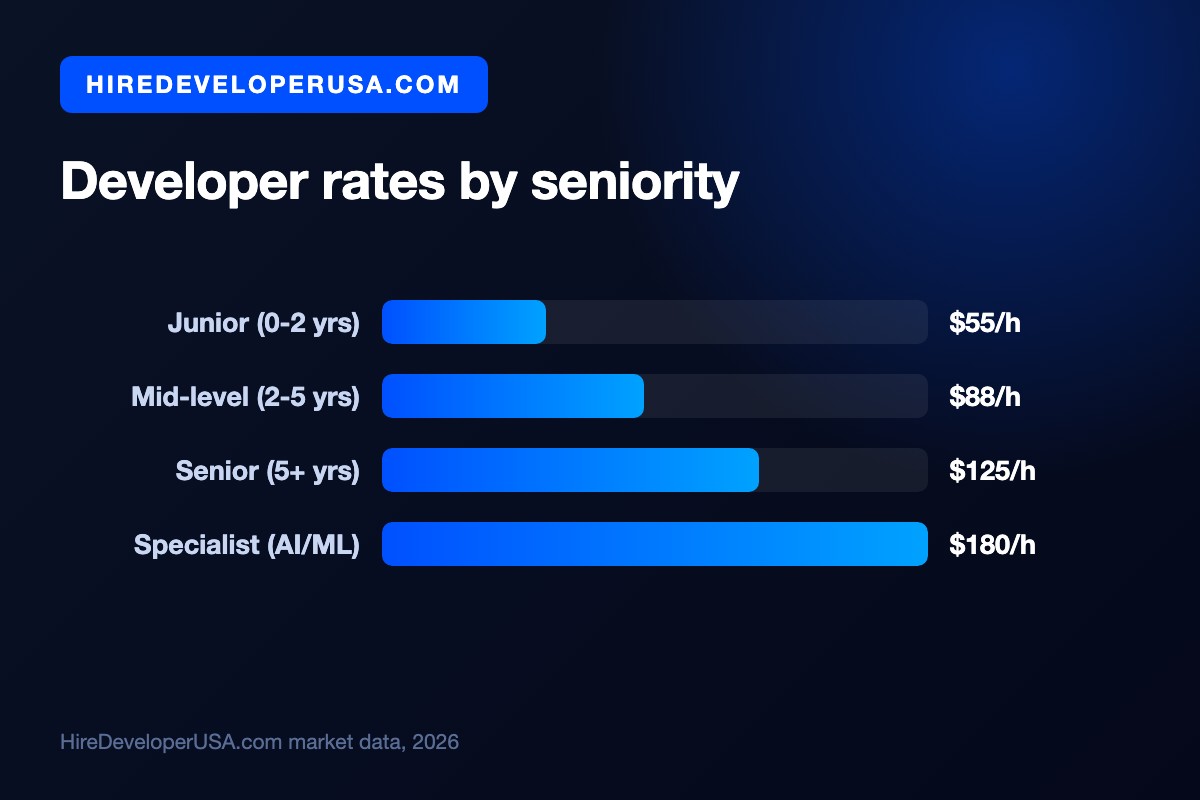
On US-focused marketplaces and contract engagements, the seniority bands look like this:
- Junior (0 to 2 years): $40 to $70 per hour. Productive on well-defined tickets inside an existing codebase, but needs senior review. Budget mentoring time or expect rework.
- Mid-level (2 to 5 years): $65 to $110 per hour. Owns features end to end, works independently against a spec. The workhorse tier for most product teams.
- Senior (5+ years): $100 to $150 per hour and above for specialists. Makes architecture decisions, unblocks others, and prevents the expensive mistakes. AI/ML, security and infrastructure specialists sit at the top of this band.
Stack matters as much as years. WordPress and standard PHP work prices near the bottom of each band; Rust, machine learning and platform engineering price near the top because the talent pool is thinner and demand keeps climbing.
In-house hires: the salary is not the cost
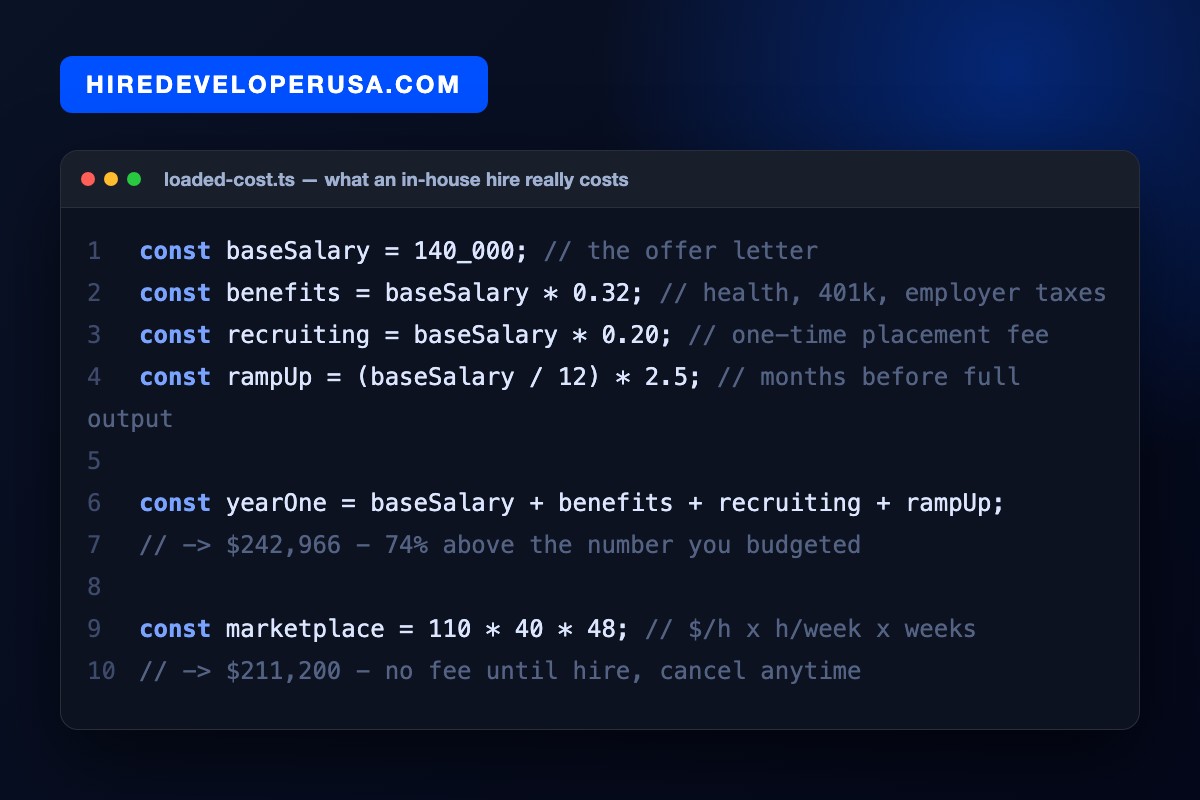
The offer letter is only the visible part of an in-house engineer's cost. A realistic US budget adds:
- Payroll taxes and benefits: typically 25 to 40 percent on top of base salary (health insurance, 401(k) match, employer taxes).
- Recruitment: external recruiters charge 15 to 25 percent of first-year salary per placement; even in-house sourcing consumes weeks of engineering interview time.
- Ramp-up: two to three months before a new hire is fully productive, paid in full.
- Tooling and overhead: equipment, licenses, office or stipend, management time.
A $140,000 engineer is realistically a $185,000 to $200,000 annual commitment once loaded. That is why contract-to-hire and marketplace models keep gaining ground for teams under 50 people: you pay for delivery now and defer the fixed-cost commitment until the product justifies it. Our savings calculator puts side-by-side numbers on your specific case.
What moves the price
- Seniority and specialization: the single biggest driver. A senior AI engineer can cost triple a junior generalist per hour and still be the better deal per shipped feature.
- Technology stack: scarce skills (Rust, Solidity, MLOps, embedded) command 20 to 40 percent premiums over mainstream stacks like JavaScript or Python.
- Engagement model: agencies bundle project management and QA into the rate; marketplaces charge for the engineer alone; in-house shifts all overhead onto you.
- Location within the US: Bay Area and NYC salaries run 20 to 35 percent above national medians, though remote-first hiring has been flattening that curve.
- Urgency and risk: rescue missions on failing projects and hard-deadline builds price above calm, well-scoped work. Chaos is billable.

The hidden costs founders forget
Most software budgets do not blow up on the rate. They blow up on these:
- The wrong hire. The most expensive developer is the one who builds the wrong thing confidently. Replacing a bad senior hire can consume six months and six figures once you count the rework.
- Over-scoping. A partner who happily quotes your full 40-feature wishlist is not doing you a favor. Strong teams push back, cut scope to a shippable core, and get you to market before the budget runs out.
- Management gaps. Freelancers at $50 per hour still need someone to write specs, review work and hold the schedule. If that someone is you, price your own time in.
- Churn. Every developer swap costs onboarding time and lost context. Retention terms and overlap periods are worth negotiating up front.
The video below walks through how non-technical founders should vet developers before signing anything, and it matches what we see daily: methodology and communication predict project success better than any rate card.
US rates vs offshore: the comparison nobody prices honestly
Offshore rate cards look irresistible: $20 to $45 per hour for the same job titles. Sometimes that trade works. More often, three costs erode the sticker saving:
- Communication overhead. A 10 to 12 hour time-zone gap turns every one-day question into a two-day round trip. On a four-month build, review latency alone can add four to six weeks of calendar time, and calendar time is payroll time.
- Specification burden. Cheap execution requires expensive precision. If nobody on your side writes airtight specs, you pay for the gaps in rework, and rework at any rate is pure loss.
- Accountability distance. Enforcing quality standards, IP protections and deadlines across jurisdictions is slower and weaker than doing it under US contract law.
A realistic comparison is not $30 versus $110 per hour. It is the total cost of a shipped, maintainable feature. Teams that thrive with offshore talent usually already have strong in-house technical leadership doing specs and review. Teams that lack it consistently do better paying more per hour for engineers who work US hours, communicate directly with stakeholders, and own outcomes rather than tickets. That total-cost logic is exactly why mid-range vetted marketplace rates keep winning the middle of the market.
Which model fits your situation
| Your situation | Sensible default | Expected budget |
|---|---|---|
| MVP, pre-revenue, 3 to 4 month build | Marketplace senior + mid pair | $60,000 – $150,000 |
| Scaling product, need 2 to 5 engineers fast | Vetted marketplace team | $25,000 – $80,000/month |
| Fixed-scope project, no internal tech lead | Agency with delivery ownership | $150 – $250/hour blended |
| Core product, funded, long horizon | In-house seniors + contract specialists | $185,000+/year per senior, loaded |
Whichever route you take, insist on the same three things: a trial period measured in days rather than promises, weekly demos of working software, and the contractual ability to scale down as well as up. See how our 48-hour matching works and the flat pricing model if you want the marketplace route without the vetting burden.
Frequently asked questions
How much does it cost to hire a software developer for a startup MVP?
A typical MVP built by one senior and one mid-level developer over three to four months costs $60,000 to $150,000 at US marketplace rates. Cutting scope to a single core workflow is the most reliable way to land near the bottom of that range.
Is it cheaper to hire a freelancer or use a vetted marketplace?
Open freelance platforms show lower hourly rates, often $30 to $100, but you absorb the screening, management and replacement risk. Vetted marketplaces cost more per hour and remove the recruitment fee entirely, which usually wins once you price your own time and the cost of a mis-hire.
How much does a software developer cost per month?
A full-time contract engagement at $70 to $120 per hour works out to roughly $11,000 to $19,000 per month. An in-house mid-level engineer costs $10,000 to $14,000 per month once salary, benefits and employer taxes are combined.
What do senior developers charge in the US in 2026?
Senior engineers on vetted US-focused platforms bill $100 to $150 per hour for mainstream stacks. Specialists in AI/ML, security and distributed infrastructure reach $160 to $200 per hour, and in-house equivalents command $160,000 to $200,000 plus in base salary.
Hire vetted talent