
Key takeaways
- →The fee model, not the pitch, sets the price: the same $180,000 hire costs $50,400 through retained search and $0 in placement fees through a marketplace.
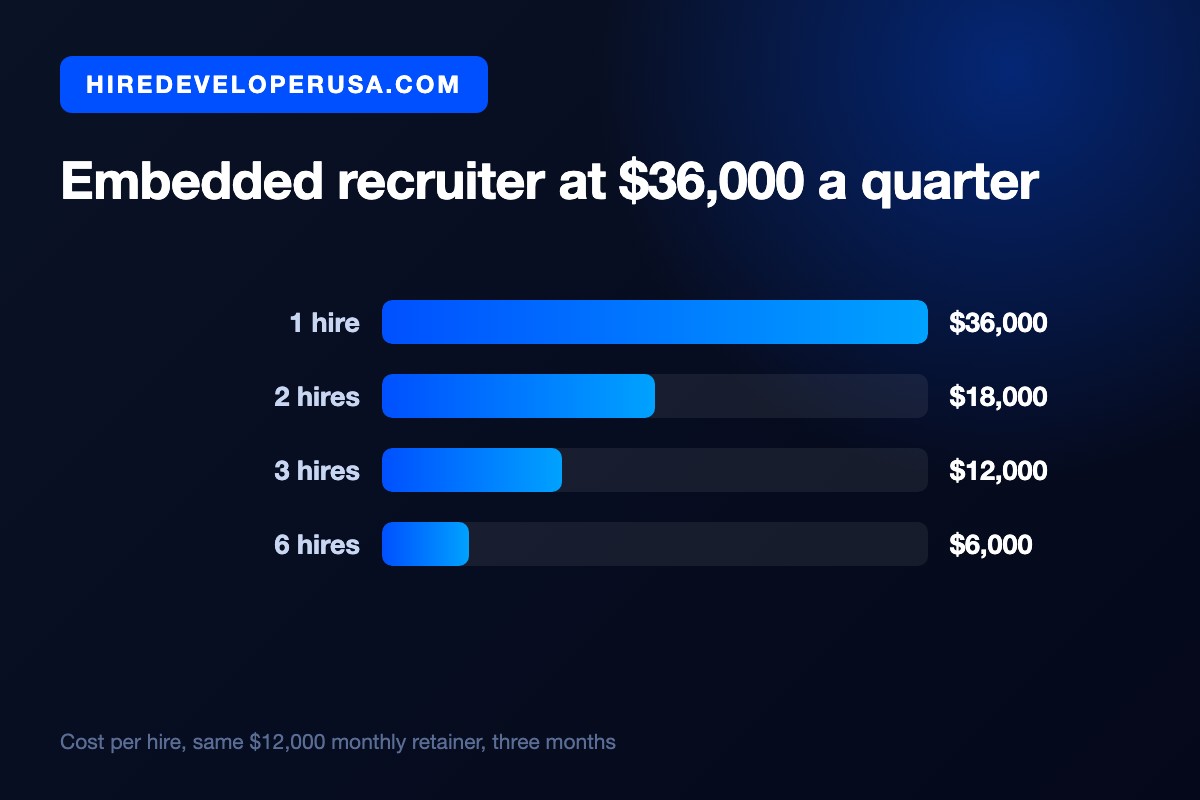
- →Retainers beat per-hire fees from the second hire onward. At $36,000 a quarter, an embedded recruiter costs $36,000 for one hire and $12,000 each for three.
- →Insist the fee is calculated on base salary only. The same 20% applied to a $215,000 package instead of a $180,000 base costs an extra $7,000 per hire.
- →Ask what share of their submissions reached a panel on the last three searches. A firm that cannot answer is not measuring, and you will do the filtering.
- →Write the intake brief before the first call. The band, the loop and who can say yes are what make or break the search.
The best SaaS recruiter for your company is the one whose fee model matches how many people you actually plan to hire this quarter. On a single senior engineer at a $180,000 base, the five common models price out anywhere between $0 and $50,400 for the same seat, and the gap has almost nothing to do with the quality of the shortlist. It comes from how the firm gets paid.
You will not find a ranked list of firms below, and that is deliberate. A list ordered by who paid for the placement tells you nothing about who will fill your role. What follows is the method instead: what each model costs on one worked example, the break-even that decides between a retainer and a per-hire fee, the eight questions we score any firm on, and the five contract clauses that quietly change the invoice. Use it to rank the three firms already sitting in your inbox.
The five ways to buy SaaS hiring
Every recruiting partner you will talk to is one of five things wearing different words. SaaS adds two wrinkles to the usual picture: your roles split across engineering and go-to-market, and a large slice of compensation is equity, which makes the question of what the fee is calculated on much sharper than it is in other industries.
| Model | What you pay | When you pay | Best fit |
|---|---|---|---|
| Contingency agency | 15% to 25% of first-year base | Only when a hire starts | One or two open roles, no appetite for upfront risk |
| Retained search | 25% to 33% of first-year base | Usually in thirds: engagement, shortlist, start | VP level and above, confidential or hard to source seats |
| Embedded recruiter or RPO | $8,000 to $20,000 per recruiter per month | Monthly, typically a three month minimum | Three or more hires a quarter in the same function |
| In-house recruiter | $90,000 to $130,000 base plus tooling | Payroll, continuously | Ten or more hires a year, sustained for at least a year |
| Vetted marketplace | An hourly rate, no placement fee | On hours worked | Contract and contract to hire, when you need someone shipping this month |
A staffing agency is a variant of the last row with a different margin structure: instead of a transparent hourly rate, it bills a markup of roughly 40% to 70% over what the contractor is paid, and you rarely see the split. The number that matters there is the bill rate, not the markup percentage they quote you.
The same hire, priced five ways
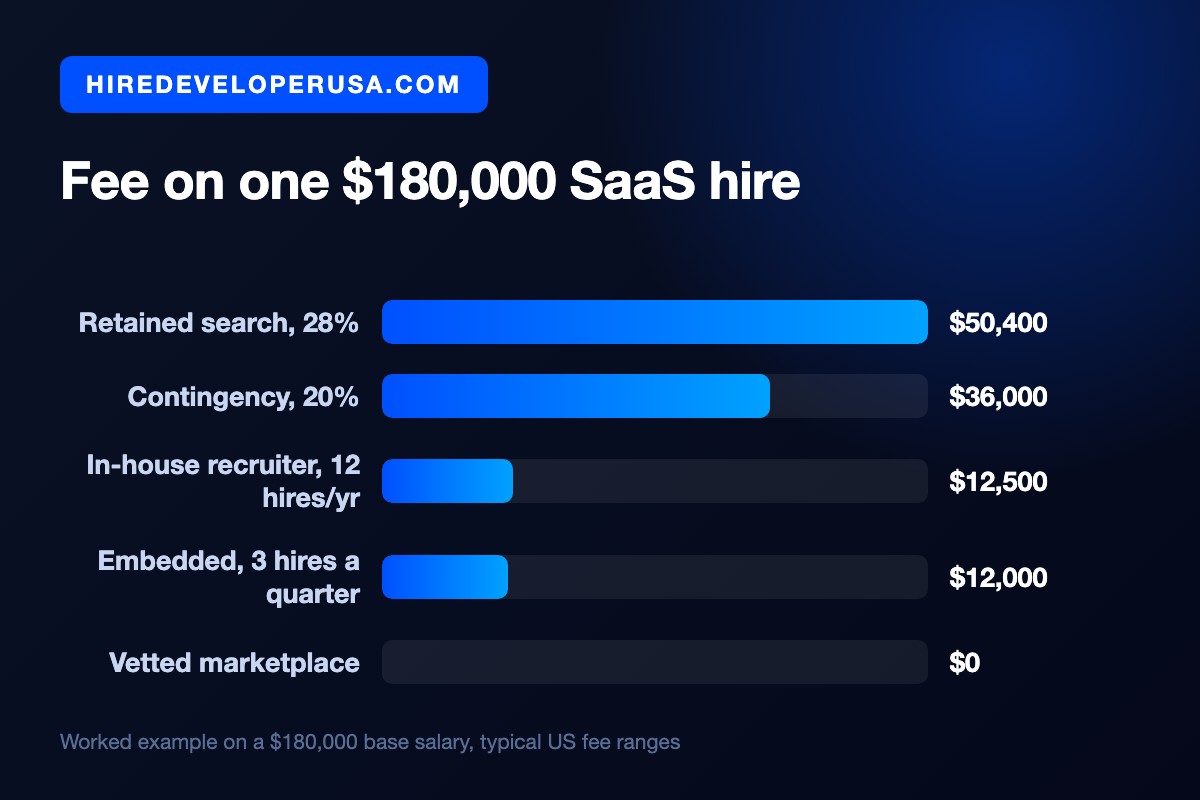
Take one senior backend engineer for a Series A SaaS company, $180,000 base. Here is the arithmetic, which is worth doing on your own numbers before any call.
- Retained search at 28%: $50,400, with roughly $16,800 due before anyone has been contacted. You are buying priority and confidentiality, and you pay whether or not the search lands.
- Contingency at 20%: $36,000, due only if someone starts. The risk transfer is real, and you pay for it in attention: a contingency firm works the searches it believes it can close fastest.
- Embedded recruiter at $12,000 a month: $36,000 for a quarter. If that quarter produces three hires, each one cost $12,000.
- In-house recruiter: a $110,000 base loads to about $137,500 with payroll taxes and benefits, plus roughly $12,500 for sourcing seats, job boards and scheduling tools. Call it $150,000 a year. At twelve hires, that is $12,500 per hire. At four hires, it is $37,500.
- Vetted marketplace: no placement fee at all. The cost sits entirely in the hourly rate, so a contractor at $85 an hour is $13,600 a month and stops costing you the day the work stops.
Notice the first comparison that falls out of this: a single $36,000 contingency fee buys the same thing as an entire quarter of a dedicated recruiter. If you have one role open, that is a fair trade. If you have four, it is an expensive way to buy the first one. For the full picture of what the person themselves costs once hired, our breakdown of what it costs to hire software developers covers the rate side of the same budget.
The break-even that picks the model for you
Retainers and per-hire fees cross at a volume, not at a quality level. With an embedded recruiter at $36,000 a quarter and contingency at 20% of a $180,000 base, the crossover is two hires: one hire makes the retainer cost $36,000, exactly what contingency would have charged, and the second hire makes it half that.
That gives you a decision rule that survives any sales call:
- One hire this quarter: contingency, or a marketplace contractor if the work can start before the search ends.
- Two to four hires in the same function: embedded, almost always. You also get an intake process, a scheduling cadence and a candidate experience that one-off agencies have no reason to build for you.
- Ten or more a year, steady: hire the recruiter. Below that number, a full-time recruiter spends a lot of expensive time waiting for requisitions.
- One executive seat: retained, and accept that you are paying for the search rather than the outcome.
The honest caveat: these break-evens assume the hires actually happen. A retainer against a hiring plan that gets frozen in week three is the most common way SaaS companies waste recruiting money. Ask for a pause clause before you ask for a discount.
The eight questions we score every firm on
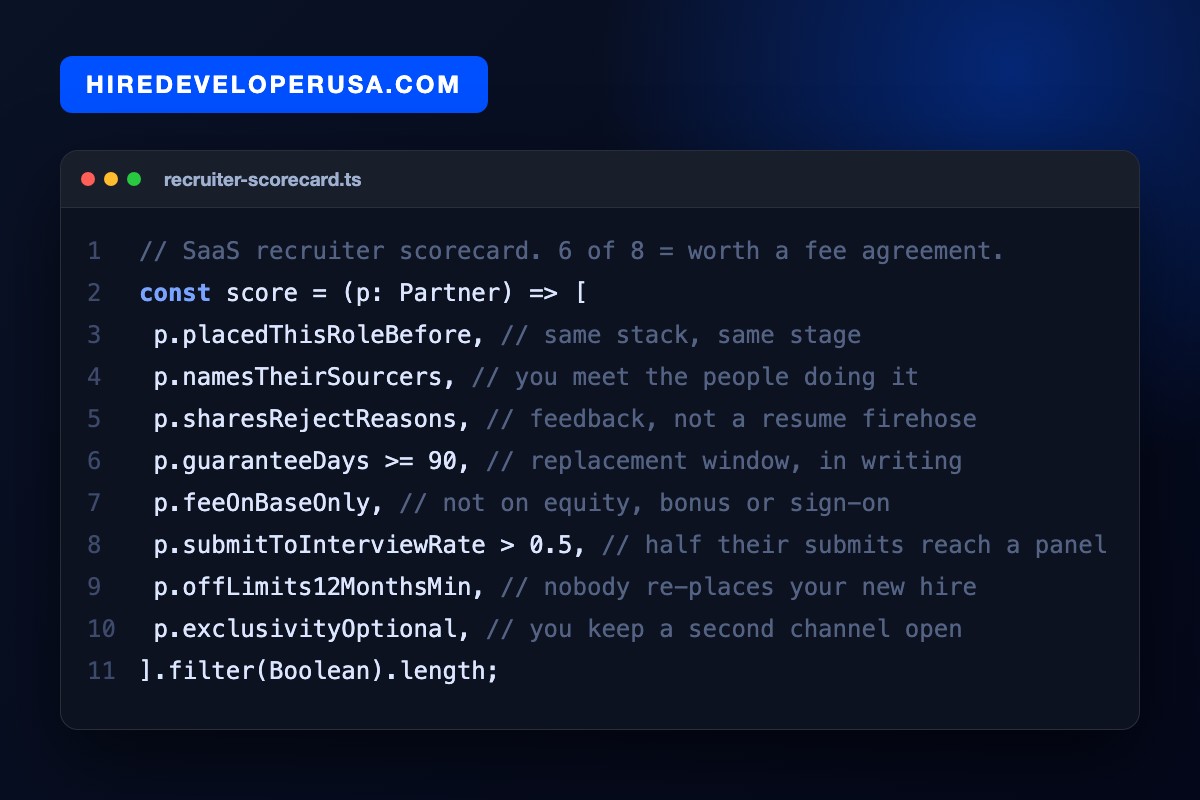
Score each firm out of eight. Six or better is worth a fee agreement, and anything at four or below is a firm selling you access to a database you could rent yourself.
- Have they placed this exact role, at this stage, in the last twelve months? Not the function, the role. A recruiter who fills enterprise sales seats is not a recruiter who fills platform engineering seats.
- Will they name the sourcer doing the work? The partner on the pitch call is rarely the person writing the outreach. Ask to meet whoever is.
- Do they send reject reasons? A firm that reports why candidates said no is running a feedback loop. A firm that forwards resumes is running a firehose.
- Is the replacement guarantee at least 90 days, in writing?
- Is the fee calculated on base salary only? In SaaS this is the single most expensive line in the agreement. More on that below.
- What share of their submissions reached a panel on the last three searches? If they cannot answer, they are not measuring, and you will be the one doing the filtering.
- Does the off-limits clause run at least twelve months? The firm that places someone on your team should not be allowed to place them off it next spring.
- Is exclusivity optional? A firm confident in its pipeline will let you keep a second channel open.
Question six is the one that separates the shortlist. Pair it with your own panel discipline: if your technical interview is inconsistent, no recruiter can keep a submission rate high, and the firm will be blamed for a problem living inside your loop.
Five clauses that decide what you actually pay
The percentage is the headline. These five lines are where the invoice is really set.
- What the fee is calculated on. Base salary only, excluding equity, sign-on, bonus and relocation. A 20% fee on a $180,000 base is $36,000. The same 20% applied to a $215,000 package is $43,000, so one sentence in the agreement is worth $7,000 on a single hire. In SaaS, where equity is often a large share of the offer, this clause is not a detail.
- The guarantee, and what it pays. Ninety days is the usual ask. Check whether it pays cash back or only a credit against a future search, whether it is prorated, and whether it survives a layoff or a reorg. A credit-only guarantee from a firm you will not use again is worth nothing.
- Candidate ownership. Agree a window, commonly six months, during which an introduced candidate is theirs, and agree in writing that the first documented introduction wins when two firms send the same person. Without it, you will eventually pay two fees for one engineer.
- Off-limits. Twelve months minimum, and name the entity properly, including parent and subsidiaries. Otherwise the clause covers a holding company nobody recruits from.
- Payment terms and conversion. Net 30 from the start date, not the offer date, so a candidate who never shows up does not generate an invoice. If you may convert a contractor to full time, fix the conversion fee now, ideally on a scale that declines with every month worked and reaches zero after nine or twelve months.
What a good intake call sounds like
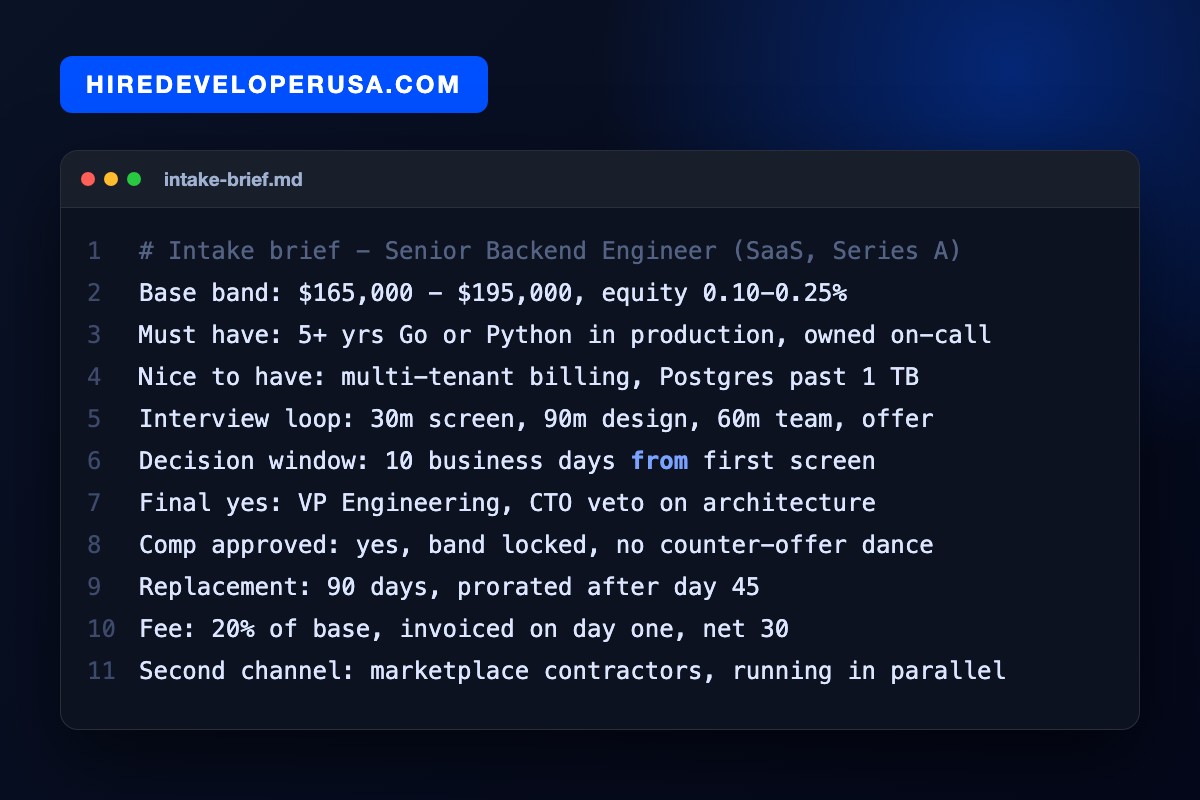
The intake call predicts the search better than the firm's logo wall. A good one lasts about an hour, and the recruiter leaves with a written brief they drafted and you corrected, not a job description you emailed over.
Bring the band, the loop, and the decision rights. The band means the real range with equity attached and sign-off already obtained, because a recruiter who discovers your ceiling in week four has wasted a month. The loop means the actual stages and their length. Decision rights mean who says yes and who can veto, which is the detail most often missing and the reason offers stall.
The red flags are just as legible. Resumes arriving within an hour of the intake call mean you are being shown shelf inventory. A refusal to work without exclusivity before any candidate has been presented means the pipeline is thinner than the pitch. A fee quoted on total compensation means they have decided not to mention the $7,000 above. And a recruiter who never asks what your engineering manager expects in the first 90 days is screening for keywords, which is exactly how you end up with someone who was senior on paper and junior in practice.
Where we fit, and when we are the wrong answer
Disclosure, since this page sits on our own site: HireDeveloperUSA is the last row of that table. We are a vetted marketplace, we charge no placement fee, and we bill an hourly rate for contract and contract-to-hire engagements, mostly on SaaS product and platform teams. That model is a good fit when the work needs to start in days rather than after a six-week search, when the scope is a quarter or two, or when you want to see someone ship before converting them to payroll.
It is the wrong answer in three cases, and we would rather say so here than on a sales call. If you need a VP of Engineering or a Head of Revenue, use retained search. If you are hiring ten people on payroll this year, hire a recruiter, because at that volume nothing beats the per-hire math. And if the role is genuinely scarce, say a staff-level engineer with billing systems depth in your exact market, a specialist contingency firm with that one network will usually beat a general pool.
Your next step
Do these three things in order, and the choice of firm mostly makes itself. First, write the intake brief, because it is the artifact that exposes whether the role is real. Second, count the hires you will genuinely make in the next ninety days and apply the break-even: one means contingency or a contractor, two to four means embedded, ten a year means in-house. Third, score the firms in your inbox out of eight and send the five clauses to whoever survives, before you sign anything.
If the first hire needs to be working this month rather than sourced next quarter, tell us what the role needs and we will come back with profiles and rates, with no placement fee attached to either.
Frequently asked questions
What do SaaS recruiters typically charge?
Contingency agencies commonly charge 15% to 25% of first-year base salary, and retained search runs 25% to 33%, usually invoiced in thirds. Embedded recruiters and RPO providers bill a monthly retainer, often $8,000 to $20,000 per recruiter with a three month minimum. A vetted marketplace charges no placement fee at all and bills an hourly rate. On a $180,000 base, that is $36,000 at a 20% contingency fee and $50,400 at a 28% retained fee for the same seat.
Is a retained search worth it for a SaaS engineering role?
Usually not. Retained search earns its premium on confidential searches and on executive seats where the pool is small and you need the firm working your role first. For individual engineering hires, you are paying upfront for a search you could buy on contingency, or cheaper still through an embedded recruiter if you have more than one seat to fill.
How do I compare SaaS recruiting agencies without relying on a best-of list?
Score them on evidence rather than reputation: placements in the same role and stage in the last twelve months, a named sourcer, reject reasons shared, a 90 day written guarantee, fees on base only, a measured submit-to-interview rate, a twelve month off-limits clause and optional exclusivity. Six out of those eight is a firm worth a fee agreement.
Should I hire an in-house recruiter instead of using an agency?
Only at volume. A $110,000 recruiter loads to roughly $150,000 a year with payroll costs and tooling, which is $12,500 per hire across twelve hires but $37,500 per hire across four. Below about ten hires a year, an embedded recruiter on a quarterly retainer gives you the same process without the fixed cost.
Hire vetted talent