

Key takeaways
- →A seniority mismatch is a judgment gap, not a coding gap. The tell is what happens when a problem arrives without a specification attached.
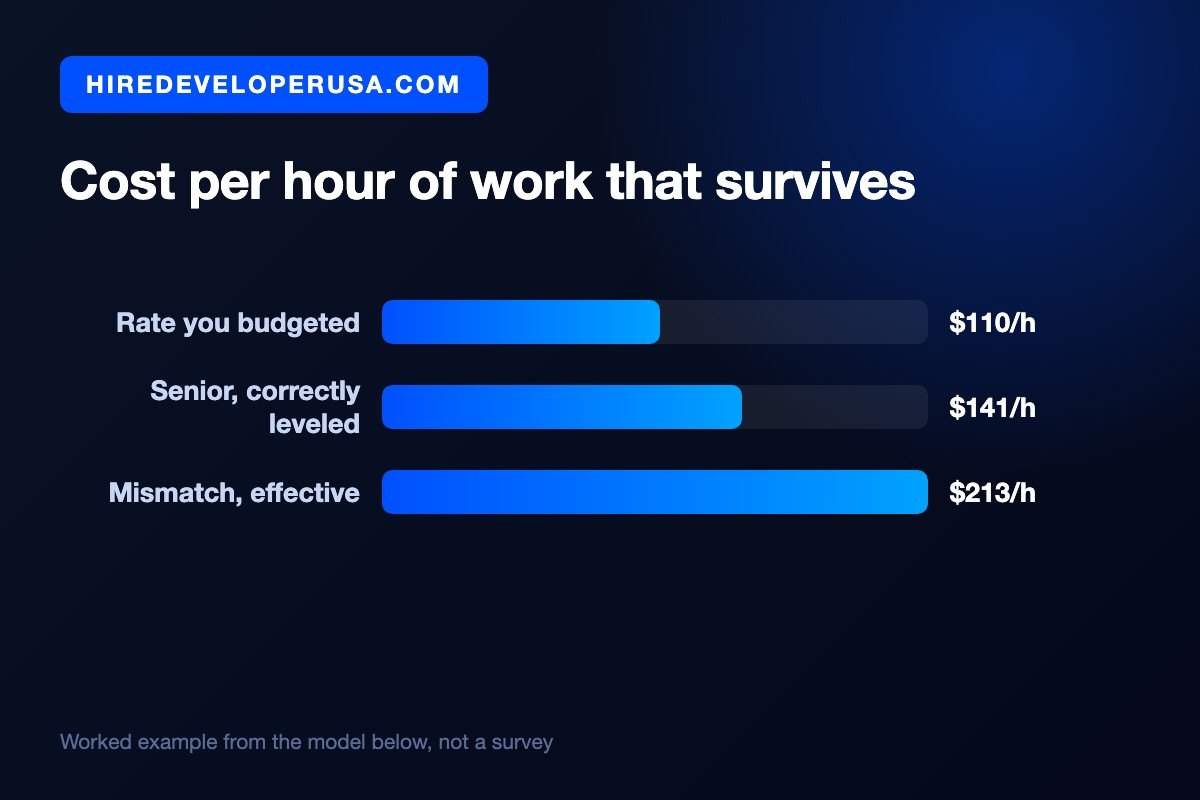
- →The cost is never the rate. In the worked example here, $110 an hour becomes about $213 for every hour of work that survives review.
- →Resumes cannot show ambiguity handling. Years, logos, tech lists and small-company titles are all compatible with a career of well-specified tickets.
- →A 40-minute unscripted probe on a real, messy problem separates the two far better than a take-home exercise does.
- →If you already hired one, re-scoping or re-leveling is usually cheaper than replacing, as long as you reset the rate or the expectations with it.
A developer who looks senior on a resume yet performs at junior level does not cost you their hourly rate. In the worked example below, a contract at $110 an hour becomes roughly $213 for each hour of work that survives review: somebody else rebuilds a quarter of the output, and a real senior spends six hours a week re-specifying the rest. Bad code is almost never where the gap appears. Instead you see a person who is excellent with a clear ticket and lost without one, and that is exactly the difference the title was supposed to buy.
This guide puts a price on that mismatch using numbers you can change. It also explains why resumes produce it so reliably and hands you a 40-minute probe that exposes it before any offer goes out.
A senior title buys judgment under ambiguity, not more code
Most teams bring on a senior expecting cleaner patterns and faster output, and then feel shortchanged when the code looks ordinary. The expectation was wrong from day one. Four years into shipping, a mid-level developer writes perfectly good code. The senior level changes something else: the kind of input the person can take.
Give a mid-level developer a defined problem and they build it well. A senior gets something vague, such as "checkout feels slow this quarter" or "retention dropped after the redesign", and has to turn it into a short list of candidate explanations, rank them, choose one, get it built and prove afterwards that it worked. Nobody writes the ticket for them. They are the ones who write it.
This one difference is why years of experience track seniority so poorly. A person can spend eight years receiving well-written tickets from a strong product organization without once deciding what to build next. Nothing is being faked. They are senior in tenure and mid-level in scope, and the job description quietly assumed the second while the screening process only ever measured the first.
Price one month of the mismatch
Arguments about seniority go in circles until somebody writes the arithmetic down. What follows is a worked example rather than a survey: every input is an assumption you should replace with your own, but the shape of the result holds across most teams.
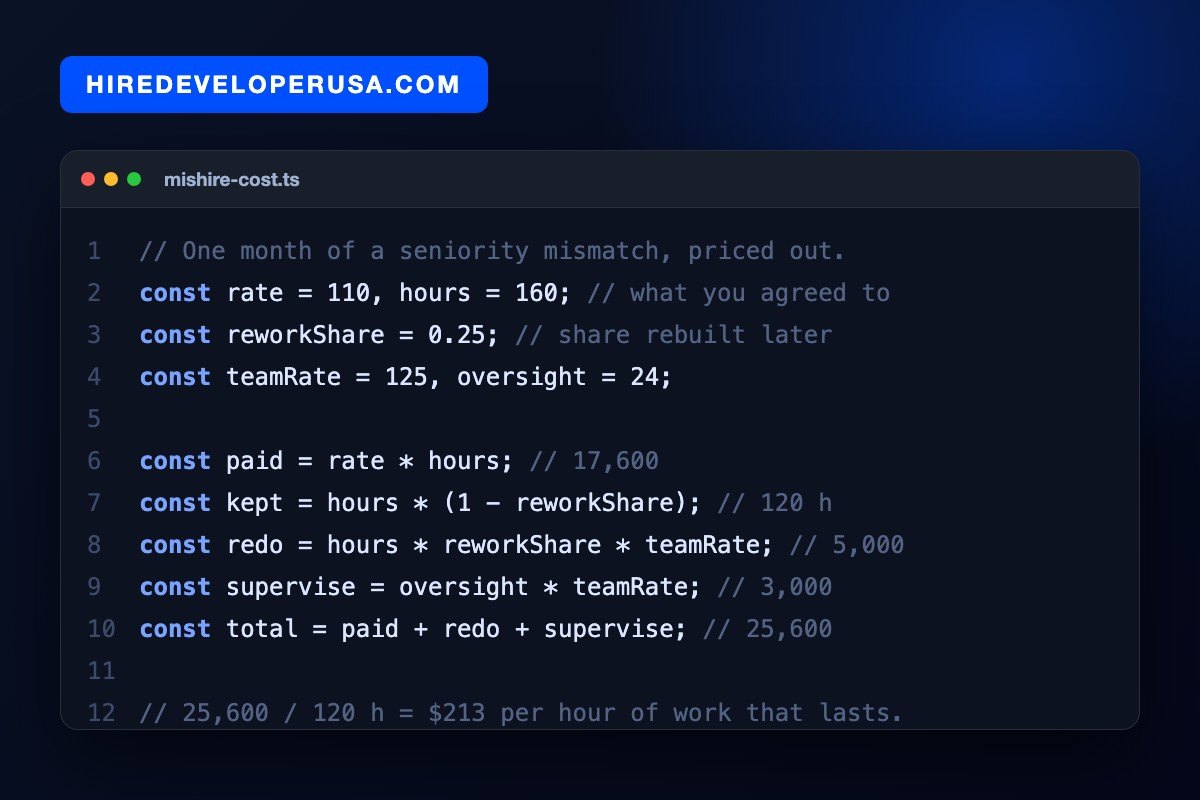
Begin with a contract at $110 an hour for 160 hours in the month. That sits at the bottom of the US senior full-stack band, and a slight discount is exactly the way a seniority mismatch tends to arrive. For the full band before setting your own inputs, our breakdown of the cost to hire software developers lists the current ranges by model and level.
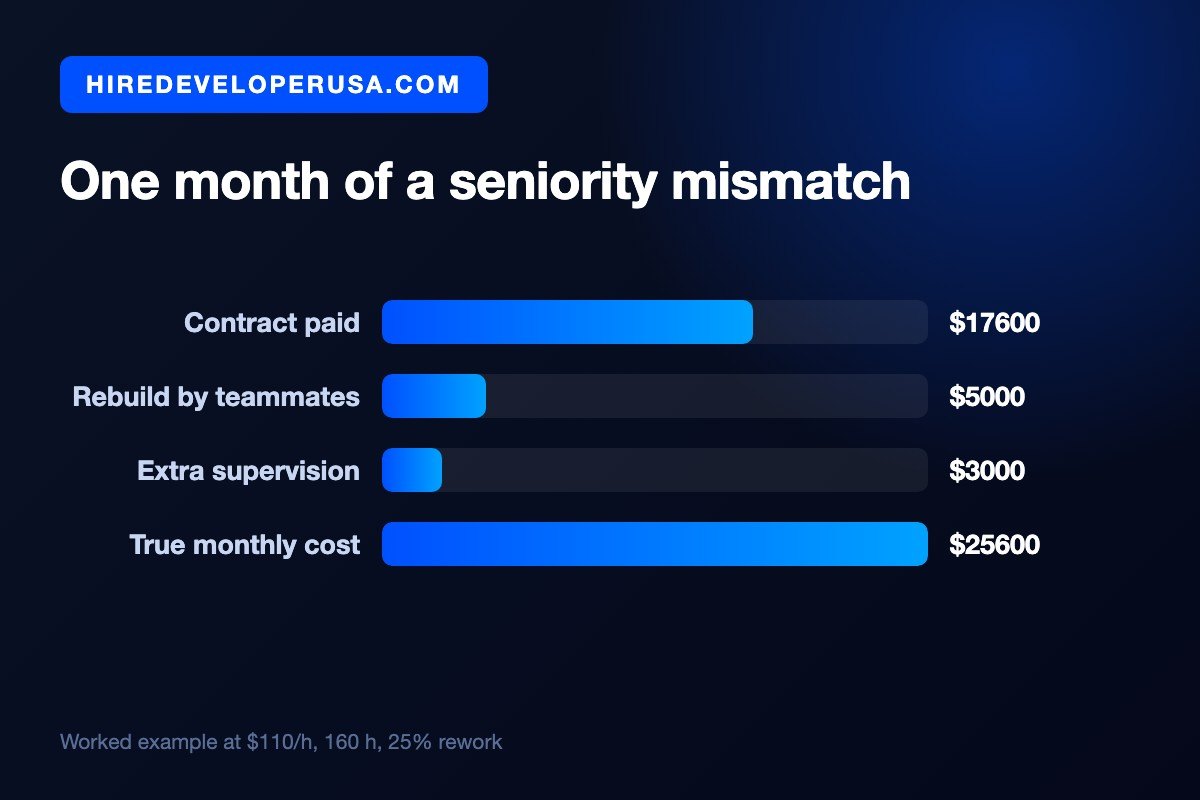
- You pay $17,600 for the month.
- One ticket in four comes back, and somebody else rebuilds it. So 40 of the 160 hours are gone, which leaves 120 hours of work that survives.
- Rebuilding takes 40 hours at a blended internal rate of $125 for whoever does the cleanup: $5,000.
- A senior on the team puts six hours a week into re-specifying tickets and unblocking: 24 hours at $125, or $3,000.
The seat costs $25,600 in total, for 120 hours of work that stayed. That comes to $213 an hour. Compare a correctly leveled senior at $135 an hour with two hours of ordinary review a week: $22,600, all 160 hours delivered, which works out at $141. Per hour of work that lasts, the cheaper contract is about 51 percent more expensive, and that is before you count a single day of delay.
Most of the weight here sits on two assumptions: the rework share and the supervision hours. Lower numbers on your side narrow the gap. If nobody on your team can say what either one is, that is a finding in itself. To run the same seat against your own blended rates, the team cost calculator is a quick option.
Why resumes manufacture the illusion
Nothing on a resume is built to show how someone behaves when the problem is vague. Four things in particular read as seniority without being it.
Years. Tenure measures exposure, not scope. Eight years of well-specified tickets produce a fast, reliable, mid-level engineer, and the resume looks identical to eight years of owning ambiguous problems.
Logos. A well-known employer shows you the hiring bar on the day the person joined, not what they held afterwards. Big product organizations run enormous volumes of carefully specified work. That makes a fine career and a poor proxy for the skill you are buying.
Tech lists. A broad stack signals learning, and it is also the easiest thing on a resume to grow on purpose. Knowing six frameworks says nothing about whether someone can pick between two approaches with a deadline looming.
Titles from small companies. At a ten-person startup the third engineer is a Senior Engineer or a Lead on day one, because somebody has to be. That title was inventory management, not an assessment, and the person wearing it may well be excellent. You simply cannot read it as a grade.
None of this is dishonest. The resume answers a different question from the one you are asking, and no amount of closer reading will fix that.
Six signals that separate the title from the work
You can observe every signal below in a conversation. None requires a code sample. That helps, since code samples are the part of the profile least likely to be in doubt.
| Signal | Senior performance | Junior performance under a senior title | Where it shows up in your sprint |
|---|---|---|---|
| Ambiguous problem | Reframes it and asks what better would mean before proposing anything | Waits for a spec, or builds the first idea that occurs to them | Tickets bounce back to the product manager for clarification |
| Solution space | Names several candidate approaches, then chooses out loud | Names one and defends it | You never hear about the option you would have picked |
| Prioritization | Ranks by return on effort and states what gets skipped | Works top to bottom through the board | The sprint closes with the hard part untouched |
| Delegation | Splits the work, briefs other people, stays accountable for the outcome | Takes all of it personally and finishes late | One person is the bottleneck for an entire feature |
| Measurement | Defines the number that will prove success before building | Calls it done when the pull request merges | Nobody can say whether the fix actually worked |
| Changed constraints | Replans in the open and says what the change costs | Keeps executing the original plan | Scope changes land as surprises during review |
Go back over the right-hand column. Those six lines describe how the mismatch actually feels from inside a team, and they explain why the cost lands on other people instead of on the person holding the title.
The 40-minute probe that replaces the take-home
A take-home exercise tests what is not in doubt. It comes as a written specification with an obvious definition of done, and that is precisely the condition under which a seniority mismatch stays invisible. Candidates who thrive on clear tickets turn in excellent take-homes.
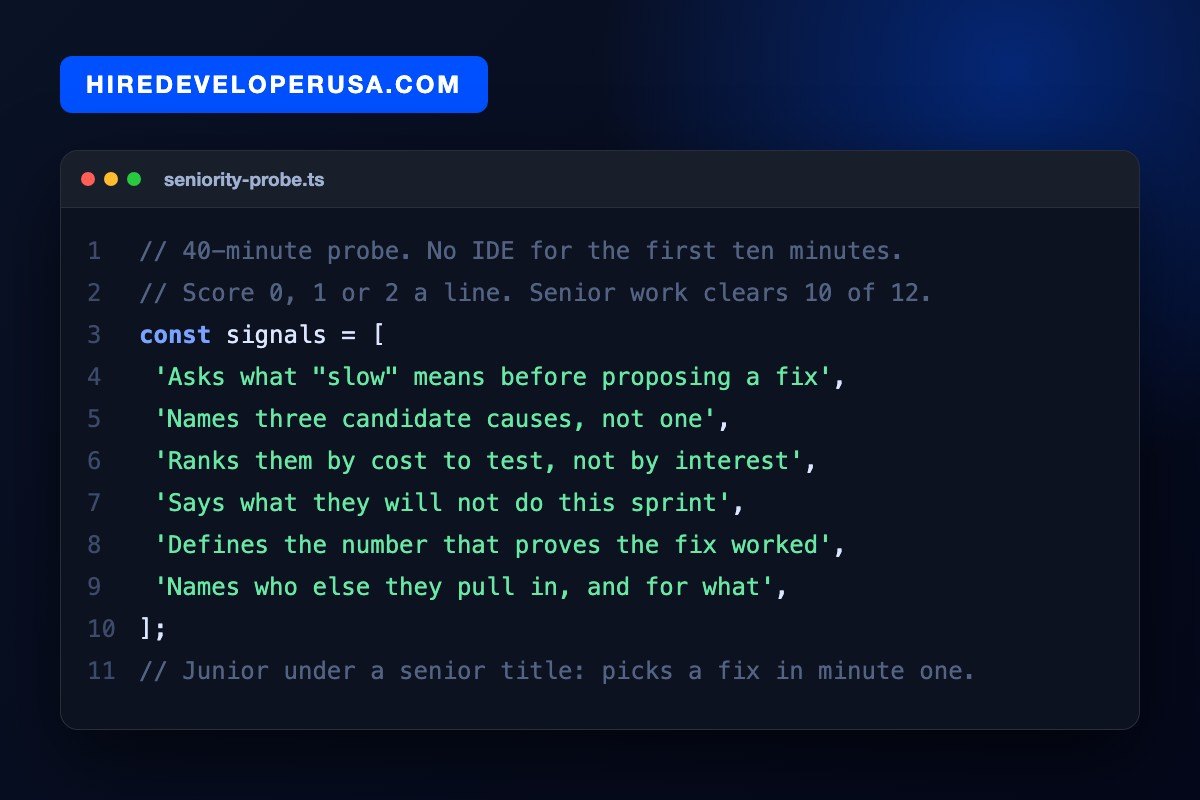
Run this instead. Bring a single real, unsolved, slightly embarrassing problem from your own backlog. Put it in one sentence, ban the IDE for the first ten minutes and score the behavior, not the answer. At the halfway point, add a constraint you left out at the start (for instance, the database team being frozen for the quarter) and watch what happens to the plan. A senior replans out loud and tells you what the constraint costs. The mismatch just keeps building the plan from minute one.
The scoring card is short on purpose, since long rubrics turn into box-ticking. A candidate who proposes a fix in the first minute and never widens the frame has given you your answer, and that holds whether the fix was good or not. For the rest of the loop, our guide to running a technical interview covers the one-problem format that this probe fits into cleanly.
One warning. Senior candidates burned by bad processes sometimes squeeze all of this into thirty seconds and move on, so ask them to narrate. The reasoning is where the signal lives, and it is not always volunteered.
You already hired one. Re-scope, re-level or replace
There are three options, listed from cheapest to most expensive. The order matters, because teams reach for the expensive one first.
Re-scope. Keep the person and give them defined work, which is usually where they are strong. The catch: you now pay a senior rate for mid-level scope, so reset the rate at renewal or accept the premium with your eyes open. What you cannot do is keep the rate and the scope mismatch and still expect the rework line to disappear.
Re-level with a plan. Hand them one ambiguous problem a month with a named senior as sponsor, and agree beforehand on what a good outcome looks like. Ninety days is enough to know. It works more often than people expect, since the gap is usually missing practice rather than a ceiling, and it costs far less than the alternative.
Replace. Before you commit, count the notice period, the re-hire and three to six weeks of ramp. Replacing is the right call when the seat exists specifically because nobody else can own ambiguity, as re-scoping then removes the only reason the role was funded. Should you replace, the first thirty days decide whether the new hire gets a fair run at it, and our checklist for onboarding a remote developer is built around exactly that window.
The hourly rate on the contract is not the number that should drive the decision. What should is the cost per hour of work that survives review, where a discount on paper becomes a premium in practice.
Where to start this week
Before the posting for the next senior role you are about to open goes live, do two things. First, write down in one sentence the ambiguous problem that person will own in their first quarter. If you cannot name one, you need a mid-level developer and should hire and pay accordingly, a better outcome than finding out in month three. Second, swap one stage of your interview loop for the 40-minute probe and actually score it, so two interviewers can compare notes on something other than impressions.
If the bottleneck is the pipeline rather than the process, our startup hiring page is where to start, and the signals above work just as well on a shortlist you did not source yourself.
Frequently asked questions
How many years of experience make a developer senior?
None by itself. Tenure measures how long somebody has been exposed to the work, not the scope they held while doing it, and a developer can spend a decade building well-specified features without ever owning an ambiguous problem. Use years as a filter for breadth of situations seen, then test the scope directly: hand over a vague problem and watch whether it gets reframed, ranked and measured, or simply built.
Can a take-home test catch a seniority mismatch?
Rarely. A take-home is a written specification with a clear definition of done, the exact condition under which the mismatch disappears. Candidates whose strength is executing clear tickets tend to turn in the best take-homes in the pile. In a third of the time, a live conversation about an unsolved problem from your own backlog, with a constraint added halfway through, surfaces far more.
What does a seniority mismatch cost over a year?
Hold the output constant and the gap in the worked example above is roughly $11,500 a month, or close to $138,000 across a year, because buying 160 surviving hours at an effective $213 costs about $34,100 against $22,600 for a correctly leveled senior at $135 an hour. Those are example inputs rather than market figures, so run the same arithmetic on your own rework share before you quote the number to anyone.
Is it fair to re-level someone you hired as a senior?
It is fairer than leaving them in a role they were set up to struggle in, provided you do it openly. Say which specific behaviors the level requires, name the sponsor who will coach them, and agree on what ninety days of progress looks like. What is not fair is keeping the title and the rate while quietly routing every ambiguous problem around the person, which is the most common outcome and the most expensive one.
Hire vetted talent