
Key takeaways
- →Name the job shape first: a new SaaS product, a legacy PHP rescue and an API backend call for different Laravel profiles at different prices.
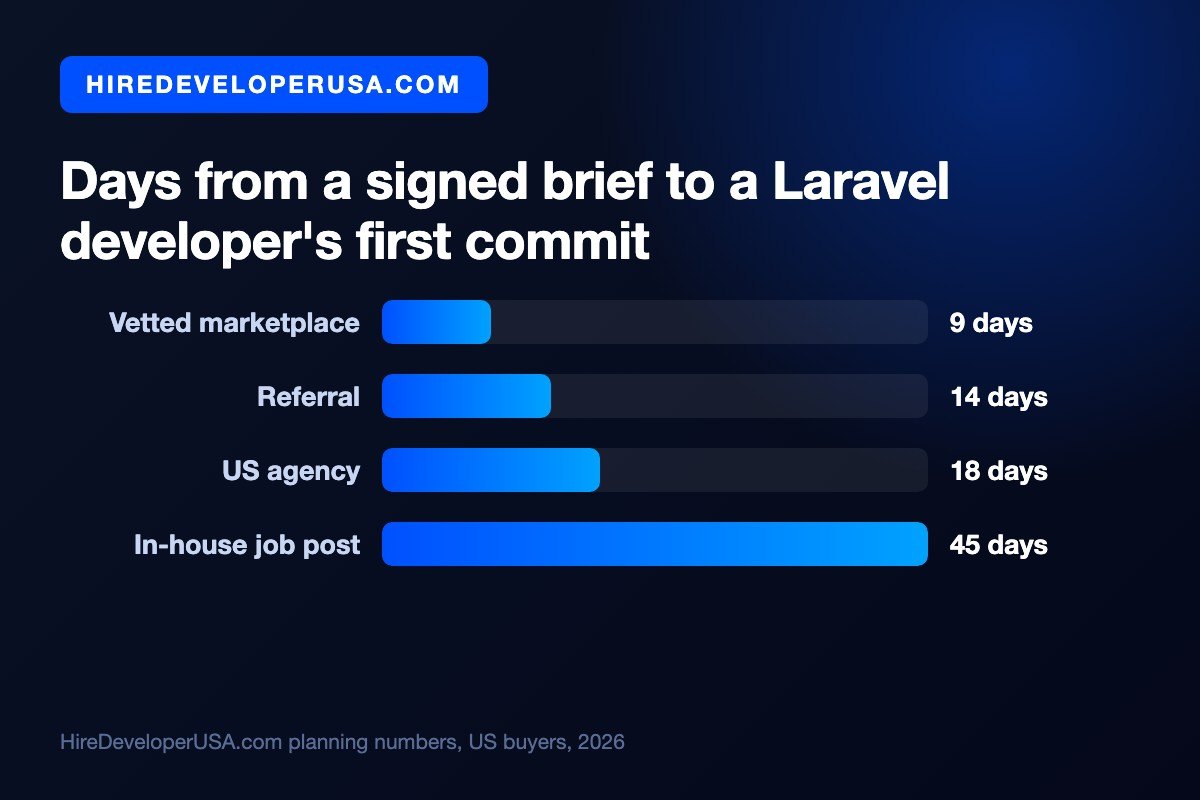
- →Plan about 9 days from brief to first commit through a vetted marketplace, 14 through a referral, 18 through a US agency and about 45 through an in-house job post.
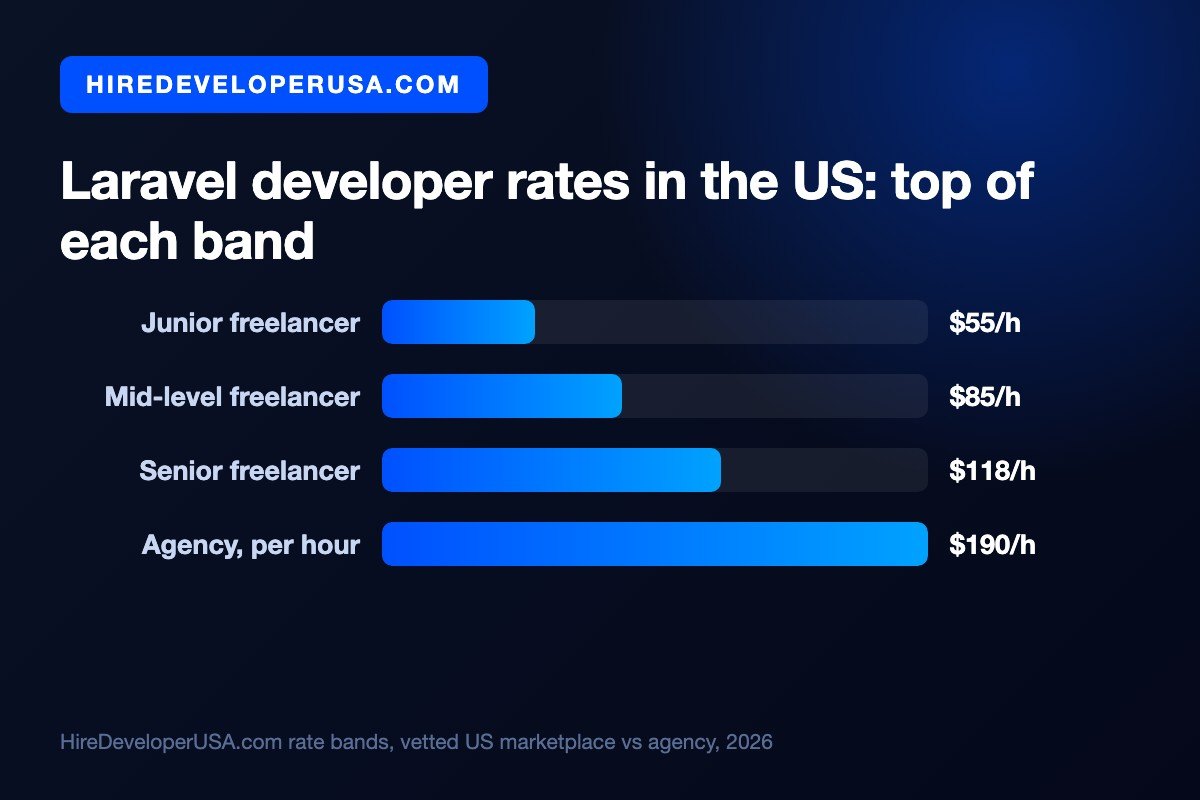
- →US Laravel freelancers bill $32 to $118 an hour by seniority, agencies $105 to $190, and full-time base salaries run $90,000 to $155,000 before a 25 to 35 percent loading.
- →Replace trivia with a 40-minute review of a junior snippet: routes, auth middleware, schema foreign keys, SQL-level queries and Form Request validation. Four of five books a paid trial.
- →Pay for 10 to 15 hours on one real ticket, land it on staging, and review the pull request like production before signing anything longer.
To hire Laravel developers who ship, run the same sequence every time: write down which of the three kinds of Laravel work you are buying, source from a channel that matches your deadline, screen with a 40-minute code review of a junior snippet instead of a trivia quiz, and pay for one bounded week before you commit. Done in that order, a US buyer lands a working developer in about 9 days through a vetted marketplace and about 45 days through an in-house job post, at $32 to $118 an hour for a freelancer, $105 to $190 an hour through an agency, or $90,000 to $155,000 in base salary for a full-time hire.
Laravel is a buyer-friendly market: the pool is large, the framework is mature, and rates sit below trendier stacks. The catch is that the same pool holds many developers who learned PHP a decade ago and picked up Laravel syntax without Laravel judgment. This playbook is about telling the two apart before the invoice arrives.
Decide which of the three Laravel jobs you are buying
Almost every Laravel engagement in the US falls into one of three shapes, and each one calls for a different profile at a different price.
A new SaaS product. Subscriptions, teams or tenants, an admin panel, background jobs, and a JavaScript front end through Livewire or Inertia. This is where Laravel is strongest and where seniors earn their band: they know how billing edge cases fail, how to keep tenants from leaking into each other, and how to keep queues honest when a payment webhook arrives twice.
A legacy PHP rescue. A working business system written in procedural PHP or an abandoned framework that has to become maintainable without a big-bang rewrite. The developer you want has migrated schemas in place, written tests around code that had none, and talks about strangler patterns unprompted. This pays toward the top of the band because the downside is a broken business, not a delayed launch.
An API backend. Laravel serving a mobile app or a separate React or Vue front end through token-authenticated JSON endpoints. Pure server-rendered experience is not enough here; you need someone who has versioned an API, paginated properly, and handled authentication for devices, not browsers.
Write the shape down, along with the current stack, the deploy target, and one paragraph on what "done" means. If the work is really general PHP maintenance rather than framework work, say so; you will pay less and get a better match. If it is Laravel, the Laravel hiring page is the shortest route to a vetted shortlist.
Where Laravel developers come from, and how long each channel takes
Laravel has an unusually strong community layer: a video platform most practitioners learned from, an annual conference, regional meetups, and a package ecosystem where good developers are visible through what they publish. That changes the sourcing math. Referrals are stronger than in most stacks and open freelance boards are weaker, because the strongest Laravel developers rarely need to bid.
| Channel | Days to first commit | Typical US cost | Best for | Where it fails |
|---|---|---|---|---|
| Vetted marketplace | About 9 | $32 to $118 per hour, no placement fee | Deadlines, budget control, trying before committing | You still own the technical decision |
| Community referral | About 14 | Market rate, often senior | Long-running products | Slow when your network is not in PHP |
| US agency | About 18 | $105 to $190 per hour | Buyers who want a team and a project manager | Bench swaps, junior hours billed at blended rates |
| In-house job post | About 45 | $90,000 to $155,000 base, plus recruiter fee if used | Core product you will maintain for years | Six weeks or more before code, and the market prices in Laravel demand |
| Open freelance board | About 12 | Wide spread, often below $40 per hour | Small, well-specified tickets | Screening is entirely on you, and the failure mode is silent |
The days are planning numbers measured from a signed brief to a developer's first merged commit, not to a signed contract. The gap between channels is almost entirely sourcing time; the screen itself takes the same 90 minutes wherever the candidate came from.
What Laravel developers cost in the US
On a vetted US marketplace, Laravel freelancers bill $32 to $55 an hour at junior level, $55 to $85 at mid level, and $85 to $118 at senior level. Agencies charge $105 to $190 an hour for a blended team. Full-time base salaries land between $90,000 and $155,000 depending on city and seniority, before payroll taxes, benefits, and equipment, which typically add 25 to 35 percent on top.
What moves a candidate up the band is ecosystem fluency rather than years of PHP: queues and Horizon, Livewire or Inertia, testing with Pest or PHPUnit, and a real deployment story with zero-downtime releases. SaaS experience with billing and multi-tenancy carries a premium, and so does legacy rescue work. Server-rendered CRUD alone prices at the bottom, whatever the resume says.
Here is the arithmetic for a common case: a 10-week SaaS MVP built by one senior developer at 40 hours a week, 400 hours in total.
| Engagement model | Rate basis | Cost of the 10 weeks | Hidden line items |
|---|---|---|---|
| Senior marketplace freelancer | $95 per hour | $38,000 | About 16 hours of your own time on screening and review |
| US agency | $150 per hour blended | $60,000 | Discovery phase billed separately; confirm who actually writes the code |
| Full-time hire | $135,000 base, about $175,000 loaded | About $33,700 of salary cost | About 45 days before the first commit, a recruiter fee of roughly 20 percent of salary if you use one, and the salary continues after week 10 |
The full-time line looks cheapest on paper and is the right answer when the product is core and permanent. For a first version, a proof of concept, or a rescue with an end date, the marketplace number wins because it stops when the work stops.
The five code signals that separate a senior from a resume
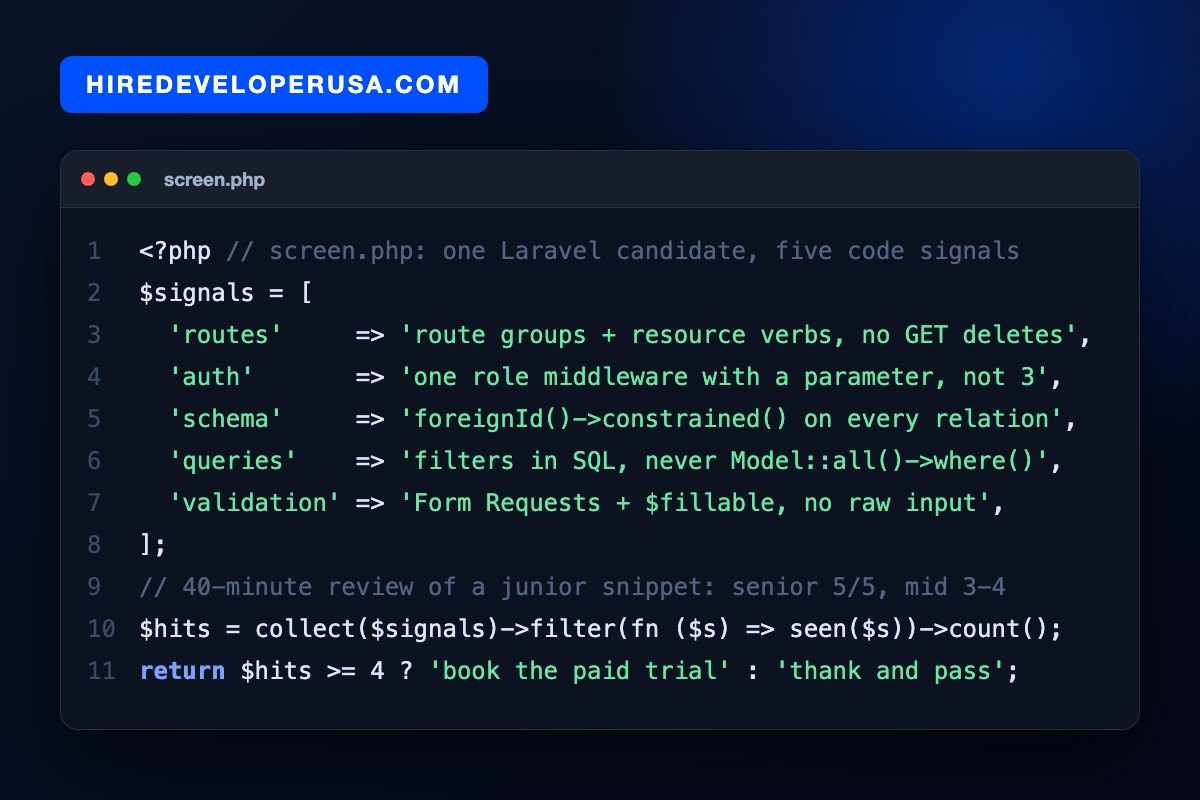
Trivia questions about facades and service containers reward people who studied for interviews. What predicts performance is whether a candidate can look at working but naive Laravel code and see what a maintainer will curse in a year. So we hand candidates a small, real-looking junior codebase, a routes file, a middleware, a migration, and a controller, and ask them to review it out loud. In our screens, seniors find all five of the following in under 40 minutes and mid-level developers find three or four. Anyone who finds fewer than three is not ready to own your product.
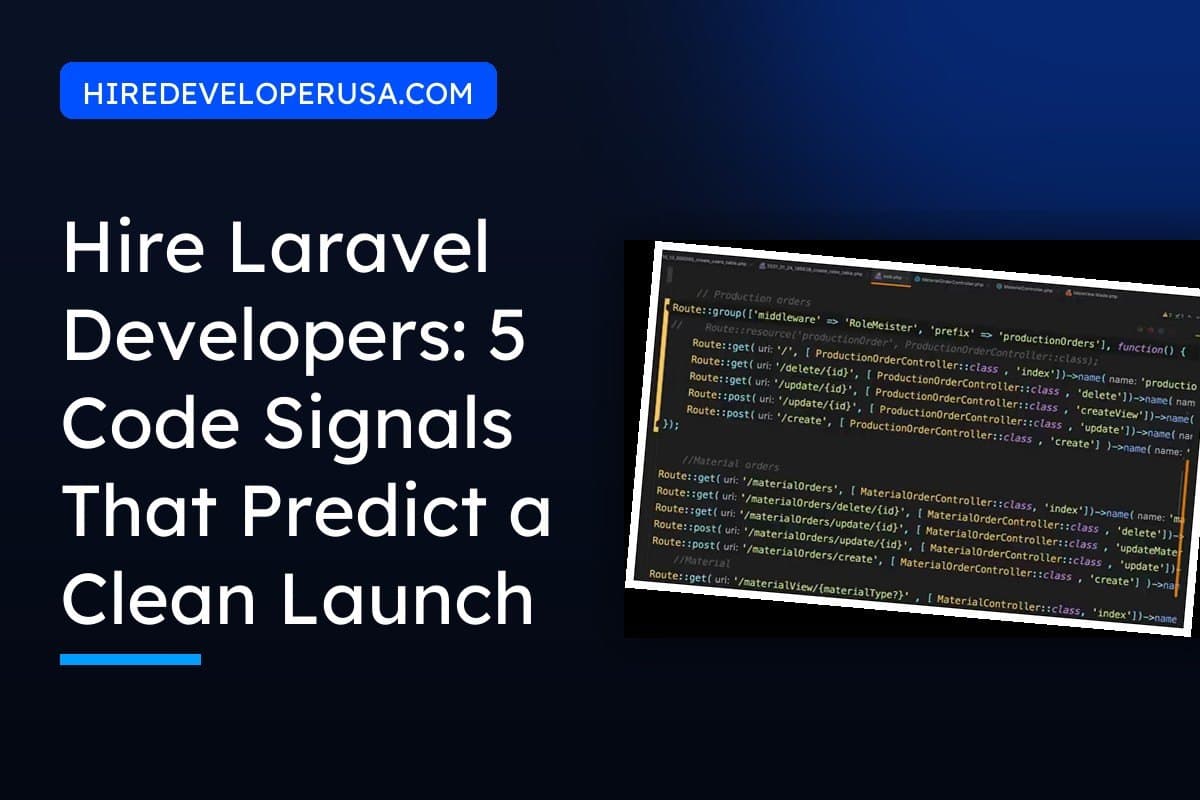
1. Routes. The junior version declares middleware and a URL prefix on every line and uses GET requests for deletes and updates. A senior groups routes by shared middleware and prefix, reaches for resource controllers with the seven standard actions, and insists on the correct HTTP verb, not because the framework forces it but because the next developer on the team will assume the standard.
2. Auth and middleware. The junior middleware checks whether the user is logged in, then fetches the user again from the database, then nests role checks inside redirects. A senior notices the auth check belongs on the route group, that the authenticated user is already loaded, that a 403 is more honest than a silent redirect, and that three near-identical role middlewares should be one middleware with a parameter.
3. Schema. The users table stores a role as a plain integer with no foreign key. A senior adds the constraint at the database level so a role cannot be deleted while users still hold it, uses the snake_case column convention so relationships resolve without configuration, and writes the change as a new, reversible migration instead of editing an old one.
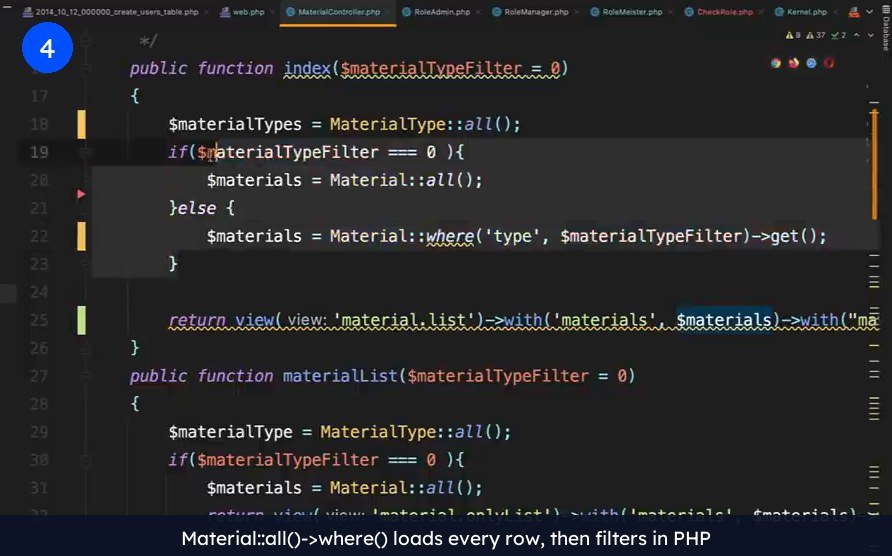
4. Queries. This is the one that costs real money in production. The junior controller loads every row of a table with a call to all() and then filters the resulting collection in PHP. It works on a demo database with 50 rows and falls over at 50,000. A senior pushes the filter into the query, uses conditional clauses for optional filters, and asks about eager loading the moment a loop touches a relationship.
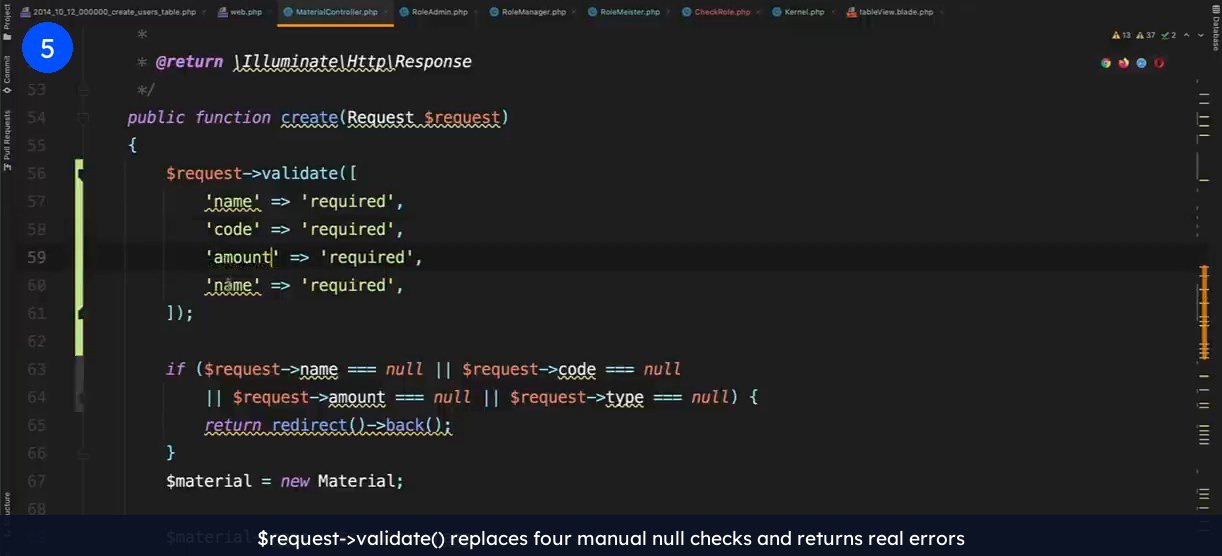
5. Validation and input. The junior controller compares each request field to null by hand, redirects back with no error messages, and assigns fields to the model one line at a time. A senior replaces the whole block with a Form Request class, creates the model from validated input only, sets the fillable list deliberately, and redirects to a named route with a flash message rather than back to wherever the browser came from.
Two smaller tells round out the review. Route model binding, so controllers stop calling find-or-fail by hand, and a consistent code style enforced by a formatter rather than by memory. Neither is a deal breaker on its own. Together with the five above they draw a sharp line between someone who has maintained Laravel in production and someone who has completed tutorials.
A 90-minute screen and one paid week that predict the first month
The technical screen fits in one afternoon per finalist, and you should not need more than three finalists if the brief is clear.
Minutes 0 to 20: scope. Walk through the brief and let the candidate ask questions. You are listening for the questions a maintainer asks: which Laravel version, how it deploys today, where the tests are, who owns the database. A candidate who asks none of these will build exactly what you said and nothing you meant.
Minutes 20 to 60: the code review. Share the junior snippet and ask for a spoken review. Do not hint. Count the five signals, and pay attention to the order they come out in. A senior goes to the query problem and the missing foreign key first, because those are the ones that hurt in production, and treats formatting last.
Minutes 60 to 90: production judgment. Ask what happens when a queued job fails three times, how they release a migration without downtime, how they would approach a major-version upgrade on a codebase with no tests, and how they would structure API authentication for a mobile client. You are not grading for the textbook answer; you are grading for whether they have clearly been there.
Score it as pass or fail on the five signals plus the production conversation. Four or more signals and credible production answers earns a paid trial. Anything less is a polite no, however good the portfolio looked.
Then the paid trial, which is the real interview. Pay for 10 to 15 hours on one bounded ticket from your actual backlog, in your actual repository, at the candidate's normal rate. Good tickets add one small feature end to end: a migration, a model change, a Form Request, a controller action, a test, and a note on how to deploy it. Greenfield toys reveal nothing about how the candidate treats existing code.
Review the pull request the way you would review any other: migrations reversible, tests present and meaningful, validation in the right place, no secrets committed, and a clear question raised where the ticket was ambiguous. If you have never formalized that, how to review a pull request is a 20-minute read that will keep you from approving work you do not understand. Give the trial a staging environment to land on, so the developer shows the feature working instead of describing it.
Six mistakes buyers make when they hire Laravel developers
Posting for a PHP developer. You will get applicants whose PHP predates Composer. Ask for current Laravel work and name the version you run.
Buying on the lowest hourly rate. The $32-an-hour developer who filters collections in PHP costs you a bigger server this quarter and a rewrite next year. Price the work, not the hour.
Skipping the code review because the portfolio is strong. Portfolios show finished screens. The review shows how they get finished.
Interviewing without a written brief. Every candidate answers a different question and you cannot compare them. A one-page software project brief takes an hour and fixes this permanently.
Letting the agency name the team later. Insist on the named engineer in the contract and interview that person, not the sales engineer.
Ignoring the upgrade path. Laravel ships one major release a year. A developer who has never upgraded a codebase across a major version is about to learn on yours.
What to do next
Write the one-page brief today and name which of the three job shapes you are buying. Pick the channel that matches your deadline: a vetted marketplace if you need code in under two weeks, a job post if this is the core product you will own for years. Prepare the junior snippet once and reuse it for every candidate. Hold to the rule of four signals out of five, pay for one bounded week, and review that week like production.
If you want the shortlist done for you, hire Laravel developers through HireDeveloperUSA: pre-vetted profiles, US-friendly hours, and a matched candidate in about 48 hours, so the 9-day clock starts the moment your brief is ready.
Frequently asked questions
How much does it cost to hire a Laravel developer in the US?
On a vetted marketplace, expect $32 to $55 an hour for a junior, $55 to $85 for a mid-level developer and $85 to $118 for a senior. Agencies bill $105 to $190 an hour for a blended team. A full-time hire runs $90,000 to $155,000 in base salary, plus roughly 25 to 35 percent in payroll taxes, benefits and equipment. A 10-week MVP with one senior freelancer at $95 an hour comes to about $38,000.
How long does it take to hire a Laravel developer?
Plan about 9 days from a written brief to a first merged commit through a vetted marketplace, about 14 days through a community referral, about 18 through a US agency and about 45 days through an in-house job post. The screen itself is 90 minutes per finalist plus a one-week paid trial; the difference between channels is sourcing time.
What should I look for when hiring a Laravel developer?
Ecosystem fluency rather than years of PHP: queues, Livewire or Inertia, testing with Pest or PHPUnit, and a real deployment story. In a code review, a senior spots five things quickly: routes that need grouping and correct HTTP verbs, middleware that repeats auth work, a schema missing foreign keys, queries that load every row and filter in PHP, and hand-written validation that belongs in a Form Request.
Should I hire a Laravel freelancer, an agency or a full-time developer?
Choose a vetted freelancer for a first version, a proof of concept or a rescue with an end date, because the cost stops when the work stops. Choose an agency when you want a team and a project manager and can accept blended rates. Choose a full-time hire when the product is core and permanent and you can absorb about 45 days before the first commit.
Hire vetted talent