
Key takeaways
- →Decide whether the work is a Go problem before you pay the Go premium: Go bills roughly 10 to 20 percent above an equivalent Node.js or Python hire because the work sits in infrastructure.
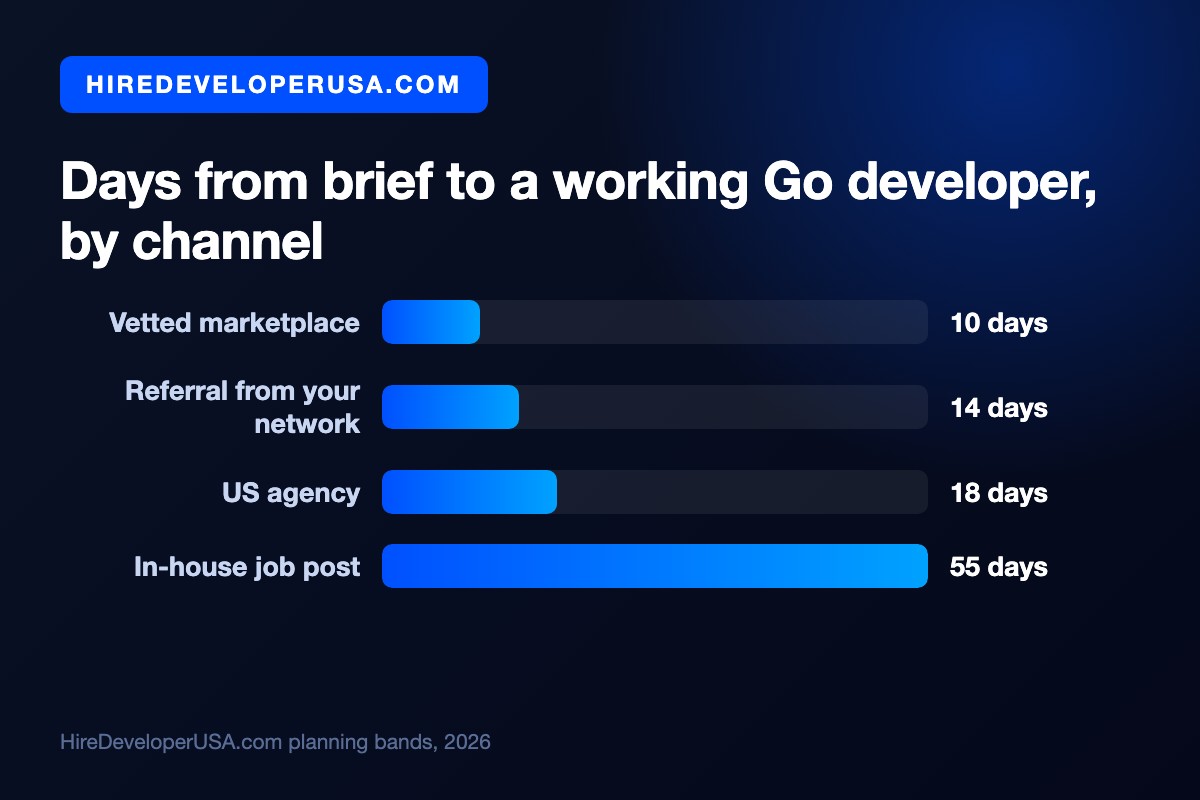
- →Plan about 10 days to a working developer through a vetted marketplace, 14 through a referral, 18 through an agency and about 55 days through an in-house job post.
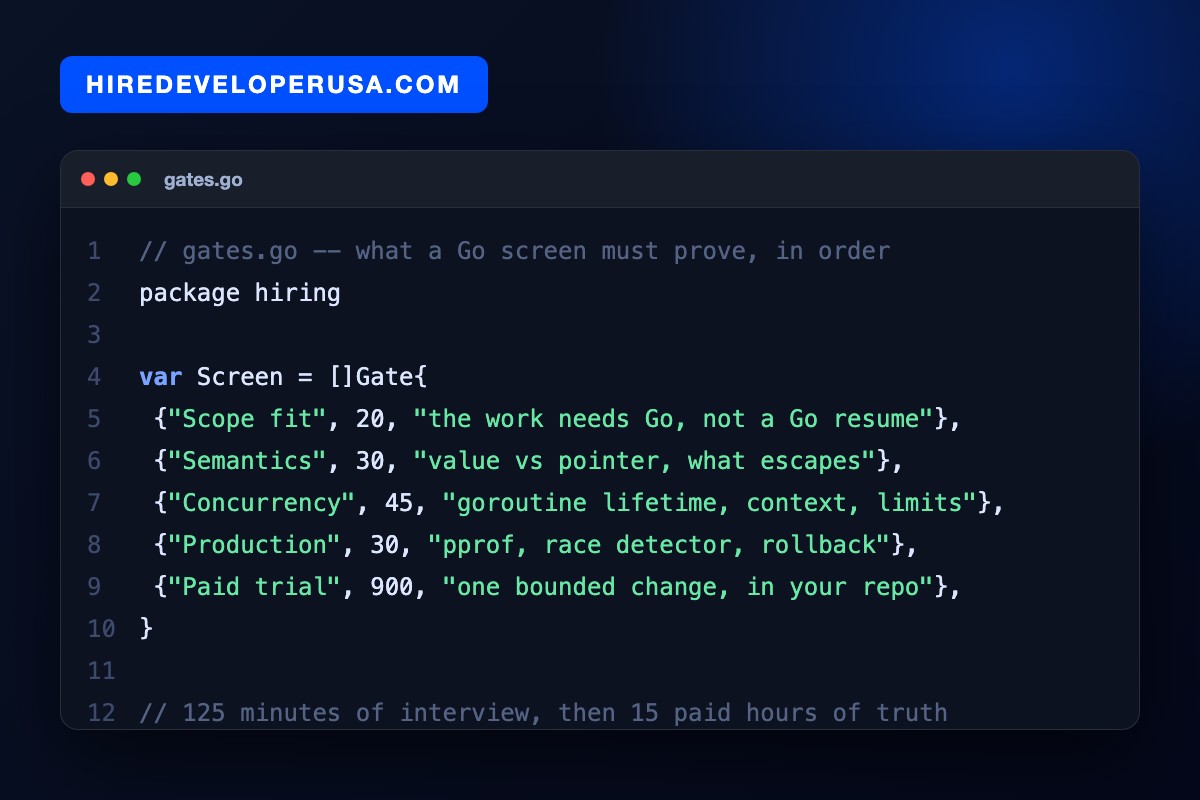
- →Run five gates in order: scope fit (20 min), semantics (30 min), concurrency (45 min), production judgment (30 min), then a paid trial of 10 to 15 hours.
- →US Go rates: $45 to $75 junior, $75 to $110 mid-level, $110 to $150 senior on a marketplace, $135 to $235 at an agency, $115,000 to $190,000 as a full-time base salary.
- →Budget 20 hours of your own time per hire, and treat the paid trial as the interview that actually predicts the next six months.
To hire Golang developers without guessing, run the same five gates every time: prove the work actually needs Go, test semantics and concurrency in a 75 minute technical conversation, check production judgment, pay for one bounded trial task, and hold a budget you set before you meet anyone. Run in that order, the process lands a working developer in about 10 days through a vetted marketplace and about 55 days through an in-house job post, at $45 to $150 an hour for a contractor or $115,000 to $190,000 in base salary.
This is the operator version of that process. Where Go people actually are, the questions that separate production Go from a resume line, the rate guardrails that hold when a project slips, and the trial task that catches everything an interview misses.
Before anything else, decide whether the job needs Go
Go bills roughly 10 to 20 percent above an equivalent Node.js or Python hire. That premium is not a language tax, it is a work-type tax: Go jobs cluster in Kubernetes controllers, gRPC services, CLI and platform tooling, observability agents, and payment or event pipelines. Those systems are expensive when they fail, so the market prices the people who run them accordingly.
So write the requirement down in numbers before you write the job post. Requests per second at peak. The p99 latency you have to hold. The memory ceiling on the box. Whether you need a single static binary you can drop on a customer machine. If you can fill in those numbers, you have a Go problem and the premium is worth paying. If you cannot, what you actually want is a back-end developer in whatever stack your team already runs, and the same product will ship sooner and cheaper.
The second question is who reviews the work. Go has a small, opinionated style culture, and a single Go engineer with nobody to review them is how a codebase acquires five different approaches to error handling in four months. If this is your first Go hire, budget either a second Go reader or a senior reviewer on retainer from the start.
Where Golang developers actually come from
Go is a smaller pool than JavaScript or Python, and it behaves differently: the strongest candidates are usually employed, not searching, and they are visible through what they have run rather than through a job board profile. Five channels are worth your time, and they trade speed against control in predictable ways.
| Channel | Days to a working developer | Typical US cost | Best for | Where it fails |
|---|---|---|---|---|
| Vetted marketplace | About 10 | $45 to $150/hour | A bounded project, or a first Go hire you do not want to gamble on | You still run the project. Nobody else will. |
| Referral from your network | About 14 | Usually marketplace rates | Trust on day one, with a real reference behind it | One bench, one candidate. A single no and you restart. |
| US agency or consultancy | About 18 | $135 to $235/hour | Multi-person builds that need a PM, QA and continuity | You pay for the bench, not only for the engineer on your standup |
| In-house job post | About 55 | $115,000 to $190,000 base | Permanent ownership of a Go platform you intend to keep | Roughly eight weeks of not shipping while the role is open |
| Offshore or nearshore team | About 20 | $30 to $70/hour | Maintenance and specified feature work on an existing Go codebase | Deep production Go is thin at the bottom of that band, and infra work needs overlap hours |
Whichever channel you use, the sourcing signal is the same. Look for people who have operated Go in production rather than written it: contributors to Go infrastructure projects, engineers who can name the service they paged for at 3am, talks or writeups about a migration they actually ran. A GitHub profile full of tutorial repos tells you someone learned the syntax. A closed issue on a Go project used by other people tells you someone shipped. When you want that filtering done before you spend a call on it, that is exactly what a vetted Golang developer shortlist is for.
The five gates, and what each one has to prove
A Go screen is not one interview, it is five decisions taken in order, each one cheap enough to fail fast. Total interview time is 125 minutes per candidate, which is why the shortlist has to be short before the first call.
Gate 1, scope fit (20 minutes). Not a technical call. You describe the system in the numbers you wrote down earlier and ask what they would want to know first. Strong candidates interrogate the constraint. Weak ones start proposing a design.
Gate 2, semantics (30 minutes). Value versus pointer semantics, what a slice actually is, what escapes to the heap. This is where resume Go and production Go separate, and it takes half an hour.
Gate 3, concurrency (45 minutes). Goroutine lifetime, cancellation, and limits. The longest gate because it is the one that costs you money in production.
Gate 4, production judgment (30 minutes). Profiling, the race detector, deployment and rollback. Someone who has only ever written Go on a laptop stops having answers here.
Gate 5, the paid trial (10 to 15 hours). One bounded change in your repo, paid at the agreed rate. Everything the four calls could not tell you shows up in the first pull request.
What to ask in the technical screen
Skip the trivia. The best Go questions are simple on the surface and open into the whole language underneath, which lets one question do the work of six. Three examples that carry a full screen:
What is the difference between make([]int, 10), make([]int, 0, 10) and make([]int, 10, 10)? The minimum answer is length versus capacity. The answer you are hiring for keeps going: a slice is a three word header of pointer, length and capacity, which is why appending can reallocate and silently stop aliasing the array you thought you were sharing, why append and copy behave differently, and why preallocating capacity keeps allocations off the heap in a hot path. Candidates who stop at the definition are not wrong, they are just junior.
This HTTP handler starts a goroutine per request. What happens at 10,000 requests per second? You are listening for bounded worker pools, backpressure, and goroutine leaks from work nobody is waiting on. The follow-up is the real question: how does that goroutine learn it should stop? If context does not come up unprompted, the concurrency gate has failed.
A Go service is using 4 GB of memory in production and climbing. Walk me through the next hour. Heap profile through pprof, allocation sites, goroutine count, then the boring checks: an unbounded cache, a slice retained by a long-lived pointer, a ticker nobody stopped. Someone who has operated Go answers this as a procedure. Someone who has not answers it as a theory.
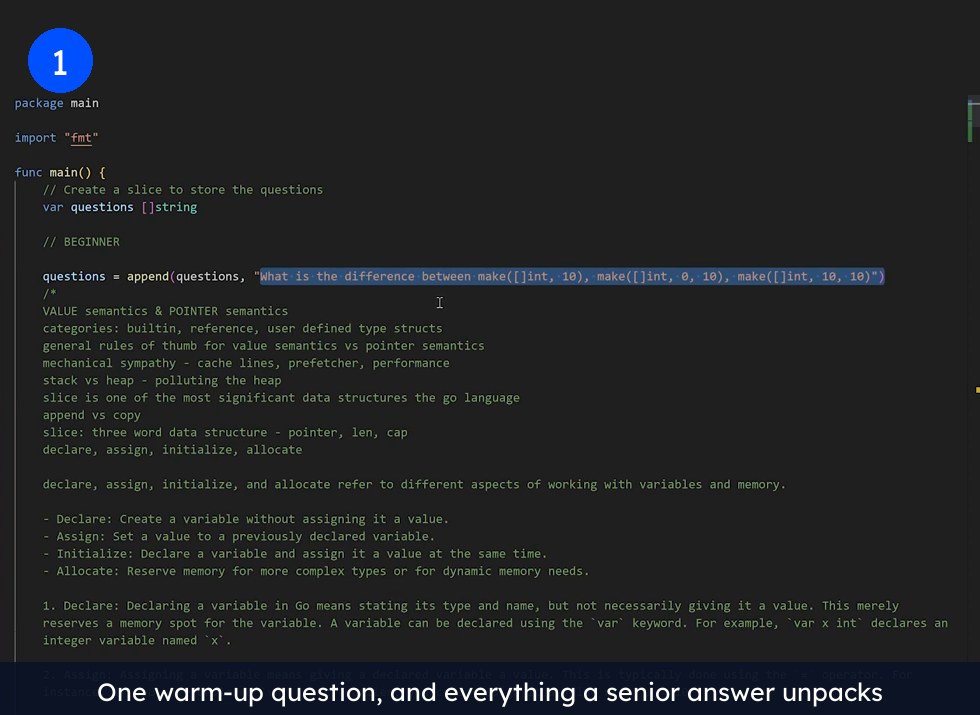
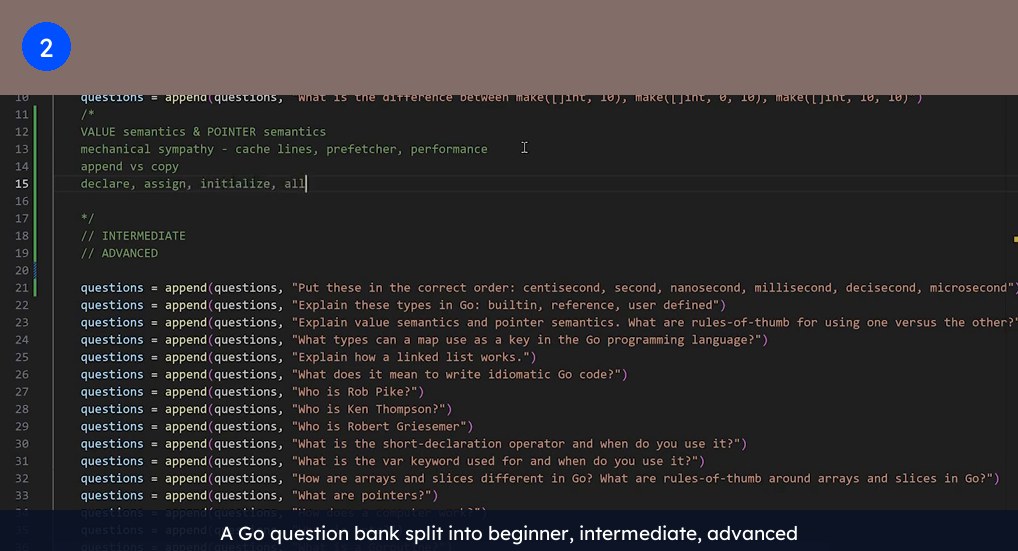
Sort your question bank by band before the call, and keep two or three from each level. Beginner questions are door closers: cheap to ask, fatal to fail. Intermediate and advanced questions are for calibration, not for elimination, because a strong mid-level engineer who reasons well out loud is a better hire than a senior who recites. Note what candidates do when they do not know something. In Go work, the honest "I would measure it" beats a confident wrong answer about escape analysis every time.
One more filter that costs nothing: ask for the last thing they deleted. Go rewards deleting code, and engineers who have carried a Go service for a year always have a story about the abstraction they removed.
Budget guardrails that survive a slipping project
US marketplace rates for Go run $45 to $75 an hour at the junior band, $75 to $110 mid-level, and $110 to $150 senior. Agencies quote $135 to $235. A full-time hire lands between $115,000 and $190,000 in base salary, which becomes roughly 1.25x to 1.4x that number once payroll taxes and benefits land. The full breakdown, with four engagements worked out in dollars, is in our guide to what it costs to hire Golang developers.
What matters at hiring time is not the band, it is the four guardrails around it:
Set the number before the first call. A rate you decide after meeting a candidate you like is not a budget, it is a preference.
Buy seniority by phase, not by project. Senior for the design and the first two weeks, mid-level for the build. Paying $130 an hour for six months of CRUD handlers is the most common way to overspend on Go.
Plan 30 to 32 billed hours a week, not 40. Forty billed hours from one contractor who also has to think is a fiction, and every schedule built on it slips in week three.
Add about 10 percent of the contract for your own time. Reviews, questions, unblocking. It is real money and it is never in the quote.
When the budget does not reach, cut scope, never the rate on the same scope. A discounted senior on an unchanged deadline is a resource you have already lost to their better-paying client.
The paid trial is the real interview
The Go hires that work out almost always go through a bounded, paid trial before the contract. Ten to fifteen hours, one real change in your repo, paid at the agreed rate. The properties that make a trial task useful are specific: it touches one service, it is reversible, it needs at least one test, it has a written definition of done, and it is something you genuinely want merged.
Then grade the process, not just the diff. Did they read the surrounding code before changing it, or pattern match from somewhere else? Is the pull request one reviewable change or a pile of unrelated edits? Did they write the test you would have asked for without being asked? And the one that predicts the next six months: what did they do when the task turned out to be ambiguous, ask a sharp question on day one or build the wrong thing quietly for two days? Our pull request review checklist works as the grading rubric here.
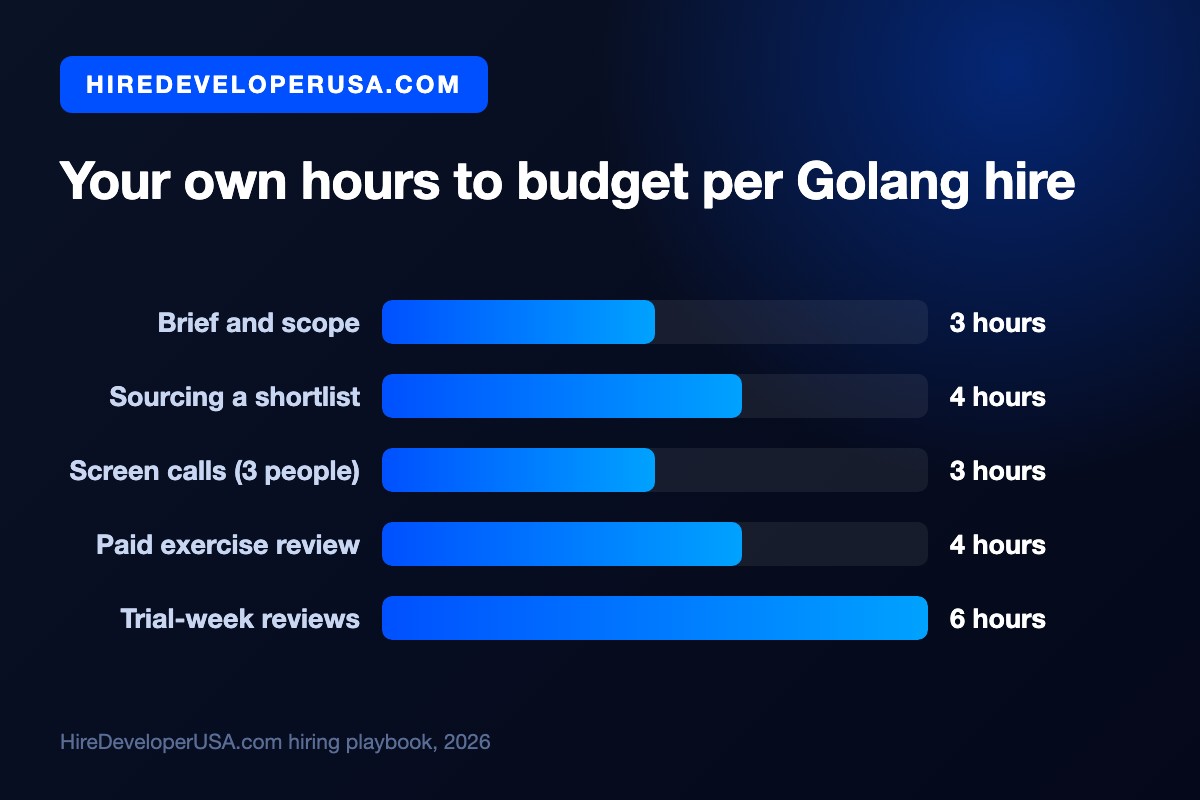
Budget your own time too, because this is the line most hiring plans forget. About 20 hours across a single Go hire: 3 on the brief, 4 sourcing, 3 on screen calls, 4 reviewing the paid exercise, and 6 during the trial week. Skipping the last 6 is how a good hire turns into a bad first month. When the trial passes, the same rhythm carries straight into onboarding a remote developer, and week one stops being a write-off.
Five ways Go hires go wrong
Hiring Go for a product that is not a Go problem. The premium buys throughput, operational simplicity and a static binary. If none of those is a measurable requirement, you paid for nothing.
Screening for syntax. Go is small enough that a competent engineer from any language passes a syntax quiz in a week of study. It proves nothing about production behavior.
The one-person Go island. No second reader means no review, and Go codebases drift fast without one. Pair the hire with a reviewer, even a part-time one.
Trusting a take-home instead of a paid trial. Unpaid take-homes select for candidates with free time, not for the best engineers, and strong senior people simply decline them.
Thin timezone overlap on infrastructure work. Four hours of overlap is the floor when someone is touching Kubernetes, deploys or anything that can page you. Feature work survives less. Platform work does not.
What to do next
Write the requirement in numbers today, then decide whether it is a Go problem at all. If it is, set your band inside $45 to $150 an hour before you talk to anyone, source from a channel whose timeline matches your deadline, and run the five gates in order: scope fit, semantics, concurrency, production judgment, paid trial. Book 20 hours of your own calendar for the process, and do not let the trial week be the part you cut.
If you want the shortlist step done for you, tell us the constraint you wrote down and we will match you with vetted Golang developers who have carried that exact shape of system in production, usually within a week.
Frequently asked questions
How long does it take to hire a Golang developer?
Plan about 10 days from a written brief to a developer working in your repo through a vetted marketplace, about 14 days through a referral, about 18 days through a US agency, and about 55 days if you open an in-house job post. The gap is sourcing, not interviewing: the screen itself is 125 minutes of calls plus a 10 to 15 hour paid trial.
How much does it cost to hire Golang developers in the US?
Marketplace contractors run $45 to $150 an hour, split as $45 to $75 junior, $75 to $110 mid-level and $110 to $150 senior. Agencies quote $135 to $235 an hour. A full-time Go engineer lands between $115,000 and $190,000 in base salary, roughly 1.25x to 1.4x that once payroll taxes and benefits are counted.
What should I ask in a Golang interview?
Three questions carry a full screen: the difference between make([]int, 10), make([]int, 0, 10) and make([]int, 10, 10), which opens into slice internals and heap allocation; what happens when an HTTP handler starts a goroutine per request at high traffic, which tests cancellation and backpressure; and how they would diagnose a Go service whose memory keeps climbing in production, which separates people who have operated Go from people who have only written it.
Should I hire a Go developer or retrain a back-end engineer we already have?
Retraining works for the language and fails for the judgment. A strong Python or Java engineer writes reasonable Go within weeks, but goroutine lifetime, profiling and production rollout habits take longer than your deadline. The cheapest path is usually both: retrain the engineer who will own the service, and bring in a senior Go contractor for the design weeks and code review.
Hire vetted talent