
Key takeaways
- →Golang developers in the US cost $45 to $150 an hour on a vetted marketplace, $135 to $235 an hour at an agency, and $115,000 to $190,000 in base salary as a full-time hire.
- →Go bills roughly 10 to 20 percent above an equivalent Node.js or Python hire because the work clusters in infrastructure, not because the language is harder to write.
- →Marketplace bands by seniority: $45 to $75 junior, $75 to $110 mid-level, $110 to $150 senior. Buy senior for the design weeks and mid-level for the build.
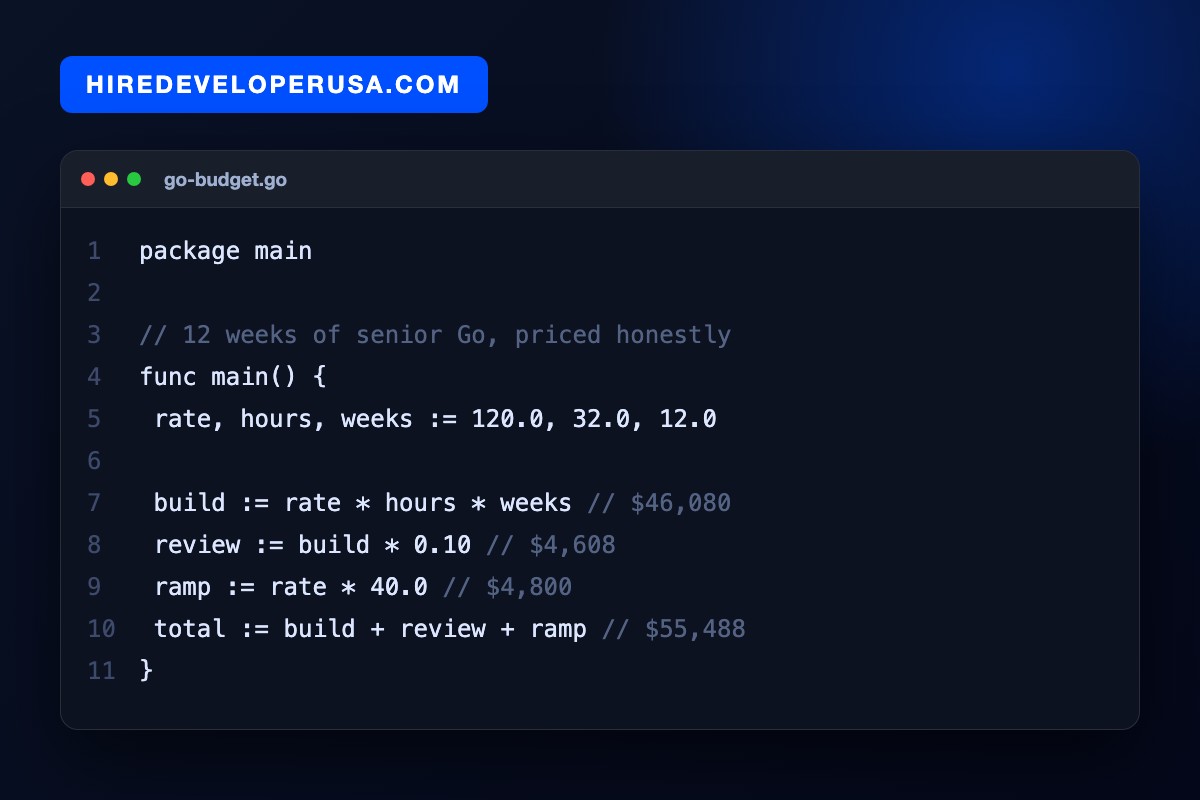
- →A 12-week senior engagement at $120 an hour and 32-hour weeks costs $46,080 in developer hours and about $55,488 once ramp-up and your own review time are counted.
- →If throughput, latency and operational simplicity are not measurable requirements, a mainstream stack delivers the same product for less than Go will.
Hiring Golang developers in the US costs $45 to $150 per hour through a vetted marketplace, $135 to $235 per hour at an agency, and $115,000 to $190,000 in base salary for a full-time hire. Senior Go engineers sit at the top of every one of those bands, and they get there for a reason that has nothing to do with the syntax: Go work clusters in infrastructure, high-throughput APIs and cloud tooling, which are senior problem spaces whatever language they are written in.
That is the price. The rest of this guide is the part that decides whether you overpay for it: where the Go premium actually comes from, what each seniority band should be trusted with, four engagement budgets worked out in dollars, the costs that never appear on an invoice, and the three interview questions that separate real Go experience from a resume line.
The short answer, in one table
Four ways to buy Go hours, and what each one really costs in 2026.
| How you hire | Typical US cost | Time to start | Best fit | The catch |
|---|---|---|---|---|
| Vetted marketplace contractor | $45 to $150/hour | 1 to 2 weeks | A bounded service, a migration, a platform project with a defined end | You run the project. Nobody else will. |
| US agency or consultancy | $135 to $235/hour | 2 to 4 weeks | Multi-person builds that need a PM, QA and continuity if someone leaves | You are paying for the bench, not only for the engineer on your standup |
| Full-time in-house hire | $115,000 to $190,000 base | 6 to 14 weeks | Permanent ownership of a Go platform you intend to keep for years | Loaded cost is roughly 1.25x to 1.4x base once payroll taxes, benefits and equipment land |
| Offshore or nearshore team | $30 to $70/hour | 2 to 3 weeks | Maintenance and well-specified feature work on an existing Go codebase | Deep production Go is thin at the bottom of that band, and infrastructure work needs overlap hours |
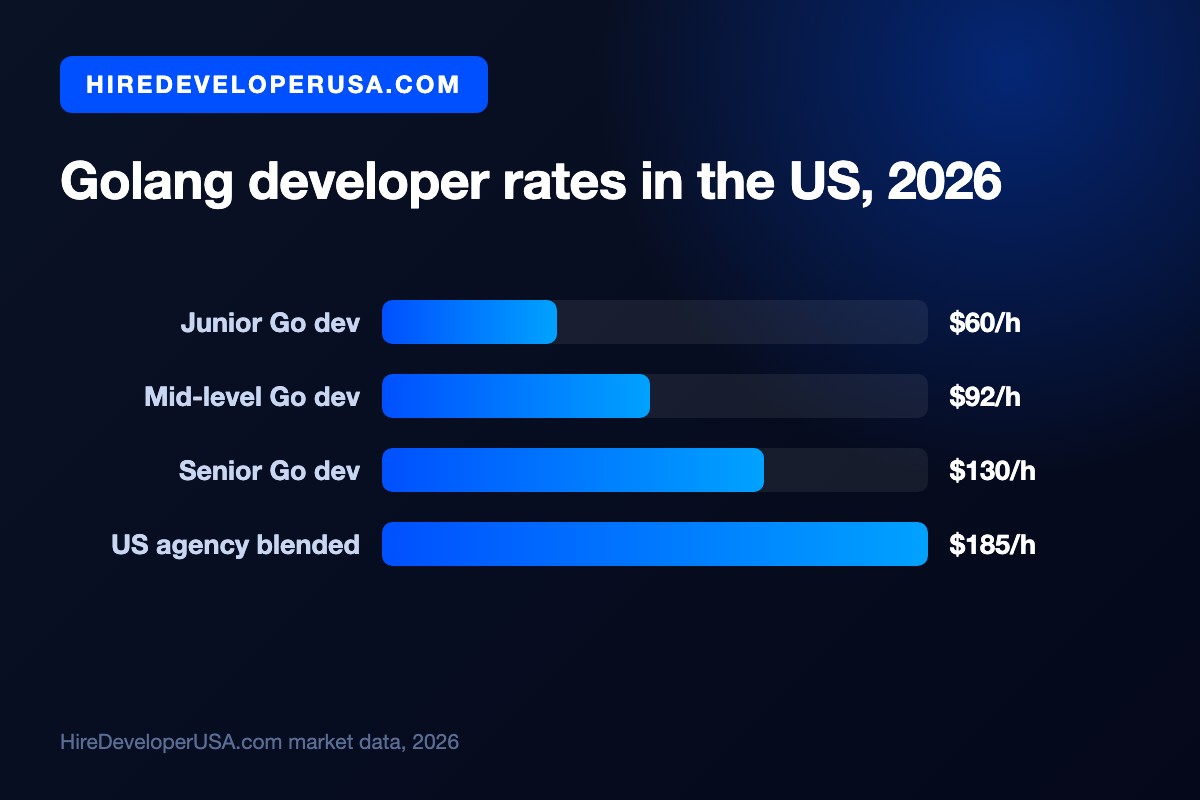
The salary row is the one buyers convert wrong. Take a $150,000 base, apply the 1.3x rule of thumb for payroll taxes and benefits, and you are at roughly $195,000 a year. Spread that over about 1,880 productive hours after vacation, holidays and sick days and the true internal rate is around $104 an hour, before recruiting fees and before the eight weeks you spent not shipping while the role was open. That is why a $130 an hour senior contractor is not the expensive option for a three-month project. Midpoint to midpoint, the marketplace bands work out to about $60 an hour for a junior, $92 for a mid-level and $130 for a senior, against a blended $185 an hour at a US agency. Our general cost guide to hiring software developers works through the same math across other stacks.
Why Go costs more than a general backend hire
On our own rate bands, Go runs roughly 10 to 20 percent above an equivalent Node.js or Python hire. That gap is not a language tax. It comes from three things, and understanding them is how you decide whether to pay it.
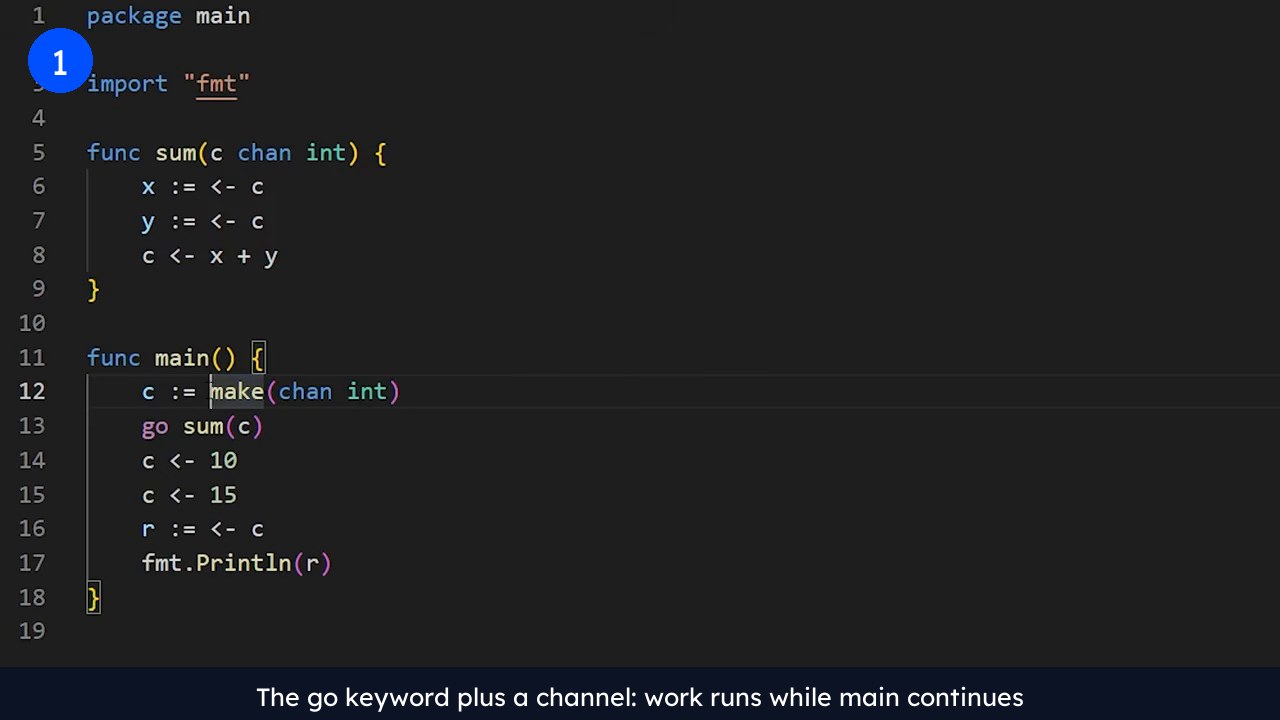
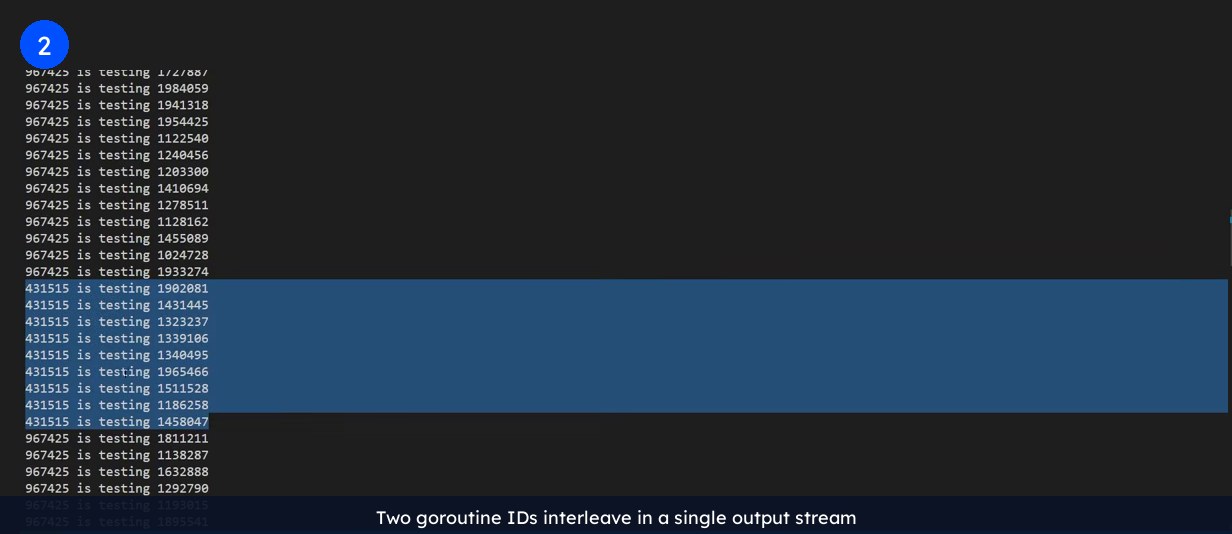
Concurrency is in the language, so the mistakes are too. Putting the word go in front of a function call starts a lightweight thread, and a channel moves values between those threads. A competent developer from any language learns that syntax in an afternoon. What you are actually paying for is the engineer who knows when not to spawn one, how to size a buffered channel, how to cancel work in flight with a context, and how to avoid the deadlock that stays invisible until production traffic hits it.
The work lives where the money is. Go concentrates in Kubernetes controllers, gRPC services, CLI and platform tooling, observability agents, payment and event pipelines. Those systems are expensive when they fail, so they are staffed by expensive people. Hire a Go developer and you are usually hiring a distributed-systems developer, which is a different market from general backend development.
Almost nobody starts in Go. Developers arrive in the language from Java, Python, C++ or Node after years in production, so even the mid-level Go band is staffed by people with real mileage behind them. There is very little cheap end to this market, which is exactly why the junior band is narrower here than in web development.
What each rate band should actually buy you
Rates only mean something next to the work they can carry. Here is how the three marketplace bands break down in practice.
$45 to $75 an hour, junior. Writes handlers, tests and small features inside a service somebody else designed. Needs review on every change that touches concurrency. Perfectly good value for adding endpoints to a healthy codebase, a poor bet for choosing a queue or a retry strategy.
$75 to $110 an hour, mid-level. Owns a service end to end. Reaches for context cancellation and error groups without being told, writes table-driven tests, keeps the interface stable while the internals change. Most of the value in a typical engagement sits in this band.
$110 to $150 an hour, senior. Draws the boundaries: what is a goroutine, what is a queue, what is a separate deployment. Reads a pprof profile and can tell you which allocation is worth removing and which one is noise. Knows the operational cost of the design, not only its throughput.
The practical rule: buy senior for the first two or three weeks when the shape of the system is being decided, then run the build at mid-level with the senior on review. Paying $130 an hour for CRUD handlers is a budget mistake, and so is paying $75 an hour for architecture. If you want the underlying bands for adjacent roles, our backend developer rate page covers the general market, and you can see the current pool when you hire Golang developers through us.
Four Go budgets, worked out in dollars
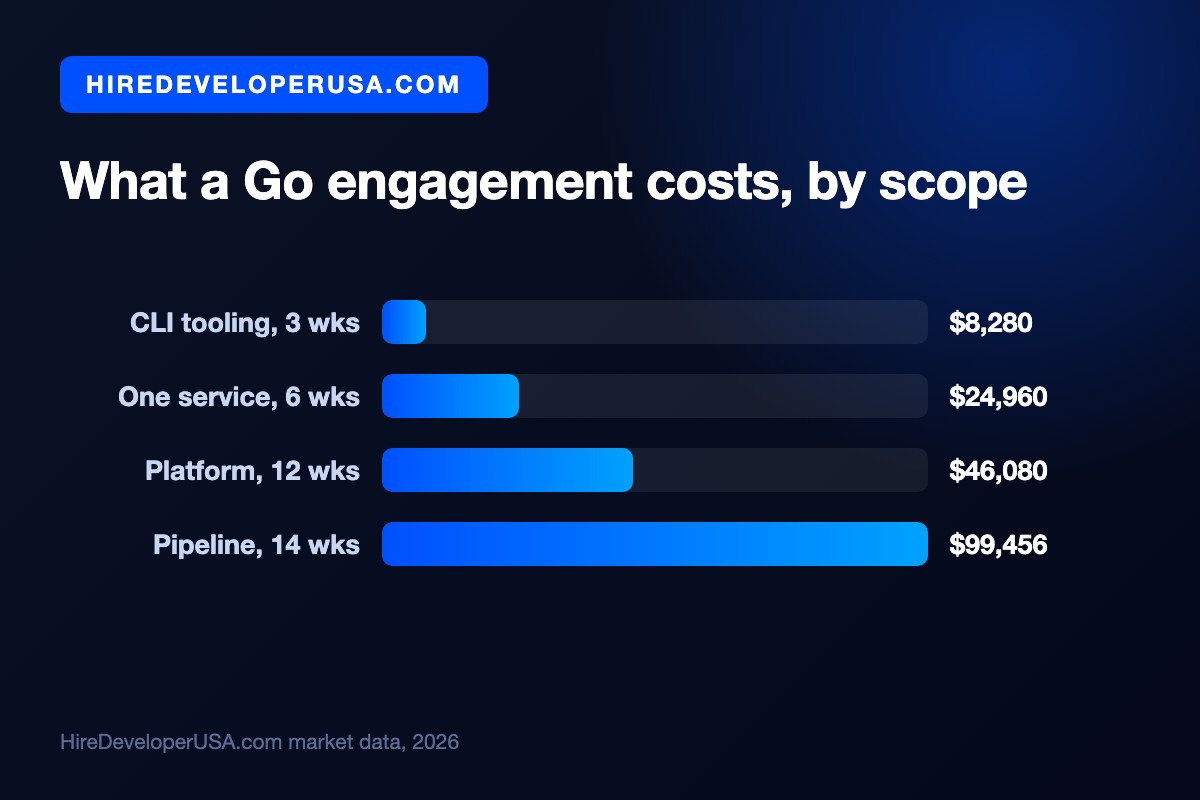
Every figure below uses the bands above and a realistic 30 to 32 hour week, because 40 billed hours a week from a contractor who also has to think is a fiction that wrecks schedules.
Internal CLI or platform tooling, 3 weeks. One mid-level developer at 30 hours a week: 90 hours at $92 is $8,280. This is the cheapest useful Go project there is, and often the best first engagement with a new contractor.
Extracting one service out of a monolith, 6 weeks. One senior at 32 hours a week: 192 hours at $130 is $24,960. Budget separately for the deploy pipeline if you do not already run containers.
A 12-week platform build, one senior. 384 hours at a negotiated $120, because a 12-week commitment is worth a rate break to the contractor: $46,080.
An event pipeline rebuild, 14 weeks, two people. One senior at 448 hours and $130 is $58,240; one mid-level at 448 hours and $92 is $41,216. Total $99,456. Two people is the point at which you should also budget your own engineering manager's attention.
The costs that never show up on the invoice
Take the 12-week build above. The quoted number is $46,080. The real number is not.
Ramp-up. Week one produces context, not code: reading the schema, finding out why the retries are the way they are, getting credentials. At $120 an hour that is about $4,800 spent before the first merged pull request. It is unavoidable and worth paying for; it is not worth pretending it is free.
Your own review time. Budget around 10 percent of the contract value for the internal engineer who reviews the work, answers questions and unblocks access. On this engagement that is another $4,608 of salaried time you are already paying for but have not allocated.
A second toolchain. Go deploys as a single static binary, which is genuinely cheap to run. But introducing Go into a Python or Node shop adds a CI path, a dependency policy, a set of on-call runbooks and a hiring requirement that outlives the project. Adding a language is a permanent decision made with a temporary budget.
The expensive mistake. Hiring a recent convert who writes Java or Node in Go. It compiles, it passes review from anyone who is not fluent, and it ships. Six months later someone spends a quarter untangling an interface hierarchy that should have been three functions and a channel. That rewrite costs more than the difference between every rate band on this page.
How to buy Go hours without overpaying
Decide whether you need Go at all. This saves more money than any rate negotiation. If the requirement is a CRUD product with a deadline, a mainstream stack ships it faster and cheaper. Go earns its premium when throughput, tail latency, memory behavior or operational simplicity at scale are actual requirements someone can measure.
Scope in services, not sprints. Ask for a quote on a named service with a named interface and a definition of done. Quotes for a number of weeks are not comparable across vendors; quotes for the same service are.
Pay for a trial task. Four to eight hours at the full rate, on a small existing service, with a real bug or a real feature. Ask for a benchmark or a run under the race detector alongside the fix. You will learn more from that than from three interviews, and the same approach works for contractors on any stack, as we covered in our guide to freelance developer hourly rates.
Ask the three questions that separate real Go from resume Go. How do you cancel work that is already in flight? When do you reach for a buffered channel instead of a mutex? What does turning on the race detector do to your CI time, and what do you do about it? Vague answers to all three mean you are looking at a convert, which is fine at mid-level rates and expensive at senior ones.
Structure the contract for the unknowns. Hourly with a weekly cap while the design is still moving, fixed price only once the interface is agreed. Repository in your organization from day one, IP assigned as invoices are paid, and no shared credentials that outlive the engagement.
What to do next
Budget $45 to $150 an hour for marketplace Go talent, $135 to $235 at an agency, and $115,000 to $190,000 for a full-time hire, then add ramp-up and about 10 percent of the contract for your own review time. On a 12-week engagement that turns $46,080 into roughly $55,488, and knowing that in advance is what keeps a Go project from looking like an overrun when it is simply a budget that was written short.
The practical next step is small: write down the single service you want built in Go, decide whether its design needs a senior or its build needs a mid-level, and start with a paid two-week trial rather than a three-month commitment. When you are ready to see who is available and what they charge, you can hire Golang developers matched to that scope in about 48 hours.
Frequently asked questions
How much does it cost to hire Golang developers in 2026?
Expect $45 to $150 per hour through a vetted marketplace, $135 to $235 per hour at a US agency, and $115,000 to $190,000 in base salary for a full-time hire. In project terms, a bounded six-week service extraction lands near $25,000 and a 12-week platform build near $46,000 in developer hours before your own review time.
Why are Go developers more expensive than Node.js or Python developers?
Because of where Go is used, not how hard it is to write. Go work concentrates in Kubernetes tooling, gRPC services, high-throughput APIs and event pipelines, which are senior problem spaces in any language. The talent pool also skews experienced, since developers arrive in Go after years in another stack rather than starting there.
Can I hire a junior Golang developer to save money?
Yes, at $45 to $75 an hour, as long as the service is already designed and someone reviews every change that touches concurrency. Junior Go is good value for adding endpoints and tests to a healthy codebase and a poor bet for choosing a queue, a retry strategy or a deployment boundary.
Is it cheaper to hire Golang developers offshore?
Nominally yes, at roughly $30 to $70 an hour, but deep production Go is thin at the bottom of that band and infrastructure work needs enough time zone overlap to debug live. Plan to spend part of the saving on review time, and start with a paid trial task before committing to a long engagement.
Hire vetted talent