
Key takeaways
- →Getting paid on time is a contract question: amount, cadence, payment term, late fee and a stop-work clause, all signed before the first commit.
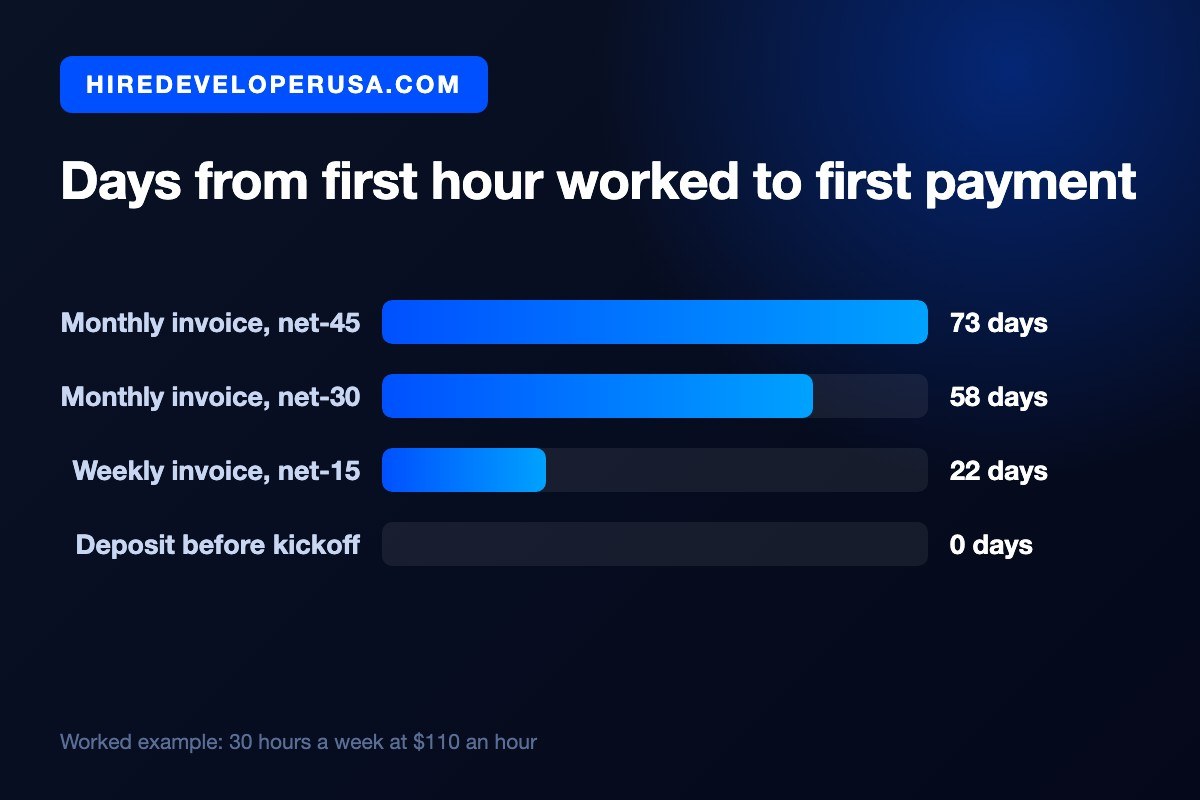
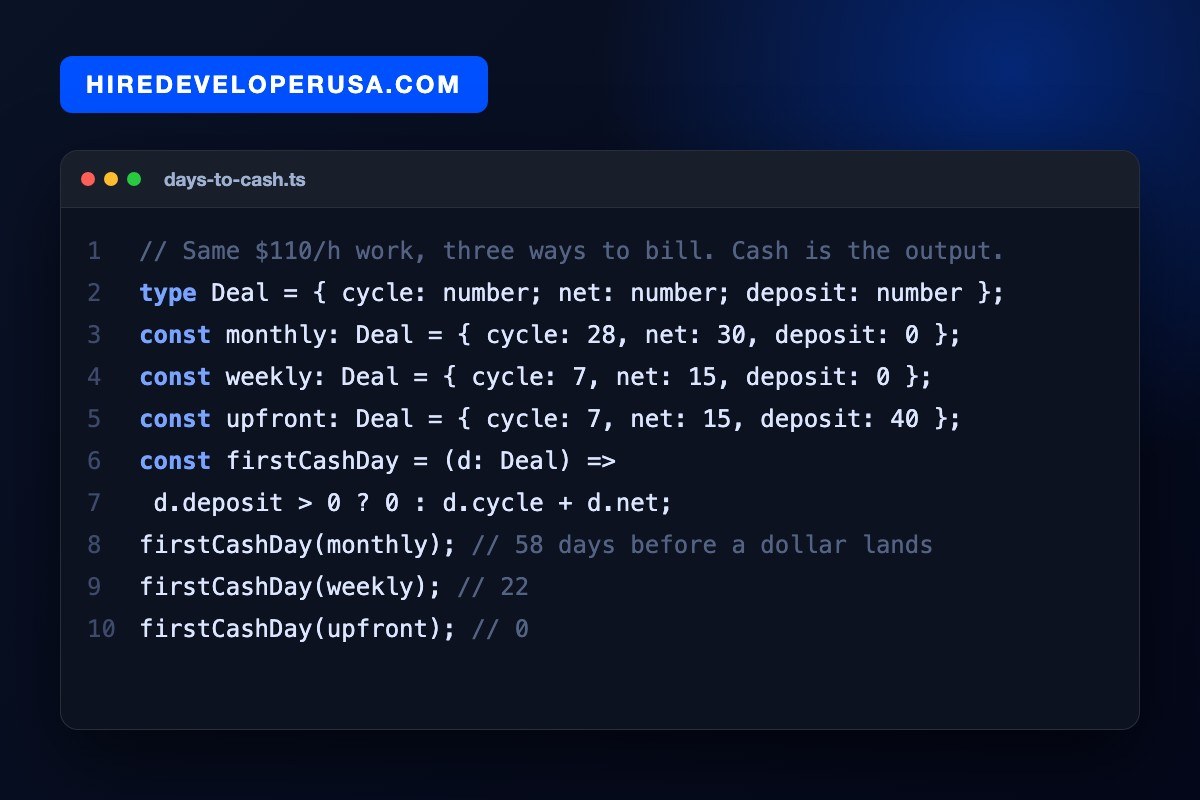
- →A deposit moves cash more than anything else. Billed monthly on net-30, your first dollar lands about 58 days after your first hour; billed weekly on net-15, day 22.
- →Put a calendar date on the invoice, not a term. Net-30 is a reading exercise, Due September 25 is a deadline.
- →Send every invoice to accounts payable with your project contact copied, and include the PO number if the client uses one.
- →Schedule the follow-up at day minus three, zero, three, seven, fourteen and thirty, so collections is a process rather than a confrontation.
You get paid on time by settling when you get paid before you write the first line of code. Four things do almost all of the work: a signed contract that names the amount, the billing cadence and the late fee; a deposit or a funded escrow before kickoff; an invoice carrying an exact calendar due date instead of a payment term; and a follow-up sequence that runs on dates rather than on how annoyed you are. Chasing is what happens when one of those four is missing.
What follows is the mechanics: why invoices sit unpaid inside otherwise healthy companies, what belongs in the contract, which terms to ask for, the seven fields that stop an invoice being parked, the follow-up schedule, what the wait costs in dollars, and what to do when the money still has not arrived.
Late payment is a process failure, not a character flaw
Most late invoices are not a client deciding to keep your money. They are an invoice that met a process it did not fit. Knowing which one you are dealing with is worth more than a firmer tone, because each has its own fix.
- The payment run. Finance teams pay on a cycle: weekly, twice a month, or the last business day of the month. An invoice that arrives the day after a run waits a full cycle for the next one. Ask for the run date in week one and time your invoices to land two or three days ahead of it.
- Vendor setup. Nobody can pay a vendor who does not exist in their system. The W-9, the banking form and the approved vendor record usually take longer than the invoice does, so finish that paperwork during kickoff week rather than on the day you first bill.
- The missing PO number. Companies that run on purchase orders reject invoices without one, and the rejection often arrives as silence.
- The wrong recipient. Your day-to-day contact is an engineering manager, not accounts payable. An invoice sent only to them waits until they remember to forward it.
- A scope argument nobody has had yet. If the invoice is the first time anyone reads that the work grew, it will not clear this cycle. Scope belongs in writing before the work starts, which is exactly what a software project brief is for.
None of these are solved by sounding more assertive. They are solved by information you can collect in the first week of the engagement.
Settle the money before the first commit
A contract is not there to win a lawsuit. It is there so the payment conversation happens once, in a calm week, instead of every month in a tense one. For US contract development work, these are the clauses that decide whether you get paid on time.
- Legal names and addresses, for both parties, spelled the way they appear on the tax forms. The entity that signs is the entity that pays.
- Scope and deliverables, written as outcomes, with the number of revision rounds included and one sentence defining what counts as new work.
- Rate and billing model. Hourly with a weekly cap, fixed price by milestone, or a monthly retainer billed in advance. Say which, and say what a billable hour includes.
- Deposit. Thirty to fifty percent before kickoff is normal for fixed-scope project work, and billing a retainer in advance is normal for ongoing work.
- Invoice cadence and payment term, stated in days, with the date of the first invoice named.
- Late fee. A monthly finance charge of around 1.5 percent is the common commercial figure. It matters less as revenue than as a due date with teeth.
- Stop-work clause. New work pauses once an invoice passes an agreed number of days. This one sentence does more work than any reminder email, because it turns your cash-flow problem into their delivery problem.
- Notice and cancellation. A notice period for retainers, a cancellation fee for fixed projects.
- IP transfer on payment. Ownership passes when the final invoice clears, not when the work ships.
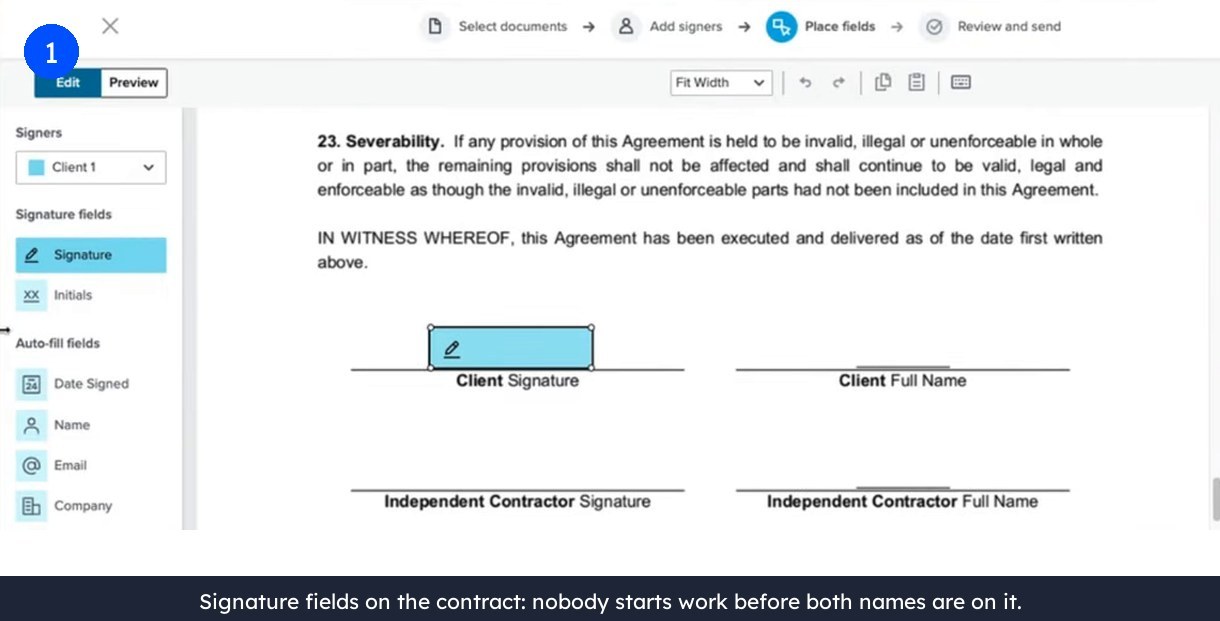
- Signatures and dates from both sides, before the first commit.
Contract law varies by state and none of this is legal advice. If you plan to reuse one template for years, having a lawyer read it once is cheap insurance.
Payment terms, compared
Net-30 means the invoice is due 30 days after its issue date. It is a default, not a law, and on a new engagement it is negotiable far more often than freelancers assume. Here is what each common structure does to your cash.
| Structure | When the money lands | Best for | Watch out for |
|---|---|---|---|
| Deposit plus balance on delivery | Part on day 0, the rest at handover | Short fixed-scope projects | A handover dispute holds the whole balance |
| Due on receipt or net-7 | Within a week of invoicing | Small jobs, clients you know | Rare inside companies that pay on runs |
| Net-15 | 15 days after issue | Most contract work | Ask at proposal stage, not after invoice one |
| Net-30 | 30 days after issue | The US default | Monthly billing plus net-30 is 58 days from your first hour |
| Net-45 or net-60 | 45 to 60 days after issue | Enterprise procurement | You are financing them, so price the wait in |
| Milestone payments | On each accepted milestone | Fixed-price builds over six weeks | Acceptance criteria have to be written down |
| Weekly through a funded marketplace | Weekly, from money already held in escrow | Ongoing remote engagements | A platform fee, and scope still needs defining |
Ask for net-15 as your standing default and treat net-30 as the compromise. Enterprise procurement will counter with net-45 or net-60 because their internal cycle genuinely runs that long. If you accept it, price the wait into the rate instead of pretending it is free; current US freelance developer hourly rates give you the room to do that.
The invoice that cannot be parked
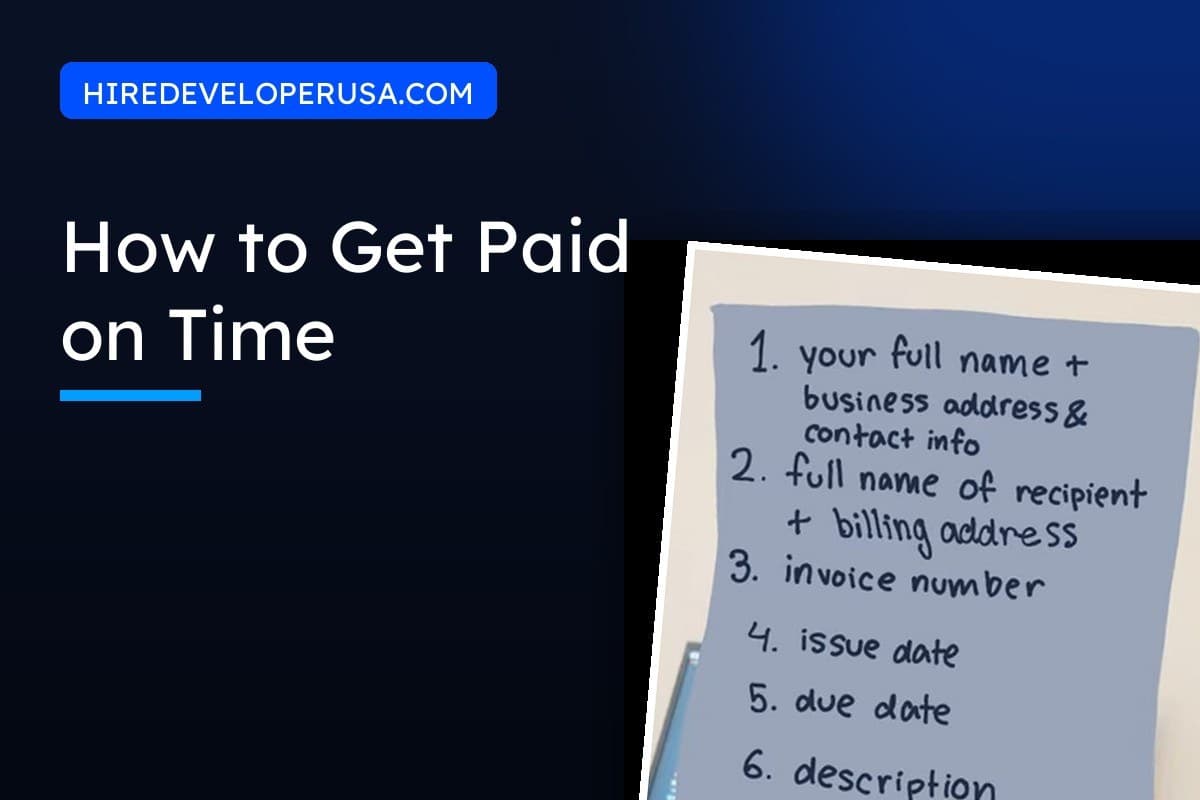
An invoice is a payment instruction, and a good one clears faster because it removes every excuse to ask a question first. Seven fields carry the weight.
- Your full business name, address, contact details and tax ID.
- The client’s legal entity name and billing address, not just your contact’s name.
- An invoice number in a sequence you can quote over the phone.
- The issue date.
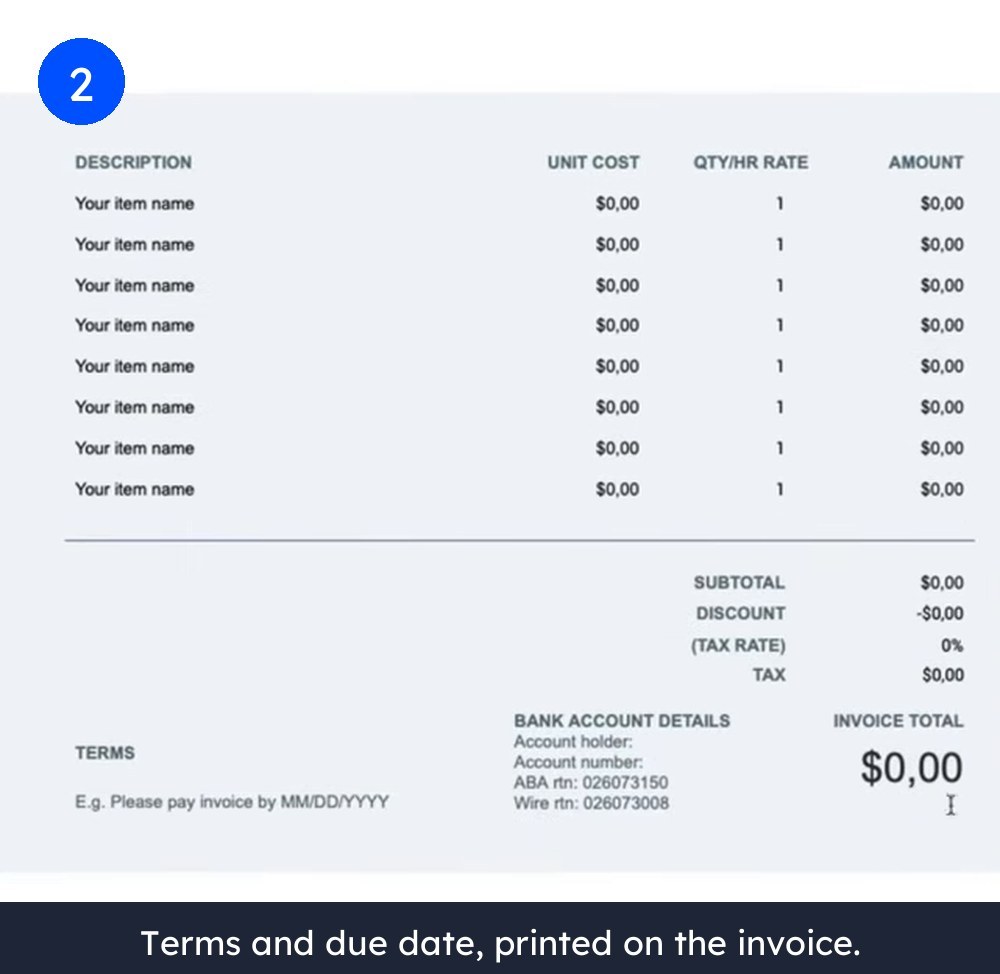
- The due date, written as a calendar date.
- Line items describing deliverables, hours or dates, at the rate in the contract.
- A footer with payment methods, the late-fee clause and the PO number if they use one.
Two habits do the rest. Write Due September 25, 2026 rather than Net-30, because a term is a reading exercise while a date is a deadline, and it is the date that gets typed into the payment system. And send the invoice to accounts payable with your project contact copied, so approval and payment start at the same moment instead of one after the other.
The follow-up sequence that gets an answer
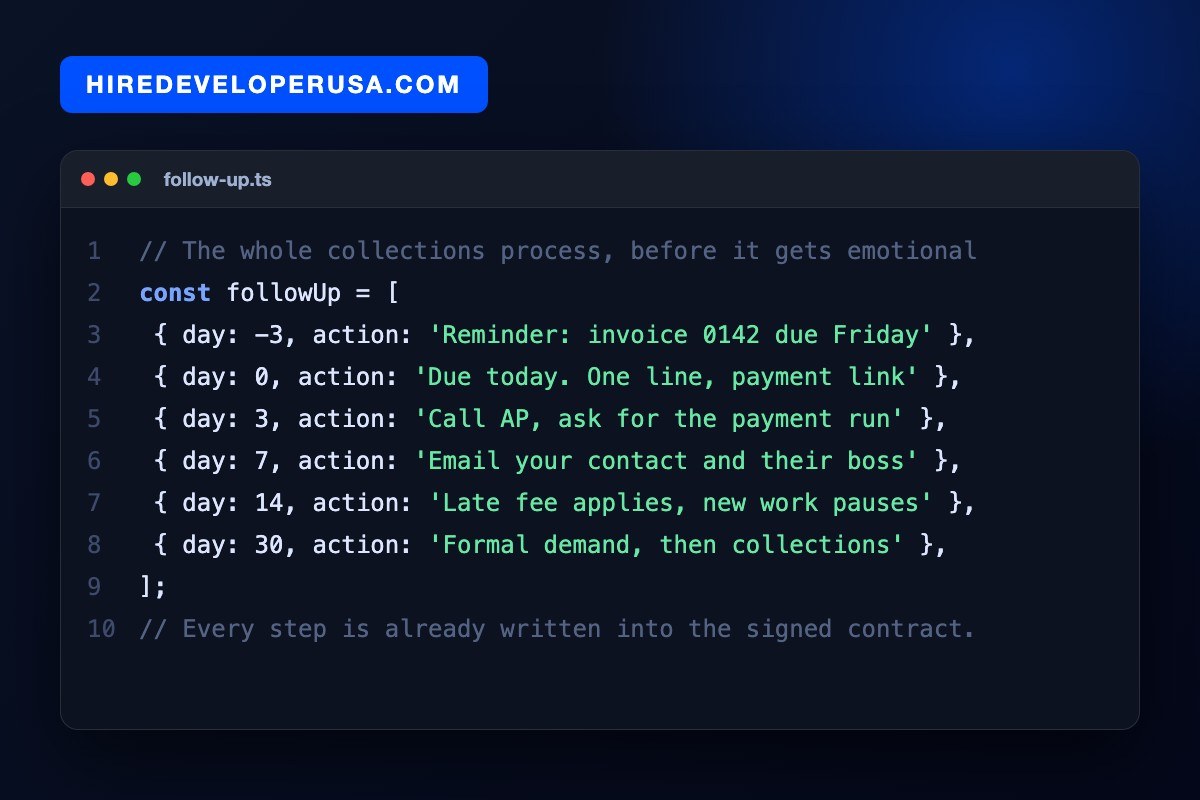
Set the schedule the day you send the invoice, not the day it goes late. Six touches cover almost every case, and none of them need a difficult tone.
- Three days before the due date. One line: invoice number, amount, due date, payment link. This is the cheapest message you will ever send, because at this point nothing has gone wrong yet.
- The due date. A short note confirming the invoice is payable today.
- Day three. Stop emailing and call accounts payable. Ask one question: which payment run is this invoice in? The answer is either a date, which ends the uncertainty, or a problem you can fix that afternoon.
- Day seven. Email your contact and their manager together, invoice attached again, contract clause quoted.
- Day fourteen. Apply the late fee and pause new work exactly as the contract says. Announce it, do not threaten it.
- Day thirty. A formal demand with the amount, the dates and the next step spelled out.
Because every step was agreed in advance, none of it is a confrontation. You are simply running the process the client signed.
What the waiting actually costs
Run the numbers on an ordinary engagement. A senior contractor at $110 an hour working 30 hours a week bills $3,300 a week, or $13,200 across a four-week cycle. Invoiced monthly on net-30, the first dollar lands roughly 58 days after the first hour of work. Invoiced weekly on net-15, it lands on day 22. With a 40 percent deposit, $5,280 lands before any code is written.
Same client, same work, same rate. The entire difference sits in the paperwork, and it is the difference between a business that can absorb a slow month and one that cannot.
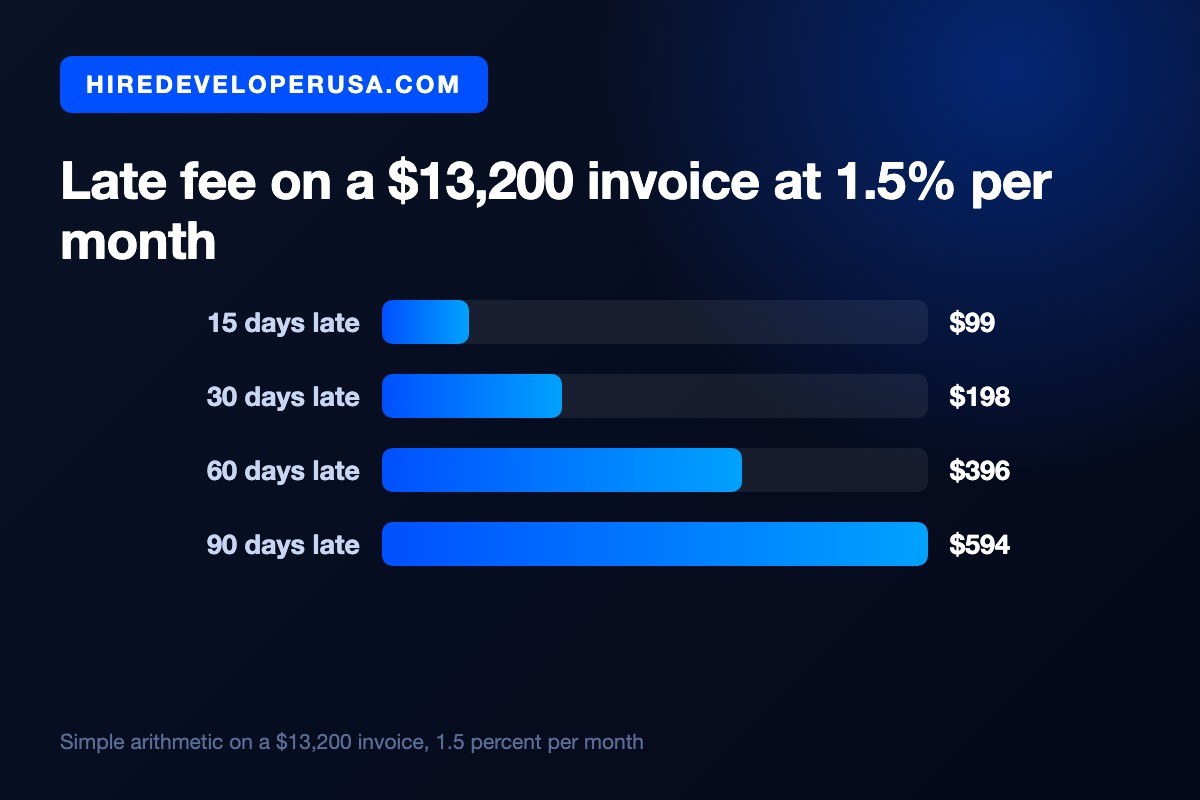
The late fee is the smaller half of the story. At 1.5 percent per month, a $13,200 invoice earns $198 for the first month it runs late and $594 by the third. Useful as a signal, thin as a revenue line. The real cost is that you have extended a company $13,200 of interest-free credit with no credit check, while your own bills stayed on their original schedule.
When the invoice is still unpaid
Past day thirty you are not invoicing any more, you are collecting. In order of cost to you:
- Stop work, in writing. Quote the clause, confirm the date work resumes on payment, and keep it factual. A paused sprint gets attention that a fifth reminder email never will.
- Send a formal demand. Invoice number, amount, contract clause, accrued late fee, and the date by which you expect payment.
- Use the platform if there is one. An escrow-funded marketplace engagement comes with a dispute process and, more usefully, with money already held.
- Small claims court. Filing is cheap and needs no lawyer, but the dollar ceiling varies widely from state to state, so check yours before you count on it.
- A collections agency or an attorney letter. Both take a share of whatever they recover, which is why they sit at the bottom of the list.
Every one of these costs more time and money than the contract clause that would have prevented it.
If you are the one paying developers
Read all of the above from the buyer’s side and the practical version is short. Create the vendor record and collect the W-9 during kickoff week. Tell your contractor which day the payment run happens. Approve or query invoices within 48 hours. Pay the terms you signed.
Predictable payment is one of the cheapest advantages a company can hold in a tight talent market. Contractors who trust your schedule quote you their normal rate, keep your tickets at the front of the queue and pick up the phone in a crisis. The ones who have been burned price the risk in, and you pay for it in the rate. If you are budgeting a new engagement, our breakdown of what it costs to hire a software developer shows where the money goes, and you can start a search for full-stack developers or a broader software development engagement as soon as the scope is ready.
Your next step
Open the contract you use today and look for five sentences: deposit, invoice cadence, payment term in days, late fee, and stop-work clause. If any of them is missing, add it before your next engagement rather than during the one that goes wrong. Then schedule the follow-up sequence on the day you send the invoice, so getting paid on time stops depending on whether you remember to ask.
Frequently asked questions
What payment terms should a freelance developer ask for?
Net-15 with a deposit is a reasonable default for US contract work, and net-30 is the compromise most companies expect. Ask at proposal stage, while terms are still part of the negotiation, rather than after the first invoice has gone out. If a client’s procurement genuinely runs on net-45 or net-60, treat the wait as a cost and price it into the rate instead of accepting it quietly.
Can I charge a late fee on an unpaid invoice?
Only if it was agreed in advance. A finance charge belongs in the signed contract and in the invoice footer, stated as a monthly percentage, commonly around 1.5 percent. What a state allows varies, so it is worth having a lawyer read your template once. In practice the fee prevents more than it earns, because it turns a due date into a deadline that costs something to miss.
Should I ask a new client for a deposit?
Yes, and it is the single change that improves cash flow the most. Thirty to fifty percent before kickoff is standard for fixed-scope project work, and retainers are normally billed in advance. A client who refuses to fund any part of the work before it starts is telling you something useful about how the final invoice will go.
What do I do when a client stops responding to invoices?
Change the channel and the person. Call accounts payable and ask which payment run the invoice sits in, then email your contact and their manager together with the contract clause quoted. If day thirty passes with no answer, stop work in writing, send a formal demand, and choose between small claims court and a collections agency, both of which cost more than the clause that would have prevented the problem.
Hire vetted talent