

Key takeaways
- →Mid-level Java in 2026 runs $65 to $95 an hour in the US, $55 to $85 in Germany, $38 to $60 in Poland, $35 to $55 in Brazil, $22 to $38 in India and $20 to $33 in the Philippines. Senior sits roughly 40 to 60 percent above mid-level in every market.
- →Add fees, management time and ramp and the landed cost of a billable hour is about a quarter higher than the quoted rate: $60.39 for a $48 Polish contractor, $45.03 for a $30 Indian contractor, $93.20 for an $80 US contractor.
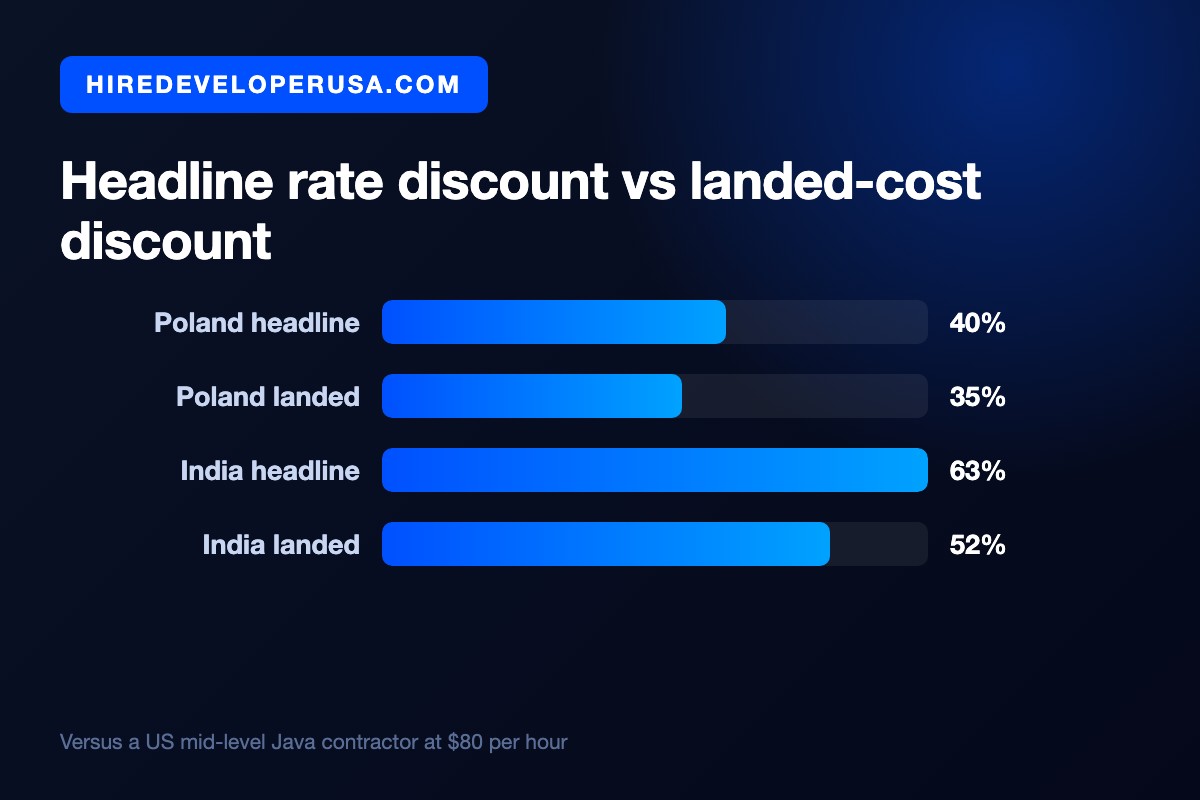
- →Headline discounts shrink once they are landed: 40 percent on Poland becomes 35 percent, and 63 percent on India becomes 52 percent.
- →A $60 hourly budget buys a US junior, a strong mid-level engineer in Poland, a senior in Mexico or Brazil, and the top of the senior band in India.
- →Overlap is the hidden price: six to seven hours with Mexico and Brazil, two to three with Central Europe, none with South and Southeast Asia unless the team shifts its day.
In 2026 a mid-level Java developer bills $65 to $95 an hour in the United States, $55 to $85 in Germany, $38 to $60 in Poland, $35 to $55 in Brazil, $22 to $38 in India and $20 to $33 in the Philippines. Senior engineers sit roughly 40 to 60 percent above those mid-level bands in every market on the list. Those are the rates you will be quoted. They are not what the engineer will cost you.
The gap between the two is the part nobody puts on a rate card: the fee that moves money across a border, the hours your own lead spends covering a time zone, and the first three weeks when output is partial. Priced properly, an Indian rate that looks 63 percent cheaper lands around 52 percent cheaper, and a Polish rate that looks 40 percent cheaper lands around 35 percent. Still worth having. Just not the number in the proposal.
Java developer hourly rates by country in 2026
These are planning bands for a remote contractor hired through a vetted channel, not a salary survey. Use them the way a buyer should: a credible quote falls inside the band, a quote well under the floor is a staffing model you have not been told about yet, and a quote above the ceiling needs a reason you can name.
| Market | Mid-level | Senior | Overlap with 9 to 5 Eastern | What moves the number |
|---|---|---|---|---|
| United States | $65 to $95 | $95 to $132 | 5 to 8 h | Deepest enterprise Java pool and the highest floor of any market here |
| Canada | $55 to $80 | $80 to $110 | 5 to 8 h | Same working day as the US at a lower floor |
| United Kingdom | $50 to $75 | $75 to $105 | 3 h | Deep financial-services Java experience, priced accordingly |
| Germany | $55 to $85 | $85 to $115 | 2 h | Enterprise and industrial Java, formal contracting, slower starts |
| Poland | $38 to $60 | $60 to $85 | 2 h | Large Spring Boot pool competing for Western European budgets |
| Romania | $32 to $52 | $52 to $75 | 1 h | Cheaper than Poland with a thinner senior layer |
| Mexico | $38 to $58 | $58 to $85 | 6 to 7 h | You are paying a premium for the working day, not for the code |
| Brazil | $35 to $55 | $55 to $80 | 6 to 7 h | Deep pool, strong product engineering, currency swings move quotes |
| India | $22 to $38 | $38 to $60 | 0 h, 3 to 4 h on a shifted day | The channel you buy through sets the price more than the engineer does |
| Philippines | $20 to $33 | $33 to $50 | 0 h, full on a night shift | Java bench is thinner locally than .NET or PHP |
Before you start shortlisting, notice two things. At the midpoint of the bands, the cheapest mid-level hour and the most expensive one are roughly three to one apart, and the ratio gets close to five to one when the bottom of the Philippine band sits next to the top of the American one. A spread that wide changes what you can afford to build. The ranking also says nothing about quality: every market on that list ships production Java for companies you have heard of. Price moves the depth of the senior layer, how long a good engineer stays available, and how much of your own week the engagement eats.
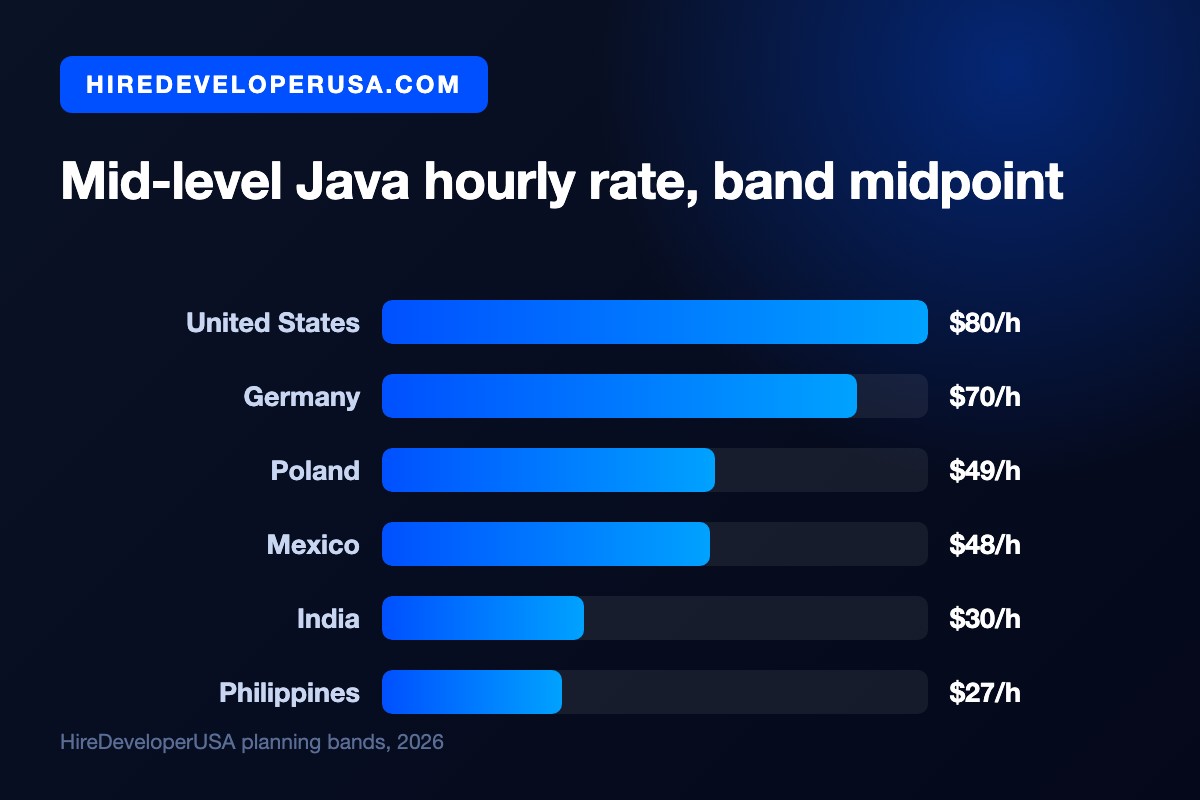
Why the same Java work costs three times more in one country than another
The number comes from four forces. Only one of them concerns Java.
What the engineer can earn locally. A rate has to beat the best full-time offer in the same city, plus a margin for the risk of contracting. In markets where a senior backend salary clears $160,000, nobody takes $45 an hour. Cost of living matters less than the local salary ceiling, which is why two countries with similar living costs can price 30 percent apart.
Who else is bidding. Polish and Romanian engineers are not competing for American budgets alone. German, Dutch and Nordic companies hire in the same pool and pay in euros, which keeps the Central European floor higher than its cost of living implies. In the Philippines, by contrast, most of the local demand is for .NET, PHP and support work, so a Java engineer is priced against a thinner domestic market.
The shape of the Java work itself. Java is not one labor market. Spring Boot services, Android, JVM data platforms and legacy modernization have different pools and different prices in every country on the list. Modernization work, where somebody reads a 2009 codebase and keeps it running, is the one category that prices close to parity everywhere: there are not many engineers in any market who will do it, so the discount narrows. Before you compare countries, decide which of these you are actually buying. Our guide on how to hire Java developers breaks the four shapes down with the screening signals for each.
The channel. A given engineer in a given city can reach you at three prices: direct, via a vetted marketplace, or via a staffing firm that adds 15 to 25 percent on top. Comparing two countries usually means comparing two channels, and the channel often accounts for more of the gap than geography does. We cover this in more detail in the cost of hiring software developers.
The quoted rate is about three quarters of what you will spend
Four line items fall outside the rate card. All four are predictable enough to budget for before you sign anything.
- Moving the money, 3 to 8 percent. This covers contractor-of-record or employer-of-record services, cross-border payment fees, and the legal review that checks the intellectual property clause actually holds in the engineer's jurisdiction. Six percent works as a reasonable planning default.
- Your own management time. Asynchronous work turns questions into written specifications, so budget 1.5 hours a week of a US lead for somebody in your working day, 3 hours across a European gap, and 5 hours across a half-day gap. At $85 an hour for that lead, it becomes a real line.
- The ramp. Expect two to three weeks of partial output from a nearshore or European hire, and three to four weeks when overlap is near zero, because each clarification then costs a day rather than a message.
- Replacement risk. If an engagement ends at month four, you pay for the ramp twice. That line item is what quietly decides whether the cheapest market was also the cheapest decision.
Set those numbers against a $48 hourly rate in Poland, and a billable hour really costs a quarter more than the quote.
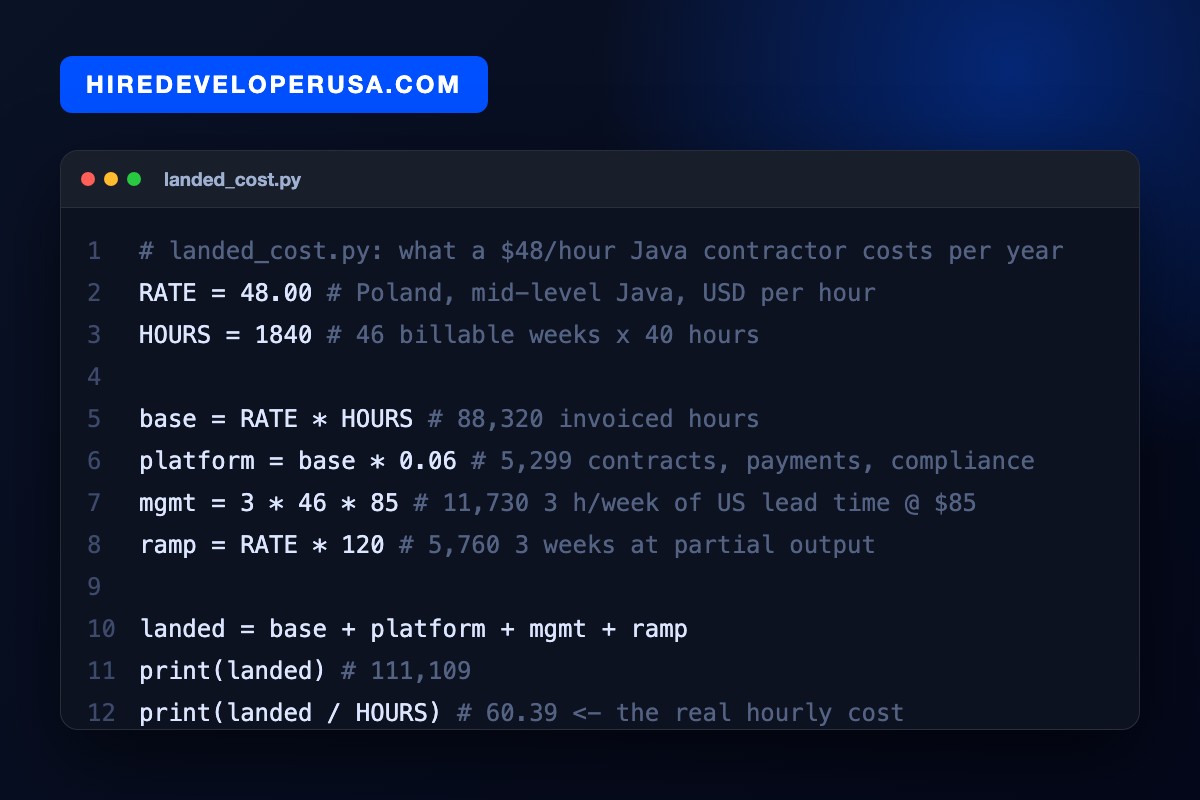
A 63 percent discount lands at 52 percent
Run that calculation across three markets at mid-level and the picture tightens. A US contractor at $80 an hour lands at $93.20 per billable hour once you add the same fees, 1.5 hours a week of lead time and a three-week ramp. A Polish contractor at $48 lands at $60.39. An Indian contractor at $30, carrying 5 hours a week of lead time and a four-week ramp, lands at $45.03.
The headline 40 percent saving on Poland is therefore a 35 percent saving in practice, and the headline 63 percent saving on India is 52 percent. Nobody should turn down half their engineering budget. Still, the two figures answer different questions. Only one belongs in a business case; the other belongs in a proposal.
The same correction applies in reverse to US rates, which is why a domestic hire sometimes wins a comparison it appeared to lose. If your team ships by pairing, reviews pull requests the same afternoon and runs incident response across business hours, the management line is not 1.5 hours a week, it is zero, and the gap closes further.
What $60 an hour buys you in each market
The quickest way to see what you are choosing between is to fix the budget and read the bands backwards. At $60 an hour in 2026:
- United States: under the mid-level floor. What you get is a junior, or a mid-level engineer between contracts who will go when a better one shows up.
- Germany or the United Kingdom: a solid mid-level engineer, but not enough for a senior.
- Poland: the top of the mid-level band, or the entry point to senior. When people say Central Europe is good value, this sweet spot is usually what they mean.
- Mexico or Brazil: a senior engineer working your hours, with the entire afternoon free for pairing.
- India: the top of the senior band. That price should buy an architect-level engineer; if the vendor offers two people instead, reread the proposal.
- Philippines: above the senior band entirely. Either you are overpaying, or you are buying a team lead whose job is coordination rather than code.
Depending on where you spend it, one budget buys four different levels of experience. That is the real decision, and it frames the choice better than cheap versus expensive does. Our freelance developer hourly rates guide takes a cross-stack view of the same question, with the US bands by role.

Time zones decide how much of the discount you keep
Overlap is the variable that turns a good rate into a good engagement, and it is arithmetic rather than opinion. Against a 9 to 5 day in New York:
- Mexico and Brazil give you six to seven hours. A question asked at 10am is answered before lunch, and the engineer joins standup without anyone staying late.
- London offers three hours, Berlin and Warsaw two, and Bucharest one. The European morning is over before your day begins, which squeezes reviews into a narrow window and leaves everything else asynchronous.
- India and the Philippines give you none on a local schedule. Teams get around this by shifting hours, usually starting in the early afternoon in India to gain three or four hours of overlap. It works well, and it adds a premium to the rate.
A single rule covers it all: buy fewer overlap hours and the engagement takes more of your senior people's time. That cost is real whether or not it shows up anywhere in your budget. It is also the single most common reason an offshore engagement that priced beautifully gets quietly wound down at month six. When overlap matters more to you than the last few dollars of rate, begin with nearshore markets and hire Java developers who already keep your hours.
How to price your own Java engagement in a week
Five steps, and you can run them in parallel.
- Name the job shape. Spring Boot services, Android, data platform or modernization. Write down the first three tickets the person will pick up. Vendors price a vague brief defensively, and their margin is where that defense sits.
- Pick two markets, not five. Choose one in your working day and one offshore. Go beyond two and you end up comparing proposals rather than engineers.
- Demand quotes in the same shape. One named engineer, billed hourly, 160 hours a month, seniority stated and fees disclosed. Any quote that comes back as a monthly team price answers a different question.
- Run the landed-cost line. Take rate times hours, add fees, add your management hours at your own loaded cost, then add the ramp. Compare the totals, never the rate cards.
- Buy three weeks before you buy six months. Run a paid pilot on a real ticket from your backlog, merged and reviewed like production work. It tells you more than any interview does and costs less than one bad month.
When the stack is specifically Spring, both pool and price move again, so start from our Spring Boot hiring page instead. In either case, settle the shape first and the geography second. Your chosen market sets the price of an hour, and what you do with those hours sets everything else.
Frequently asked questions
What is the hourly rate for a Java developer by country in 2026?
For a remote contractor hired through a vetted channel, budget $65 to $95 an hour for a mid-level Java engineer in the United States, $55 to $80 in Canada, $50 to $75 in the United Kingdom, $55 to $85 in Germany, $38 to $60 in Poland, $32 to $52 in Romania, $38 to $58 in Mexico, $35 to $55 in Brazil, $22 to $38 in India and $20 to $33 in the Philippines. In each market senior engineers sit roughly 40 to 60 percent above the mid-level band, so the US ceiling is $132 and the Indian ceiling is $60.
Is it cheaper to hire Java developers offshore?
Yes, though by less than the rate card implies. Add cross-border payment and compliance fees of 3 to 8 percent, the extra hours your own lead spends covering a time-zone gap and a longer ramp, and a 63 percent discount on the rate comes closer to 52 percent on the cost of a billable hour. That saving is real, and worth having. It is just smaller than the number in the proposal, and it shrinks further if the engagement ends early and you pay for the ramp twice.
Which country offers the best value for Java development?
It depends on what you are optimizing. For overlap with a US working day at a clear discount, Mexico and Brazil give you six to seven shared hours at mid-level rates in the $35 to $58 range. For the deepest pool of Spring Boot engineers at a middle price, Poland is the usual answer at $38 to $60. For the lowest cost per hour when the work can be specified in writing, India runs $22 to $38 at mid-level. There is no market on the list that cannot ship good Java, so choose on overlap and seniority depth rather than on price alone.
How much does a senior Java developer cost per hour in the US?
As a contractor on a vetted marketplace, a senior Java engineer in the United States bills $95 to $132 an hour. A US agency charges $115 to $210 an hour for comparable work, since its rate carries sales, delivery management and bench cost. Full-time, a senior hire costs $100,000 to $175,000 in base salary before payroll taxes, benefits and equipment, or between $125,000 and $220,000 fully loaded.
Hire vetted talent