

Key takeaways
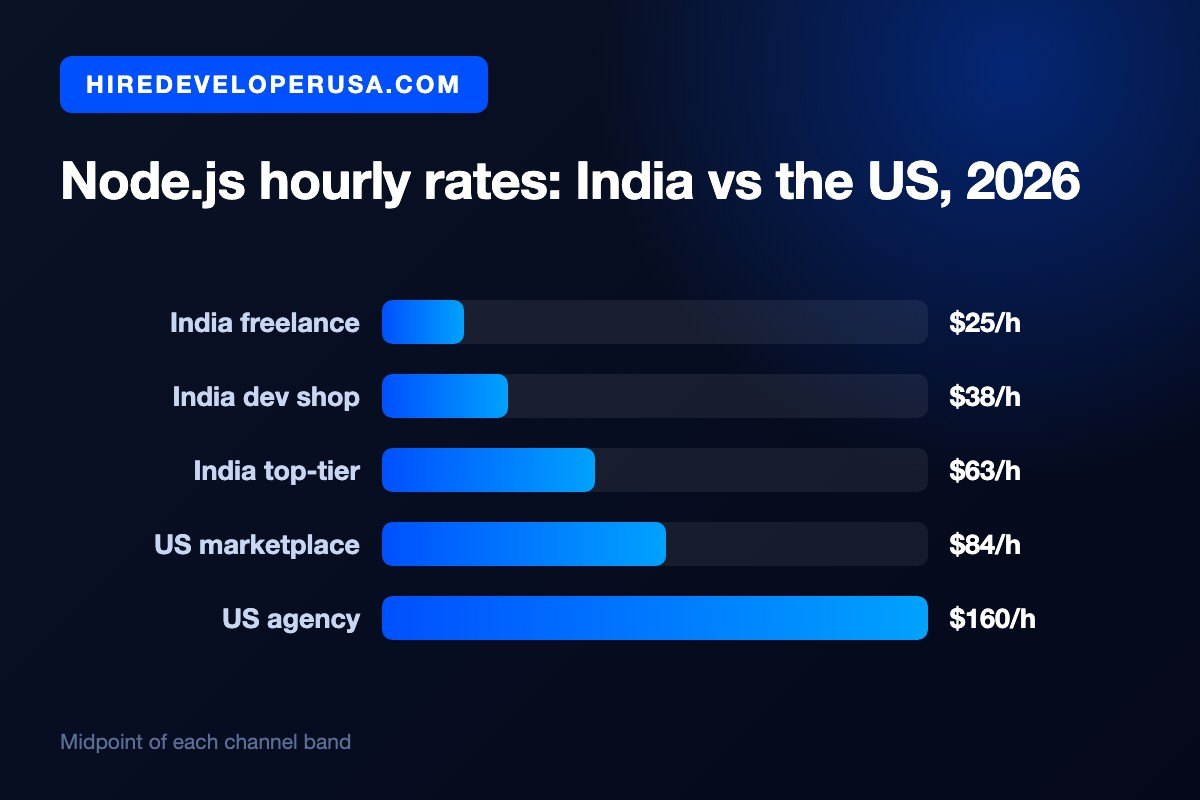
- →Node.js programmers in India invoice $15 to $35 an hour on open freelance platforms, $25 to $50 at an established development shop and $45 to $80 at a top-tier product engineering firm.
- →Node prices at the bottom of the Indian backend range because supply is deepest there, not because the work is worth less. The quality spread at any given rate is correspondingly wide.
- →Normalize every quote to cost per month before comparing. Hourly hides billable clarifications, dedicated monthly hides holidays and notice periods, fixed bid hides a risk premium and change orders.
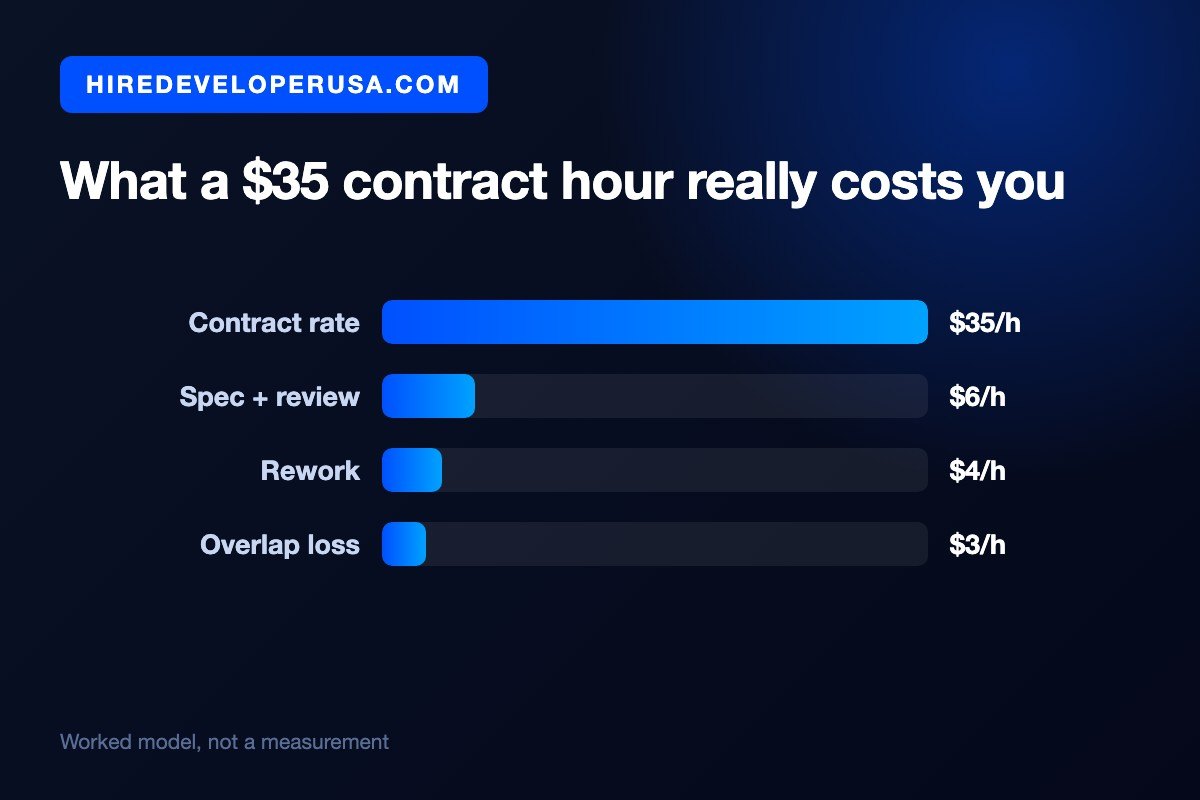
- →Budget about a third on top of the contract rate for specification, rework and the day lost whenever a question waits for the overlap window. A $35 hour plans at roughly $48.
- →Screen in writing. A nine and a half to thirteen and a half hour gap makes the live interview the worst value hour in the process, and this stack rehearses well for it.
You can hire Node.js programmers in India for $15 to $80 an hour in 2026, and where you land inside that band is decided by the channel you buy through rather than by the engineer. Open freelance platforms sit at $15 to $35. An established Indian development shop quotes $25 to $50. A top-tier product engineering firm asks $45 to $80. At 160 hours that is $2,400 to $12,800 for one full-time Node developer a month, against $6,080 to $20,800 for the same role on a vetted US marketplace.
The figure worth your attention is not the gap. What matters is why Node sits at the bottom of the Indian backend price range rather than in the middle. That is a supply signal, not a quality discount. Read it correctly and it changes how you handle the quote in front of you: what the hourly figure covers, what the monthly figure hides, and which of the three pricing models on offer actually protects your budget.
What Node.js programmers cost in India in 2026
These are planning bands rather than a survey. Treat them as the range a credible quote should fall within, and read anything well below the floor as a question, not a bargain.
| Channel | Hourly | One developer-month at 160 hours | What the price includes |
|---|---|---|---|
| Open freelance platform | $15 to $35 | $2,400 to $5,600 | One engineer. You source, vet, specify, review and manage. |
| Established Indian development shop | $25 to $50 | $4,000 to $8,000 | An engineer plus a delivery coordinator, and bench cover when someone is out. |
| Top-tier product engineering firm | $45 to $80 | $7,200 to $12,800 | Senior-weighted staffing, architecture input, a written engineering process. |
| US vetted marketplace (reference) | $38 to $130 | $6,080 to $20,800 | Pre-screened individuals, US contracting, working hours that overlap yours. |
| US agency (reference) | $110 to $210 | $17,600 to $33,600 | A team with project management and QA billed inside the rate. |
Two warnings about the monthly column. It is arithmetic rather than a quote: most vendors discount a monthly commitment against their hourly card, so treat the multiplication as a ceiling and ask them to beat it. And 160 hours is a billing convention, not a promise of 160 hours of engineering. Holidays, standups and handover eat into that number on every continent. The US reference figures are the same ones on our Node.js developer rates page.
Why Node.js prices below every other backend stack in the same city
Ask a vendor in Pune to quote a Java engineer, a Go engineer and a Node engineer at the same seniority, and the Node number usually comes back the lowest. Supply is the cause, and it compounds in one direction.
JavaScript is the entry point to the Indian web industry. Bootcamps teach it first, service companies staff it fastest, and it offers the shortest path from knowing a language to being billable as a backend engineer. The result is the deepest backend pool in the country, by a wide margin. Java carries two decades of enterprise and banking demand, which keeps a floor under its price. Go pools are thin and concentrated in infrastructure teams, so scarcity pushes that rate up. Node has neither a demand floor nor a supply ceiling, so its market clears low.
For a buyer the consequence is specific: at any given price point, Node shows a wider quality spread than any other backend stack you could shortlist. A cheap rate here buys a bigger haystack, not a discount on the same good.
That is also why the job title tells you so little. An engineer who has only ever written CRUD routes behind Express holds the same title as one who has debugged event loop starvation under production load, and both answer the circulating screening questions equally well. Asking what a runtime environment is, or how a route parameter differs from a query string, separates nobody who has read the standard interview list. What you need are questions only production experience can answer, and those are the subject of the screen further down this page. If you are still settling the role shape rather than the price, start with Node.js developers.
The three ways Indian vendors price Node work
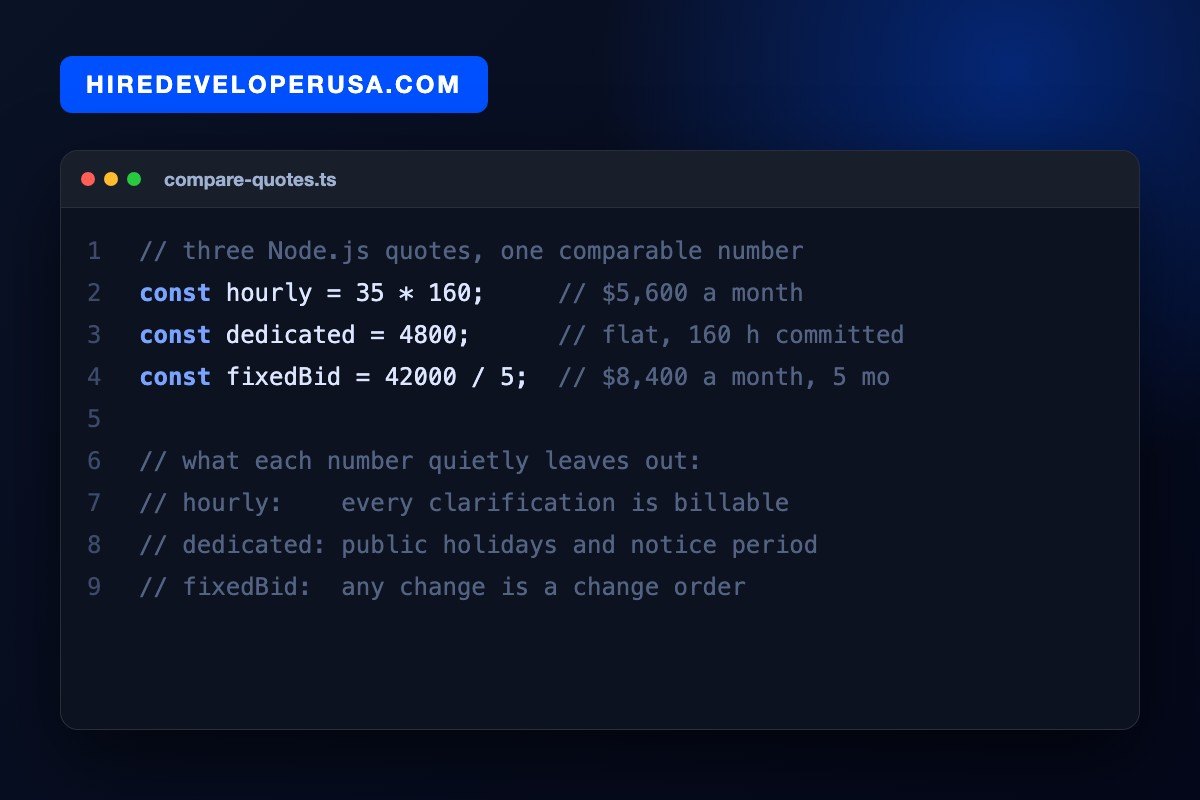
Nearly every quote you receive takes one of three shapes. Each is honest, and each hides a different cost.
Time and materials. You pay for the hours worked, usually on a monthly invoice. This is the right model when the scope is genuinely unknown, say a discovery phase or an integration against an API nobody on either side has used. What it hides: every clarification call is billable, and the incentive to write tight tickets rests entirely with you. Cap it in writing, by the month, and require approval before the cap is exceeded.
Dedicated monthly. A flat fee for a named engineer at an agreed commitment, and the most common shape for ongoing Node work. It is usually the best value, since the vendor can plan its bench. Its blind spot is the calendar. Indian public holidays vary by state and a typical company holiday list runs to ten or more days a year, notice periods typically run longer than US norms, and your fee does not pause automatically when the engineer gets reassigned. Name the individual in the statement of work, and write the replacement terms before you sign.
Fixed bid. A single price for a defined deliverable. It appeals when the scope is genuinely closed, such as porting a documented service or building a well-specified API against a frozen contract. Behind it sits a risk premium you cannot see, and every change after signature turns into a change order priced without competition.
Before comparing anything, convert all three into one unit: cost per month, across the months you expect the work to run. A fixed bid that looks cheap as a total often prices above a dedicated engineer once you divide it by the delivery window.
The full-stack JavaScript discount, and when it is a trap
The cheapest way to quote Node work is to staff it with a single full-stack JavaScript engineer who covers the React front end as well as the Node back end. Vendors like this because one person costs less than two. Sometimes they are right.
It works when the backend is mostly plumbing: an early product, CRUD-shaped endpoints, one database, no real-time requirement and traffic that fits comfortably on a single instance. There, one competent generalist moves faster than two specialists who have to coordinate.
It fails when the backend is the product. That means real-time features over WebSockets, job queues that must survive a restart, streaming or batch data work, several third-party integrations each with their own failure modes, or a database that needs a deliberate index strategy. In those cases the generalist writes code that runs on a laptop and falls over the day your traffic doubles. You pay twice: once for the build and again for the engineer who rewrites it.
There is a second reason why the rate you pay is not the quoted one. Offshore work moves cost onto your side of the ocean: the hours your lead spends on a specification precise enough to survive without a hallway conversation, the second pass when the first attempt misses, and the working day lost each time a question has to wait for the overlap window. Budget roughly a third on top of the contract rate. A $35 hour plans out at about $48. Our guide to hiring developers in India has the full breakdown of those offshore costs, attrition and team shape included.
Screening Node engineers across a half-day gap
Depending on daylight saving, Indian Standard Time runs nine and a half to ten and a half hours ahead of New York, and twelve and a half to thirteen and a half ahead of San Francisco. As a result, the live technical interview, the format most US teams default to, becomes the hardest step in the process to schedule and one of the weaker signals you can buy. It also rewards the candidate who has rehearsed the standard question list, and in this stack that is most of them.
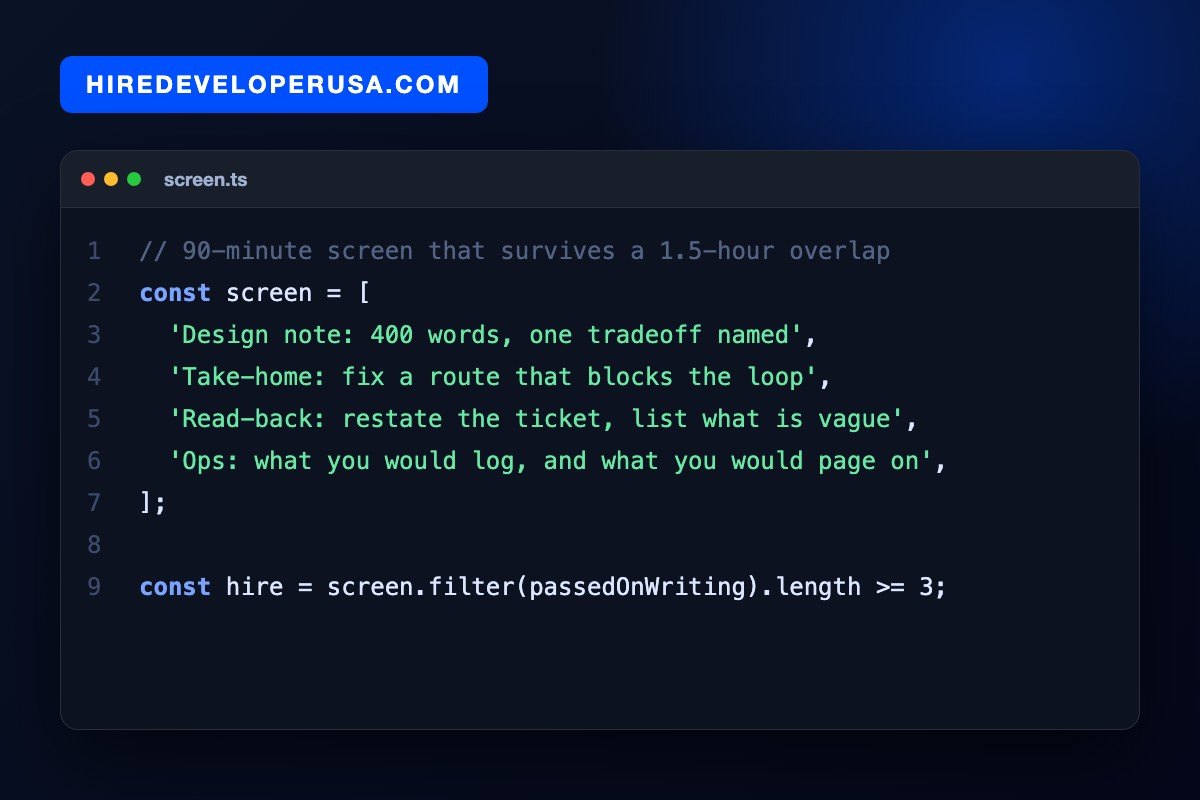
Screen in writing instead. Four artifacts, graded asynchronously, will tell you more than an hour on a call:
- A design note of about 400 words on a problem taken from your own backlog, naming one tradeoff and arguing it. The test is whether the engineer can think on paper, since that is the only mode you will have on most days.
- A small take-home built around a route that blocks the event loop under load, plus a written explanation of the fix. The explanation counts for more than the patch.
- A read-back: have the candidate restate one of your real tickets and list everything ambiguous in it. An engineer who comes back with three good questions will cost you far less in rework than one who comes back with none.
- An operations question: what would you log here, and what would you page someone for at 3am. It separates people who have carried a service from those who have only built one.
Grade the writing as strictly as the code. Written clarity is what stands in for the hours you do not share. For the deeper technical filters after a candidate passes this gate, see the four we run before calling anyone a Node.js expert.
A three-week pilot instead of a six-month contract
The cheapest way to learn whether a $25 hour is a bargain is to buy a few of them first. One engineer for three weeks at 40 hours a week costs $4,200 at $35 an hour. Set that against a six-month commitment that turns out to be wrong in month four.
Scope the pilot as a real slice of the work rather than a sandbox exercise: a service you actually need, deployed to your staging environment, reviewed by your own engineers. Write the exit criteria before day one and keep them behavioral rather than cosmetic. Did the engineer raise the ambiguity in the ticket before writing code. Did the pull request arrive in reviewable pieces. Did anything break in staging, and how was it found. Was the daily written update specific enough that you never had to ask what happened yesterday.
Make the onboarding real as well, because offshore engagements lose more time to a missing credential than to a missing skill. Our checklist for onboarding a remote developer doubles as the pilot setup list.
What to do next
Settle the channel before you gather prices: the channel sets the band, and nothing you negotiate within it will shift the number much. Ask each shortlisted vendor to quote in the shape they prefer, then normalize every quote to cost per month over your expected delivery window. Add a third for your own side. Then buy three weeks before you commit to six months.
If you would rather skip the vendor comparison altogether, tell us the Node.js workload, the overlap hours you need and the budget band you are working within, and we will put pre-vetted engineers in front of you instead.
Frequently asked questions
How much does it cost to hire Node.js programmers in India in 2026?
Between $15 and $80 an hour, depending on the channel: $15 to $35 on open freelance platforms, $25 to $50 at an established development shop and $45 to $80 at a top-tier product engineering firm. Over 160 hours that works out to roughly $2,400 to $12,800 a month for one full-time developer, before your own specification and review time is added.
Is a $20 an hour Node.js developer in India worth it?
It can be, for bounded, well-specified work, provided you have the review capacity to catch problems early. The risk is not that the engineer is bad; the problem is that the pool at that price is enormous and mixed, so the cost of a bad pick falls on you rather than on the vendor. Buy a paid trial ticket before any contract, and never accept a rate below the band floor without asking what the vendor is leaving out.
Should I pay hourly or a dedicated monthly rate for Node.js work?
Dedicated monthly for ongoing product work, since the vendor can plan its bench and you get a predictable number. Hourly for scope that is genuinely unknown, such as discovery or an unfamiliar integration, with a written monthly cap. Fixed bid only when the specification is closed and you accept that every later change is priced without competition.
How many hours a day will an Indian Node.js team overlap with my US team?
A 2pm to 11pm IST shift buys roughly four and a half shared hours with New York and about an hour and a half with San Francisco. West Coast teams should assume the engagement is asynchronous by default and invest in written specifications and daily written updates rather than meetings.
Hire vetted talent