

Key takeaways
- →A resume cannot separate Express users from engineers who have carried Node under load: screen for event loop discipline, backpressure, failure handling and observability, in that order.
- →US pricing in 2026: $38 to $63 an hour junior, $63 to $95 mid-level and $95 to $130 senior on a vetted marketplace, $110 to $210 at an agency, or $98,000 to $170,000 in base salary.
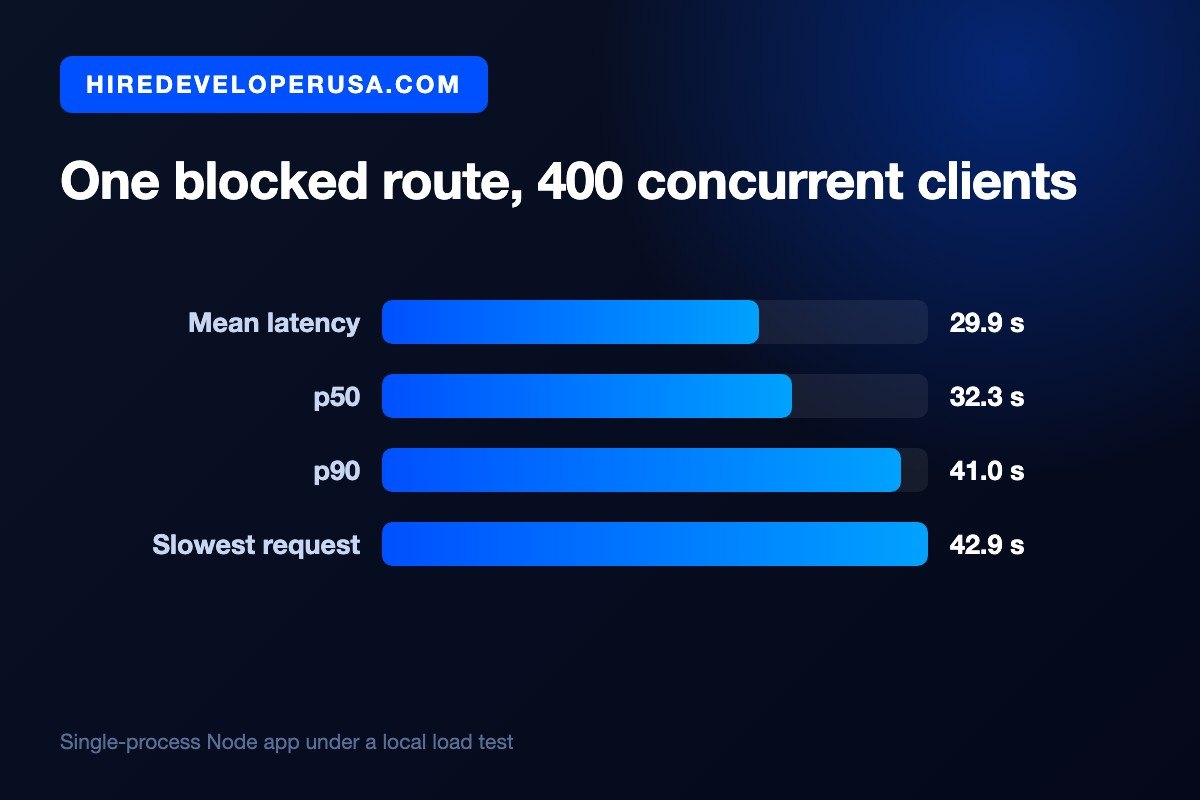
- →One blocking line stops every request in the process. Under 400 concurrent clients, a single CPU bound route pushes mean latency to about 30 seconds and p90 past 41 seconds.
- →Decide which scale you are buying before you write the brief: more cores (cluster and worker threads), more machines (statelessness), or less work (caching and queues).
- →Pay for one bounded trial task and grade streaming, failure handling and whether the candidate asked a clarifying question before starting.
If you want Node.js experts who can handle real traffic, screen for four things, in this order: event loop discipline, backpressure, failure handling and production observability. Framework names on a resume predict almost nothing. A strong engineer switches between Express, Fastify and NestJS in an afternoon. Budget $38 to $130 an hour on a vetted marketplace, $110 to $210 through an agency, or $98,000 to $170,000 in base salary for a full-time hire, and expect roughly two weeks between a written brief and a first merged pull request.
What follows is the operator's version of that process. It covers why the deepest talent pool in back-end hiring is also the hardest one to filter, the four filters that do the work, how each one sounds in a real screen, the rate bands that hold up when a project slips, and the paid trial task that tells you more than any interview does.
Why five years of Node.js tells you almost nothing
Node is the default server runtime for everyone who learned JavaScript on the front end. Anyone who shipped a React app with a few Express endpoints behind it has Node on their resume, and they are not lying. That is exactly the problem. The same line covers two populations who have almost nothing in common.
The first group writes JSON endpoints that a modest number of users hit politely. The second group has kept a Node service alive while traffic arrived in bursts, has read a flame graph at an unpleasant hour, and has shipped the fix before the morning standup. Both groups write the same sentence: five years of Node.js, Express, MongoDB, REST APIs.
Framework questions will not separate them either. Express, Fastify and NestJS are conventions layered over the same runtime, and the engineers you want treat the choice as a detail that follows the team. What separates the two groups is behavior under load and under failure, so your screen has to create those conditions in conversation. Node.js developers are plentiful. Engineers who have operated Node are not.
The four filters that separate Express users from engineers who scale
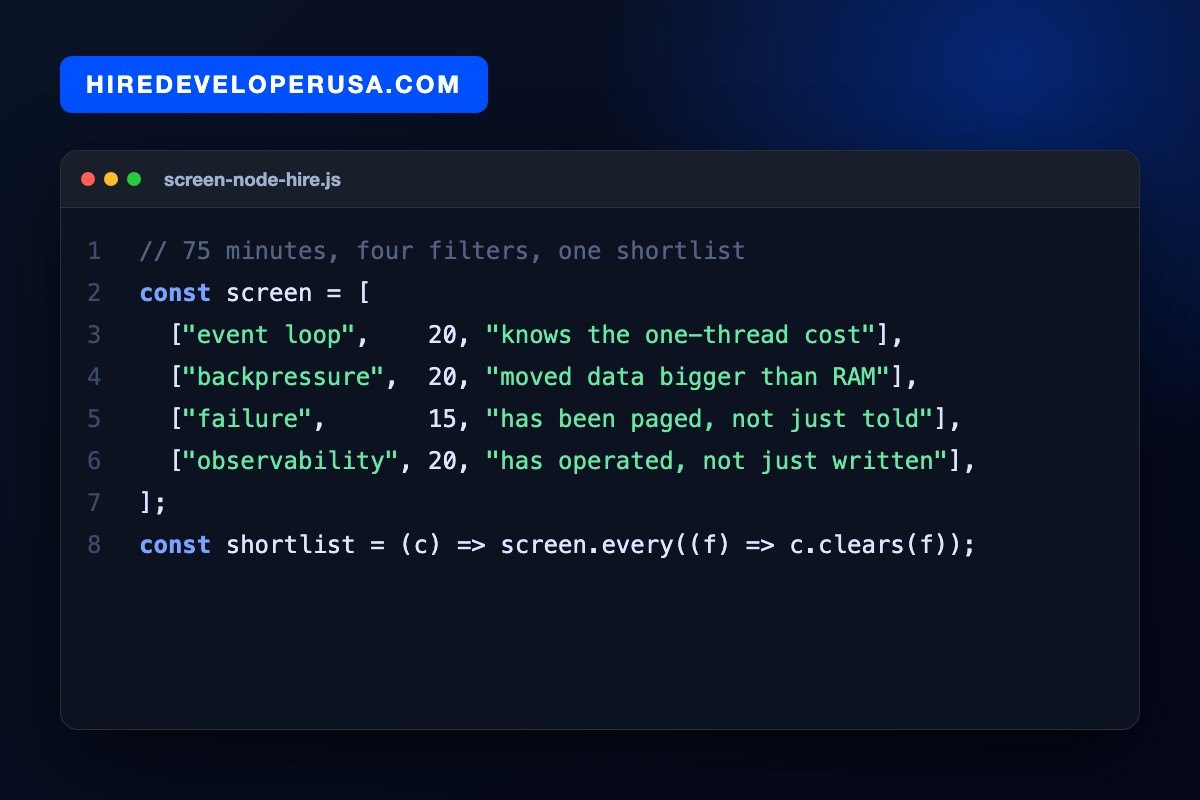
Four filters, 75 minutes in total, run in one conversation or split across two. Each one asks about something the candidate has done, not something they have read.
| Filter | What it proves | The question | A weak answer sounds like |
|---|---|---|---|
| Event loop discipline (20 min) | They know that one thread serves every request in the process | Where in your last service could a 300 ms CPU task appear, and what did you do about it? | Node is non-blocking, so it handles that |
| Backpressure and streams (20 min) | They have moved data larger than memory | A 2 GB CSV lands in object storage and has to end up in Postgres. Walk me through it. | Read the file, loop over the rows, insert them |
| Failure handling (15 min) | They have been paged, not just told about incidents | An unhandled promise rejection takes the process down in production. How do you find it? | We wrap everything in try/catch |
| Observability (20 min) | They have operated the thing they wrote | The p95 doubles overnight and CPU is flat. What do you look at first? | A list of tool names with no method attached |
On top of the four, add one default expectation: TypeScript on the server. In 2026, an untyped Node codebase reads as debt rather than speed, and typed boundaries are what allow a stranger to review a pull request in ten minutes instead of an hour. When a candidate argues that types slow them down, they are telling you how small their past codebases were.
Filter one in practice: the route that stops everything
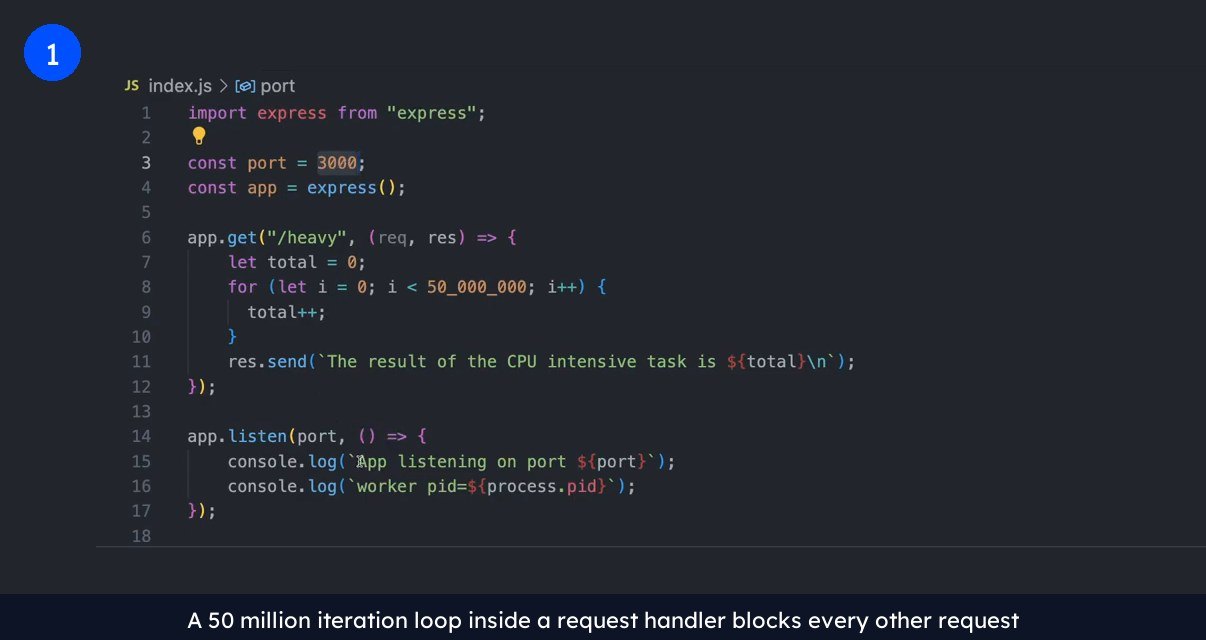
Node executes your JavaScript on a single thread. A CPU heavy route does not slow that route down. It stops every other request handled by the process, including the health check your load balancer is watching. This is the most common production surprise in Node, and the quickest way to learn whether a candidate has run into it.
The demonstration fits in a dozen lines: an Express handler that counts to fifty million before it responds. Put one process under a load test with 400 concurrent clients and mean latency climbs to about 30 seconds, the median lands near 32 seconds, the ninetieth percentile passes 41 seconds, and a large share of requests fail outright. Nothing is wrong with the machine. One line is doing arithmetic where it should be delegating.
Ask for the real version instead: name three things in your last service that blocked the loop. Strong answers are specific and unglamorous. Serializing a large payload with JSON.stringify. A synchronous crypto call like pbkdf2Sync. Resizing images in the request path. A sort over an unbounded array. Next, ask how they moved that work (to a worker thread, a queue with a separate worker process, a native module or another service) and, above all, how they proved it: event loop lag tracked as a metric, a CPU profile, a flame graph. One answer that contains a measurement beats three answers full of vocabulary.
If you are not tracking event loop lag yet, add it before the new hire starts. Without it, the first week of a Node engagement is mostly archaeology. Our guide to setting up monitoring for a web app shows where that metric belongs alongside latency and error rate.
Scaling Node is a design decision before it is a hiring decision
Before you write the job brief, decide which kind of scale you are buying. There are three, and they call for different people.
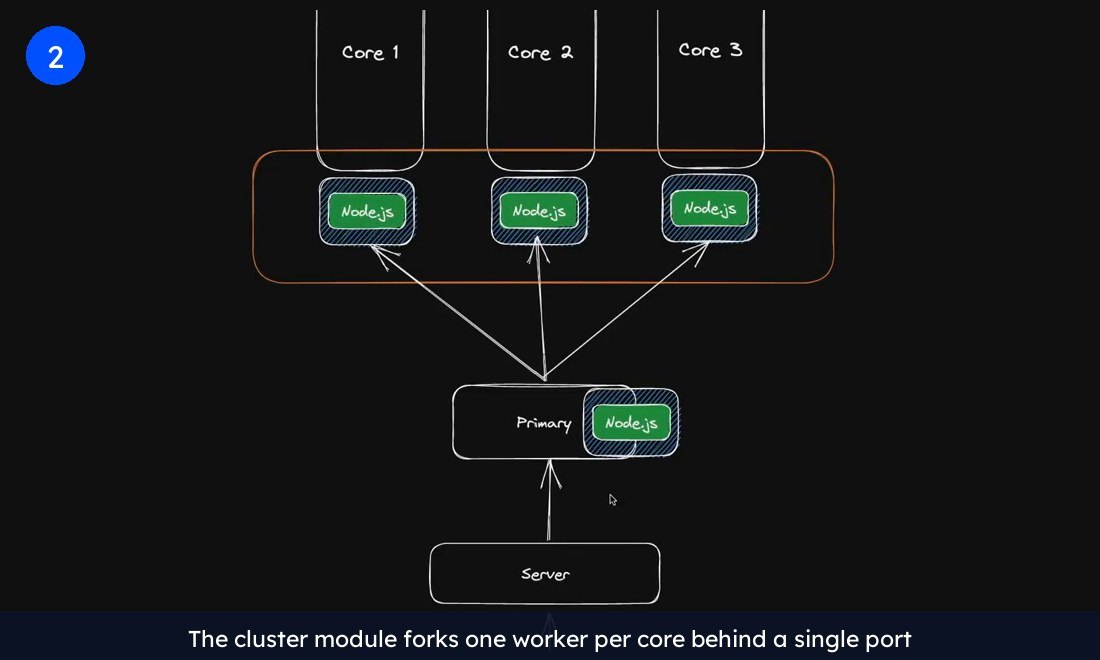
More cores on one machine. The standard library's cluster module forks one worker process per CPU core; all of them share a single port, and a primary process hands out connections. It needs no container orchestration and only a few lines of code, and for most products it is the right first step. Worker threads are the better tool for CPU bound work inside a single request, since clustering multiplies processes while each request is still served by one thread.
More machines. Here the problem is statelessness rather than Node. No sessions held in process memory, no writes to local disk, shared state kept in Redis or the database, and sticky sessions only where WebSockets force your hand.
Less work. Caching, queues, and pulling everything that does not need to answer the user out of the request path. Of the three, it is usually the cheapest, and the one candidates bring up last.
One good screening question: we run four workers on an eight core box and the p95 is still bad, what do you check first? The candidate should establish whether the work is CPU bound or I/O bound before proposing anything, and then go looking at the database. An engineer who answers add more workers is repeating a tutorial. Also ask what happens when a worker dies. Production cluster code listens for the exit event and forks a replacement, and anyone who has run it will warn you that an automatic respawn can hide a memory leak for months.
What Node.js experts cost in the US in 2026
Rates follow production judgment far more closely than framework lists. Budget against the bands below; the full breakdown by seniority and engagement model is on our Node.js developer rates page.
| Hiring model | Typical US rate | What you are buying | Where it goes wrong |
|---|---|---|---|
| Marketplace, junior | $38 to $63 per hour | Supervised feature work on an existing service | Every pull request needs a senior reviewer, and that time is not free |
| Marketplace, mid-level | $63 to $95 per hour | Ownership of a service against a written brief | Architecture decisions stay on your desk |
| Marketplace, senior | $95 to $130 per hour | The design, the load profile and the incident response | Expensive on CRUD work a mid-level engineer could carry |
| Agency or consultancy | $110 to $210 per hour | A team with continuity, QA and project management | You pay for the bench, not only for the engineer on your standup |
| Full-time in-house | $98,000 to $170,000 base | Permanent ownership of the platform | The role usually sits open six to ten weeks, and benefits sit on top |
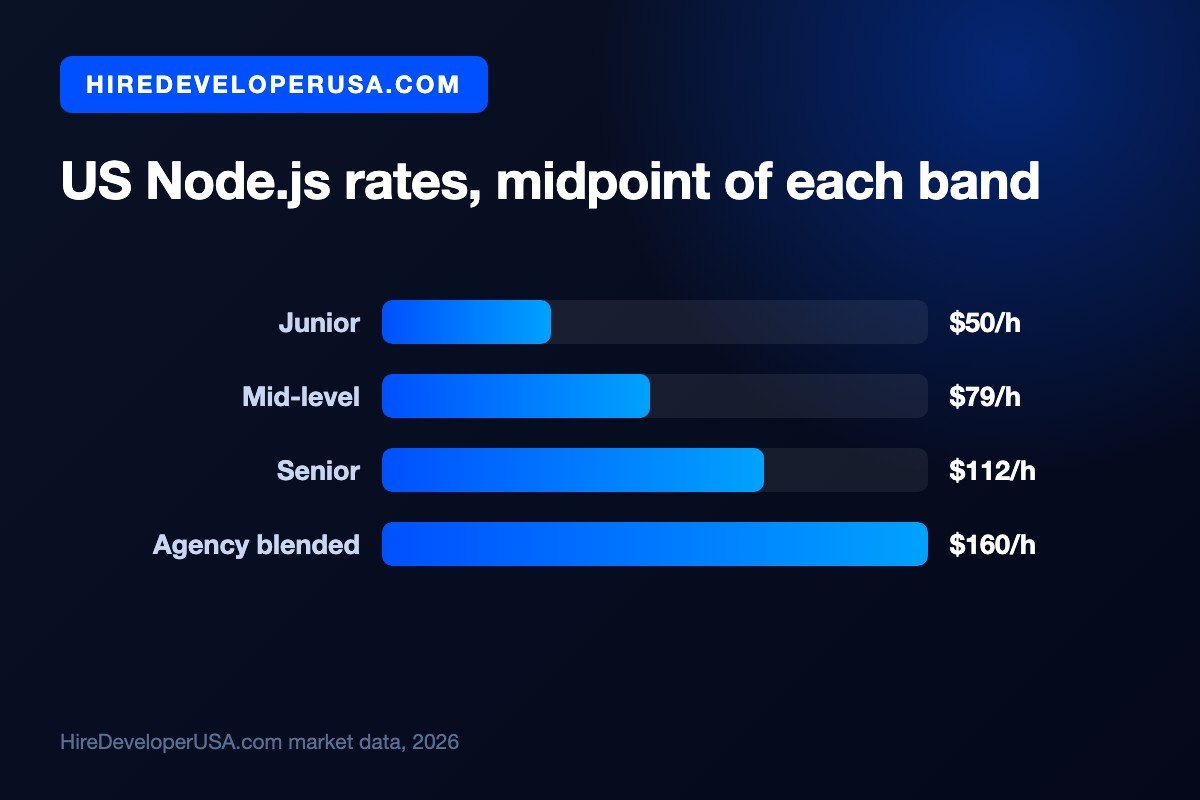
Between a mid-level engineer at $79 an hour and a senior at $112 (the midpoints of those two bands), the gap comes to about four hours of your own review time each week. When nobody on your side can review Node work, the senior is the cheaper hire. If you already have a strong reviewer, though, the mid-level engineer is the better trade on anything that is not latency sensitive.
The paid trial task that predicts the next six months
Interviews measure explaining. A trial measures working. Pay the agreed rate for a single bounded task: four to eight hours of work, due in three days, with a brief short enough to read in two minutes.
For Node, an ingest endpoint is the task that exposes everything. It should accept a large file, parse it as a stream, write it to the database in batches, survive a failure in the middle and expose one metric that shows progress. Then add one awkward requirement, such as rows that must never be inserted twice when an upload is retried.
Grade five things. Does it stream, or does it pull the whole file into memory. What happens when the database rejects a batch halfway through. Do the logs carry enough context to debug that failure at 2 a.m. Is there at least one test for the awkward requirement. Did the candidate ask a clarifying question before starting. That final signal predicts the next six months better than anything else in the process, since it is exactly the behavior you need in week three, when your brief turns out to be wrong.
The trial tests your brief as well. When three candidates read the same two paragraphs three different ways, the brief is the problem, and you found that out for the price of one day of work rather than a quarter.
Four ways Node hires go wrong
Hiring for the framework instead of the load profile. A NestJS specialist is not what you need if ninety percent of the product is file processing and queues. Write down what the system actually does all day before you write the job post.
Hiring an engineer for an infrastructure problem. When the database is the bottleneck, a better Node developer barely moves the number. Profile first. Then decide whether the next hire writes application code or owns the data layer.
Letting the candidate choose the trial task. Everyone has some demo they built before. A trial exists so you can watch someone meet your constraints, not their favorite ones.
Starting without an owner on your side. The most expensive Node hires are the ones nobody reviewed for three weeks. Name the reviewer and the first deliverable before the contract starts, and work through our guide to onboarding a remote developer in week one.
What to do next
Write your load profile in numbers before you write the job post: requests per minute at peak, the largest payload the system has to accept, the p95 you are willing to pay for, and the one operation that must never block. Three sentences are enough. That page decides whether you need a senior, a mid-level engineer with a reviewer behind them, or a back-end engineer who happens to write Node.
After that, run the four filters in a single 75 minute conversation, pay for one bounded trial task, and stick to the budget guardrail you set before meeting anyone. Once you are ready to see candidates, begin with our Node.js developers, and have the first two weeks planned ahead of time.
Frequently asked questions
How much does it cost to hire a Node.js expert in the US?
On a vetted marketplace, roughly $38 to $63 an hour for a junior, $63 to $95 for a mid-level engineer and $95 to $130 for a senior. Agencies bill $110 to $210 an hour for a team with project management and QA included, and a full-time in-house hire runs $98,000 to $170,000 in base salary before benefits.
What should I ask a senior Node.js developer in an interview?
A screen rests on three questions. Name three things in your last service that blocked the event loop and how you proved it. A 2 GB CSV has to reach Postgres, walk me through it. The p95 doubled overnight and CPU is flat, what do you look at first? Someone who has operated Node can answer each one in two minutes; someone who has only written it almost cannot.
Do I need a Node.js expert, or a back-end engineer who can learn Node?
If the product is API and real-time work on a JavaScript codebase, hire the Node expert, because the failure modes are specific and expensive to learn on your time. If the hard part is data modeling, queues or database performance, a strong back-end engineer from another stack will be productive in Node within a few weeks and better on the actual problem.
How long does it take to hire a Node.js developer?
Plan on about two weeks from a written brief to a first merged pull request through a vetted marketplace or a referral, since the screen itself is 75 minutes and the trial task takes three days. An in-house job post usually keeps the role open six to ten weeks before anyone starts.
Hire vetted talent