
Key takeaways
- →Name the job shape first: Spring Boot services, Android, JVM data platforms and legacy modernization are four labor markets with different prices and different interviews.
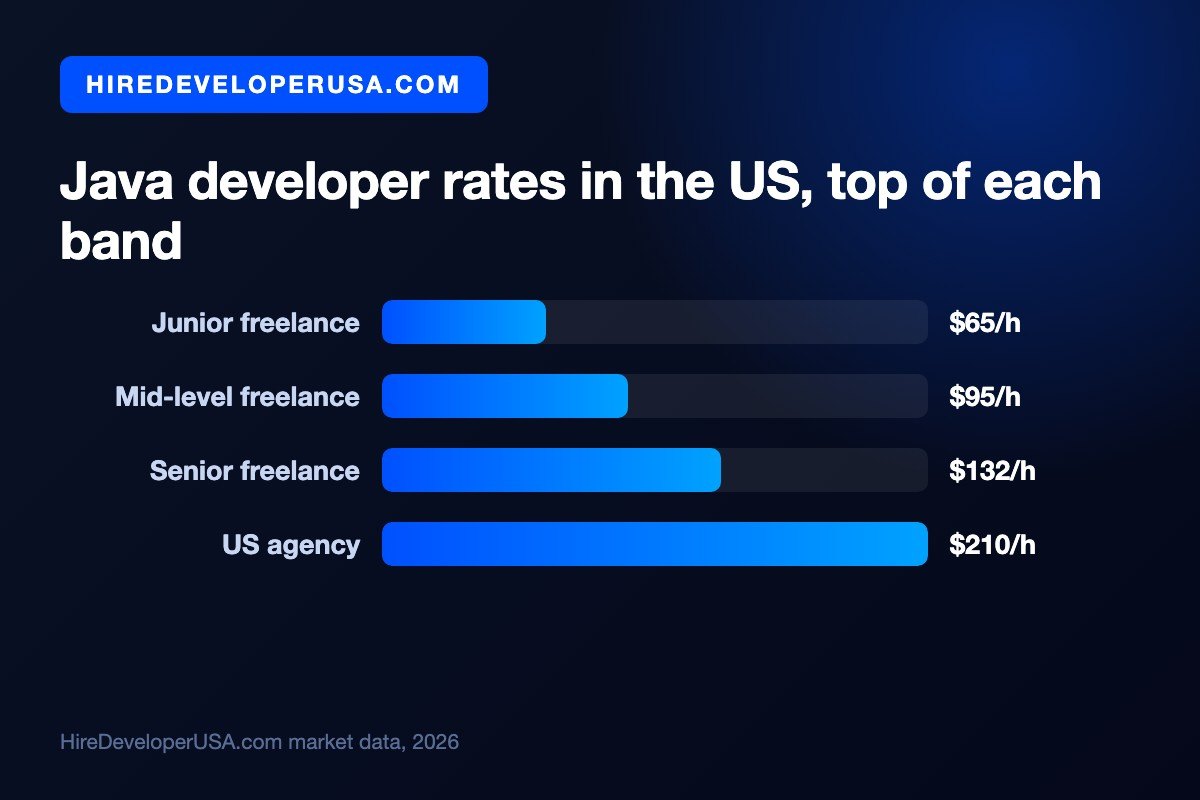
- →US Java freelancers bill $40 to $65 an hour junior, $65 to $95 mid-level and $95 to $132 senior; agencies charge $115 to $210 and full-time base salaries run $100,000 to $175,000.
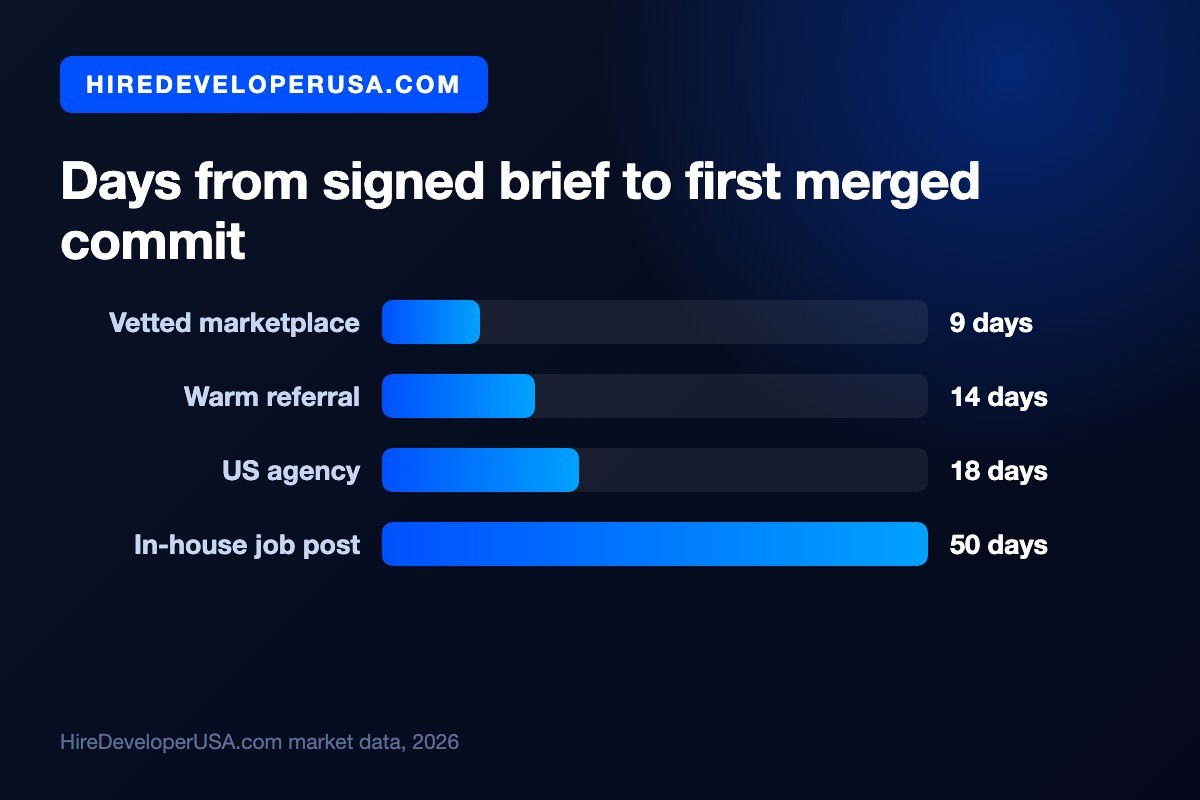
- →Plan about 9 days from signed brief to first merged commit through a vetted marketplace, 14 through a referral, 18 through a US agency and about 50 through an in-house job post.
- →Screen one real code sample against five signals: constructor injection, exceptions never swallowed, query-aware data access, current Java idioms, and tests plus a reproducible build. Four of five advances the candidate.
- →Replace the fourth interview with a paid ticket of 10 to 15 hours on your own backlog, merged to staging and reviewed like production, before signing anything longer.
Hiring Java developers in the US in 2026 means planning on $40 to $65 an hour for a junior freelancer, $65 to $95 for a mid-level engineer and $95 to $132 for a senior, $115 to $210 an hour through a US agency, or a base salary of $100,000 to $175,000 for a full-time hire. Price is the easy part. The costly mistake is to treat "Java developer" as a single job: the language spans at least four separate labor markets, and a candidate who excels in one of them can be a slow, expensive hire in another.
On every Java search we follow the same process, in this order: name the job shape, choose the sourcing channel that suits your deadline, screen one real code sample against five signals, and then pay for one real ticket before anyone signs a longer contract.
Java is four hiring markets, not one
Java has run in production for three decades, so the title now covers work that barely overlaps. Decide which of these four you are actually buying before you write a job post.
Spring Boot services and APIs. Most commercial Java work lives here: REST and messaging services with a relational database behind Hibernate or JDBC, deployed in containers. You draw from this pool for most backend roles. It is also where Spring Boot specialists price at the top of the band.
Android. The platform is shared by Java and Kotlin, and most Android engineers now write new code in Kotlin while they maintain Java. Putting an Android engineer on a Spring Boot service, or doing the reverse, is the single most common mis-hire we see in this stack.
JVM data platforms. Think Kafka consumers, Spark and Flink jobs, and streaming pipelines. Engineers here reason in throughput, backpressure and serialization formats. They are harder to find than backend generalists, and they are aware of it.
Legacy modernization. This means moving a Java 8 or Java EE codebase onto a current long-term-support release, splitting a monolith into services, or replacing an application server. Patience and reading comprehension matter more here than framework fashion. It is the one shape where a quieter, less trend-aware resume is often the right hire.
Put the shape in the first line of your brief. It changes which channel you source from, the rate you should expect and every question you will ask.
What Java developers cost in the US in 2026
On a vetted US marketplace, Java freelancers bill $40 to $65 an hour at junior level, $65 to $95 at mid-level and $95 to $132 at senior level. A US agency or development shop charges $115 to $210 an hour for the same work, and a full-time hire costs $100,000 to $175,000 in base salary before you add payroll taxes, benefits and equipment, which most teams budget at roughly a quarter to a third on top.
Four factors reliably shift a Java rate: depth in the Spring ecosystem rather than passing familiarity, JVM performance skill (garbage-collection tuning, profiling a service that degrades under load), enterprise integration experience with messaging and identity systems, and domain exposure in financial services or insurance, where Java runs the core and buyers pay for people who have already been through an audit.
| Engagement | Typical US cost | Time to first merged commit | Best when |
|---|---|---|---|
| Marketplace freelancer | $40 to $132 an hour | About 9 days | One service or feature, clear scope, you have a reviewer in house |
| Warm referral | $40 to $132 an hour | About 14 days | You have a trusted network and can wait for availability |
| US agency or dev shop | $115 to $210 an hour | About 18 days | You need a team, a project manager and someone accountable for delivery |
| Full-time employee | $100,000 to $175,000 base | About 50 days | The system is permanent and the roadmap runs past a year |
The honest comparison is not hourly rate against salary. A senior freelancer at $120 an hour for 20 hours a week costs about $125,000 a year with no benefits load, no recruiting fee and no severance risk. The same engineer in house costs more in cash but gives you full context retention. Run that arithmetic before you argue about rates, and read our breakdown of software developer hiring costs if you need the model for the rest of your team.
Where to source, and what each channel costs you in days
Java has one of the deepest talent pools in the US, and that flips the usual problem. Candidates will not be hard to find. The struggle is filtering a hundred resumes that all list Spring, Hibernate and microservices. Choose the channel by how much of that filtering it does for you and how quickly you need code in your repository.
A vetted marketplace gets you to a first merged commit in about nine days, because the screening was done before you arrived. Going through a warm referral takes around two weeks and gives the best signal per hour you spend, though it only works if someone in your network has recently worked with a Java engineer who is available. A US agency takes about eighteen days and buys you a team plus accountability, at the price premium above. An in-house job post is the slowest honest number on the page: roughly fifty days from signed brief to first commit, once you count sourcing, three interview rounds, notice periods and onboarding.
Whichever you choose, the calendar goes to sourcing, not interviewing. If your deadline is inside a month, a job post is not a plan. If you want the engagement structure that sits between a freelancer and an employee, our guide to hiring dedicated developers covers how those contracts are written.
The five signals we screen for in a Java code sample
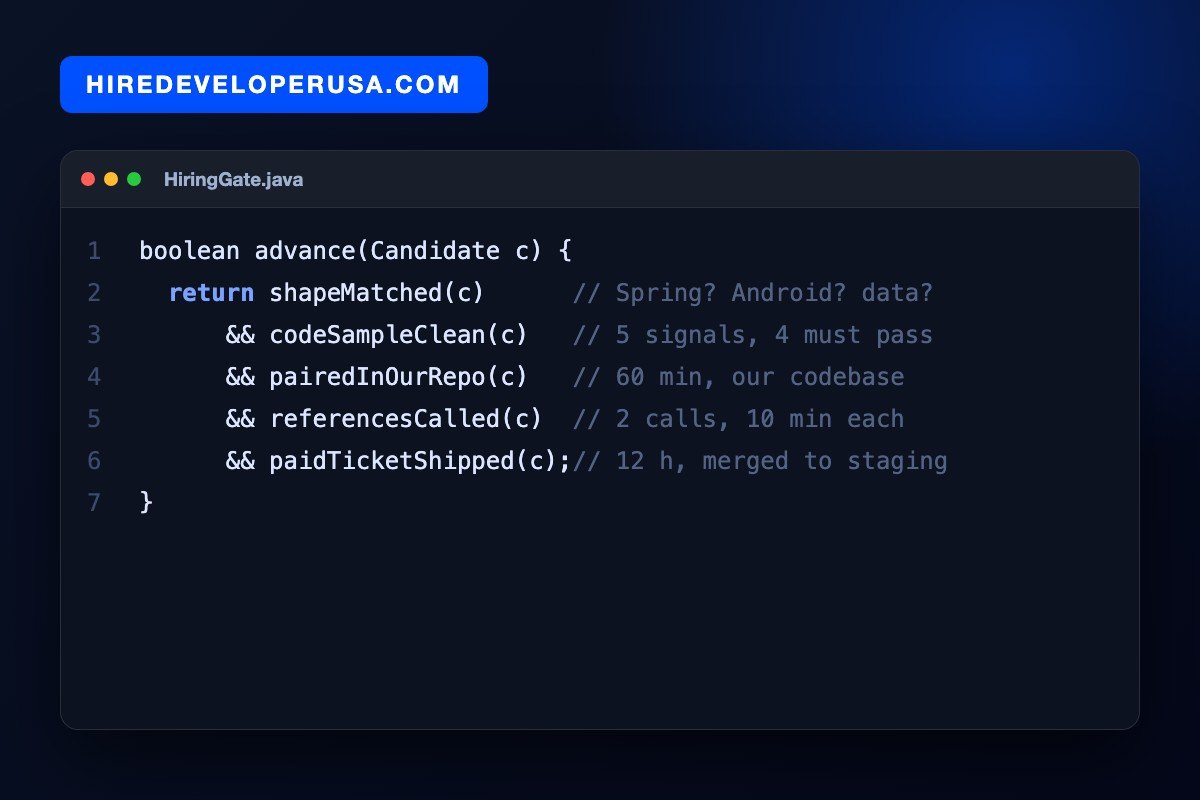
Trivia on how an interface differs from an abstract class rewards people who studied for interviews. Sixty lines a candidate actually wrote reward people who ship. Ask each finalist for a small sample they own (a service class or a module) and spend forty-five minutes on the five signals below. A candidate who passes four of five is strong.
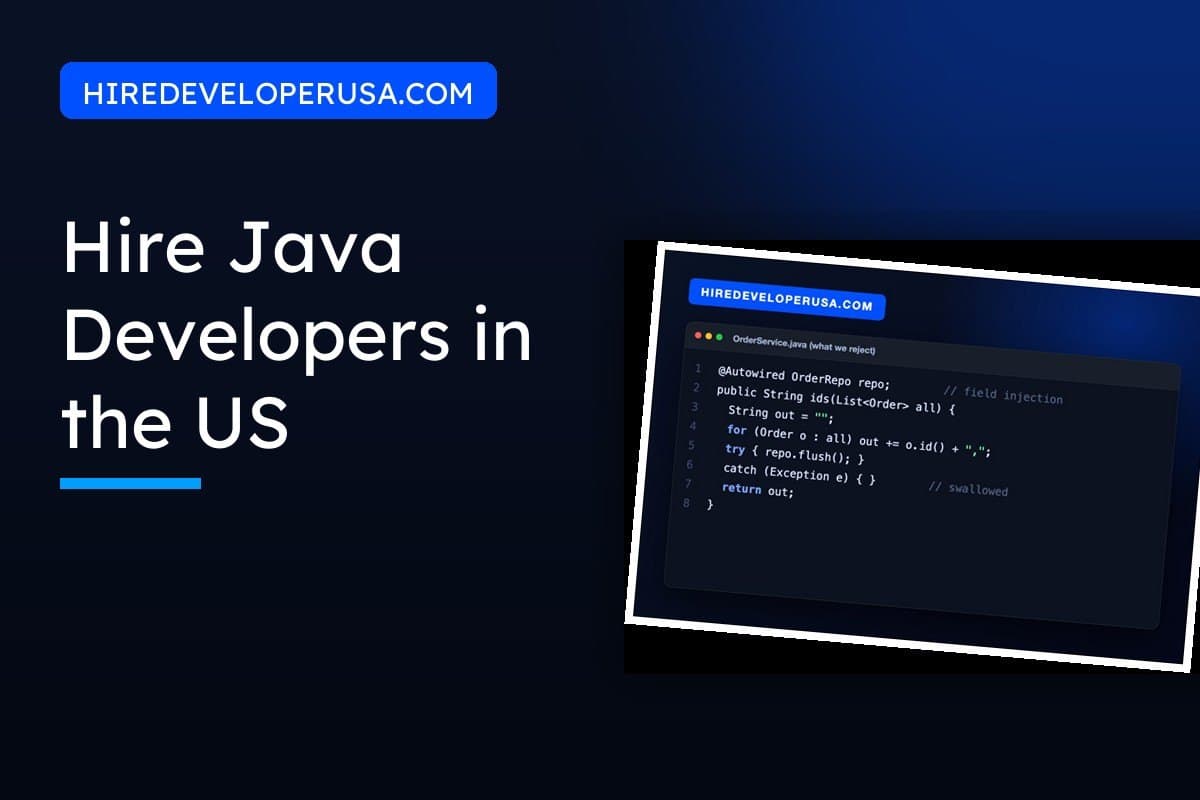
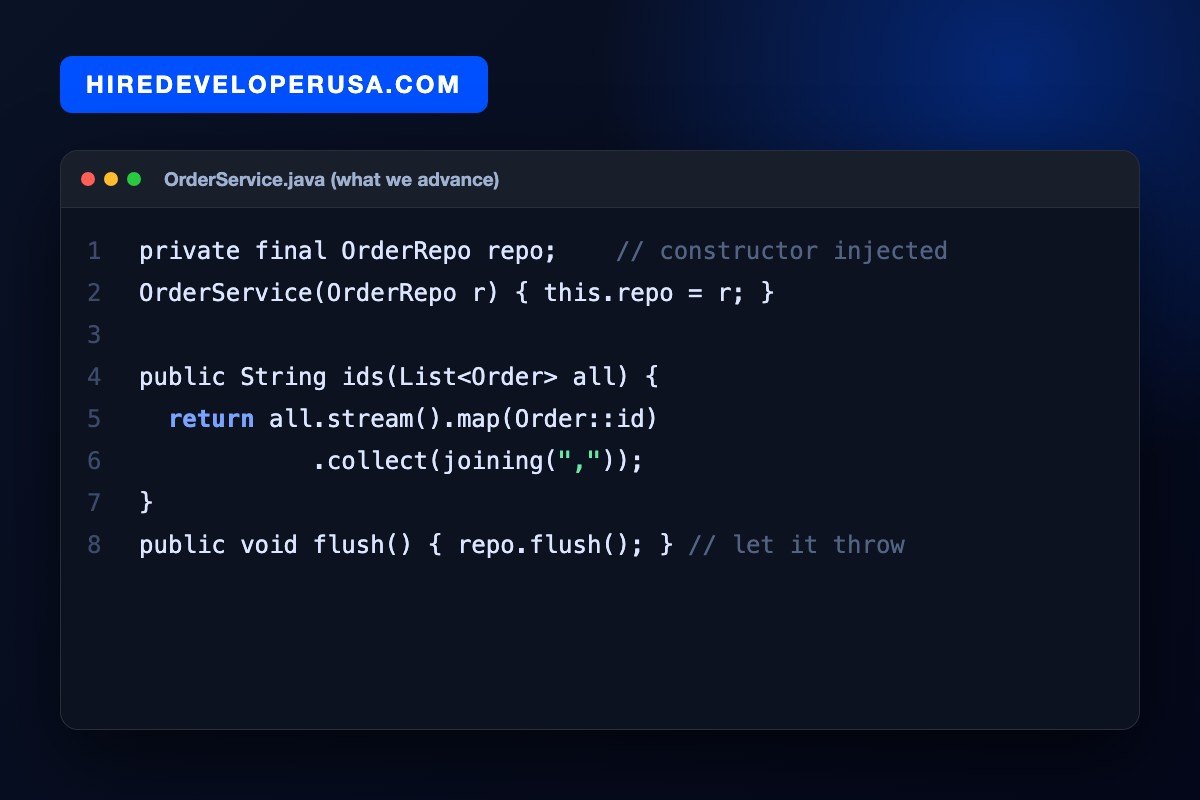
Signal 1: dependencies arrive through the constructor. Without a framework, a class with annotated fields and no constructor cannot be instantiated in a plain unit test, so its tests either vanish or become slow integration runs. Constructor injection with final fields is the senior default. It shows the person has written tests that run in milliseconds.
Signal 2: exceptions are handled or propagated, never swallowed. An empty catch block, or a catch that logs and continues, converts a failure into silent data loss. We look for narrow catch types, a custom exception that carries context, and a deliberate decision at each boundary about who is allowed to fail.
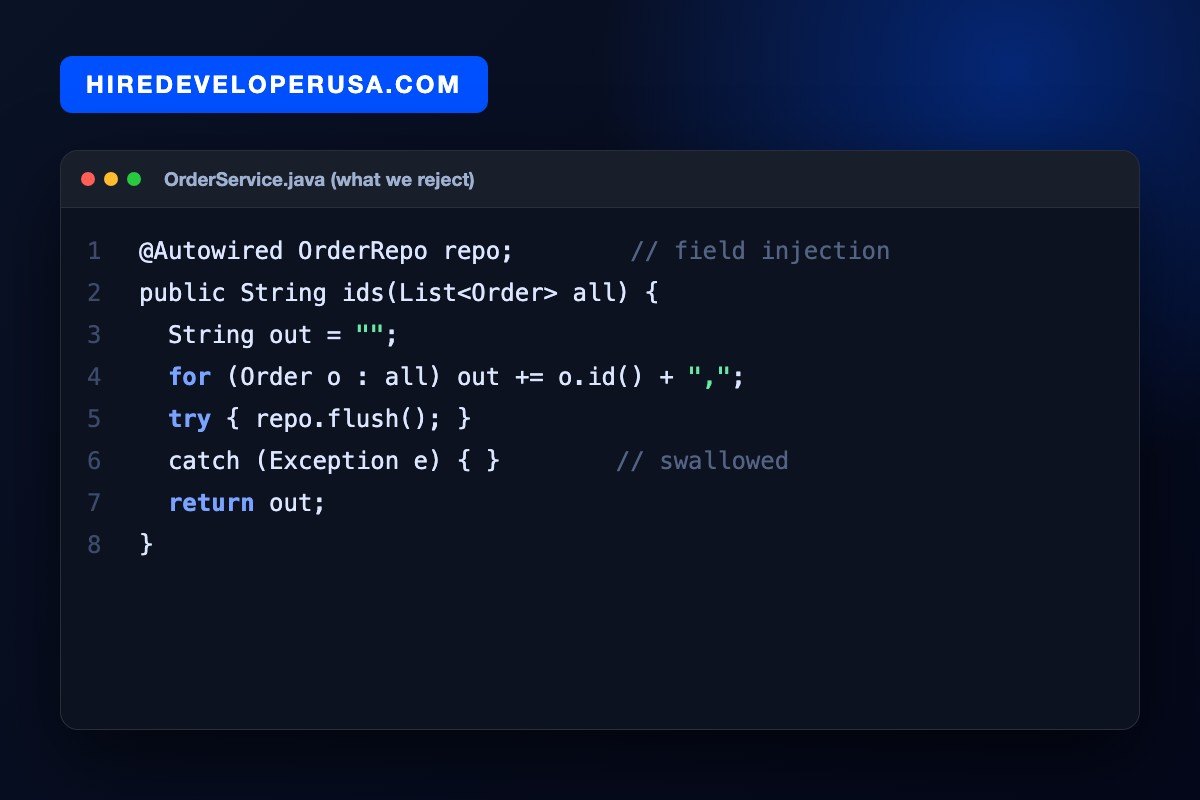
Signal 3: the code knows what the database is doing. Java hides SQL so well that an engineer can ship an endpoint issuing one query per row of a result set and not notice it until production. We want explicit fetch strategies, pagination on anything that can grow and at least one comment or test showing the author checked the generated queries.
Signal 4: current Java, used where it helps. That means records for data carriers, Optional as a return type but not as a parameter, streams where they make a transformation clearer than a loop would, text blocks for embedded SQL or JSON, and awareness of what virtual threads changed for request-per-thread services. Novelty is not the point. What matters is that an engineer writing 2014 Java in 2026 has stopped reading.
Signal 5: tests that bind to behavior, and a build that is reproducible. JUnit 5 with meaningful names, no test that sleeps while waiting for something, container-backed integration tests for the few paths that touch the database, and a Maven or Gradle build with pinned versions that runs on a new machine at the first attempt. For a shared vocabulary when you have this conversation with your team, our note on how to review a pull request applies the same standard.
The question behind "top Java development companies"
Buyers look for a ranked list of Java companies because they want the diligence done by someone else. No list can do it. The variable that decides your outcome is not how big the vendor is; it is the contract and the specific people assigned to you. Six questions tell a good Java vendor apart from an expensive one, and they apply just as well to a marketplace team as to an agency:
- Who owns the code and the repository? It should be you, from the first commit, in your own version control, not delivered as a zip at the end.
- Can you interview the actual engineer? You want a named individual you screened, not a pool that can be swapped once the contract is signed.
- What happens if you want to replace them? Before you sign, get the substitution clause and the notice period in writing.
- How many overlap hours do you get? Four hours of shared working time separates a developer who asks a question from one who spends a day guessing.
- What does handover include? Runbooks, environment setup, architecture notes and credentials, each named as a deliverable instead of assumed.
- Who reviews the code? When the answer is nobody on your side, what you bought is output, not quality. Set aside your own senior time for review, or pay for a reviewer as well.
Answer those six and the ranked list stops mattering. You can browse our Java developer pool or ask for profiles in a specific shape, but either way the questions above are what to put in the contract.
Replace the fourth interview with a paid ticket
Once a Java candidate has cleared a code-sample review and an hour of pairing, one more interview adds almost nothing. A paid trial does. Choose one real ticket worth ten to fifteen hours (something from your actual backlog that touches your build, your database and your review process) and pay the candidate their normal rate to deliver it.
That week shows you everything an interview cannot: how they set up an unfamiliar project, what they ask before writing code, whether their pull request reads well, whether the tests they add would catch the bug they fixed, and how they react when you ask for changes. Land it on staging and review it as you would production. Only then negotiate a longer contract. If the trial converts, our remote onboarding checklist makes week two about shipped work rather than waiting for access.
What to do next
Today, write a one-page brief naming the job shape (Spring Boot service, Android, JVM data or legacy modernization), the Java version and build tool you use, the systems the new engineer will integrate with and the first ticket they would pick up. That single page filters more than any job board does.
Next, choose the channel your deadline calls for: a vetted marketplace when you need commits within two weeks, an agency when you need a team and a manager, and a job post only if the roadmap runs past a year. Screen one code sample against the five signals. Pay for one real ticket and sign once it merges. Three weeks of this process costs less than a single quarter with the wrong Java hire.
Frequently asked questions
How much does it cost to hire a Java developer in the US?
Expect $40 to $65 an hour for a junior on a vetted marketplace, $65 to $95 for a mid-level engineer and $95 to $132 for a senior. For the same work US agencies bill $115 to $210 an hour, while a full-time hire costs $100,000 to $175,000 in base salary before payroll taxes and benefits. Depth in the Spring ecosystem, JVM performance tuning and enterprise integration experience push candidates to the top of each band.
How long does it take to hire a Java developer?
Measured from a signed brief to a first merged commit, plan about 9 days through a vetted marketplace, 14 through a warm referral, 18 through a US agency and about 50 through an in-house job post. Most of that calendar is sourcing and scheduling, not interviewing, so the fastest lever you control is a brief that names the job shape precisely.
Should I hire a Java developer or a Kotlin developer?
For a new Android app, hire for Kotlin and treat Java as the maintenance language it has become on that platform. For server-side work, Java remains the default and the larger pool, though many engineers write both and some teams run Kotlin on Spring Boot. Ask which language the candidate has shipped to production in the last year rather than which one appears on the resume.
Is it cheaper to hire Java developers offshore?
Hourly rates are lower, and for a well-scoped service with a senior reviewer on your side the savings are real. The costs that offset them are overlap hours, specification detail and review load, all of which rise when the working day barely intersects with yours. Price your own review time into the comparison, and insist on at least four hours of overlap in the contract rather than treating it as a detail to settle later.
Hire vetted talent