

Key takeaways
- →A dedicated developer bills $45 to $120 an hour in the US, against $100 to $200 at an agency and an $85,000 to $175,000 base salary in house.
- →At 40 hours a week a mid-level dedicated developer costs about $147,200 a year, roughly $9,000 less than the same seat in house once benefits and overhead are loaded in.
- →The model needs at least three months of continuous work to absorb the one to three week ramp you pay for at full rate.
- →Five gates predict the hire: maintenance history, restating the problem, written overlap, a paid one day work sample, and a named replacement clause.
- →Direction stays your job. A dedicated developer with nobody setting priorities produces output, not progress.
A dedicated developer is an engineer who works solely on your product for a set number of hours each week, engaged via a marketplace or vendor rather than added to your payroll. In the US, expect $45 to $120 an hour on a vetted marketplace, compared with $100 to $200 an hour at an agency and a base salary of $85,000 to $175,000 for the same work done in house. The model pays off when you have at least three months of continuous work plus someone internal who can set direction. It backfires when the work is short or comes in bursts, and also when nobody on your side is ready to decide what gets built next.
This guide walks through what a year costs under each model and the three situations that turn the arrangement into a loss, then the terms that prevent it.
What "dedicated" actually buys you
Dedicated means exclusivity of time, not a different kind of engineer. The developer blocks a fixed number of hours a week for you and does not slice them across three other clients. That single commitment produces most of the value people associate with the model.
You get continuity: the same person holds the context of why the payment retry logic looks odd and which migration is half finished. Context is the most expensive thing to rebuild, and a rotating cast of contractors rebuilds it every engagement. You get direct management: you assign work, you set priorities, you run standups, with no account manager translating between you and the person writing the code. And you get capacity you can plan around, which matters the moment you start making roadmap promises to anyone outside engineering.
It is just as important to be clear about what the arrangement does not include. A dedicated developer is not an employee, so there is no notice period beyond what your contract states and no bench behind them if they get sick. There is no project manager unless you pay for one. There is no QA unless you hire it. And intellectual property does not transfer by default in a contractor relationship: it transfers because your agreement says so in writing. Teams that assume otherwise discover the gap during due diligence, which is the worst possible moment. If you need one person who can cover both sides of the stack rather than a specialist, start from the full stack developer pool and narrow from there.
What a dedicated developer costs for a year, three ways
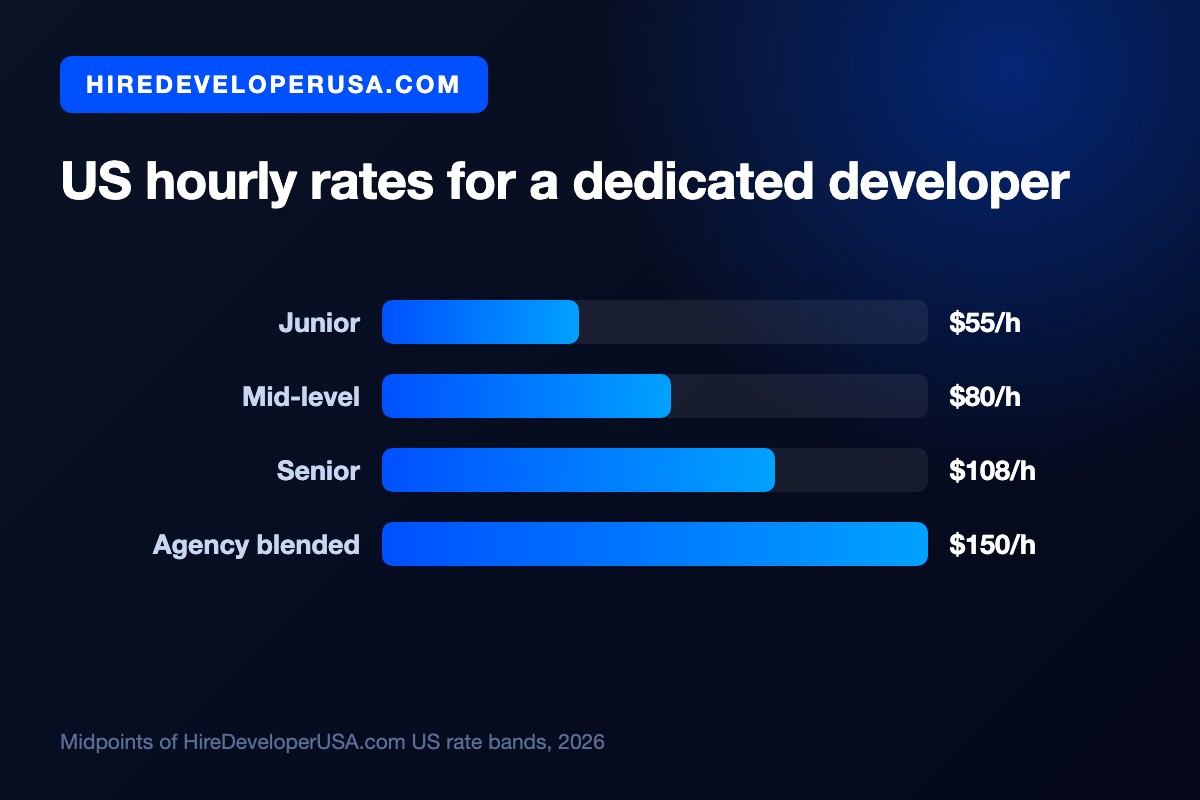
In the US, hourly rates for a general software developer divide neatly by seniority: $45 to $65 for junior work that needs review, $65 to $95 for a mid level engineer able to own a feature end to end, and $95 to $120 for a senior who can own architecture and releases. That puts the midpoints at roughly $55, $80 and $108 an hour. Agencies charge $100 to $200 for the same work with a manager attached, which is a blended midpoint near $150. For a finer split by specialization, see our US software developer rate page.
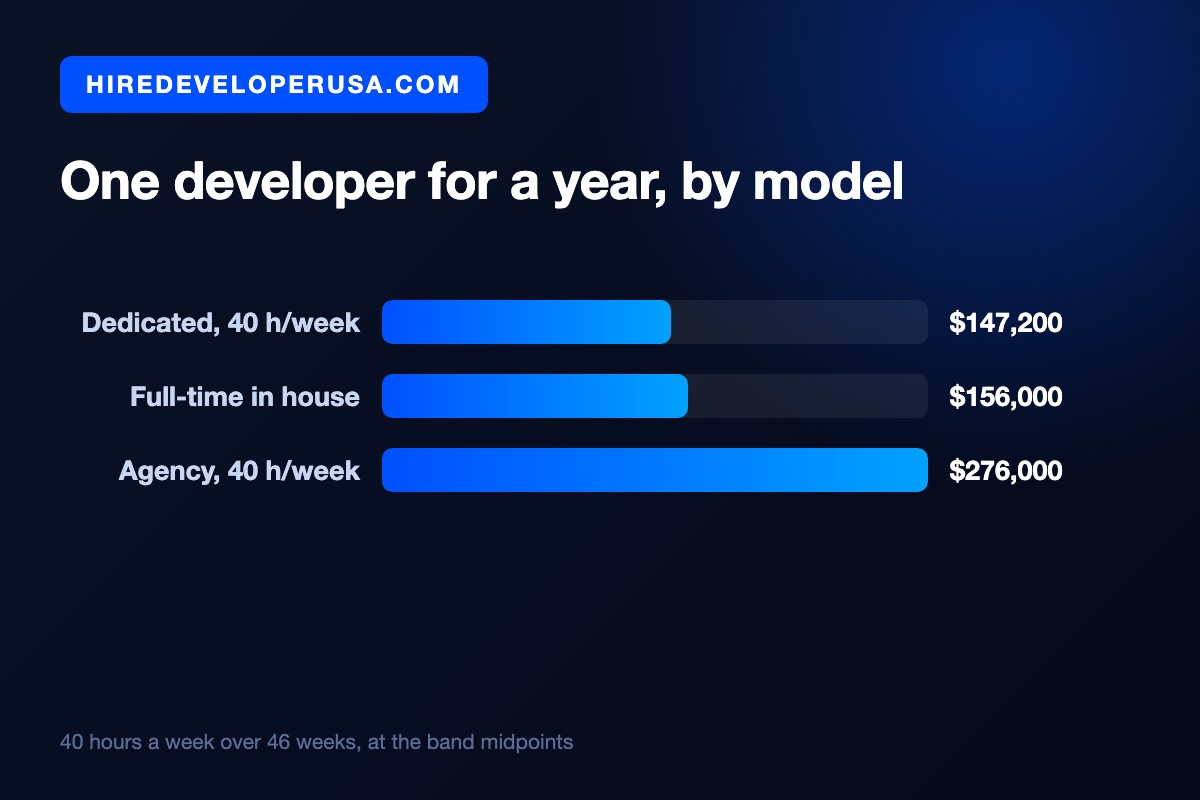
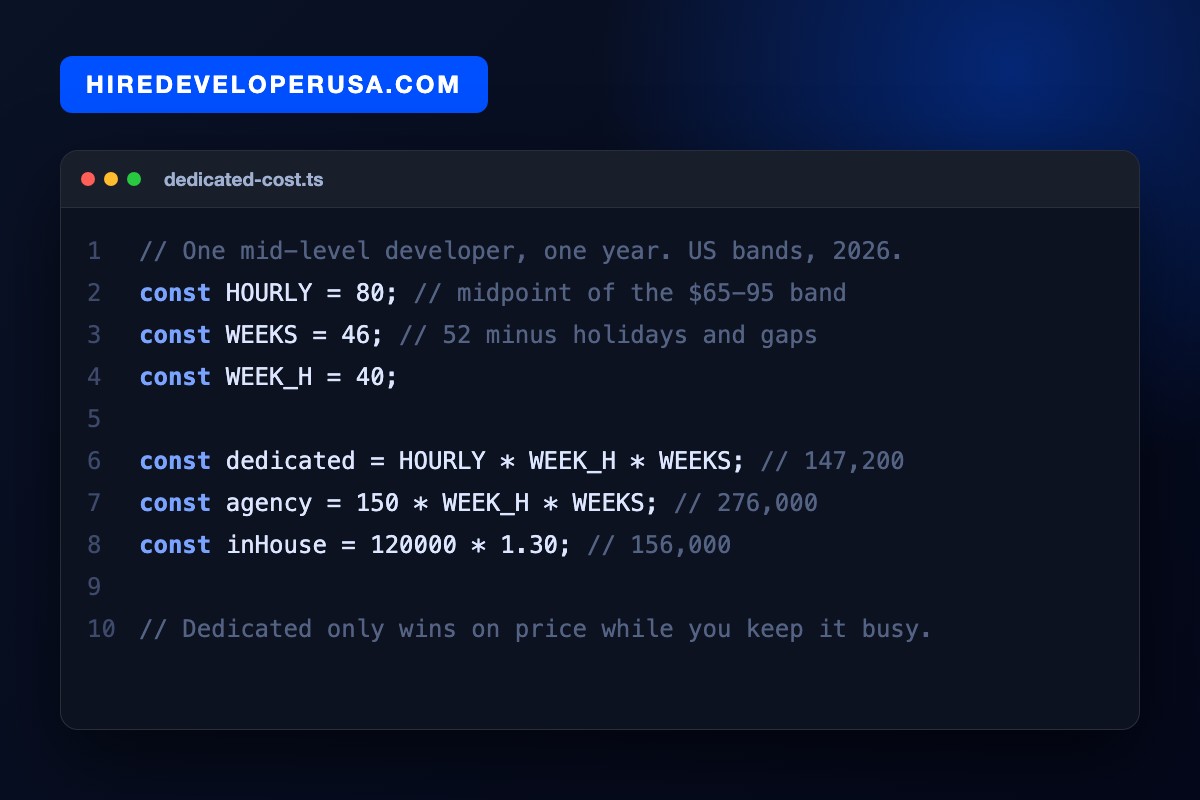
Once you annualize those numbers, the comparison becomes more useful than any argument about hourly rates. Consider a mid level developer at the $80 midpoint working 40 hours a week for 46 weeks a year, after allowing for holidays and gaps between sprints. The total is $147,200. Hiring for the same seat in house at a $120,000 base salary costs about $156,000 after you load the 25 to 40 percent added on top by benefits, payroll taxes, equipment and management overhead. At $150 an hour, the agency equivalent reaches $276,000.
| Model | Typical US cost | Best for | Main risk |
|---|---|---|---|
| Dedicated developer | $45 to $120 per hour, committed hours | Three months or more of continuous work on one product | You pay for the hours whether or not the backlog is ready |
| Freelancer, part time | $45 to $120 per hour, fewer hours | Defined, separable tasks with a clear finish line | Your work queues behind their other clients |
| Agency or dev shop | $100 to $200 per hour, blended | No internal technical owner, or a full team needed at once | You fund a management layer you may not need |
| Full time employee | $85,000 to $175,000 base, plus 25 to 40 percent | Permanent ownership of core product | Slowest to hire and hardest to reverse |
So over a year, a dedicated developer and a full time hire end up within about $9,000 of each other. Price does not decide it. What does is speed, reversibility and how long the work lasts. Our breakdown of the cost to hire software developers gives a wider view of what moves these numbers.
Three cases where the dedicated model backfires
One: the work is shorter than three months. Each engagement has a ramp cost. A competent engineer takes one to three weeks to become productive in an unfamiliar codebase, and those hours are billed at full rate. That ramp can eat a quarter of the budget on a six week project, while on a nine month engagement it rounds to nothing. When the scope really is short and well defined, an hourly freelancer working task by task is the cheaper instrument; our guide to freelance developer hourly rates explains how that pricing works.
Two: the work arrives in bursts. Commitment here runs both ways. Suppose your backlog yields 15 real hours of work one week and 50 the next: you either pay for idle time or quietly let the developer pick up other clients, and at that point you have a freelancer with an inflated retainer, not a dedicated developer. Before committing to a weekly number, measure two or three weeks of actual engineering demand.
Three: nobody internally owns direction. This is the expensive one, because it does not look like a failure for the first month. A dedicated developer with no product owner will stay busy. They will refactor, improve tooling, write tests, and ship things. None of it will be the thing your business needed. If no one on your side can answer what matters most this week and why, buy an agency engagement with a project manager in it, or bring in a fractional technical lead first. Paying for direction is cheaper than paying for motion.
Scope the engagement before you talk to candidates
Most engagements that disappoint were mis-scoped before a single interview. A one page brief written before you post the role prevents most of that. It needs five things.
The outcome, not the task list. "Cut checkout abandonment by fixing the three slowest steps" tells an engineer what to optimize for. "Implement tickets 412 to 460" tells them what to type. The first gets you a problem solver, the second gets you a typist, and you pay the same rate for both.
The hours and the overlap. State 30 or 40 hours a week, plus how many of them must overlap with your working day. Four hours of genuine overlap usually covers a daily sync and same day answers. With zero overlap, things work only if your written specifications are unusually good. Most are not.
Who decides. Name who approves scope changes and who reviews code. If both are the same overloaded founder, say that openly and plan for the review bottleneck it creates.
The definition of done. Merged, tested, deployed to staging, documented: pick the line and write it down. This single sentence resolves more disputes than any other part of the brief.
The exit. Thirty days notice for either side, plus what happens to credentials and work in progress. Settling this while everyone is still optimistic costs nothing.
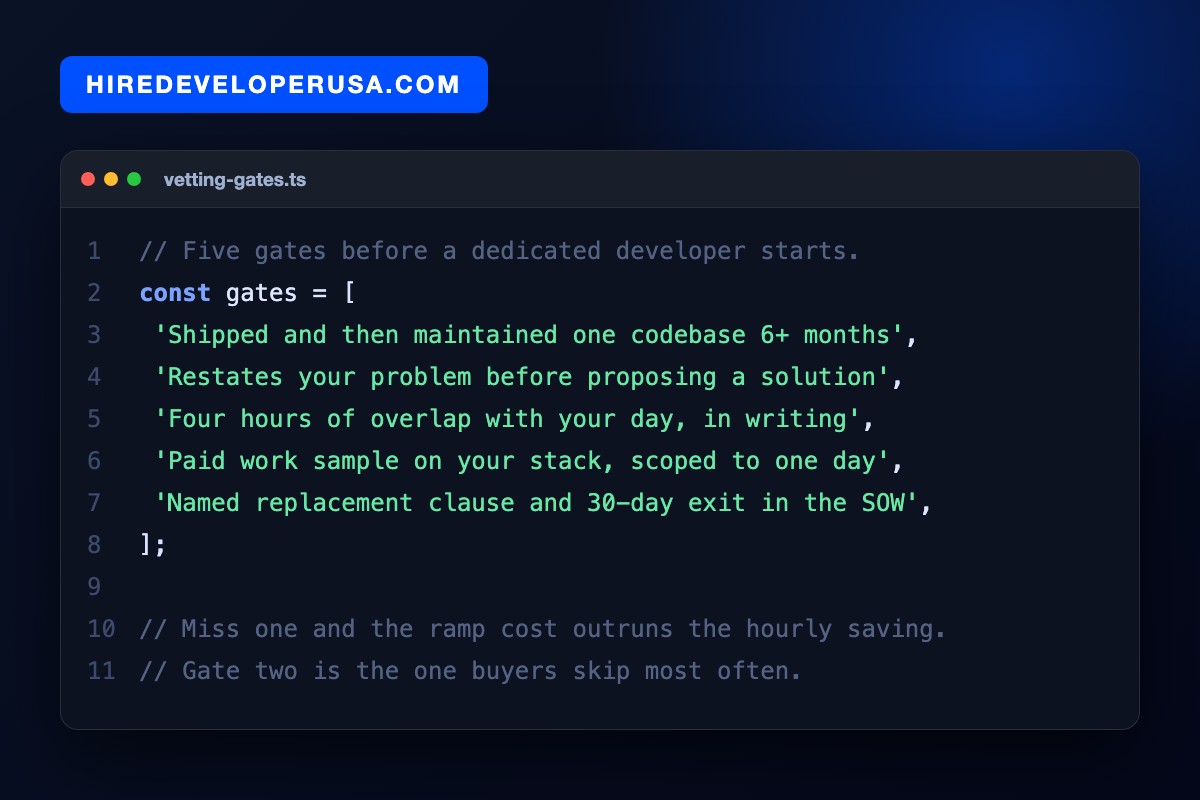
Vetting: the five gates that predict a dedicated hire
Vetting for a dedicated engagement differs from vetting for a short contract. For two weeks of work you only need to know whether someone can execute a defined task. For nine months you need to know whether they can hold context, make decisions without you, and still be there in month seven.
Gate one: maintenance history, not shipping history. Showing a launch is easy. Ask instead for a codebase they shipped and went on to maintain for six months or more, then ask what they regret building that way. Engineers who have lived with their own decisions design differently.
Gate two: they restate the problem before proposing a solution. Walk them through a real problem from your backlog and watch. Before naming any technology, the strongest candidates ask what breaks today and who it affects. Buyers skip this gate more often than any other, yet it is the one that predicts whether you can hand over a goal rather than a specification.
Gate three: written communication under your overlap window. Review their written answers, not just the call. A dedicated remote developer communicates in writing most days. If their updates are vague in the interview, they will be vague in month four.
Gate four: a paid work sample on your stack. Make it one tightly scoped day, paid at their rate. At most rates that comes to less than $1,000, and it tells you more than three interviews would. Unpaid take-homes screen out the candidates who already have options.
Gate five: contractual continuity. Confirm who takes over if they leave, how quickly, and at whose cost. Any vendor unable to answer that is selling you a freelancer with a markup.
Contract terms that decide the next six months
The rate is negotiated hard while the terms get skimmed, and that is backwards. Five clauses do the real work.
Time and materials, with a monthly ceiling. Under pure fixed price, an engineer is pushed to defend the original scope, the opposite of what you want from someone embedded in your product. Pure time and materials with no ceiling takes away your ability to forecast. With a monthly cap you get both: hourly billing, plus a number your finance team can plan around.
A thirty day trial at full rate. Not a discount, not a free trial: a normal first month with an explicit review at the end and a clean exit for either side. Good engineers accept this readily because they are evaluating you too.
IP assignment in writing. Include work for hire language, assignment of all deliverables, and a clause covering anything built before the contract that gets reused. AI assisted code needs addressing too: state that the developer is responsible for the license compatibility of whatever ships.
Access and security. Named accounts and no shared logins, their own machine with disk encryption, and a revocation checklist run on the last day.
Notice and handover. Thirty days for both sides, plus a deliverable, namely a documented environment setup and a brief written handover of open threads. Tie the handover to a payment milestone and it will actually get written.
Running a dedicated developer without becoming the bottleneck
What makes this model fail is not a bad engineer but a buyer who hires a capable developer and then manages them by remote control, writing the solution into the ticket and reviewing against an implementation they imagined themselves. Do that and you become the constraint. Nothing moves faster than your attention, and you have paid senior rates for someone taking dictation.
Lay out the problem and the constraints, and leave the choice of approach to the developer. Minimum standards should protect you from real damage: tests on payment paths, a review before anything touches production data, no direct writes to the live database. Within those limits, let work ship even when you would have done it differently. A good enough solution owned by the person who maintains it usually beats a better one they carry out reluctantly.
Give feedback as you go instead of saving it. When something is wrong in week two, say so in week two, in private and in plain terms. Good work deserves praise where the rest of the team can see it. Nobody should find out in a quarterly review what you have thought since month one, and with a contractor there may be no quarterly review at all.
Finally, treat the first two weeks as a deliberate onboarding, not a test of resourcefulness. Environment running on day one, a first small change merged by day three, access to the people who know the history. Our guide to onboarding a remote developer has the full checklist.
Your next step
Do the arithmetic for your own situation before you shortlist anyone: weekly hours of real engineering demand, times the band matching the seniority you need, times the number of weeks the work truly lasts. Should that come to less than three months, hire a freelancer for the task instead. If it reaches three months or more and you have someone who can set direction, a dedicated developer is the most cost effective way to add senior capacity without adding headcount.
Next, write the one page brief and run the five gates, then put the trial month and the notice period into the contract before the first commit. Together those three steps take about a day of your time, and they decide whether the next $147,200 buys a product or an invoice.
Frequently asked questions
What is a dedicated developer?
An engineer who commits a fixed number of hours a week to your product only, engaged through a marketplace or vendor rather than hired onto your payroll. You manage them directly, the same way you would manage an employee, but the contract and the payroll sit with someone else.
How much does it cost to hire a dedicated developer in the US?
Expect $45 to $65 an hour for junior work, $65 to $95 for a mid-level engineer, and $95 to $120 for a senior. At 40 hours a week over 46 working weeks, a mid-level developer comes to about $147,200 a year, against roughly $156,000 for the same seat in house at a $120,000 base salary once benefits and overhead are added.
Is a dedicated developer better than a freelancer?
Only when the work is continuous. The hourly rates are similar, so the difference is commitment: a dedicated developer holds your context and your hours, a freelancer fits you between other clients. Under three months of work, the freelancer is usually the better value because you are not paying for a ramp you cannot amortize.
How long does it take to get a dedicated developer working?
Sourcing and vetting through a marketplace typically takes one to three weeks, and a competent engineer needs another one to three weeks to become productive in an unfamiliar codebase. Plan for a first meaningful merge within the first week and real velocity by week three or four.
Hire vetted talent