

Key takeaways
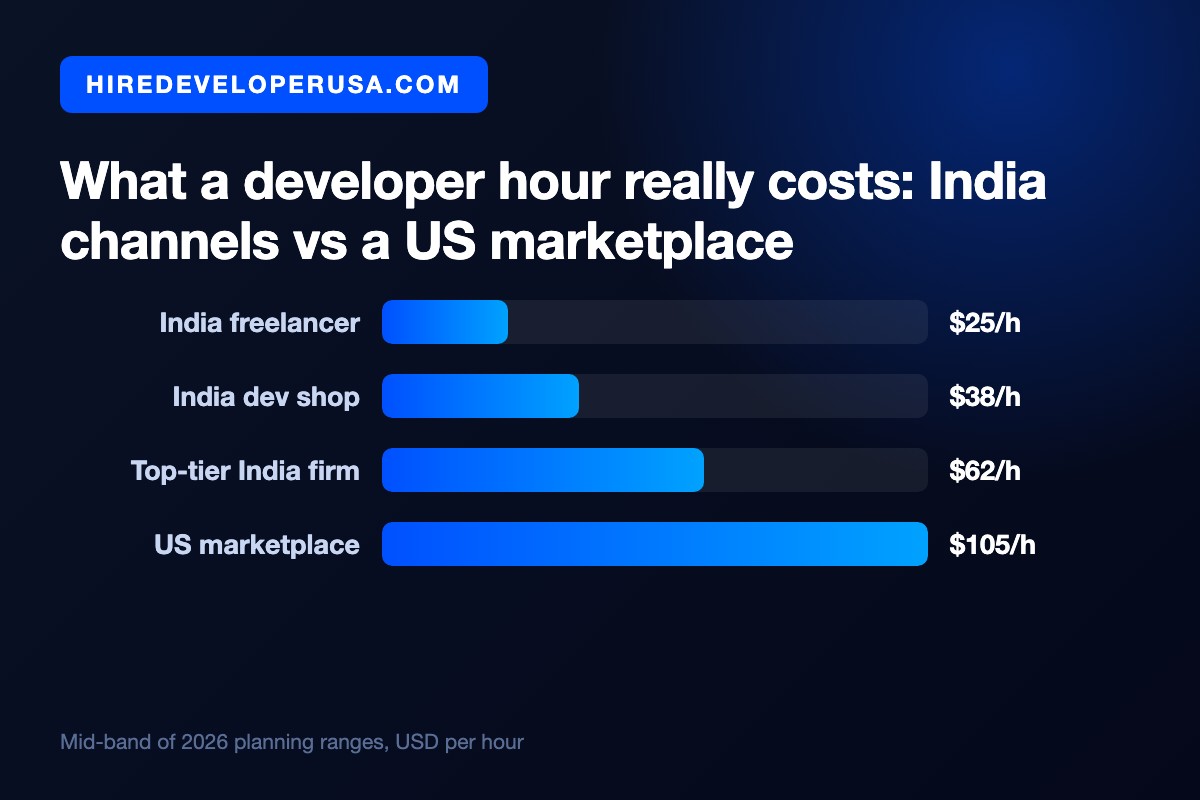
- →Rate bands in India for 2026: $15 to $35 per hour on open freelance platforms, $25 to $50 at mid-market development shops, $45 to $80 at top-tier product engineering firms.
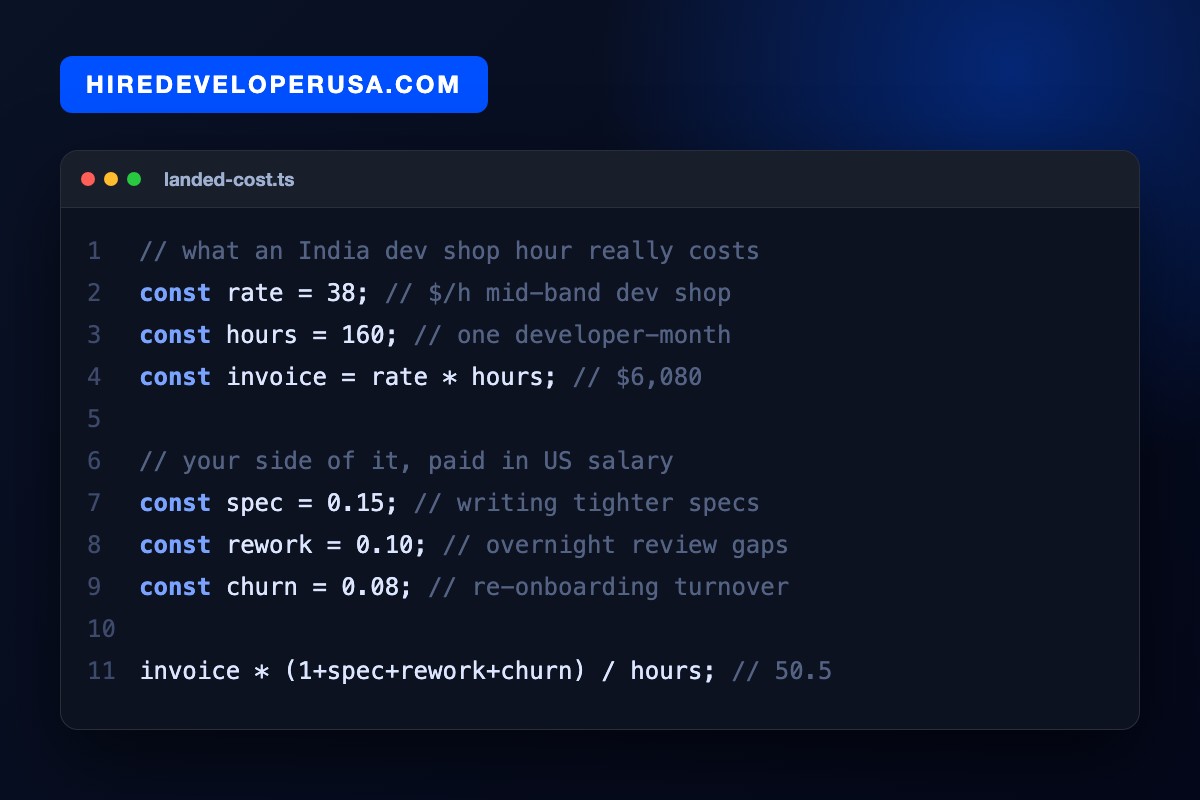
- →Budget a landed cost, not a rate. Adding your own spec writing, rework and churn overhead turns a $38 invoice hour into roughly $51 of real cost.
- →Attrition and a junior-heavy team pyramid are the two structural risks. Name individual engineers in the contract and require an allocation table.
- →A 2pm to 11pm IST shift buys about 4.5 overlap hours with New York and about 1.5 with San Francisco. West Coast teams must be async-first or they will drift.
- →Vet on a paid trial ticket in your own codebase, and test comprehension by asking the engineer to restate the requirement and name its ambiguities.
You can hire developers in India for roughly $15 to $80 per hour in 2026, depending entirely on which channel you buy through. Independent freelancers sit at the bottom of that range, mid-market development shops in the middle, and top-tier product engineering firms at the top. Measured against a US vetted marketplace mid-band of about $105 per hour, the mid-band of each Indian channel lands roughly 40 to 75 percent lower. The gap is real. It is also the least interesting number in the decision.
What actually decides whether an India engagement works is how much of the specification, review and management work stays on your side of the ocean, and whether the channel you picked can keep a senior engineer on your project long enough to finish it. This guide covers the bands by channel, the costs that never show up on an invoice, the time zone arithmetic nobody does before signing, and a vetting sequence that filters candidates before you are committed to them.
What it costs to hire developers in India in 2026
Rates in India spread wider than in any US market, because the label "developer" covers a fresh graduate on a body-shop bench and a staff engineer running a payments platform. Here are the planning ranges worth budgeting against:
| Channel | Typical hourly | What you actually get |
|---|---|---|
| Open freelance platforms | $15 to $35 | One individual. You do all sourcing, vetting, specs and project management. |
| Mid-market development shop | $25 to $50 | A small team with a coordinator. Quality varies enormously between shops at the same price. |
| Top-tier product engineering firm | $45 to $80 | Senior-weighted teams, real engineering process, contractual retention terms. |
| US vetted marketplace (for reference) | $60 to $150 | Pre-screened individuals, US contract law, overlapping working hours. |
At the mid-band those channels come out around $25, $38, $62 and $105 per hour respectively. Two things follow from that spread. First, the cheapest India option is not competing with the expensive one on quality, it is competing on who carries the risk. Second, once you climb into the $60 to $80 band for a genuinely senior Indian engineer, the arbitrage against a mid-level US contractor gets thin enough that the decision stops being about money at all. For the full US-side picture, see our breakdown of what it costs to hire a software developer and current freelance developer hourly rates.
Where the senior talent actually sits
India is not one hiring market. Bengaluru, Hyderabad, Pune, Chennai and the National Capital Region around Gurugram and Noida hold the overwhelming majority of experienced product engineers. Tier-two cities such as Ahmedabad, Kochi, Coimbatore and Indore quote noticeably lower and can be excellent for well-defined maintenance, QA and data work, but the pool of engineers who have shipped and owned a complex product is thinner there.
The structural fact that matters more than geography is the shape of the pyramid. India produces an enormous supply of junior engineers every year and a comparatively small number of engineers with ten or more years of real ownership experience. Global capability centers set up by large multinationals have absorbed a large share of that senior layer with compensation and stability the open vendor market struggles to match. The practical consequence for a US buyer is simple: junior capacity in India is abundant and cheap, senior capacity is scarce and contested, and a quote that looks too good usually means you are buying the former while being shown the latter.
That is also why stack matters. Mainstream enterprise work in Java, .NET and Node.js has deep supply at every level. Newer or narrower specialisms price closer to global rates, because the handful of people who do them well have offers from everywhere.

The three costs that eat the rate advantage
Offshore engagements rarely fail on the hourly rate. They fail on three costs that sit outside the invoice entirely.
Attrition. Job mobility is the defining feature of the Indian IT labor market, and it is a direct consequence of the same abundant supply that keeps prices low. Engineers move for step-change raises, and vendors backfill with whoever is on the bench. Every swap costs you context, and context is the expensive part of software. Mitigate it contractually: name the individual engineers in the statement of work, require written notice and a paid overlap period before any replacement, and ask the vendor for its actual twelve-month attrition figure on comparable accounts.
The seniority pyramid. A cheap blended rate is usually a junior-heavy team with a senior architect allocated at ten or twenty percent. That can work if the work is well trodden and the architect is genuinely engaged. It fails badly on anything requiring judgment. Ask for the allocation table by name, seniority and percentage, and make it a contractual attachment rather than a slide.
Specification burden. Cheap execution demands expensive precision. A local senior engineer fills gaps in a ticket by asking you in the hallway. A team nine and a half hours away fills them by guessing, and you discover the guess a day later. Whatever specification discipline you have today, an offshore engagement needs materially more of it, and that work is done by someone on a US salary.
The useful exercise is to stop comparing rates and start modeling a landed cost. Take the invoice rate, add your own overhead for spec writing, rework from async review gaps, and the amortized cost of team churn, then divide back out. The percentages below are planning assumptions to replace with your own, not measurements, but the shape of the result holds:
Time zone math: how many hours you really share
India Standard Time runs at UTC+5:30, which puts it nine and a half hours ahead of US Eastern and twelve and a half ahead of US Pacific during daylight time. A team keeping conventional Indian office hours of roughly 10am to 7pm IST is finishing its day at 9:30am Eastern and starting it in the middle of the American night. That configuration gives an East Coast company about half an hour of genuine overlap and a West Coast company none at all.
Most serious offshore teams therefore run a shifted schedule, commonly around 2pm to 11pm IST. Run the arithmetic against a 9am to 5pm US business day and the picture is much better, though still lopsided across the country:
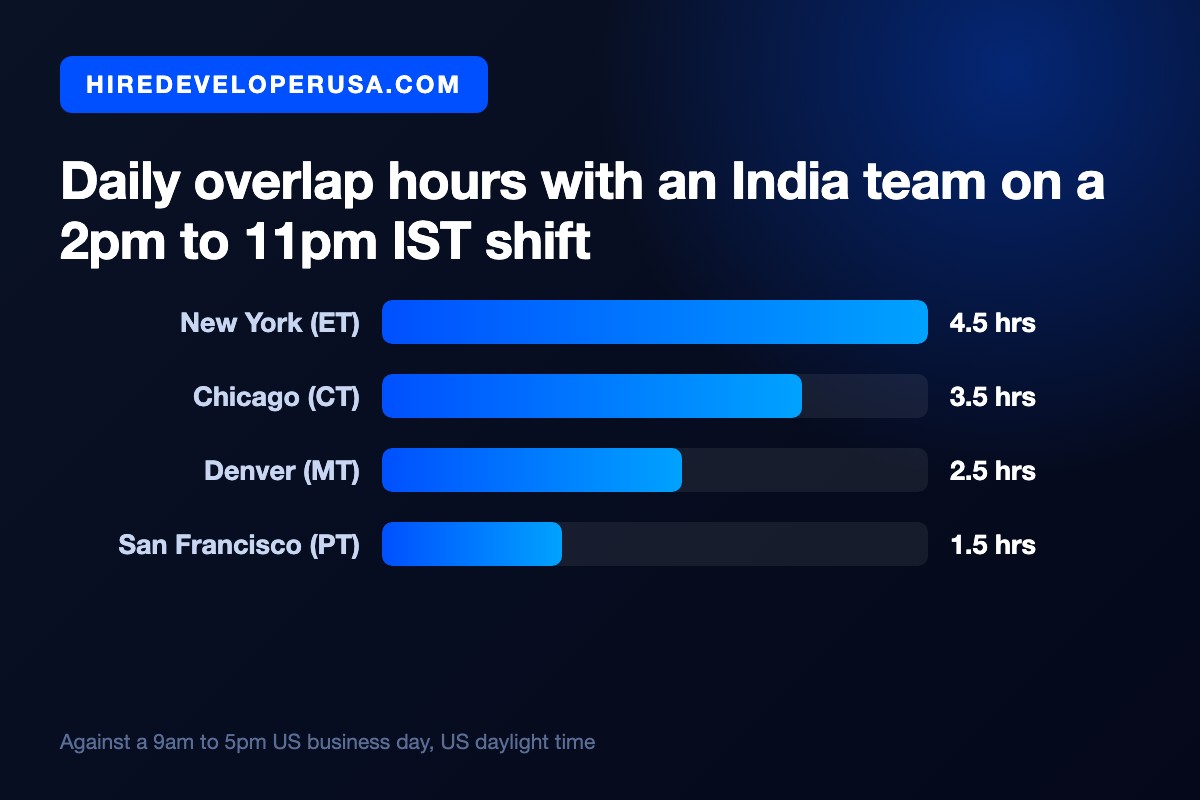
Four and a half hours is a workable collaboration window. Ninety minutes is not, and pretending otherwise is how West Coast startups end up with an offshore team that ships the wrong thing for a month. If you are on Pacific time, either budget for a genuinely async-first operating model or expect one side to work unsociable hours permanently, which is its own attrition driver.
What makes the shared window work is protecting it. Keep it free of status meetings, use it for decisions and unblocking only, and require that every decision reached in it is written down in the ticket before the window closes. Anything settled verbally and not written is effectively lost by the next morning. A weekly demo of running software, not a slide deck, keeps drift measurable.
How to vet Indian developers before you commit
The single biggest predictor of a good offshore outcome is whether you vetted the individuals or the logo. Vendors will resist the first and offer the second. Insist anyway.
- Screen the arrangement, not the brand. Ask exactly who will write the code, their seniority, their allocation percentage, how long each has been at the company, and what happens contractually if one leaves. Vague answers here predict everything that follows.
- Interview the actual engineers on camera. No account manager translating, no proxy candidates. If the person on the call is not the person on the keyboard, walk away. This is the most common failure mode and the easiest one to prevent.
- Run a comprehension test, not just a coding test. Give a deliberately slightly ambiguous requirement and ask the engineer to restate it in their own words and list what is unclear. English fluency in Indian tech is generally high, but shared vocabulary is not the same as shared meaning. An engineer who surfaces three ambiguities before writing code is worth double one who says yes to everything.
- Pay for a real trial ticket. Three to five days on an actual issue in your actual codebase, scoped so a strong engineer finishes in two. Never a take-home puzzle, which tests the wrong things and is easily outsourced.
- Judge the pull request. Tests, edge cases, commit hygiene, and above all the questions asked before starting. A clean demo of a feature that ignores your error handling conventions is a red flag, not a pass.
That sequence works whether you are hiring a full-stack developer in Pune or a contractor in Ohio. The difference offshore is that skipping a step costs more to unwind. If you would rather not run the funnel yourself, this is precisely what a vetted marketplace exists to absorb; how our matching works covers the process end to end.
Contracts, IP and payment: the paperwork that protects you
Rate negotiation gets all the attention and the contract gets skimmed. Reverse that. Five clauses do most of the protective work:
- Explicit IP assignment, signed individually. A master agreement with the vendor entity is not sufficient on its own. Every engineer who touches the code should have a signed assignment, and you should be able to see them. Work-for-hire doctrine does not transplant cleanly across jurisdictions, so make the assignment express rather than assumed.
- Governing law and venue you can actually use. Name a US state. Cross-border enforcement is slow and expensive enough that in practice the clause works by deterrence, which only happens if it is unambiguous.
- Data handling scoped to the work. No production data in development environments, named individuals on access lists, and a data processing agreement if you touch regulated health, financial or personal data. Access should be revocable by you, not by the vendor.
- Milestone-based payment. Never pay a large amount fully in advance. Tie tranches to accepted, demonstrated deliverables, and keep a final retention until handover is complete and documented.
- Key-person, notice and offboarding terms. Named engineers, a notice period, a paid overlap for any replacement, and a defined handover of credentials, documentation and repository access. The offboarding clause is the one people regret omitting.
One classification point worth raising with counsel: engaging individuals in India directly, rather than through a vendor entity, can create employment and tax exposure depending on how the relationship is structured. If you want a full-time person rather than a contracted deliverable, an employer of record is usually the cleaner instrument.
When India is the right call, and when it is not
India is a strong choice when the work is well understood, long-running and specification-friendly. Platform maintenance, QA automation, data engineering pipelines, enterprise integrations and steady feature delivery on a mature codebase all play to its strengths, particularly when you have a capable internal tech lead who can write clear tickets and review code properly. On a twelve month horizon with that lead in place, the economics are genuinely compelling.
It is the wrong call when requirements are still being discovered, when you are non-technical with nobody internal to own quality, when the deadline is tight enough that a one-day question loop is fatal, or when the work needs constant real-time collaboration with your product and design people. Pre-product-market-fit startups on the West Coast tick most of those boxes at once, which is why so many of them tell the same disappointing story.
The hybrid model resolves most of this: a senior US-hours engineer who owns architecture, code review and specification, with offshore capacity underneath for execution. You pay a US rate for the judgment and an India rate for the volume, and the review loop closes inside a single working day. Our savings calculator is a reasonable way to sanity-check that split against a fully in-house team before you commit to either.
Your next step
Before you request a single quote, write down three things: the exact scope of the first ninety days, who on your side will review the code, and what your walk-away trigger is. Teams that have those three answers get good outcomes from India far more often than teams that start by comparing rate cards, because all three are the things a rate card cannot tell you.
Then run the funnel properly: two or three vendors, named engineers interviewed on camera, a paid trial ticket in your own repository, and a contract with key-person and offboarding clauses before any large payment. If you would rather skip the sourcing and go straight to interviewing pre-screened engineers who already work US hours, that is what we do.
Frequently asked questions
How much does it cost to hire developers in India?
Expect $15 to $35 per hour for an independent freelancer, $25 to $50 per hour at a mid-market development shop, and $45 to $80 per hour at a top-tier product engineering firm. Senior specialists in scarce fields price at or above the top of that range. Budget an additional 25 to 35 percent of your own overhead for specification, review and churn, which is where a $38 rate realistically lands closer to $51.
Is it cheaper to hire developers in India or through a US marketplace?
On rate, India wins clearly: roughly $38 per hour mid-band against about $105 for a US vetted marketplace. On total delivered cost the gap narrows a lot once you account for the specification work, review latency and management time that stay on your payroll. India is usually the better economics for long-running, well-specified work; a US marketplace usually wins for short, ambiguous or deadline-critical projects.
How do I manage the time zone difference with a team in India?
India Standard Time is 9.5 hours ahead of US Eastern and 12.5 ahead of US Pacific. Ask for a shifted schedule of roughly 2pm to 11pm IST, which yields about 4.5 overlap hours with the East Coast and 1.5 with the West Coast. Protect that window for decisions rather than status updates, require every decision to be written into the ticket before it closes, and run a weekly demo of working software.
Do I own the code if I hire developers in India?
Only if the contract says so explicitly and each individual engineer has signed an IP assignment. A master services agreement with the vendor entity alone is not enough, because work-for-hire assumptions from US law do not transfer automatically across jurisdictions. Name a US governing law and venue, and hold a payment retention until repository access, credentials and documentation have been handed over.
Hire vetted talent