
Key takeaways
- →Five models cover the market: staff augmentation, dedicated team, project-based, managed services, and build-operate-transfer.
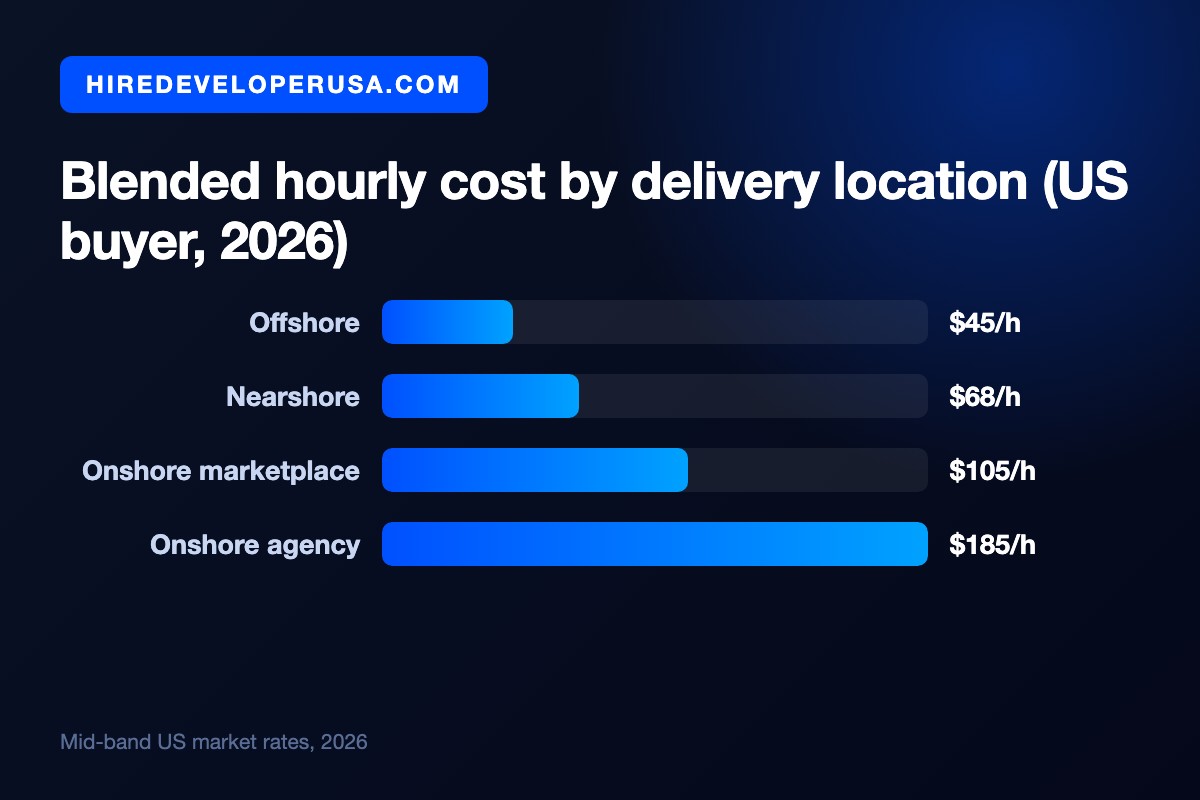
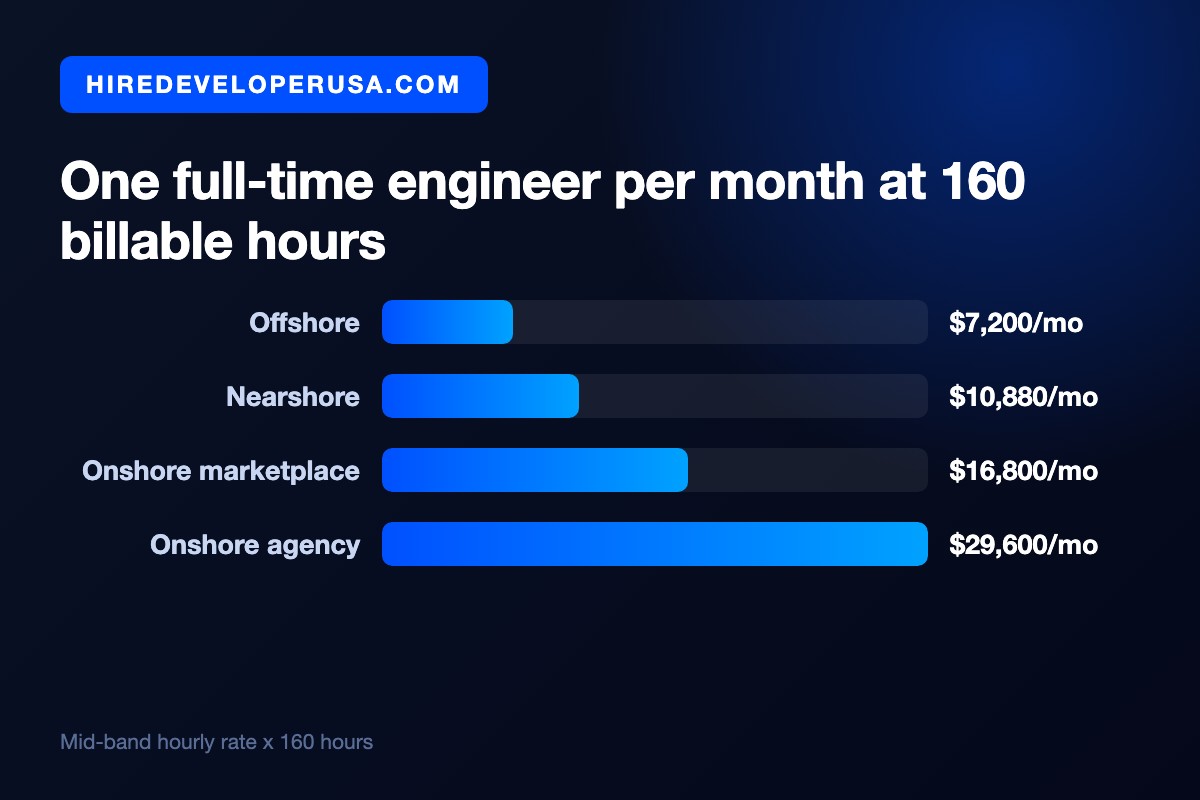
- →Delivery location moves the rate card further than the model does: $25 to $65 per hour offshore against $120 to $250 for an onshore agency.
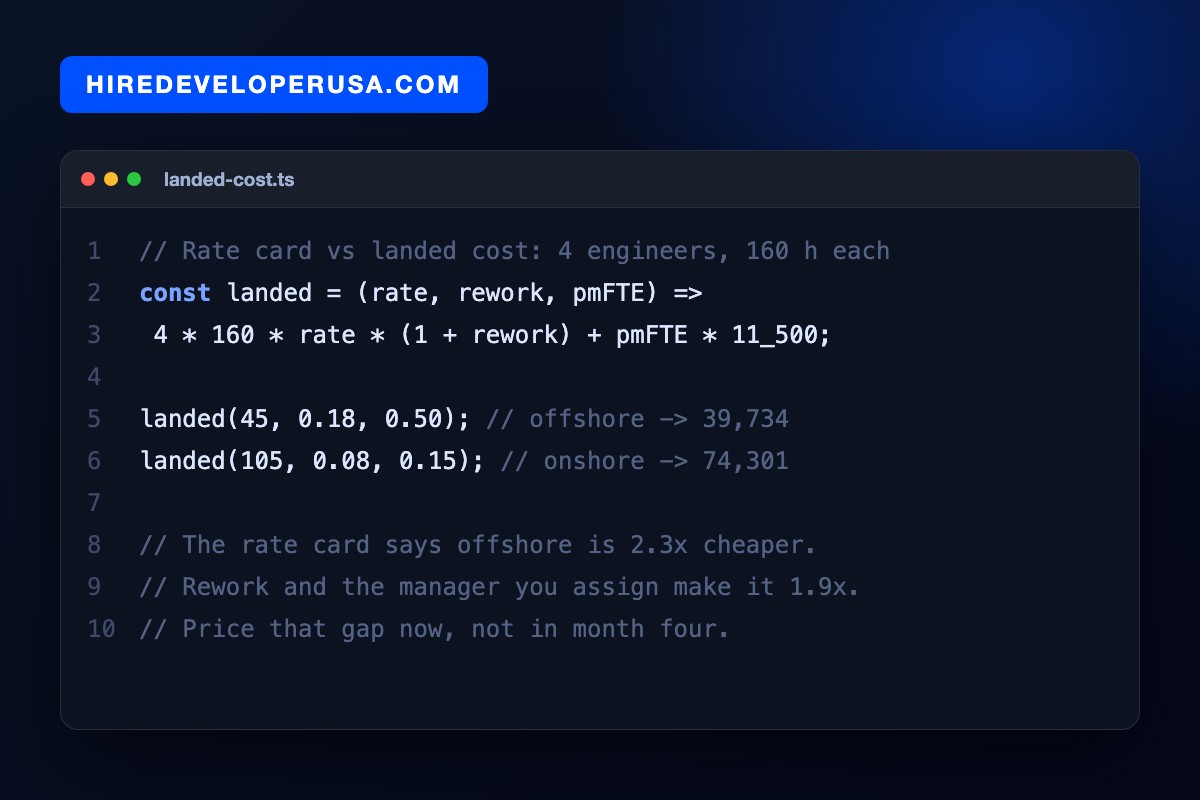
- →Landed cost closes most of the gap. Add rework and your own manager and a 2.3x rate difference lands at roughly 1.9x.
- →Fixed price transfers estimate risk to the vendor, who prices it in at roughly twenty to forty percent over the same scope billed hourly.
- →A two-week paid pilot on a real ticket predicts the engagement better than any reference call or proposal.
IT outsourcing services in 2026 come down to five models, and the model you choose moves your bill further than any rate you negotiate. Staff augmentation rents you engineers that you manage, at $25 to $65 per hour offshore, $45 to $90 nearshore and $60 to $150 through an onshore vetted marketplace. A dedicated team gives you a standing squad billed monthly, roughly $7,000 to $12,000 per engineer offshore and nearshore, $16,000 to $30,000 onshore. Project-based work buys a deliverable for a quoted price, usually with a $120 to $250 blended hourly rate hidden behind it. Managed services buys a service level rather than hours, commonly $100 to $200 per user per month for IT support. Build, operate and transfer buys a team abroad that eventually becomes your own entity.
The ranges are wide because each model shifts a different amount of risk and management work onto you. This guide prices all five the way a finance team would want them priced: the quoted number, the work it leaves on your side of the table, and the specific way each arrangement goes wrong.
The five IT outsourcing models, side by side
Vendors use these labels loosely, and two companies will sell you very different things under the same word. The useful distinction is not the name but the answer to one question: who decides what gets built next, and who is accountable when it is late.
| Model | What you are buying | Typical US cost, 2026 | Best for | Where it breaks |
|---|---|---|---|---|
| Staff augmentation | Engineers who join your team and take your direction | $25 to $65/h offshore, $45 to $90/h nearshore, $60 to $150/h onshore vetted | Filling a known skill gap on a team that already ships | Your own management capacity is the real constraint |
| Dedicated team | A standing squad with its own lead, billed monthly per head | $7,000 to $12,000 per engineer/month offshore and nearshore, $16,000 to $30,000 onshore | Product work with a horizon beyond twelve months | You cannot keep a roadmap in front of them |
| Project-based | A defined deliverable for a quoted price | $40,000 to $400,000 per project, priced behind a $120 to $250/h blended rate | A bounded build with a specification that will not move | The specification moves, and every change is a change order |
| Managed services | An outcome and a service level, not hours | $100 to $200 per user/month for IT support, or a fixed monthly retainer for application support | Run and maintain work: helpdesk, infrastructure, monitoring | You need product judgment and the contract only promises uptime |
| Build, operate, transfer | A vendor stands up a team abroad, then hands you the entity | Setup fee plus monthly per head, plus a transfer fee commonly worth several months of run cost | Committing to an engineering center you intend to own | You are not certain you will still want it in three years |
Read the last column first. Most buyers choose on price and discover the failure mode in month four, when the cheap option has quietly consumed a senior manager and the expensive option is sending invoices for work nobody asked for. If you are weighing outsourcing against an internal hire, our breakdown of what it costs to hire a software developer prices the in-house side of the same decision.
Location moves the price more than the model does
Swap a project-based contract for staff augmentation and you might move your blended rate twenty percent. Move the same work from an onshore agency to an offshore team and the rate card drops by three quarters. Geography is the biggest single lever in IT outsourcing pricing, which is exactly why it attracts the most wishful thinking.
Four arrangements are worth naming. Onshore means a US provider in your time zone, the highest price and the lowest coordination tax. Nearshore means Latin America or Canada, with one to three hours of offset, which preserves same-day review cycles at a meaningful discount. Offshore means Eastern Europe, South Asia or Southeast Asia, the lowest rate card and an eight to twelve hour offset that forces you to work in written handoffs. Onsite means the vendor's people in your building, priced at a premium and usually reserved for regulated or security-sensitive work.
The offset is the part buyers underprice. A team eleven hours away does not cost you time zone inconvenience, it costs you round trips. A question that takes four minutes in a shared afternoon takes a day when it has to wait for an overlap window. Two or three of those in a sprint and you have lost the week. Teams that make offshore work do one of two things: they buy four hours of guaranteed overlap in the contract, or they invest in specifications detailed enough that questions rarely need asking. Most buyers budget for neither.
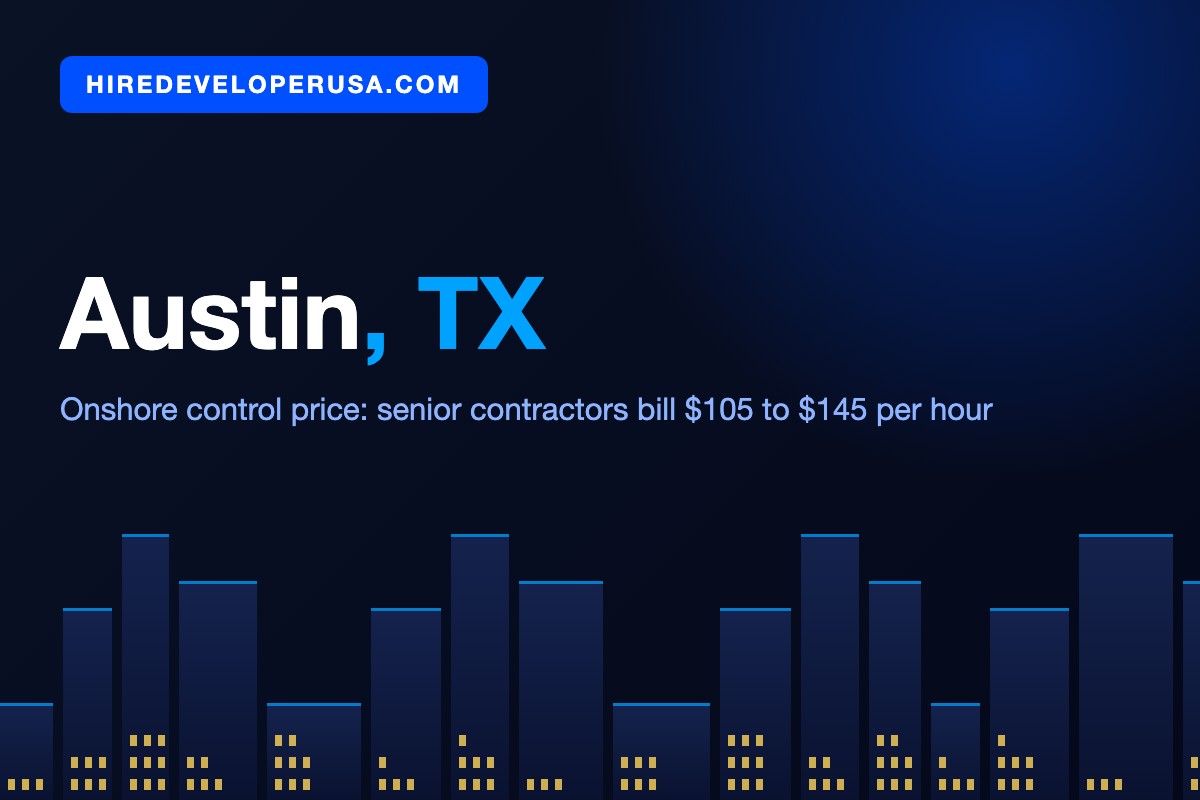
Before you accept any offshore quote, price the onshore version of the same role so you know what you are trading away. In a US tech metro such as Austin, a senior contractor bills roughly $105 to $145 per hour, and that number is the control in the experiment. A quote at a third of it is not automatically a saving; it is a hypothesis about how much coordination you are willing to absorb. Current bands by stack sit on our full-stack developer rates page.
What the rate card leaves out
Every outsourcing quote prices the hours the vendor bills. It never prices the hours you spend, and that is where the comparison between a $45 engineer and a $105 engineer actually gets decided.
Three costs sit on your side of the invoice. The first is management load. A four-person offshore squad with a large time zone offset typically absorbs half of a US product manager or tech lead: writing the specifications that replace conversation, reviewing work in batches, and unblocking at odd hours. The same squad onshore might take fifteen percent of that person. At a loaded $11,500 a month for the manager, that difference alone is over $4,000 a month.
The second is rework. Work that misses the intent gets redone, and the rate of missing it rises with distance from the people who hold the context. The third is ramp. Nobody is productive in week one, and the vendor bills week one. On a six-month engagement a two-week ramp is seven percent of the contract before anything ships.
Put plausible figures on those three and the famous offshore saving compresses fast.
How the work gets priced, and who carries the risk
Underneath the delivery model sits a pricing structure, and the structure decides who pays when the estimate is wrong. There are four in common use.
Fixed price transfers estimate risk to the vendor, and they price that risk in. A fixed quote for genuinely well-understood work is good value. A fixed quote for discovery work is a bet that one of you will lose, and vendors who do this for a living rarely lose it. Expect a fixed-price number to carry a contingency of twenty to forty percent over the same scope billed hourly.
Time and materials keeps the risk with you and keeps the price honest. It is the right default for anything where the second month's work depends on what the first month teaches you. Protect yourself with a not-to-exceed ceiling per phase rather than by arguing about the hourly rate.
Monthly retainer, which is how most dedicated teams and managed services are sold, buys capacity rather than output. It is predictable and easy to forecast, and it bills whether or not you have fed the team anything worth doing. Retainers reward buyers with a real roadmap and quietly punish everyone else.
Outcome-based pricing ties payment to a measured result. It sounds like the obvious answer and it is rare for a reason: it only works when the metric is unambiguous, attributable to the vendor, and visible within the contract term. Most software work fails at least one of those tests.
The contract clauses that decide whether the price holds
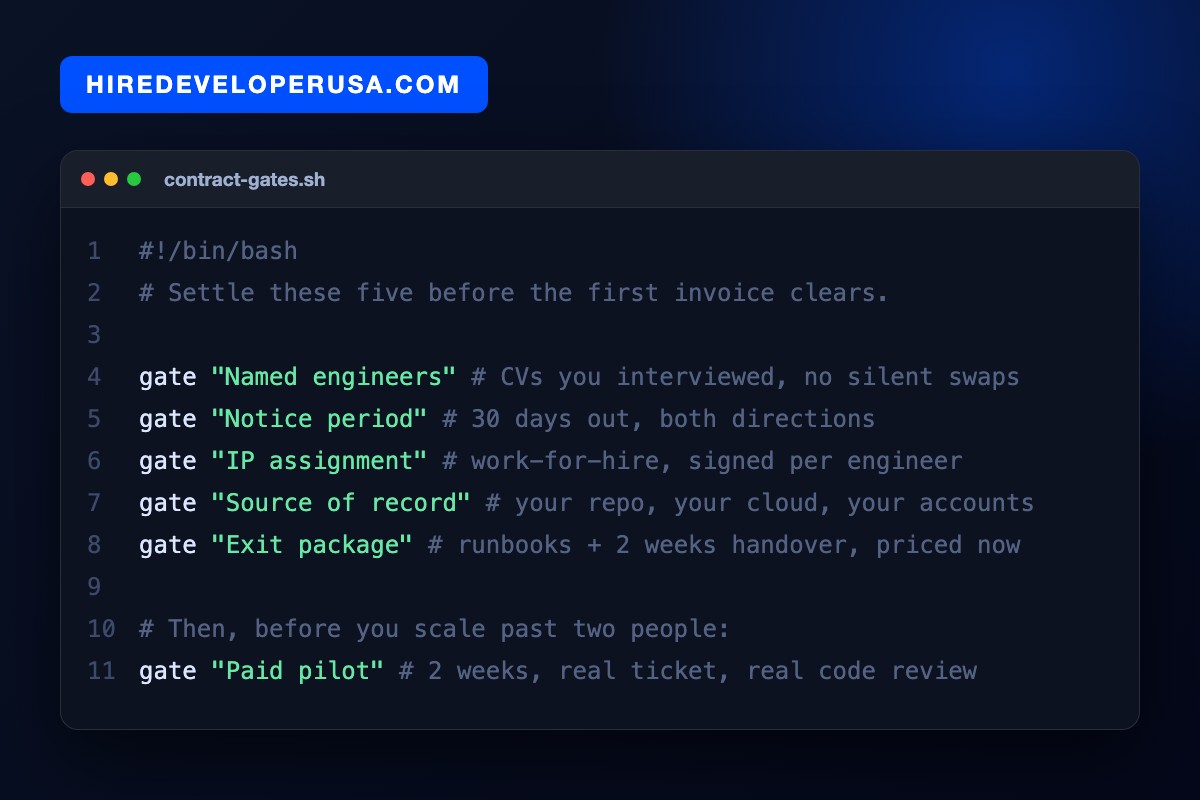
Outsourcing disputes almost never start with the rate. They start with something both sides left vague because settling it would have slowed down the signature. Six items are worth the delay.
Named engineers. You interviewed specific people. Say so in the contract, and require written notice before a substitution. Silent swaps after month two are a recurring complaint about outsourced teams, and they are trivially preventable.
Notice period. Thirty days in both directions. Anything longer locks you into a team you have already decided is wrong; anything shorter means the vendor can pull your people onto a better-paying account.
IP assignment. Work-for-hire language signed by each individual engineer, not only by the vendor entity. In several outsourcing jurisdictions a company-level assignment does not automatically bind the contractor who wrote the code.
Source of record. Your repository, your cloud accounts, your CI. If the vendor hosts the code during the build, you are negotiating from a weak position the day you want to leave.
Exit package. Price the handover while you still like each other: runbooks, architecture notes and two weeks of overlap with whoever takes over. An unpriced exit is an expensive exit.
A paid pilot. Two weeks, one real ticket from your actual backlog, reviewed by your own engineers. It costs a few thousand dollars and it tells you more than any reference call. Score it on the pull request and the questions they asked, not on how polished the demo call was.
Where IT outsourcing actually loses money
Across the engagements that go badly, the money rarely leaks through the rate. It leaks through five recognizable patterns.
Buying capacity before you have scope. A retainer signed in optimism bills every month while your roadmap catches up. If you cannot name twelve weeks of work today, buy hours, not a team.
Outsourcing the part you do not understand. Handing over the system you have never been able to specify does not remove the problem, it moves it somewhere you can no longer see it. Outsource the work you could do yourself but should not; keep the work you cannot yet describe.
No internal technical counterpart. Someone on your side has to read the code, run the demo and say no. Without that person the vendor's estimates become unfalsifiable and quality drifts for months before anyone notices.
Scope creep without a price. Mid-project additions that never get costed are how a $90,000 project becomes a $160,000 project with nobody able to point at the decision. Every addition should name the hours it adds and the ship date it moves. The same discipline drives most of the savings in our piece on how to reduce software development costs.
Treating a bad fit as sunk cost. Six weeks in, you usually know. The cost of stopping is one notice period. The cost of hoping is the rest of the contract plus the rebuild.
Your next step: a 90-day decision path
You do not need to pick the right model on day one. You need to make the expensive decision reversible.
Weeks 1 and 2: write down the twelve weeks of work you are actually buying, name the internal person who will review it, and decide whether you are buying hours, a team or a deliverable. If you cannot fill in all three, you are not ready to sign a retainer.
Weeks 3 to 6: run paid pilots with two vendors on the same real ticket. Compare the pull requests, not the proposals. Score communication latency alongside code quality, because on a distributed team those two costs are the same cost.
Weeks 7 to 12: scale the winner to a maximum of three people, with the six contract gates in place and a thirty-day notice on both sides. Review the landed cost, not the invoice, at the end of the quarter.
If the shape you need is engineers who work your hours without the overhead of standing up a vendor relationship, start with offshore developers who overlap with US business hours, or browse the full catalog of software developers by stack. Either way, buy two weeks before you buy two years.
Frequently asked questions
What is the difference between staff augmentation and managed services?
Staff augmentation gives you engineers who take your direction, so you keep the planning, review and accountability. Managed services gives you an outcome and a service level, so the vendor owns the how. The practical test is who gets blamed for a missed deadline: with staff augmentation it is you, with managed services it should be written into the contract.
How much can a US company realistically save by outsourcing offshore?
The rate card difference between an offshore engineer and an onshore agency is often three to four times. Once you add rework and the internal manager a distant team absorbs, the realistic landed saving on a four-person squad is closer to forty-five percent. That is still substantial, but it is not the number on the proposal.
Is fixed price or time and materials better for outsourced software?
Fixed price suits work you can fully specify in advance, such as a migration with a known inventory. Time and materials suits anything where the second month depends on what the first month teaches you, which covers most product development. A not-to-exceed ceiling per phase gives you most of the budget protection of a fixed price without paying the contingency.
What should a first outsourcing engagement look like?
Two weeks, one real ticket from your own backlog, paid, reviewed by your engineers, run with two vendors in parallel if you can afford it. Then scale the winner to no more than three people with a thirty-day notice period on both sides. The point of the first engagement is information, not throughput.
Hire vetted talent