
Key takeaways
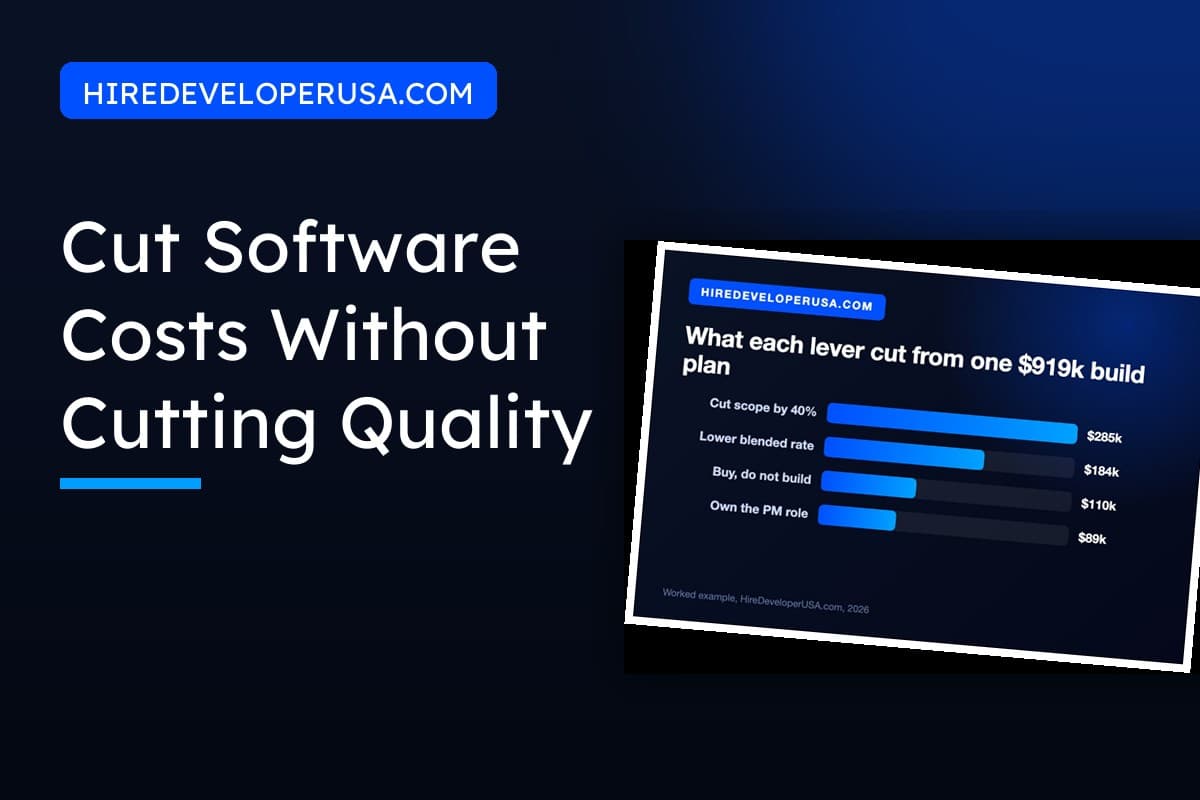
- →Scope is the biggest lever: removing 40 percent of planned hours took $284,900 out of the worked example, more than the change of rate did.
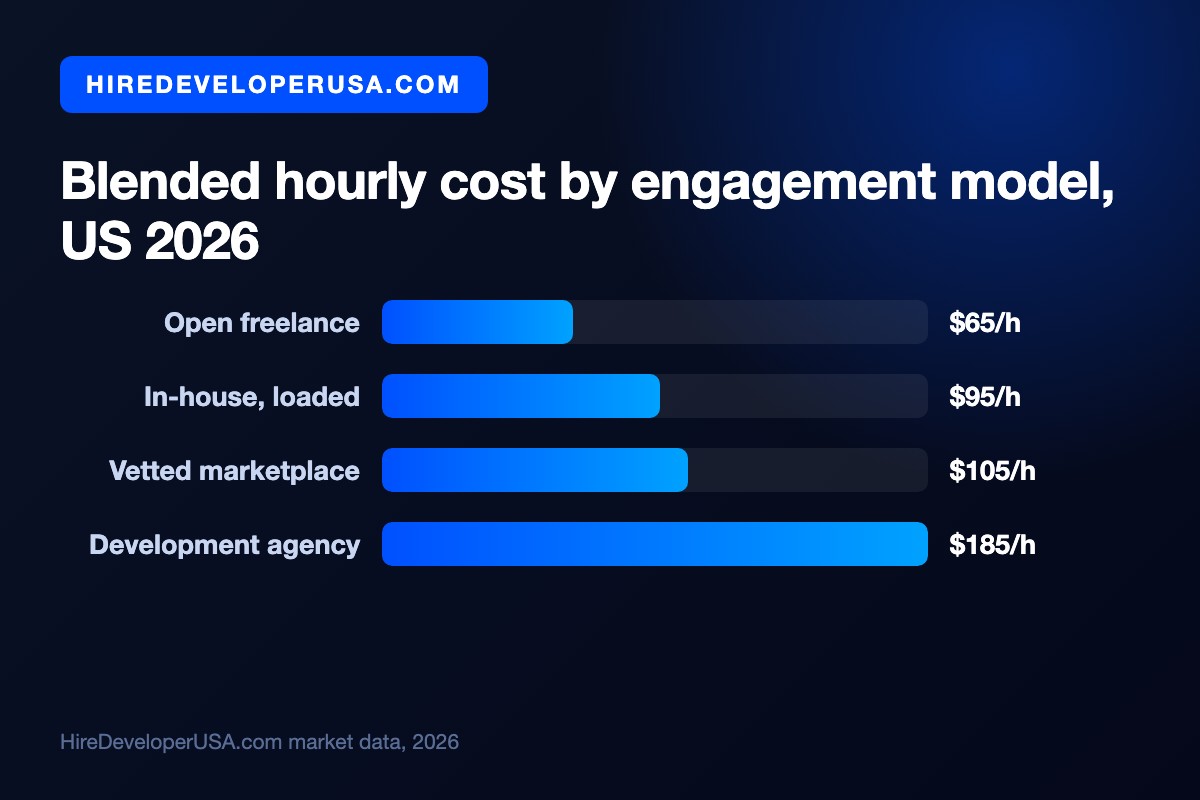
- →US bands to budget against: open freelance $30 to $100 per hour, vetted marketplace $60 to $150, agency $120 to $250, in-house $95,000 to $200,000 base plus 25 to 40 percent loading.
- →Buying auth, billing and search instead of building them turned a $120,000 line item into roughly $9,600 in year one, with a recurring cost to plan for.
- →One senior plus two mid-level engineers usually beats four mid-level engineers on both output and coordination cost.
- →Never cut vetting, testing or security review: rework is the most expensive line in any software budget and it never appears on the quote.
You reduce software development costs by removing work, not by shopping for a cheaper hourly rate. Four levers do most of the job: cut scope to the workflow that earns money, shape the team around that scope instead of adding headcount, buy the parts of the stack that are not your product, and stop paying twice for the same feature. Rate matters too, and the US bands are in the first table below, but on a typical project it moves less money than scope does.
Here is that claim in dollars. A six-month internal build priced at $919,200 comes down to $251,100 once all four levers are pulled. The arithmetic is below, lever by lever, with the US rate bands behind it and the three line items you should never cut to hit a number.
Where a software budget actually goes
Nearly every dollar in a software budget is hours multiplied by a rate. Cloud, licenses and tooling rarely clear ten percent of year one on a standard business application, and they are the first place most buyers go looking for savings. The levers that work are the ones that change how many hours get billed, or who bills them.
| Engagement model | Typical US cost | What the price buys | Where it leaks |
|---|---|---|---|
| Open freelance platform | $30 – $100/hour | Lowest sticker price, fastest start | You absorb vetting, management and replacement risk |
| Vetted marketplace | $60 – $150/hour | Pre-screened engineers, no recruitment fee | Still needs product direction from your side |
| Development agency | $120 – $250/hour | Delivery ownership, project management included | Management and sales overhead sit inside every hour |
| In-house full-time | $95,000 – $200,000 base | Long-term ownership of the product | 25 to 40 percent on top for benefits and overhead, plus months to hire |
Those bands are wide on purpose, because seniority and stack scarcity move them more than anything else. We break them down role by role in our guide to what it costs to hire a software developer, and technology by technology on the developer rates pages.
Lever 1: cut scope before you cut rates
The cheapest hour is the one you never buy. Most first drafts of a project plan contain a core workflow that pays for the project, and a ring of features around it that exist because somebody asked for them in a meeting. Pricing the ring separately is the single most useful thing a buyer can do.
Run it this way. List every planned feature, then mark the ones a user has to touch to finish the job the product exists for. That subset is release one. Everything else keeps its place in a backlog with an hour estimate attached, so the next conversation about it is a price rather than a preference.
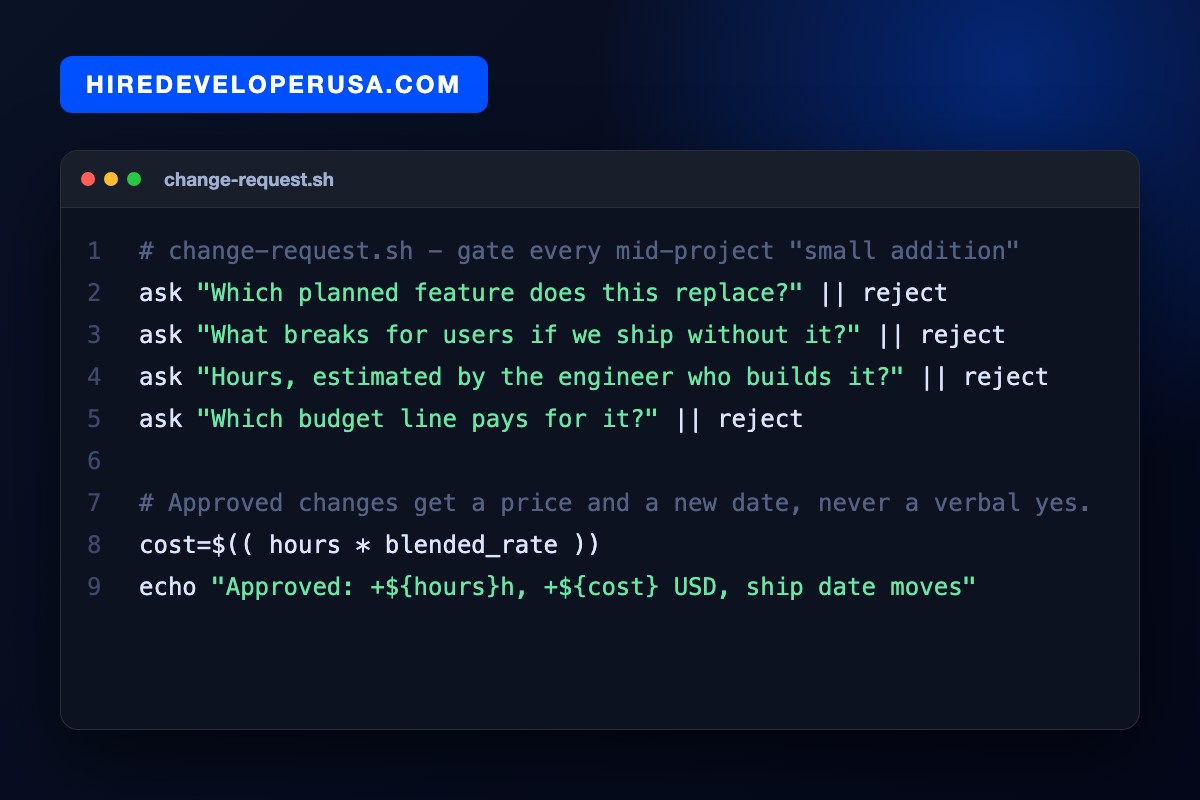
Scope creep almost never arrives as one big request. It arrives as a run of reasonable small ones, each defensible on its own, none of them re-priced. A written change gate fixes that without making anyone the department of no: every addition has to name the feature it replaces, the hours it costs and the budget line it comes from.
Estimating in ranges instead of single numbers keeps that gate honest, because a range makes the uncertainty visible to everyone signing off. The mechanics are in our guide to estimating software development costs.
Lever 2: shape the team around the scope, not the org chart
Headcount is not throughput. Adding a fifth engineer to a plan with one well-understood workflow usually buys more standups, a longer review queue and more merge conflicts, not more shipped features. Every pair of people on a project is another line of communication somebody has to maintain.
On a small build, a better default is one senior engineer at roughly $130 per hour plus two mid-level engineers at roughly $90, instead of four mid-level engineers at $90. The blended rate goes up. The hour count drops further, because the senior makes the architecture calls that would otherwise get discovered the expensive way, in production, six weeks later.
The same logic applies to specialists. Most products need serious DevOps attention for a few weeks, not fifty-two. Design, data engineering and security review are usually cheaper bought part time and early than hired full time and late.
Lever 3: buy everything that is not your product
Authentication, billing, search, notifications, analytics, admin panels and file storage are solved problems with mature hosted options. Building them in house costs engineering months up front, then keeps costing, because each one becomes code your team patches, migrates and secures for as long as the product lives.
In the plan below, auth, billing and search were going to be built for about $120,000. Bought at early-stage volumes they land near $800 per month, so $9,600 in year one. That is not a free win: subscriptions recur, they scale with usage, and a few of them get genuinely expensive at scale. It is still the right trade until one of those components becomes the thing customers are paying you for.
Keep the build for what is actually yours. The domain logic, the data model and the workflow a competitor cannot copy from a template are worth paying senior engineers to get right.
Lever 4: stop paying twice for the same feature
Rework is the most expensive line in software and it never appears on a quote. A defect caught in code review costs a few minutes. The same defect found by a customer costs a hotfix, a release, a support thread, sometimes a credit, and the context switch of everyone who had already moved on to the next thing.
The gates that prevent rework pay for themselves at almost any hourly rate: automated tests on the paths that touch money, a rule that nothing merges without a second pair of eyes, a staging environment that matches production, and a pipeline that deploys the same way every time. The minimum viable version of that is in our walkthrough on setting up a CI/CD pipeline.
This is also why the lowest hourly rate often produces the highest project cost. A $45 generalist who needs three attempts at a feature bills more hours than a $110 senior who ships it once with tests. Compare total cost to working software, never rate cards.
The worked example: $919,200 down to $251,100
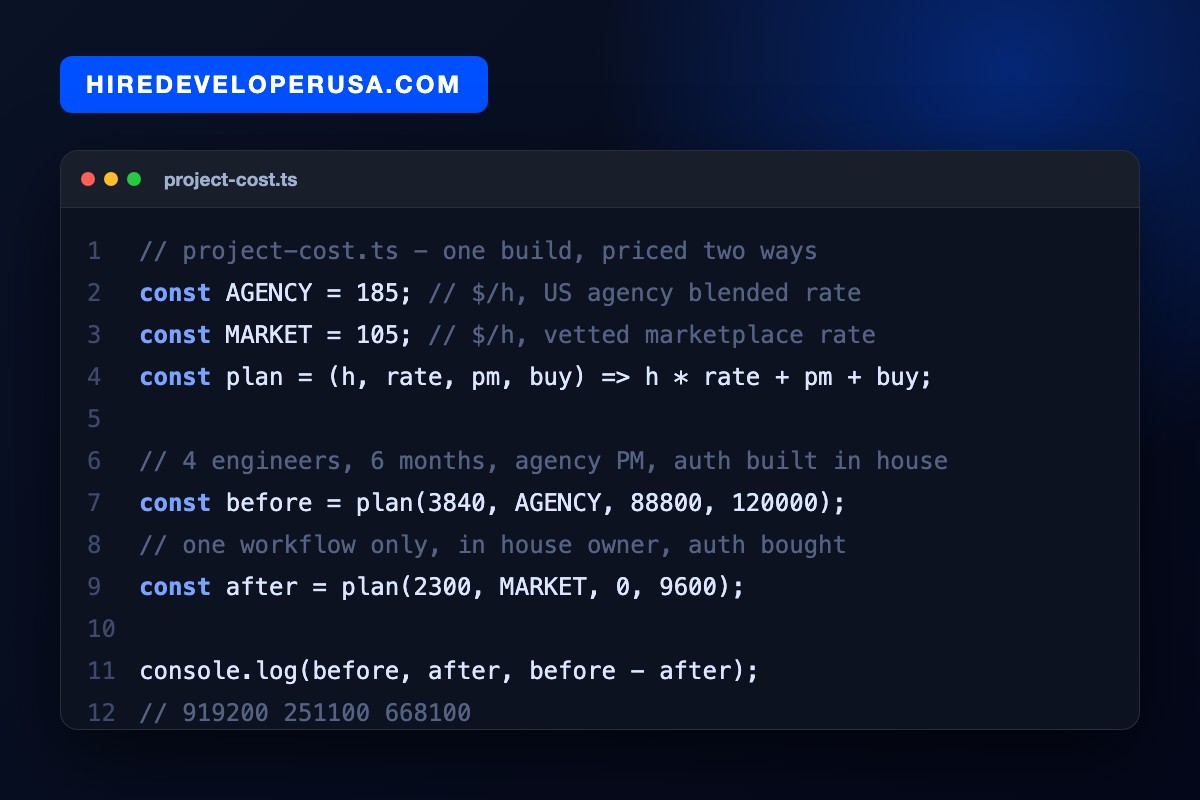
Same project, an internal customer portal for a mid-size US company, priced twice. The first plan is what a standard agency proposal looks like: four engineers for six months at a blended $185 per hour, a half-time agency project manager, and auth, billing and search built from scratch. The second keeps every quality gate and pulls the four levers.
| Line item | Original plan | Leaner plan |
|---|---|---|
| Engineering hours | 3,840 h (4 engineers, 6 months) | 2,300 h (core workflow only) |
| Blended rate | $185/hour (agency) | $105/hour (vetted marketplace) |
| Engineering cost | $710,400 | $241,500 |
| Project management | $88,800 (agency PM, half time) | $0 (in-house product owner) |
| Auth, billing, search | $120,000 (built) | $9,600 (bought, year one) |
| Year-one total | $919,200 | $251,100 |
Two honest caveats. The leaner plan ships less software: the backlog ring is still a backlog, and part of it will get built later at the same rates. And the $9,600 recurs, so by year three the third-party line is real money. Those are arguments for sequencing the spend, not for building everything up front.
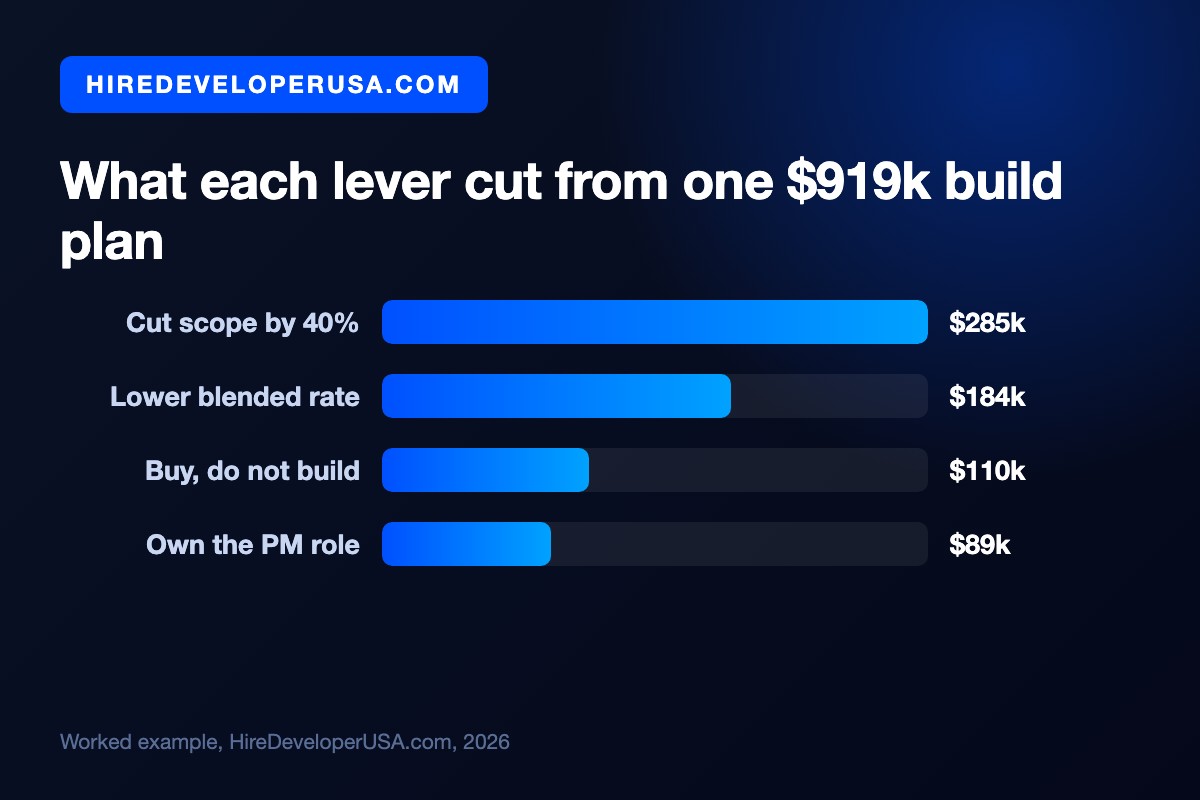
Notice which lever moved the most. Trimming scope by forty percent took out $284,900. Moving the remaining hours from agency to marketplace rates, which is what reshaping the team buys you, took out $184,000. Buying auth, billing and search instead of building them took out $110,400, and owning the product manager role in house took out the last $88,800. Rate shopping came second, and it is the lever most buyers reach for first.
Three things that are never worth cutting
Vetting. A bad hire on a six-month project costs the invoices, the weeks that pass before anyone admits the problem, and the rewrite that follows. It is the most expensive possible way to save money on a rate.
Testing and security review. Both look like overhead right up to the first incident. An application that handles payments, personal data or customer accounts does not get a discount on the consequences because the budget was tight.
The discovery that defines scope. The week or two spent writing down what the product must do is what makes lever one possible at all. Skipping discovery does not remove that work, it just moves those decisions into the build, where they cost developer hours instead of a workshop.
Where to start this week
Three moves, in order. First, print the feature list and mark everything a user must touch to finish the core job; price the rest as a separate, later phase. Second, reshape the team around that scope: one senior who can make architecture calls, the smallest number of mid-level engineers who can keep pace, specialists part time. Third, list every component on the plan that is not your differentiator and get a subscription price for it before anyone writes a line of code.
Then price the new plan against real rates instead of assumptions. If you want a second opinion on the hours and the shape of the team, our vetted engineers take software development engagements that start in days, and we will tell you when part of your plan is not worth building.
Frequently asked questions
What is the fastest way to reduce software development costs?
Cut scope. Mark every feature a user must touch to complete the core job, ship that first, and move the rest to a priced backlog. It takes an afternoon, needs no renegotiation with anyone, and on most plans it removes more money than any rate change available to you.
Does offshore or nearshore development really save money?
It lowers the hourly rate, and it can work well with a clear scope and real overlap in working hours. The savings disappear when time zones add a day to every question, when specifications have to be rewritten, or when you need a second team to review the first one. Price the total cost of getting to working software, not the rate.
How much can I save without hurting quality?
It depends entirely on how much of the original plan was never needed. Scope, team shape and build versus buy are structural, so they cut cost without touching quality. Cutting testing, security review or vetting is not a saving at all, it is a deferred bill that usually comes back larger.
Is it cheaper to hire in-house or use a marketplace?
For a defined project of six months or less, a vetted marketplace is almost always cheaper: no recruitment fee, no months of hiring, and the engagement ends when the work does. In-house wins once the work is permanent, because a loaded salary works out near $95 per hour for a mid-level engineer and that person accumulates domain knowledge you keep.
Hire vetted talent