

Key takeaways
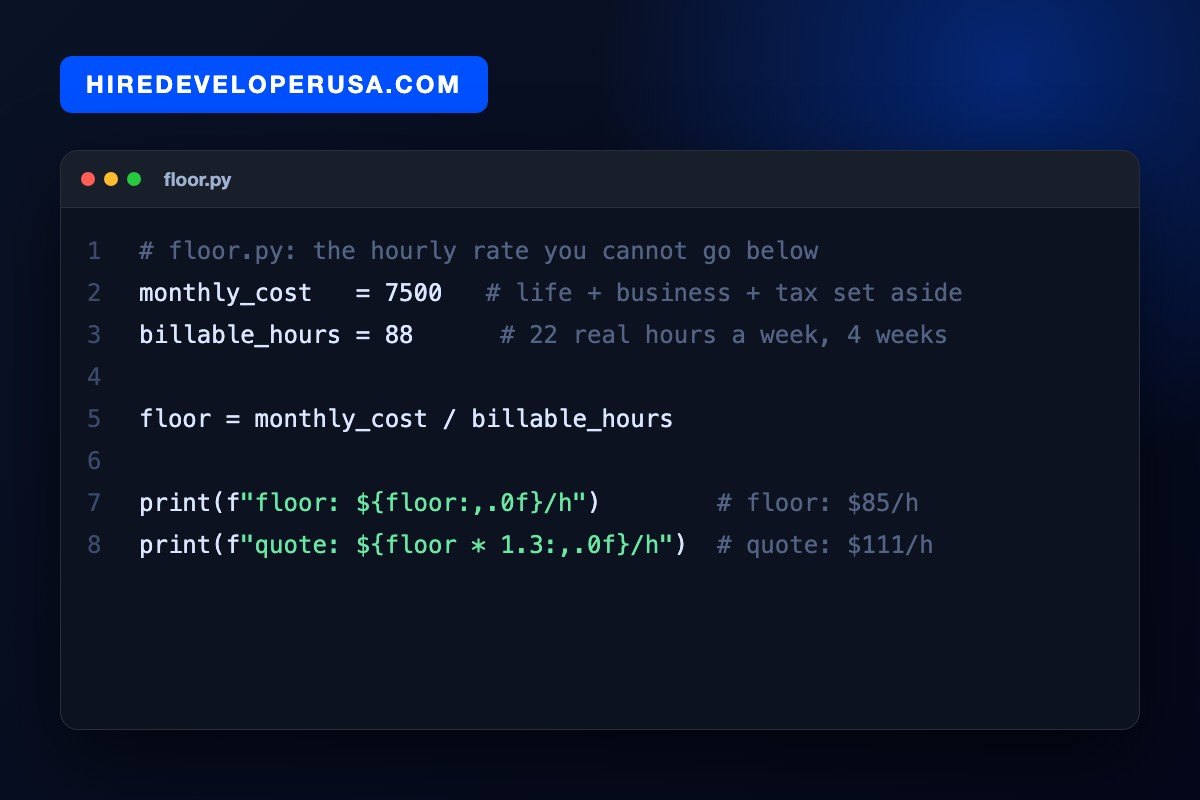
- →Your floor is arithmetic, not opinion: total monthly cost divided by realistic billable hours. $7,500 a month over 88 billable hours is about $85 an hour.
- →Channel sets the band more than seniority does: US open bidding boards pay $25 to $60 an hour, vetted marketplaces $60 to $150, and agencies bill $120 to $250.
- →Raise prices on new work only, until roughly one in four or five qualified prospects declines on price. A 100 percent close rate means you are underpriced.
- →Recovering four unbillable hours a week is worth $1,760 a month at $110 an hour, and it needs no negotiation with anyone.
- →Three retainers at $2,400 a month cover a $7,500 floor, which turns every project after that into margin instead of rent.
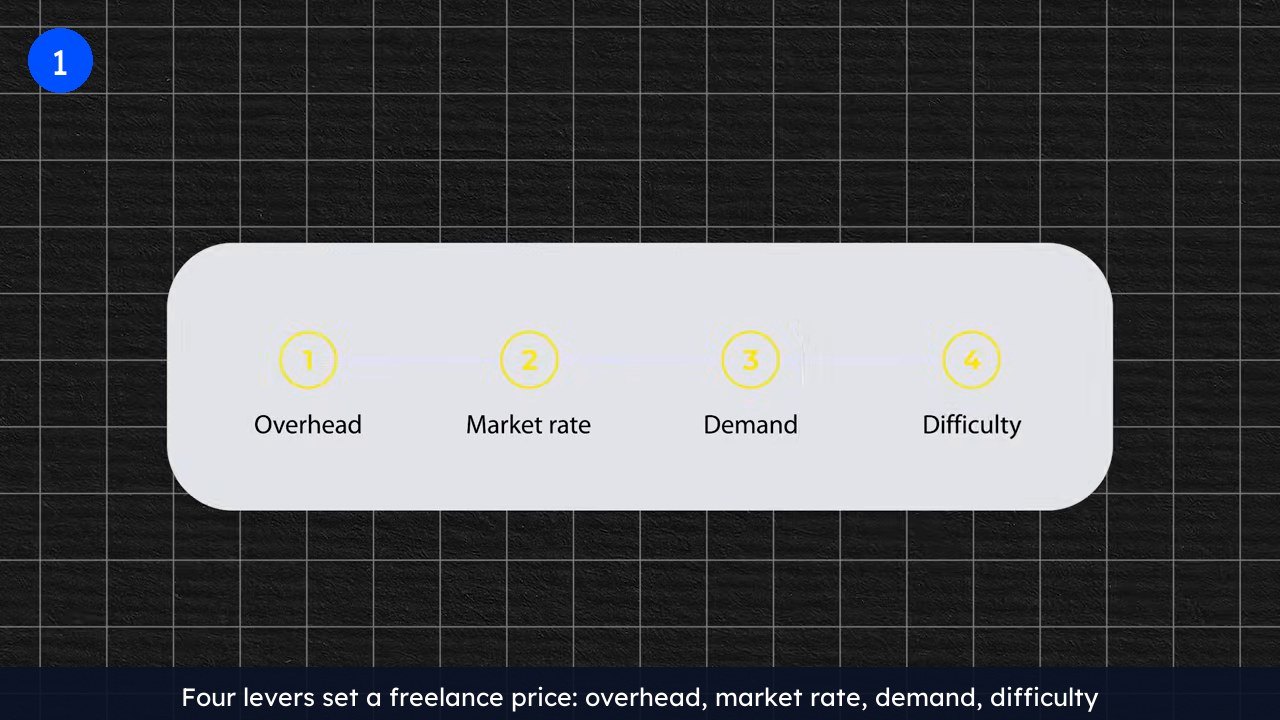
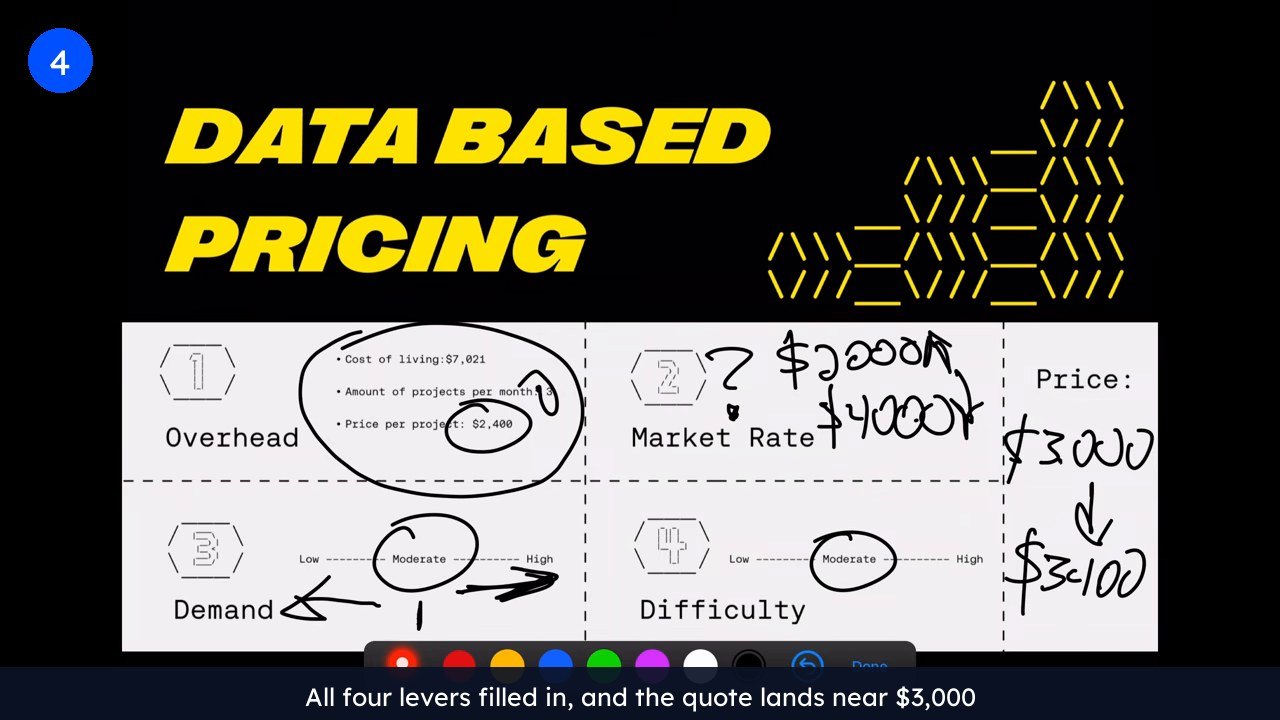
You make more money as a freelancer by changing your price, your channel and your mix of work, in that order. Raising your hourly number is only one of four levers, and it is rarely the one that pays back fastest. The four that actually move a freelance invoice are your overhead floor (the rate you cannot go below), your market rate (what comparable people charge in the same channel and the same metro), your demand (how many qualified inquiries you turn away), and difficulty (how much scope and risk you absorb). In the US, open bidding boards pay $25 to $60 an hour, vetted marketplaces $60 to $150, and agencies bill their clients $120 to $250. Moving one channel up is usually worth more than a 15 percent price increase, and it lands sooner. What follows is the arithmetic: how to compute your floor, how to price against the right market, and five moves with what each one adds in a single month.
Start with the floor you cannot go below
Most freelancers who want a raise look outward first: what is everybody else charging? Start inward instead. Your floor is the one number nobody can argue with, because it is your own cost of staying in business divided by the hours you can actually sell.
Add up what a month costs you, all in:
- Living costs you cannot postpone: rent or mortgage, food, transport, childcare.
- Health insurance, which an employer used to split with you and now does not.
- Software, hardware and subscriptions, amortized monthly rather than counted the month you buy them.
- Accounting and legal, including the quarterly filing nobody enjoys.
- Taxes set aside, self-employment tax plus income tax, moved out of the operating account the day an invoice clears.
- A slow-month buffer, because the gap between two projects is a cost even when it looks like a holiday.
Say that comes to $7,500 a month: $4,500 of living costs, $560 of health insurance, $240 of tools, $150 of accounting, $1,500 set aside for tax and $550 of buffer. Now divide it by the hours you can genuinely sell. A forty-hour week is not forty billable hours. Proposals, scoping calls, invoicing, the unpaid half of onboarding and the hours you spend learning are all real and none of them are billed. Twenty-two billable hours a week is a realistic steady state for a solo freelancer, which is 88 hours a month.
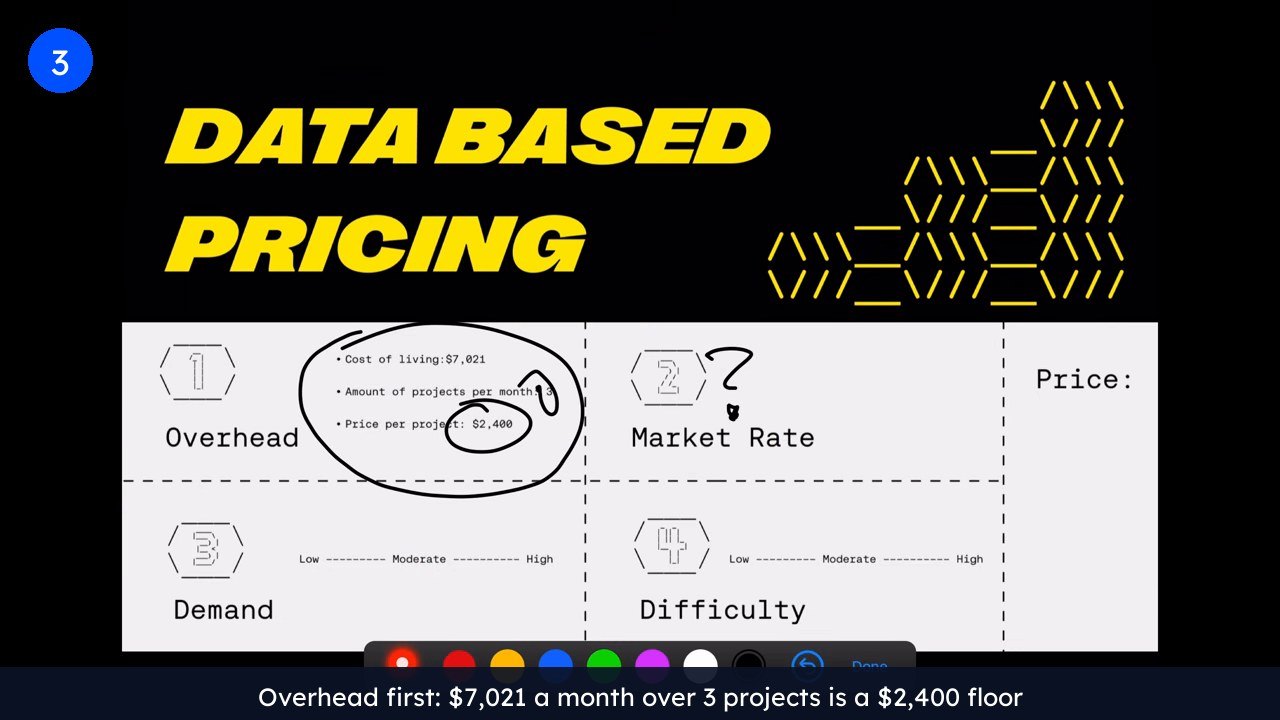
$7,500 divided by 88 is about $85 an hour. That is not your price. That is the line below which you are paying a client for the privilege of working. Add a margin of roughly 30 percent for profit, reinvestment and the projects that run long, and your quoting rate lands near $110 an hour. If you sell fixed-price work instead, the same math per project: $7,500 across three projects a month means no project below $2,500.
Price against the right market, not the global one
Market rate is the lever freelancers get wrong most often, because they compare themselves to the wrong people. A number only means something when the comparison matches on four things at once: the same specialty, the same kind of buyer, the same channel and the same metro. Change any one of them and the band moves.
Channel is the biggest of the four, and the one you control fastest. The same engineer, with the same portfolio, is priced differently depending on where the work is bought:
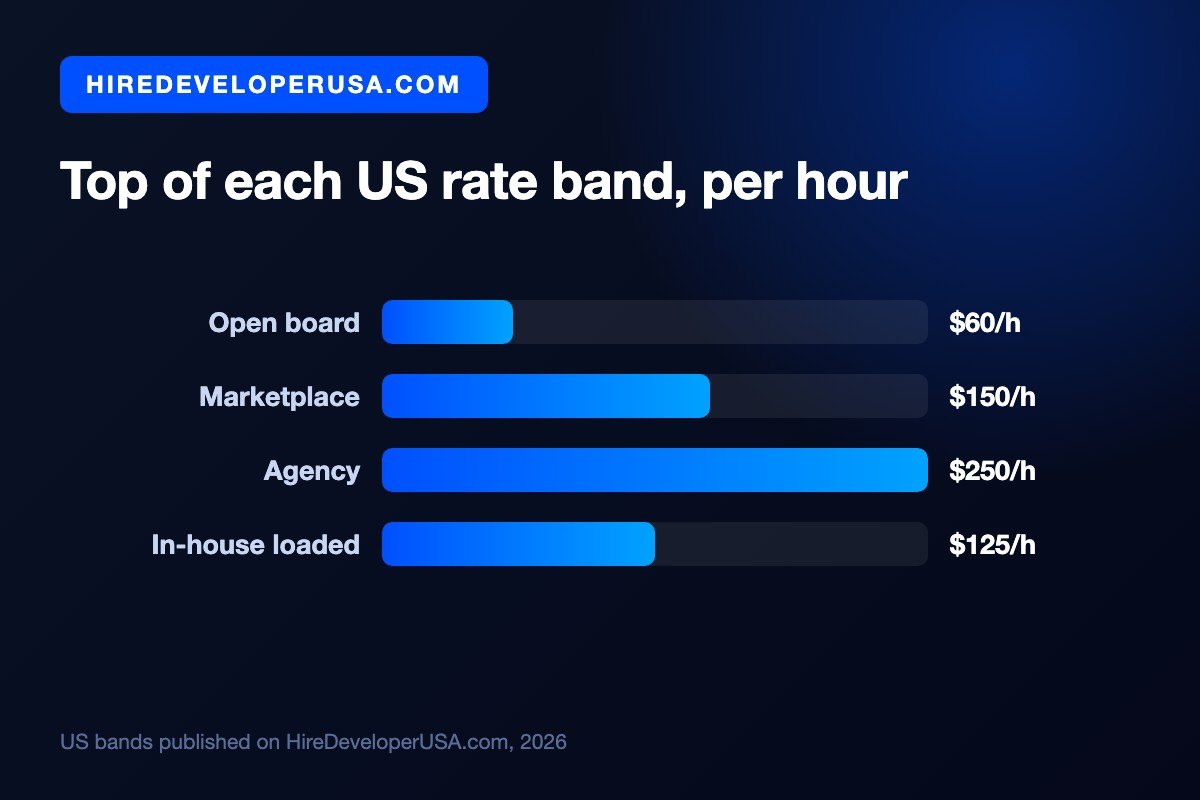
Open bidding boards run $25 to $60 an hour because the buyer is comparing twenty proposals on price. Vetted marketplaces run $60 to $150 because somebody screened the supply before the buyer saw it. US agencies bill $120 to $250, and the delivery work inside that number is often done by freelancers at a fraction of it. An in-house engineer on a $95,000 to $200,000 salary costs their employer roughly $60 to $125 an hour once taxes, benefits and overhead are loaded in, which is the number a client is really comparing you to. The detail behind each of these bands is in our breakdown of freelance developer hourly rates, and the per-role numbers sit on our software developer rates page.
Three comparisons will wreck your number if you let them:
- Different specialty. A generalist shipping full-stack web apps and a specialist doing payments compliance are not in the same market, even when the job titles match.
- Different buyer. A pre-seed founder paying out of personal savings and an enterprise team with an approved vendor budget will not converge on the same figure, ever.
- Different geography. A client in a high cost metro has a different internal benchmark than one two states away, and remote work narrowed that gap without closing it.

Let demand set the top of your range
Your price is not a fixed property of your skill. It is a function of how many people want your next available slot. Airlines have known this for decades; freelancers quote the same number in a drought and in a flood.
The signal is your close rate. If every qualified prospect says yes, your price is too low and has been for a while. A healthy range sits where roughly one in four or one in five well-qualified prospects declines on price alone. Below that and you are leaving money on every signature; well above it and you are burning pipeline.
Three rules keep this safe:
- Raise on new work first. The next proposal gets the new number. Existing clients keep theirs until a natural renewal, with notice.
- Raise when you are busy, not when you are desperate. The argument for a higher number is a calendar that is already full, and a client can feel the difference.
- Move in increments you can defend. Ten to twenty percent per step, with a reason attached, beats doubling and hoping.
Charge for difficulty and risk, not for the hours it takes you
Experience compresses hours. If a build that took you three weeks five years ago takes four days now, hourly billing quietly converts every improvement you make into a pay cut. That is the strongest argument for pricing the work rather than the clock.
Difficulty is also the lever with the clearest justification, because the client can see every item on the list. Price up when a project carries any of these:
- Legacy code with no tests. You are buying the risk of touching something nobody understands.
- Compliance scope. SOC 2, HIPAA or PCI work adds documentation, review cycles and liability.
- A hard external deadline. A conference, a funding round or a contractual go-live removes your ability to reschedule.
- Unknown third-party integrations. An undocumented API is an open-ended estimate wearing a disguise.
- Too many decision-makers. Every extra approver adds revision rounds that nobody wrote into the brief.
- Ownership after launch. On-call, support windows and bug-fix guarantees are a product, and products have prices.
The flip side matters just as much: write down what is out of scope and what a change request costs before you start. Scope creep is the single most common reason a well-priced project ends up underpaid.
Five moves, and what each one adds in a month
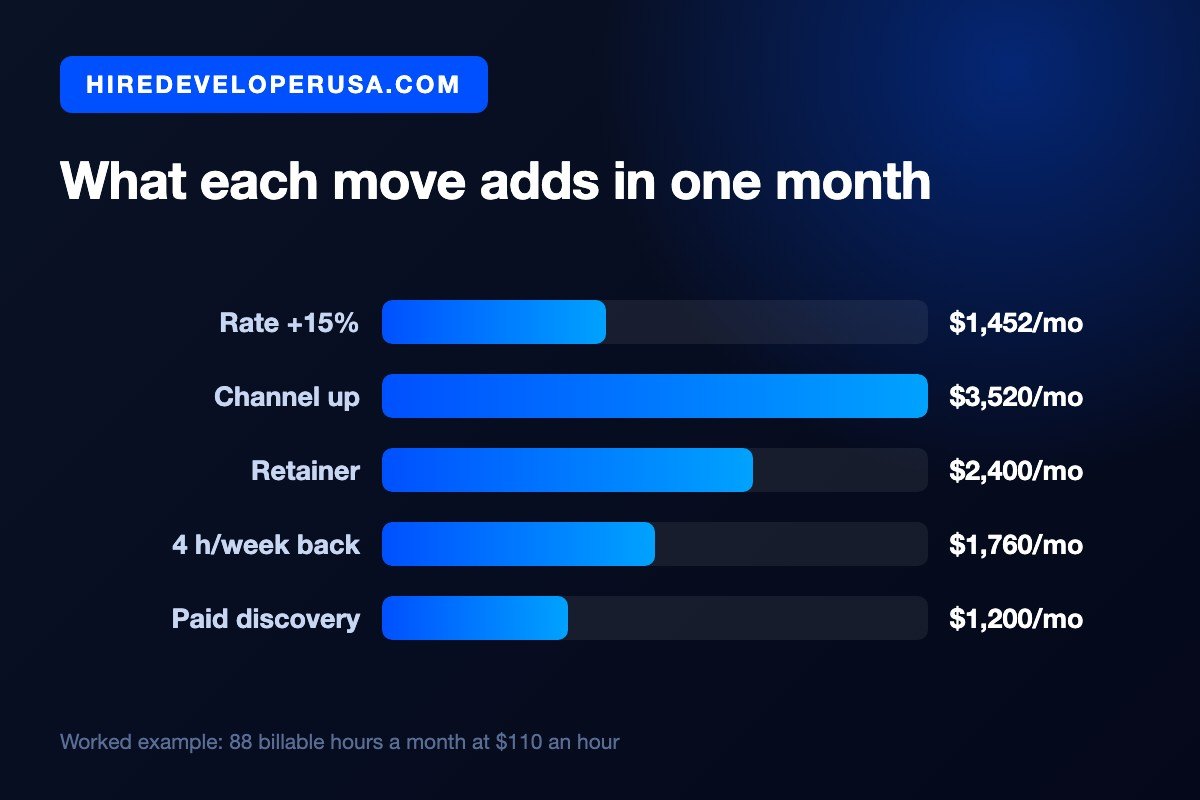
Here is the part that decides what you do on Monday. Take a freelancer quoting $110 an hour with 88 billable hours a month, which is $9,680 of revenue. These are the five realistic moves, with what each adds on that same base.
| Move | What it adds in a month | How fast it lands | What it costs you |
|---|---|---|---|
| Raise your rate 15 percent on new work | +$1,452 going from $110 to $126.50 an hour | 1 to 3 months, as new work starts | Some quotes get declined, and your close rate drops on purpose |
| Move one channel up, from open board to vetted marketplace | +$3,520 going from $55 to $95 an hour | 2 to 6 weeks | A screening process, a real portfolio and references that answer |
| Convert one client to a monthly retainer | +$2,400 booked, at 20 hours and $120 an hour | One renewal cycle | You commit capacity before you know what the month holds |
| Recover 4 unbillable hours a week | +$1,760 at your current rate | Immediate | Templates, a scoping document, and saying no to free work |
| Sell a paid discovery before each build | +$900 to $1,500 per project | Next proposal | Explaining why discovery is not free, every single time |
Two of these five do not require a single price negotiation. Recovering four unbillable hours a week is the cheapest raise available to most freelancers, and it compounds: the templates and scoping document you build to get those hours back also shorten every proposal after it.
Stop selling hours: retainers, packages and the renewal that pays twice
The ceiling on hourly work is arithmetic. There are only so many sellable hours in a week, so the only way up is a bigger number per hour, and that number has a market limit. Recurring revenue removes the ceiling by changing what you sell.
Three retainers at $2,400 a month come to $7,200, which covers almost the entire $7,500 floor from the first section. Every project you take after that is margin rather than rent, and the psychological effect on your quoting is immediate: you stop accepting work you do not want because you need it this month.
The shapes that work:
- A maintenance and support block. A fixed number of hours a month for updates, fixes and small improvements, with unused hours expiring.
- A fractional role. One or two days a week as the engineering lead, the design partner or the growth owner. Higher commitment, higher price, far less selling.
- An outcome package. A performance audit, a migration, a launch. A fixed deliverable at a fixed price, which lets your speed work for you instead of against you.
Renewals are also the cheapest revenue you will ever book, because the hours you spend finding a replacement client are unbillable by definition. Protect that revenue on the paperwork side too: a deposit before kickoff, net 15 rather than net 30, and a late fee you actually enforce. Our guide to getting paid on time covers the contract terms that keep a good month from turning into a collections problem.
What to do this week
Do the three cheapest things first, in order. Compute your floor tonight, because every other decision depends on it and it takes twenty minutes. Put the new number on your next proposal rather than announcing a price change to everyone you work with. Then look hard at your channel: if your work comes from a bidding board where buyers compare twenty quotes on price, no amount of positioning inside that channel will beat moving out of it.
If the channel move is the one you want, that is what a vetted marketplace is for. You can see how the matching, the screening and the rates work on our page for talent, and compare your current number against the published US bands before you set the next one.
Frequently asked questions
How much should a freelancer charge per hour in the US?
Start from your own floor: total monthly cost divided by realistic billable hours, then add about 30 percent of margin. Check that number against the channel you sell in. US open bidding boards run $25 to $60 an hour, vetted marketplaces $60 to $150 and agencies bill $120 to $250. By seniority on a vetted marketplace, expect $35 to $60 for junior work, $60 to $100 mid-level, $100 to $150 senior and $150 to $250 for scarce specialisms.
How do I raise my rates without losing clients?
Put the new number on new proposals first, and leave existing clients on their current rate until a natural renewal. When you do raise an existing client, give notice ahead of the renewal, attach a reason the client can verify such as added scope or faster response commitments, and move in steps of 10 to 20 percent. Expect to lose a small share of prospects on price. If you lose none, the increase was too small.
Is it better to charge hourly or a fixed price?
Fixed price pays you for the result rather than the clock, which matters because experience makes you faster every year. Use it when scope is clear and you can write down what is excluded. Keep hourly for open-ended work, discovery and anything with an unknown third-party integration. Whichever you choose, compare effective rates: a $110 hourly rate at 55 percent billable time is worth about $60 an hour across your whole week.
How many billable hours a week is realistic for a freelancer?
Around 22 to 26 hours of a 40-hour week for a solo freelancer who also does their own sales, scoping, invoicing and admin. Anyone budgeting 40 billable hours is quietly planning to work evenings. The fastest raise available to most freelancers is moving from 22 to 26 billable hours by templating proposals and tightening scoping, which is worth $1,760 a month at $110 an hour.
Hire vetted talent