
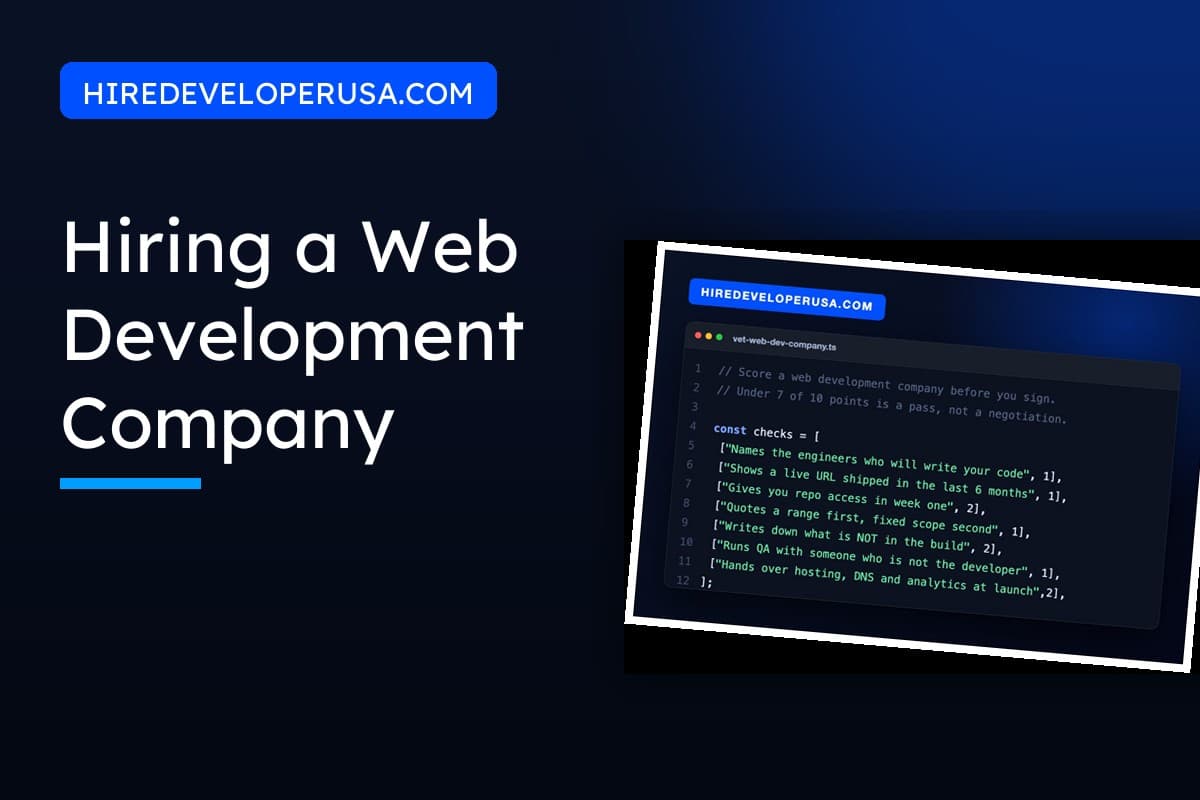
Key takeaways
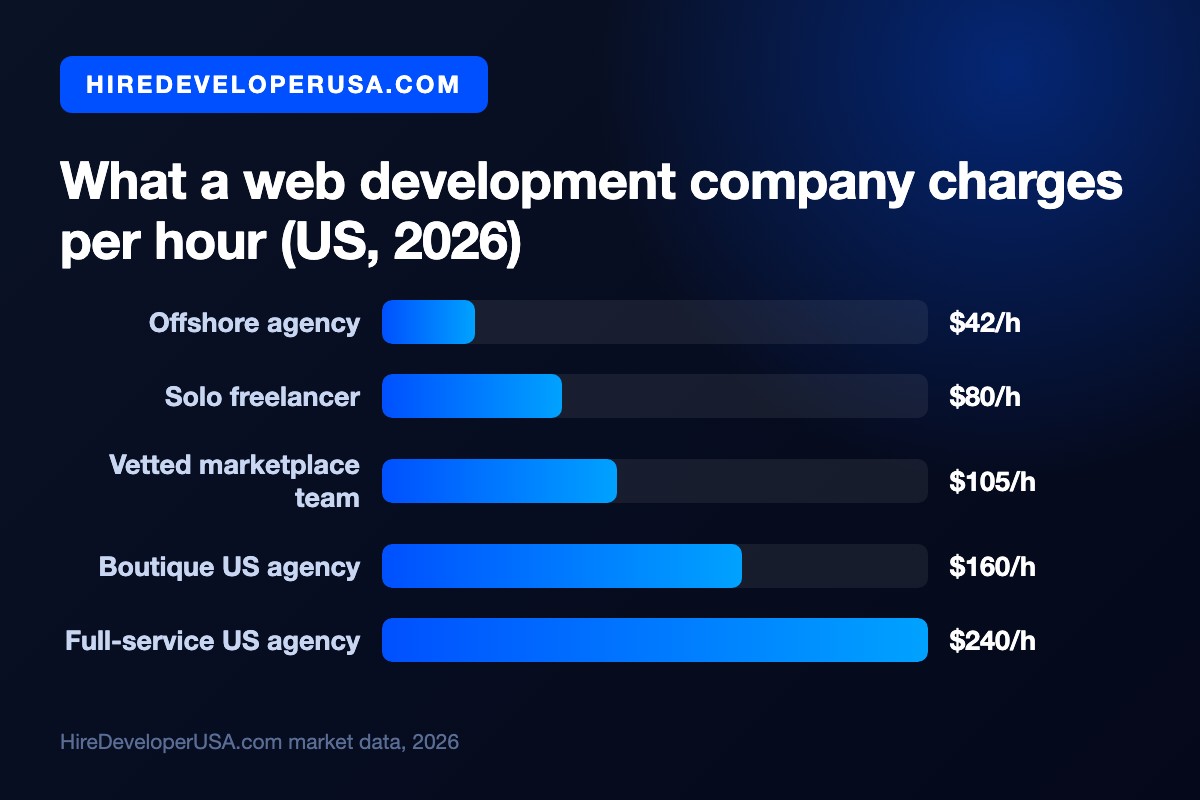
- →A US web development company charges $120 to $300 per hour depending on its size; vetted marketplace teams run $60 to $150 and offshore shops $25 to $60.
- →Five scoping documents, written before you shop, are what make competing quotes comparable.
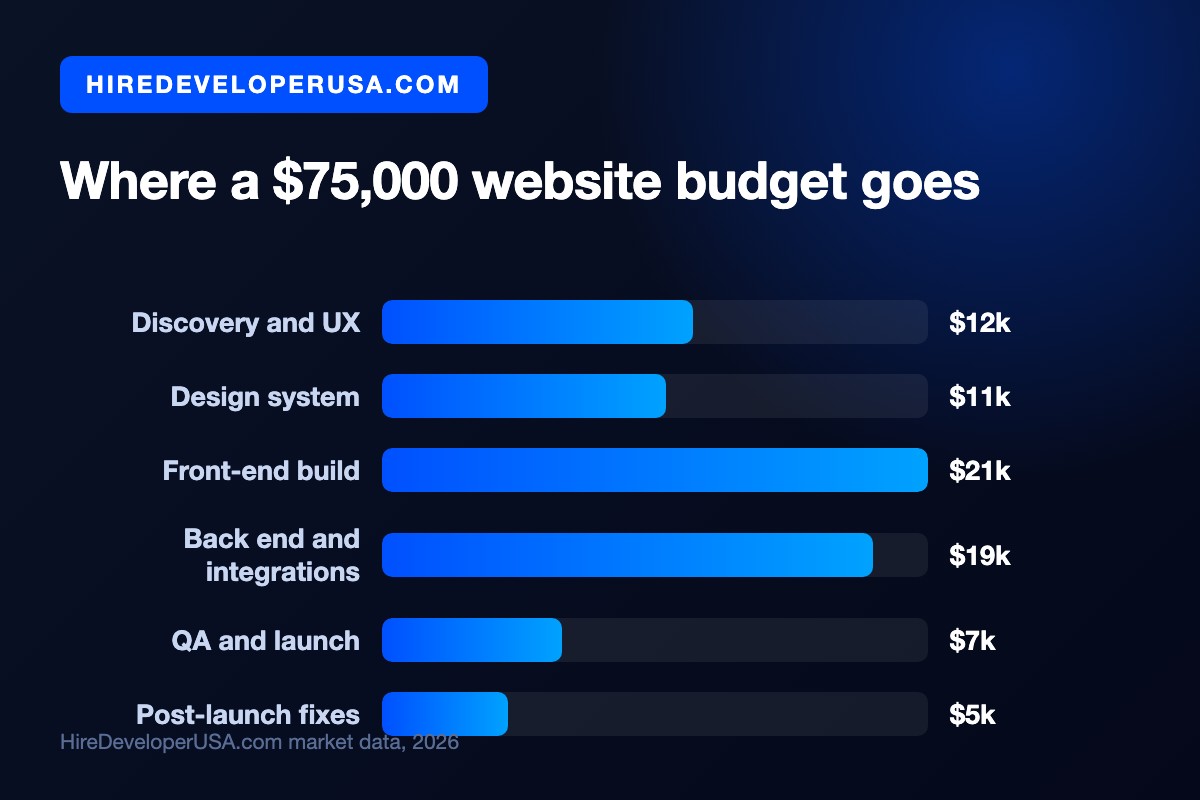
- →On a $75,000 build, front-end code is under a third of the budget; discovery, integrations and QA take the rest.
- →Own the repository, the domain and the hosting accounts from day one, and get IP assigned as invoices are paid.
- →Run the week-one test: named tech lead, repo access, staging URL, annotated scope, one shipped page.
Hiring a web development company in the US costs roughly $120 to $300 per hour at a US agency, $60 to $150 per hour through a vetted marketplace team, and $25 to $60 per hour at an offshore shop. Which band you pick matters far less than two decisions most buyers skip: writing the scope down before you start shopping, and testing the team in week one instead of month three. Do both and most competent shops will deliver something you can live with. Skip both and the best agency in your state will still hand you a website you end up rebuilding.
Below is the whole process: what a web development company actually sells, what US teams charge in 2026, where to find the ones worth a call, the questions that separate builders from sellers, the contract clauses that decide who owns your site, and a five-day plan to find out early whether you chose well.
What you are actually buying
The phrase covers at least five different businesses, and they are not interchangeable. A two-person studio and a 200-person agency both call themselves a web development company, but you are buying a completely different risk profile.
| Who you hire | Typical US cost | Realistic start | Best fit |
|---|---|---|---|
| Solo freelancer | $50 to $110/hour | 1 to 2 weeks | Landing pages, small marketing sites, fixes on an existing build |
| Vetted marketplace team | $60 to $150/hour | 1 to 3 weeks | Defined builds where you want to keep product control in-house |
| Boutique US agency (5 to 40 people) | $120 to $200/hour | 3 to 8 weeks | Brand-led sites, heavy design work, marketing sites that need strategy |
| Full-service agency | $180 to $300/hour | 4 to 12 weeks | Multi-workstream programs, regulated industries, large content operations |
| Offshore agency | $25 to $60/hour | 1 to 4 weeks | Cost-led builds where you already have a technical PM on your side |
The difference between $75 and $200 an hour is usually not code quality. It is coverage. At the high end you are paying for a project manager who chases your team for content, a designer who does not need you to describe a hover state, a QA pass run by someone other than the developer who wrote the bug, and an account lead who absorbs the scheduling pain. At the low end, all of that lands on you. Neither is wrong. Pick the one that matches how much of your own week you can actually give the project. If you want the underlying math on loaded cost versus hourly rate, we broke it down in our guide to the real cost of hiring a software developer.
Scope the build before you shop for a vendor
Most bad web projects are priced before anyone agrees what is being built. You send a paragraph, five companies send five wildly different quotes, and you have no way to compare them because they are not quoting the same thing. Fix that first. Five short documents are enough, and they take a focused afternoon.
- A one-page brief. What the site is for, who it serves, what a win looks like six months after launch. One page, not ten. Our template for a software project brief works as-is for web builds.
- A page and feature inventory. Every page, every template, every form. Mark each one new, migrated, or dropped. This single list moves quotes closer together than anything else you can send.
- An integrations list. CRM, payments, booking, email, analytics, ERP, whatever the site has to talk to. Name the systems and who owns the credentials. Integrations are where fixed bids go to die.
- A content owner. One named person on your side who writes and approves copy. Missing content delays more launches than missing code, and no vendor can fix that for you.
- A definition of launch. Write the sentence that means done: analytics firing, forms delivering to a real inbox, redirects mapped, page speed above an agreed threshold. Otherwise launch becomes an opinion.
Send that packet to every company you approach. Any quote that comes back without questions about it is a quote from someone who did not read it.
What web development companies charge in 2026
Three pricing models dominate, and each one shifts risk somewhere different.
Fixed bid works when the scope is genuinely frozen: a brochure site, a template migration, a defined set of pages. The vendor prices in a risk buffer, usually 15 to 30 percent, and you pay for certainty. The catch is that every change becomes a negotiation, so a fixed bid without a written change-order rate is a trap.
Time and materials fits anything with real product decisions still open. You pay for what happens, which is honest, but only works if you get a weekly burn report and can stop the clock. Ask for a not-to-exceed ceiling per phase.
Monthly retainer makes sense after launch, or when the site is a living asset with constant campaigns. Expect a minimum block of hours and a clause covering what happens to unused ones.
Budget shape matters as much as the total. On a typical mid-size build, code is well under half the spend. Discovery, design, integrations, QA and the post-launch fix window eat the rest, and the fix window is the line buyers cut first and regret fastest. If you want current rate bands by role rather than by vendor, our pages on front-end developer rates show the same market from the talent side.
Where to find companies worth a call
Four sourcing channels are worth your time, roughly in this order.
Referrals from companies your size. The best signal available, with one caveat: ask the referrer what went wrong, not what went well. Every project has friction, and how the vendor handled it tells you more than the finished homepage.
Vetted marketplaces. You get a pre-screened team without a recruitment fee and without a three-week sales cycle. This suits buyers who have a clear scope and want engineers rather than an account structure. It is the model we run, and you can see the process on our how it works page.
Platform partner directories. If your build is anchored to a specific stack, the platform's own partner list filters for you. Shops that live inside one ecosystem all day, whether that is a headless CMS or a mature WordPress stack, ship faster in it than generalists do.
Sites you already admire. Find three sites in adjacent industries that do what you want, then look for the build credit in the footer, the case study on the agency site, or simply ask the company who built it. Most will tell you.
Talk to four companies, not twelve. Beyond four, quotes blur together and you start deciding on presentation quality, which is the one thing every agency is good at.
The questions that separate builders from sellers
Sales calls reward the vendor with the best deck. These questions reward the vendor with the best process.
- Who exactly writes the code, and can I meet them? The person on the pitch call is often not the person on the project. You want names, seniority, and how many other projects each one is on this quarter. A shop that cannot answer is either subcontracting or has not staffed you yet.
- How much time goes into discovery, and what happens in it? A 45-minute kickoff is not discovery. Expect several hours with your team plus independent research into your market and competitors. Thin discovery is the single most reliable predictor of a site that looks fine and converts badly.
- Show me something you shipped in the last six months, live. Not a case study PDF, not a portfolio mockup. A URL you can open, on a phone, right now. Then ask what that client asked for that the team pushed back on.
- What is explicitly not in this quote? Good vendors have a ready answer: copywriting, photography, data migration beyond X records, third-party license fees, accessibility remediation. A vendor who says everything is included has not read your integrations list.
- Who runs QA, and against what? The answer you want is a person who did not write the code, working from a written test list that includes browsers, mobile, forms, and page speed.
Score the answers before the next call, while they are fresh. Two vague answers on the same vendor is usually enough to stop.
The contract terms that decide who owns your website
The commercial terms are where a fair price turns into an expensive one, months later. Six clauses carry almost all the risk.
- IP assignment on payment. Work product transfers to you as invoices are paid, not at final sign-off. If the relationship ends at 80 percent, you want to own the 80 percent.
- Repository ownership from day one. The code lives in your organization's Git account, and the vendor gets access to it. Not the reverse. This one clause prevents most hostage situations.
- Accounts in your name. Domain, DNS, hosting, analytics, and any paid plugin or SaaS license get bought under your billing, with the vendor added as a user. Agencies that host on their own account are not being sinister, but you have just made leaving expensive.
- A published change-order rate. Agree the hourly figure for out-of-scope work before you sign, not during the argument that produces it.
- A warranty window. Thirty to sixty days after launch where defects against the agreed scope get fixed at no charge. Distinguish defects from new requests in writing.
- An exit clause with a handover list. Notice period, what gets delivered on exit, and in what format: repository, database dump, design source files, credentials, documentation. Write it while everyone still likes each other.
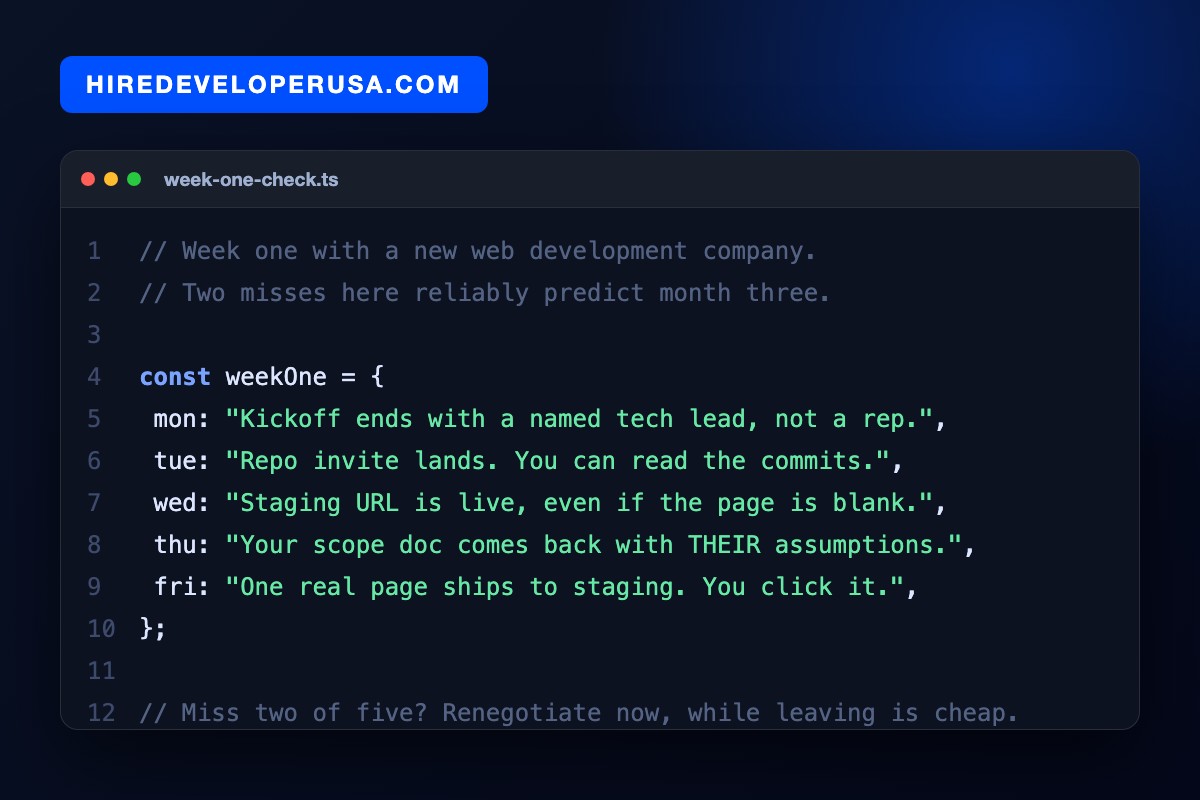
Week one: the five-day test
Do not wait for the first milestone to learn how a vendor operates. The first week tells you nearly everything, and week one is the cheapest moment to walk away or renegotiate.
- Monday. Kickoff ends with a named technical lead, a shared channel, and a written list of what they need from you and by when.
- Tuesday. Your repository invitation arrives and you can see commits. Empty repo is fine. No repo is not.
- Wednesday. A staging URL exists, even if it serves a blank page. Teams that provision environments late tend to test late too.
- Thursday. Your scope document comes back annotated with their assumptions and questions. Silence here means somebody is planning to discover the hard parts in month two.
- Friday. One real thing is on staging that you can click. A header, a template, a form. Something.
Miss two of those five and raise it immediately, in writing, before the second invoice. Patterns set in week one almost never improve on their own.
Your next step
Before you contact anyone, spend one afternoon on the five scoping documents. They cost you nothing and they change every conversation that follows, because you stop being a buyer who describes a feeling and become a buyer who hands over a specification. Then approach four companies, run the five questions, check the six contract clauses, and hold the week-one test.
If your build is well defined and you would rather hire the engineers directly than buy an agency wrapper around them, that is a different purchase with a different price. See how we place vetted developers and compare it against the agency quotes on your desk. Either way, the scope document is what makes the comparison honest.
Frequently asked questions
How much does it cost to hire a web development company?
In the US in 2026, expect $120 to $200 per hour at a boutique agency, $180 to $300 at a full-service agency, $60 to $150 through a vetted marketplace team, and $25 to $60 offshore. A 12-page marketing site with two or three integrations typically lands between $35,000 and $90,000 depending on how much design and content the vendor has to produce.
Should I hire a web development company or a freelancer?
Hire a freelancer when the scope is small and stable and you can project manage it yourself. Hire a company when the build needs design, development and QA running in parallel, or when you need continuity if one person leaves. The practical dividing line is whether you have someone internally who can answer technical questions every day.
How long does it take a web development company to build a website?
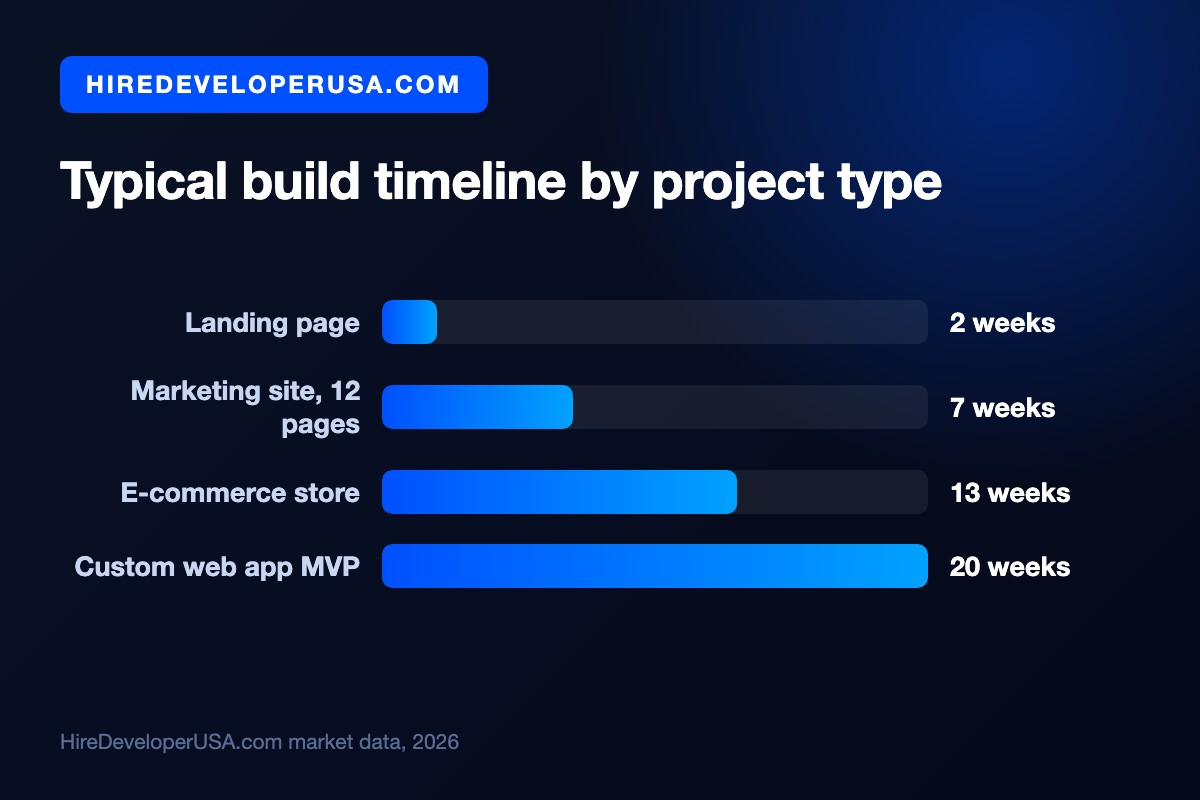
A landing page takes about two weeks, a 12-page marketing site around seven, an e-commerce store roughly 13, and a custom web app MVP about 20. Those numbers assume your content and approvals arrive on schedule, which is the most common source of slippage.
What should be in the contract with a web development company?
IP assignment as invoices are paid, repository ownership under your account, domain and hosting bought in your name, a published change-order rate, a 30 to 60 day defect warranty after launch, and an exit clause listing exactly what gets handed over and in what format.
Hire vetted talent