
Key takeaways
- →San Diego rate bands for 2026: $85 to $150 per hour for a local contractor, $60 to $150 through a vetted US marketplace, $150 to $275 at a San Diego agency, and $105,000 to $200,000 base salary in-house.
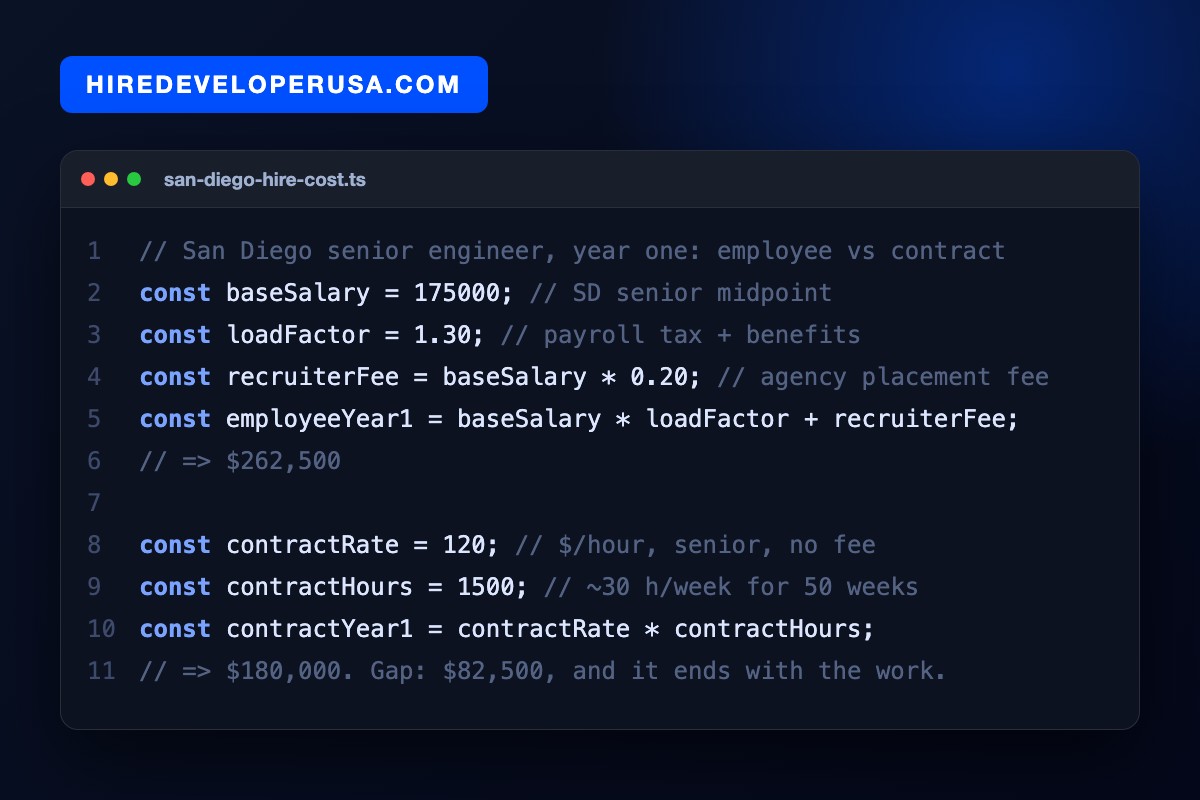
- →Budget the loaded cost, not the rate. A $175,000 senior costs about $227,500 a year once payroll tax and benefits are added, and roughly $262,500 in year one if a 20 percent placement fee is involved.
- →San Diego is three markets: wireless and semiconductor around Sorrento Valley, life sciences on Torrey Pines Mesa, and cleared defense work. Price the role against the right one or the search stalls.
- →Cleared and export-controlled roles cannot be filled by a contractor abroad. Almost everything else can be filled remotely on Pacific hours for less than a local desk.
- →Pacific time is the constraint teams forget: it covers the full West Coast day, overlaps the East Coast for about five hours, and gives you almost no overlap with Europe.
Hiring a software developer in San Diego costs roughly $85 to $150 per hour for a local independent contractor, $150 to $275 per hour through a San Diego development agency, and $105,000 to $200,000 per year in base salary for a full-time engineer, before benefits and payroll overhead. Senior hires sit at the top of that salary band. Every one of those figures lands below the San Francisco Bay Area and above the national median, which is the trade San Diego offers.
The complication is that San Diego is not one engineering labor market. A modem team in Sorrento Valley, a genomics platform on Torrey Pines Mesa and a cleared defense program are bidding for different people at very different prices, and scoping your role against the wrong one is how a search quietly runs into month four. This guide gives you the bands, the loaded cost math, the three sub-markets, and a week-one evaluation plan you can run without a recruiter.
What it costs to hire software developers in San Diego
Four channels are open to you, and each one prices in something different:
| Hiring channel | Typical cost | Best for |
|---|---|---|
| Local San Diego contractor | $85 – $150/hour | Short projects, occasional on-site days, hardware-adjacent work |
| Vetted US marketplace (remote) | $60 – $150/hour | Starting within days on Pacific hours, with no recruiting fee |
| San Diego development agency | $150 – $275/hour | Fixed-scope delivery with project management bundled in |
| In-house full-time | $105,000 – $200,000/year base | Long-term ownership of a core product |
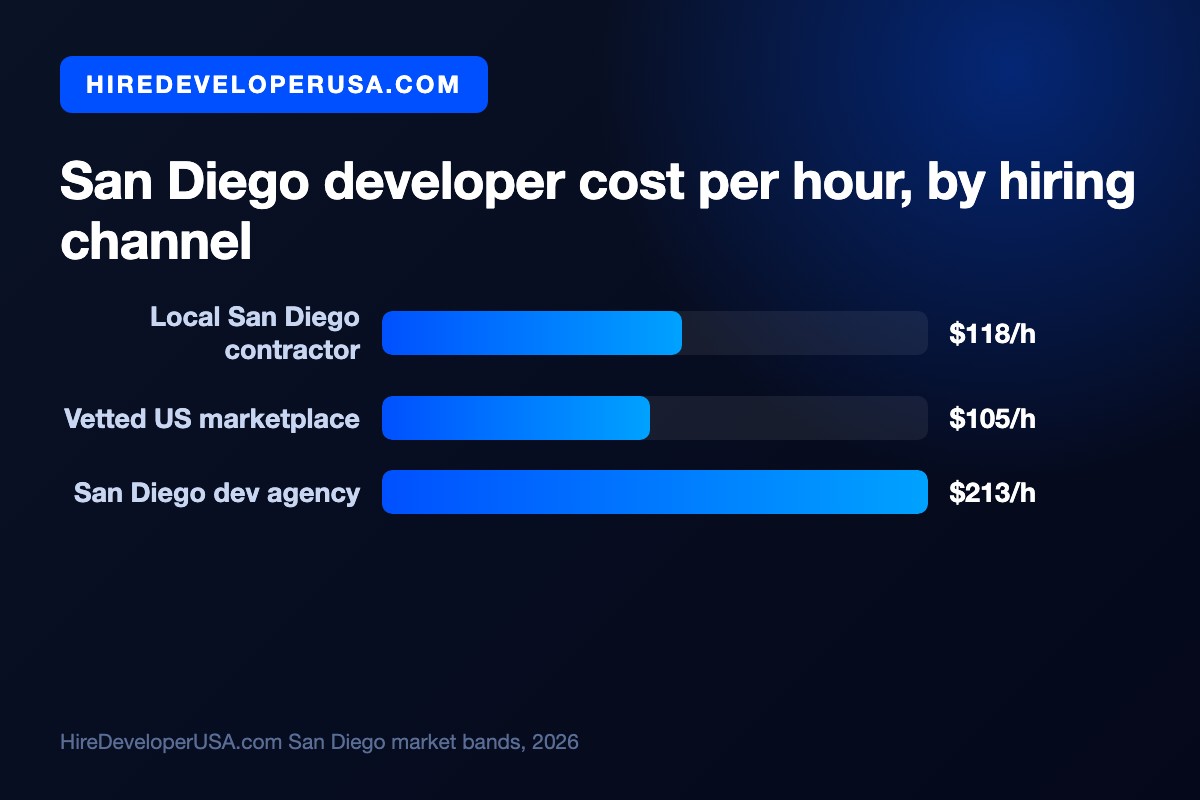
Take the midpoints and the decision sharpens: about $118 an hour for a local contractor, $105 an hour through a vetted marketplace, and $213 an hour at an agency. That agency premium is not markup on identical work. It buys a project manager, a QA pass, and continuity when somebody leaves mid-sprint. Whether it is worth roughly double depends entirely on whether anyone on your side can run a delivery. For the national picture underneath these bands, see our breakdown of what it costs to hire software developers.
In-house salary bands, and the number budgets forget
If you are hiring an employee rather than buying hours, these are the San Diego base-salary bands worth planning against in 2026:
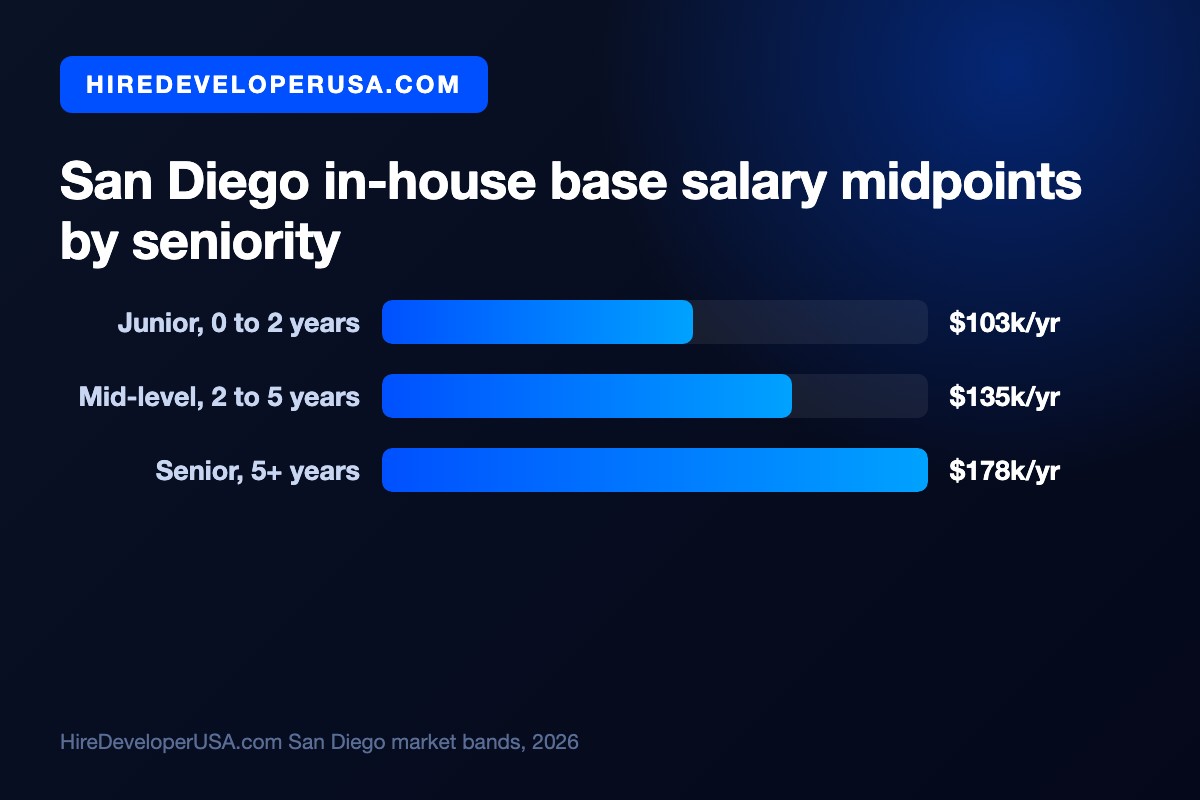
- Junior (0 to 2 years): $90,000 to $115,000. Ships well-defined tickets inside an existing codebase, with a senior reviewing every pull request.
- Mid-level (2 to 5 years): $115,000 to $155,000. Owns a feature end to end from a written spec. This is the tier most San Diego product teams actually need.
- Senior (5+ years): $155,000 to $200,000. Makes the architecture calls and stops the expensive mistakes before they reach production.
- RF, modem, cleared and staff-plus roles: above $200,000, and effectively set by what the large local employers are paying that quarter. If your role competes in that pool, budget for it or redesign the role.
Then add the part that never makes the spreadsheet. Employer payroll tax, health coverage, equipment, software and paid time off add roughly 25 to 35 percent on top of base. A $175,000 senior costs about $227,500 a year loaded. Add a 20 percent placement fee and year one lands near $262,500. That is the number to compare against a contract engagement: the same senior at $120 an hour for 1,500 hours costs $180,000. Role-by-role figures live on our front-end developer rates page.
San Diego is three hiring markets, not one
San Diego punishes the assumption that a metro area is one talent pool. Three distinct engineering economies sit within twenty minutes of each other and set three different prices for the same job title.
Sorrento Valley and Sorrento Mesa form the wireless and semiconductor corridor around Qualcomm's headquarters campus, and Apple has expanded its own wireless engineering presence in the city. This is the deepest pool of RF, modem and silicon-adjacent engineers outside Silicon Valley, and also the most expensive one to compete in. If your work is hardware verification or firmware rather than a web stack, this is your market, and a good starting point is our page on SystemVerilog engineers in San Diego.
Torrey Pines Mesa holds UC San Diego, the Salk Institute and Scripps Research, with genomics and medical device companies such as Illumina, Dexcom and ResMed in the surrounding cluster. IQHQ's Research and Development District has extended the same demand down to the downtown waterfront. The software written here is regulated software: design controls, validation evidence, audit trails, patient data handling. Engineers who have shipped under those constraints are a fundamentally different hire from product generalists, and for this work they are worth more to you than a faster prototyper.
Defense and national security is the third market. General Atomics, Northrop Grumman and Naval Information Warfare Center Pacific mean a meaningful share of local engineers hold clearances or can obtain them. A cleared role prices above the commercial band, takes longer to fill because clearance processing is slow, and cannot be handed to a contractor sitting abroad. Export-control questions belong in a conversation with counsel before you post the job, not after you have a candidate.
Two more forces shape the whole market. University City and UTC host Amazon's San Diego Tech Hub alongside other corporate engineering offices, which anchors compensation expectations for cloud and backend roles citywide. And UC San Diego's Jacobs School of Engineering, one of the largest engineering schools in the country, feeds the junior end of every pool above, which is why San Diego is a better city than its rate card suggests for hiring people you intend to grow.
Local hire, remote on Pacific time, or agency
Most teams searching for a San Diego developer do not actually need someone in San Diego. They need someone who works Pacific hours and understands US business context. Those are different requirements carrying different price tags.
A local hire earns its premium when presence is genuinely required: device bring-up on real hardware, lab or clean-room access, a regulated on-site environment, or cleared work that legally cannot happen anywhere else. It also buys a warm local network, still the fastest referral channel there is in a city this interconnected.
A remote US hire on Pacific time is the default most teams should start from. It costs less than a San Diego desk and removes the ceiling that comes from recruiting inside a thirty-mile radius. Know the trade before you commit: Pacific covers the full West Coast day, overlaps the East Coast for about five working hours, and gives you almost nothing with Europe. If your customers or your other engineers are in London or Berlin, that constraint will cost you more than the rate difference ever saves. Our guide to freelance developer hourly rates covers how independent contractors price nationally.
An agency makes sense when the scope is fixed, the deadline is external, and nobody on your side can run a delivery. You are buying management, not just engineering hours, and you should judge the proposal on the delivery plan rather than on the resumes attached to it.
Offshore is the cheapest per hour and the right answer for a narrow band of work. It is not available for cleared or export-controlled programs, and a poor fit for regulated device software, where an auditor will eventually want a named author.
Scope the role before you write the job post
The most common reason a San Diego search stalls is not budget. It is that the job post describes a wish rather than a job. That gap hurts more here than elsewhere, because the strongest candidates already have offers from employers with more cash and more brand than you, so a vague post is losing before anyone reaches the salary line.
Write a one-page spec before the post goes live. Four things belong in it:
- The problem. Not "build features" but "our data pipeline drops instrument runs overnight and nobody owns it."
- The first-quarter work. The actual tickets, in plain language, not a technology wish list.
- The 30-day proof. Usually shipping something small end to end, which is how you find out whether onboarding worked.
- The 90-day outcome. The thing that has to be true for this hire to have been worth the money.
Then decide which of the three markets the role belongs to and price it there. A post written in commercial product-engineering language will not attract cleared engineers, and a role priced against a modem team will drain a seed-stage budget in a quarter.
Screen for judgment, not keyword overlap
Resume keyword matching is the weakest signal in the entire process, and the interview format most teams copied from large tech companies is barely stronger. Puzzle questions measure how a person performs under artificial pressure, which is not a task that appears anywhere in the job.
Two changes fix most of it. First, read their code before you talk to them. A real pull request, a repository, anything they actually shipped. Twenty minutes of reading tells you more than an hour of conversation. Second, send the questions in advance. Everyone arrives prepared, you compare candidates at their best instead of at their most anxious, and you get to watch how somebody researches an unfamiliar problem, which is much closer to the real work. Teams resist this because it feels like handing over the answers. The questions were never the test.

Weight potential alongside current skill
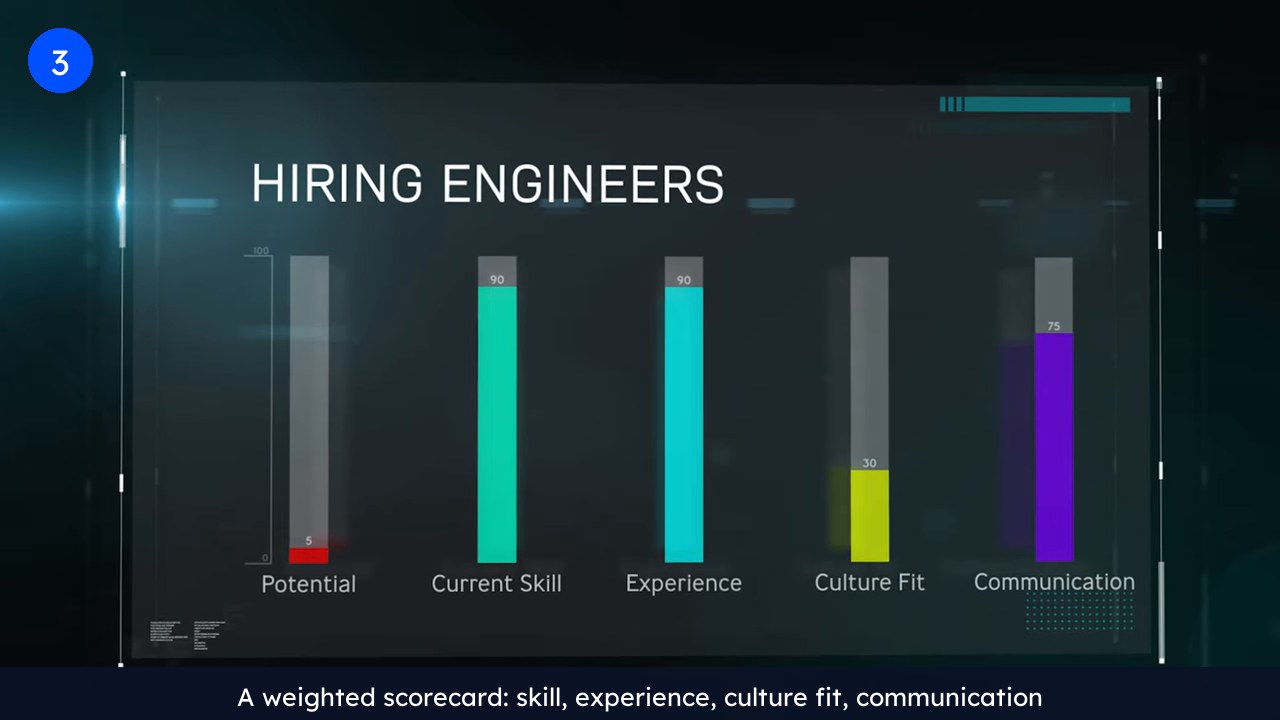
Most hiring loops score current skill and years of experience heavily, communication somewhat, culture fit loosely, and potential not at all. That weighting made sense when experienced engineers were plentiful and inexpensive. In a market where the large employers a few exits up the freeway can outbid you in cash for anyone who already has your exact stack, it works directly against you.
Set the technical bar honestly, insist that candidates clear it, then let trajectory decide between the people who do. An engineer two years into a steep learning curve, hired at mid-level money, is frequently a better bet than a senior who has repeated the same year five times. Write the weighting down before you interview anyone, because a scorecard invented afterwards is just a rationalization of whoever you already liked.
Your week-one evaluation plan
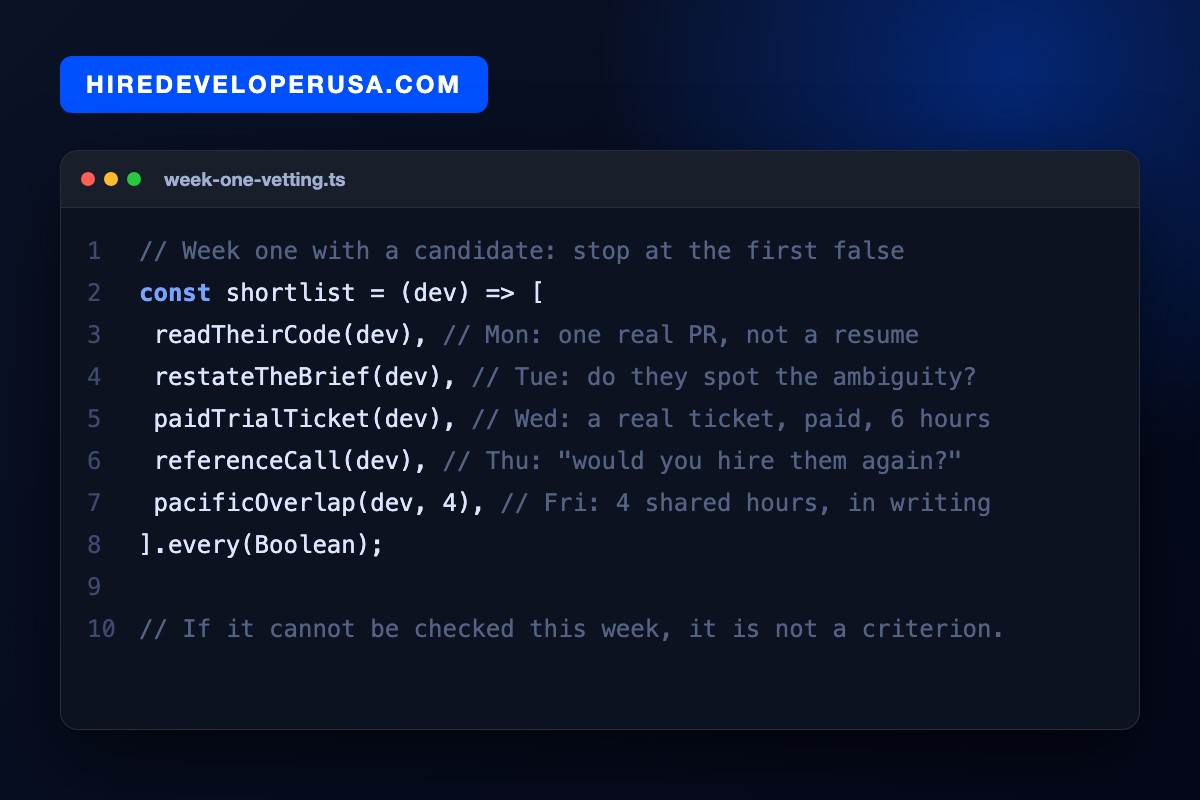
You do not need a six-stage loop. You need five days of evidence you generated yourself. Run this in order and stop at the first stage that fails.
- Monday, read the work (20 minutes). Open real code. If there is none you can see, ask for a walkthrough of something they built and why.
- Tuesday, the comprehension call (45 minutes). Describe a real requirement from your backlog and ask them to restate it and name its ambiguities. Candidates who ask sharp clarifying questions here are the ones who will not build the wrong thing in month two.
- Wednesday, a paid trial ticket (4 to 8 hours). A small, self-contained, genuinely real task in your codebase, paid at their normal rate. This is the highest-signal step in the process and the one most teams skip.
- Thursday, two reference calls. Ask whether they would hire the person again and listen to the pause before the answer. Then ask the reference to help you manage them well. People who will not criticize a former colleague will happily coach you, and the coaching contains the criticism.
- Friday, agree the overlap. Put the shared Pacific hours, the response-time expectation and the escalation channel in writing before the offer, not after the first missed handoff.
Before you sign: terms that keep the engagement clean
Two things sink first engagements more often than bad code does. The first is intellectual property. Without an explicit assignment clause covering everything created during the engagement, including code, designs and documentation, your ownership is weaker than you assume. That matters most with contractors, and it matters enormously the first time an investor reads your repository during diligence. Have counsel review one template and reuse it, and settle worker classification in the same conversation, because California applies a stricter contractor test than most states and a template borrowed from a Texas engagement will not simply transfer.
The second is unstated expectations. Write down the working week you actually expect, where decisions get made, which channel means answer now and which means answer today, how much notice either side gives, and what happens when the work runs out.
Where to start this week
San Diego rewards employers who scope precisely, because the talent here is deep enough that a specific, honestly priced role gets read seriously and answered quickly. Three moves, five days.
Write the one-page spec with a 30-day proof and a 90-day outcome. Decide which of the three markets your role belongs to, set the band from the figures above, and be honest with yourself about whether you are buying hours or hiring an employee. Then open two channels at once, your own network plus one vetted source, because relying on a single channel is how a search drifts into month three.
If you would rather skip sourcing altogether, we introduce vetted US and remote developers who work Pacific hours, usually within a few days. See how it works, or send us the spec and we will come back with a shortlist.
Frequently asked questions
How much does it cost to hire software developers in San Diego?
Expect $85 to $150 per hour for a local independent contractor, $60 to $150 per hour through a vetted US marketplace, and $150 to $275 per hour at a San Diego development agency. If you are hiring an employee instead, base salaries run $105,000 to $200,000 depending on seniority, and the loaded cost is roughly 25 to 35 percent higher than base once payroll tax, benefits and equipment are counted.
Are San Diego developers cheaper than San Francisco developers?
Yes for most roles. Comparable seniority prices below the Bay Area while sitting above the national median, which is the main financial argument for the city. The exception is wireless, RF and semiconductor work, where the concentration of local employers keeps compensation close to Bay Area levels because those companies are competing for the same small pool.
How long does it take to hire a software developer in San Diego?
A direct search for a full-time employee typically runs six to twelve weeks from posting to signed offer, and longer if the role is loosely specified. Contract or marketplace hires can start within days. Cleared defense roles are the outlier and can take several months, because clearance processing runs on its own timetable regardless of how fast you move.
Do I need to hire locally in San Diego, or can the role be remote?
Hire locally when the work truly needs presence: hardware bring-up, lab access, a regulated on-site environment, or cleared programs. For everything else, a remote US hire working Pacific hours gives you the same time-zone alignment at a lower cost and a much larger candidate pool than a thirty-mile radius allows.
Hire vetted talent