

Key takeaways
- →Chicago rate bands for 2026: $70 to $130 per hour for a local contractor, $60 to $150 through a vetted US marketplace, $130 to $250 at a development agency, and $95,000 to $185,000 base salary in-house.
- →Compare loaded costs, not rates. A $165,000 senior costs about $214,500 a year once benefits and overhead are added, and closer to $247,500 in year one if a recruiter fee is involved.
- →Chicago talent concentrates in Fulton Market and the West Loop, the Loop, River North around the Merchandise Mart, and the enterprise corridors out in Naperville and Schaumburg.
- →Do not scope a C++ or low-latency role against trading firm compensation. DRW, IMC and Jump Trading set that ceiling and will win the bidding war.
- →Most teams need Central hours rather than a Chicago address. A remote US hire on Central time overlaps both coasts and costs less than a downtown desk.
Hiring a software developer in Chicago costs roughly $70 to $130 per hour for a local independent contractor, $130 to $250 per hour through a Chicago development agency, and $95,000 to $185,000 per year in base salary for a full-time engineer, before benefits and payroll overhead. Senior hires cluster at the top of that salary band. Every one of those numbers sits meaningfully below what the same engineer costs in San Francisco or New York, which is the reason Chicago keeps quietly winning engineering budgets.
The catch is that Chicago is not one labor market. A proprietary trading firm in the Loop and a twelve-person healthtech startup in Fulton Market are bidding for different people at wildly different prices, and if you scope your role against the wrong one you will either overpay or stall for months. This guide gives you the rate bands, the salary math including the costs nobody budgets, where the talent actually sits, and a vetting sequence you can run in two weeks.
What it costs to hire software developers in Chicago
Start with the four channels available to you and what each one really prices in:
| Hiring channel | Typical cost | Best for |
|---|---|---|
| Local Chicago contractor | $70 – $130/hour | Short projects, occasional on-site days, work that benefits from a local network |
| Vetted US marketplace (remote) | $60 – $150/hour | Starting in days on Central hours, with no recruiting fee |
| Chicago development agency | $130 – $250/hour | Fixed-scope delivery with project management bundled in |
| In-house full-time | $95,000 – $185,000/year base | Long-term ownership of a core product |
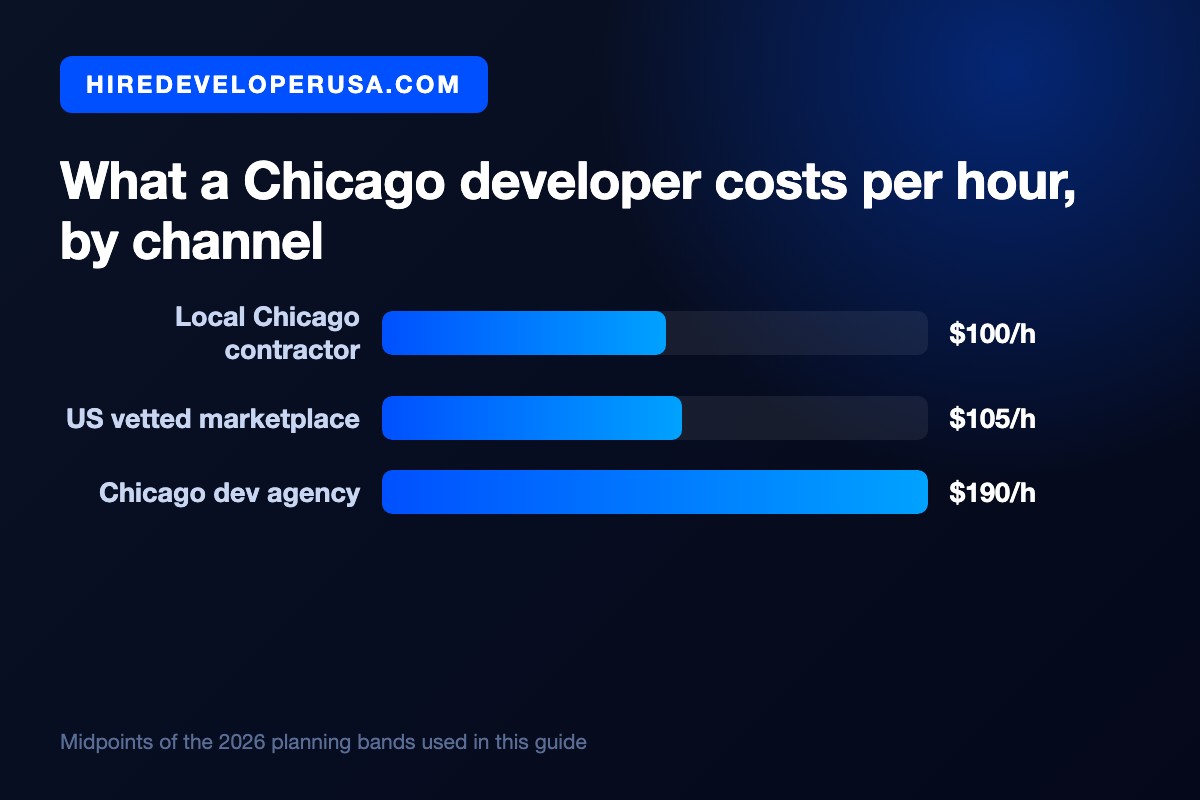
Take the midpoints and the picture sharpens: about $100 per hour for a competent local contractor, about $105 per hour for a vetted remote engineer working your time zone, and about $190 per hour for agency delivery. The agency premium buys a project manager, a QA function and someone contractually on the hook for the deadline. If you already have a technical lead who writes specs and reviews code, you are paying twice for that layer. If you do not, the premium is usually cheaper than learning the job on your own project.
The one number to distrust is the lowest one. A $55-per-hour generalist who needs three passes at a feature costs more than a $120-per-hour senior who ships it once with tests. For the national picture behind these bands, see our breakdown of what it costs to hire a software developer in the US.
In-house salary bands, and the cost nobody budgets
If you are hiring an employee rather than buying hours, these are the Chicago base-salary bands worth planning against in 2026:
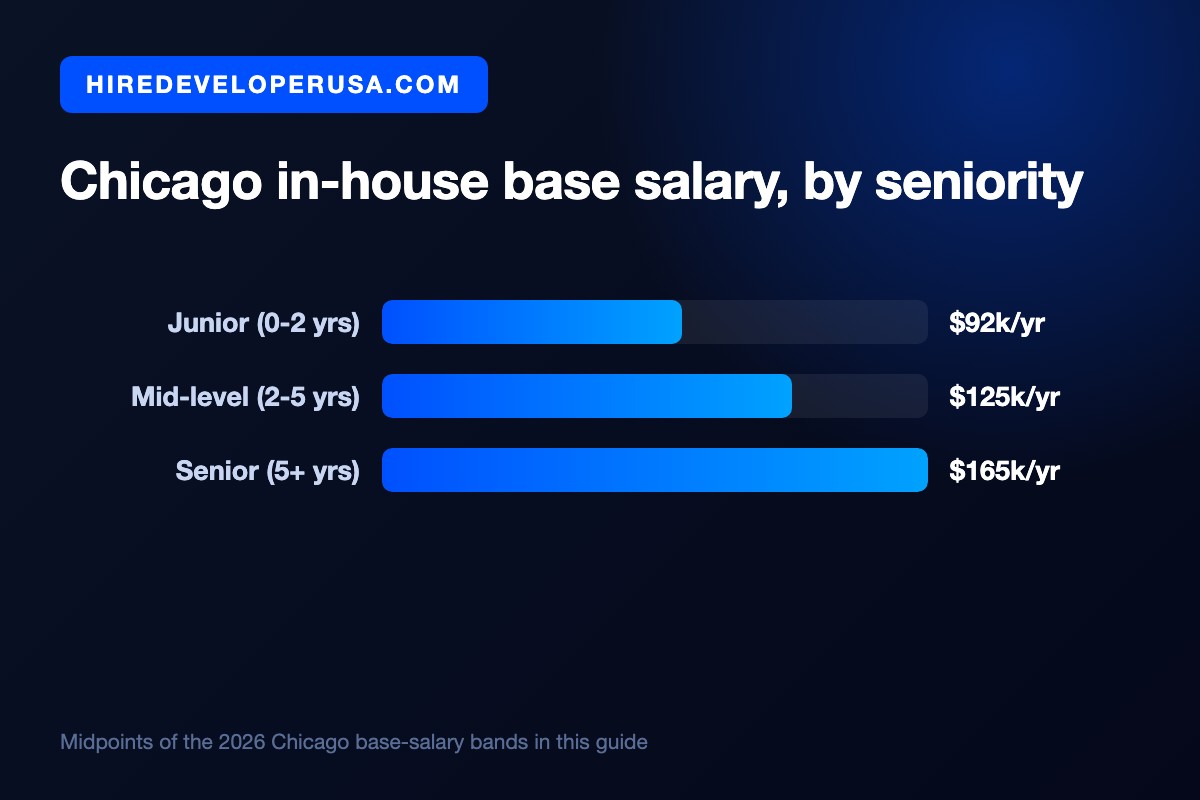
- Junior (0 to 2 years): $80,000 to $105,000. Productive on well-defined tickets inside an existing codebase, but every pull request needs a senior reviewer.
- Mid-level (2 to 5 years): $105,000 to $145,000. Owns a feature end to end against a written spec. This is the workhorse tier for most Chicago product teams.
- Senior (5+ years): $145,000 to $185,000. Makes architecture calls, unblocks other engineers, and prevents the expensive mistakes before they reach production.
- Low-latency and staff-plus roles: above $185,000 base, often with bonus structures that make base salary almost beside the point. The trading firms set this ceiling.
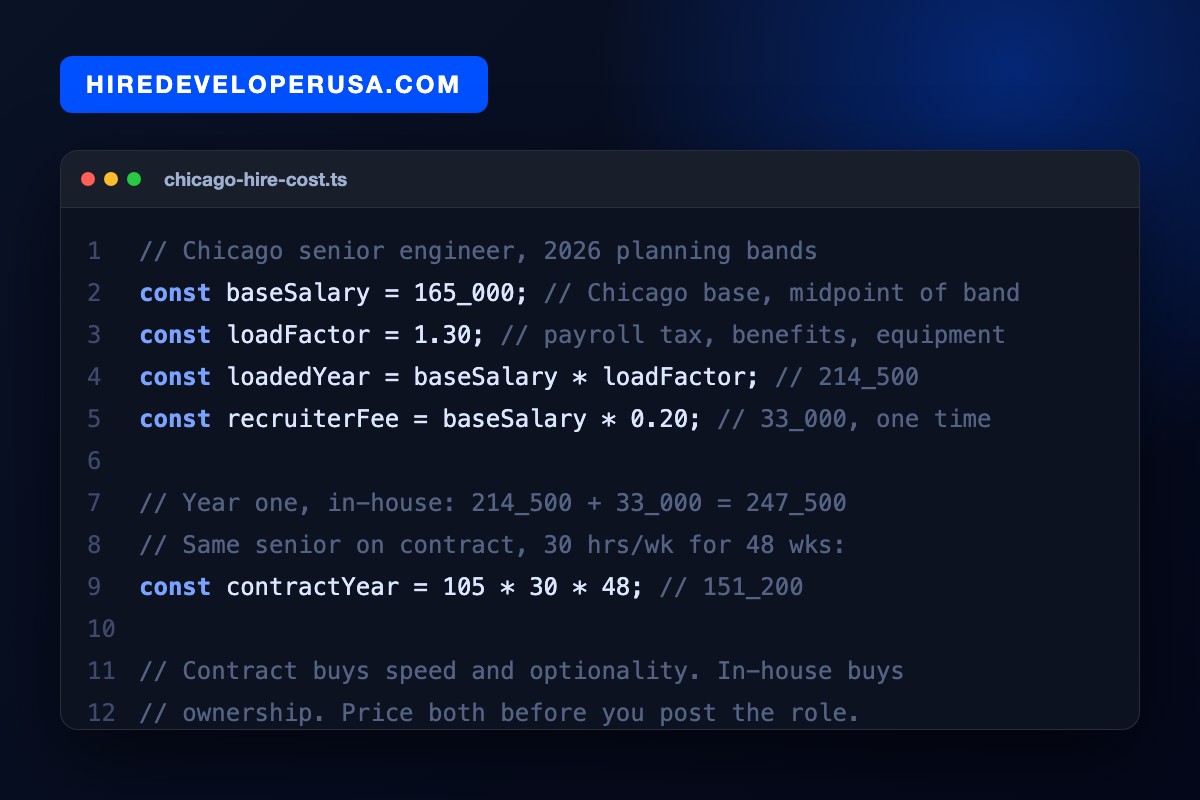
Now add what the offer letter does not show. Payroll taxes, health insurance, 401(k) match, software licenses and equipment realistically add about 30 percent on top of base. A $165,000 senior therefore costs roughly $214,500 a year to keep. If you use a contingency recruiter at a standard 20 percent fee, add another $33,000 in year one, which puts the first twelve months near $247,500. That is the number to compare against a contract engagement, not the base salary. Rate bands for individual specialties, such as back-end web developers, move around these figures by stack.
Where Chicago's engineering talent actually sits
Chicago's technology employment has consolidated into a handful of recognizable corridors, and knowing which one your role belongs to changes both your sourcing and your price.
Fulton Market and the West Loop anchor the modern corridor, with Google's Chicago office and a dense band of corporate technology tenants around it. Expect product engineers with big-company process habits and compensation expectations to match. The Loop holds Salesforce Tower, Grubhub and a heavy concentration of trading firms hiring C++ and low-latency specialists. River North and the Merchandise Mart remain the startup center of gravity thanks to the 1871 incubator, which is where you find scrappy generalists who have shipped with small teams and thin budgets. mHUB on the Near West Side covers hardware and physical-product engineering, a niche most hiring guides ignore entirely.
The suburbs are a separate market. Naperville, Schaumburg and the corridors around them are enterprise Java and .NET country, serving insurance, healthcare IT and logistics employers. Rates run lower than downtown for comparable seniority, and candidates there are often readier to work fully remote.
The pipeline feeding all of it is unusually strong. The University of Illinois Urbana-Champaign has one of the country's top computer science programs, and Northwestern, the University of Chicago, Illinois Institute of Technology and DePaul all feed local employers. That supply is exactly why Chicago compensation stays below coastal levels while the quality bar does not.
One warning that saves months. Proprietary trading firms such as DRW, IMC and Jump Trading compete aggressively for the same systems engineers you may be targeting, and they will win any bidding war you start. If your role is C++ or low-latency, either accept that you are recruiting against the top of the market or reshape it to compete on problem and autonomy rather than on cash.

Local Chicago hire, remote US, or offshore
Most teams searching for a Chicago developer do not actually need someone in Chicago. They need someone who works Chicago hours, understands US business context, and can be in the room on the rare days it matters. Those are three different requirements with three different price tags.
A local hire earns its premium when the work needs physical presence: hardware, regulated on-site environments, a founding team that genuinely designs on a whiteboard, or a client base that expects to meet your engineers. It also buys a warm local network, which is the fastest referral channel there is.
A remote US hire on Central time is the default most teams should start from. Central is the friendliest time zone in the country for collaboration: it overlaps the full East Coast workday and most of the West Coast one, so a remote engineer in Nashville or Denver is functionally identical to a local hire for everything except handshakes.
Offshore at $20 to $45 per hour is a real option, and it fails for a predictable reason: cheap execution demands expensive precision. If nobody on your side writes airtight specifications and reviews work daily, you pay the difference back in rework. Teams that succeed offshore almost always have strong in-house technical leadership already. Teams that lack it do better paying more per hour for engineers who work their hours and own outcomes. Our freelance developer hourly rates guide lays out how those bands compare across channels, and how our matching works covers the marketplace route if you would rather not run the search yourself.
Write the role before you write the job post
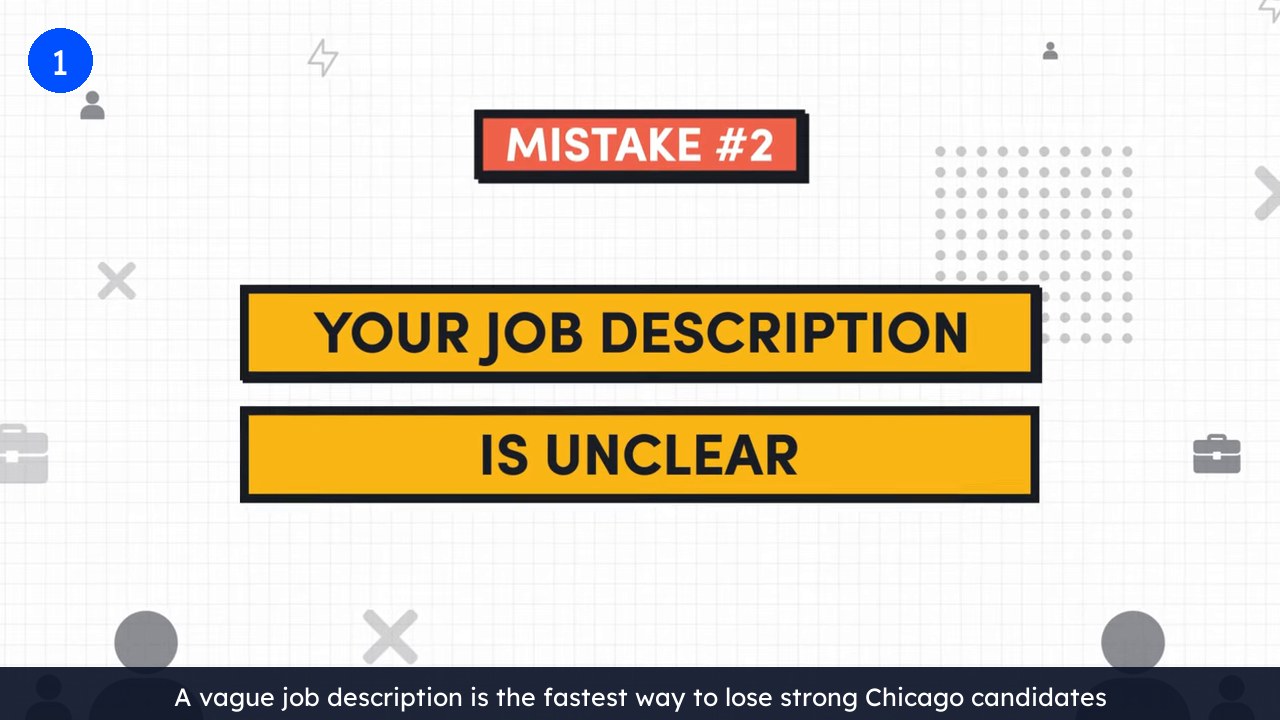
The single most common reason a Chicago search stalls is not budget. It is that the job description does not describe a job. If you cannot name the specific problems the hire will solve, the tasks they will own, and what success looks like at one month and at three months, you do not have enough clarity to evaluate anyone, and strong candidates can tell within thirty seconds of reading.
Write a one-page spec before the post goes live, containing four things:
- The problem. Not "build features" but "our checkout drops 8 percent of sessions at the payment step and nobody owns it."
- The tasks. The concrete work of the first quarter, in plain language.
- The 30-day goal. Usually shipping something small end to end, which proves onboarding worked.
- The 90-day goal. The outcome that justifies the hire, stated so both sides can agree later whether it happened.
Resist the temptation to generate the description wholesale from an AI assistant. These tools average every job post on the internet, and the internet contains a great many bad ones. Use them to tighten your own draft instead. Shorter and more opinionated beats longer and more generic every time: a post that names a real problem filters candidates better than one that lists fourteen technologies.
The vetting sequence that predicts performance
Conversations, resumes and a portfolio link tell you what someone claims. They do not tell you how someone thinks. Run this sequence in order and stop at the first stage that fails:
- Screen the work, not the resume (20 minutes). Open their code. Read a pull request, a repository, anything real.
- The comprehension call (45 minutes). Describe a real requirement from your backlog and ask them to restate it in their own words and name its ambiguities. Engineers who ask sharp clarifying questions here are the ones who will not build the wrong thing later.
- A paid trial ticket (4 to 8 hours). A real, small, self-contained task in your codebase, paid at their normal rate. This is the highest-signal step in the entire process and the one most teams skip.
- Pair programming (60 to 90 minutes). Watch the thought process, not the output. How they debug tells you more than whether they finish.
- References, done properly. Covered below, because almost everyone does this badly.
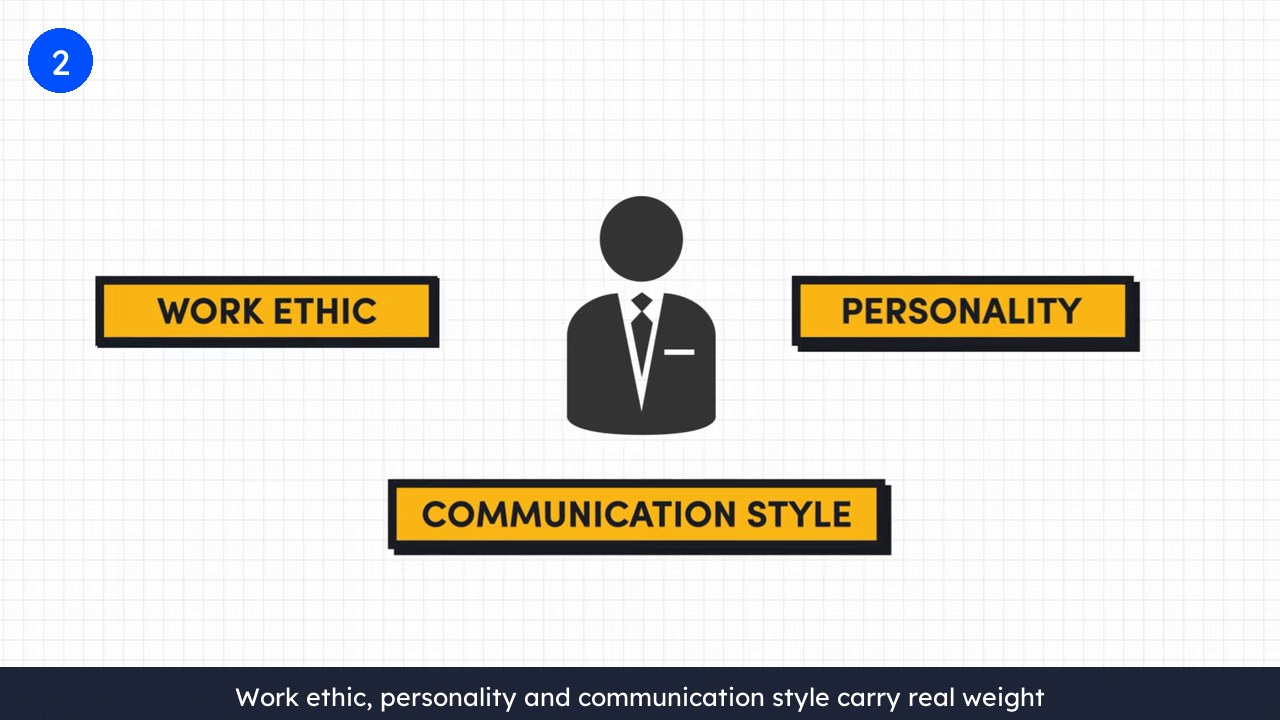
Hiring on technical skill alone is the classic failure mode, and it is expensive. Work ethic, personality and communication style decide whether a strong engineer becomes a strong teammate. So does background fit: someone who spent eight years on a hundred-person platform team at a large employer is not automatically ready to be employee number three, where the job is scrappy generalism and nobody writes your tickets for you.
Reference checks, the step everyone rushes
Two questions make a reference call useful. The first is "would you hire this person again?" and the pause before the answer is as informative as the answer. The second is a framing trick: say you are planning to hire them and ask the reference to help you manage them well. "What should I know? Where will they need support?" People who will not criticize a former colleague will happily coach you, and the coaching contains the criticism.
Better still, do not rely only on the references the candidate hands you. Check LinkedIn for people you both know and call one of them. A warm reference from someone with no stake in the outcome is worth five curated ones, and in a market as interconnected as Chicago tech you can usually find one within two degrees.
Contract and onboarding terms that protect you
Two things sink first engagements more often than bad code. The first is intellectual property. If your agreement lacks an explicit assignment clause covering everything created during the engagement, including code, designs and documentation, your ownership is weaker than you think. That matters most with contractors, and it matters enormously the first time an investor runs diligence on your repository. Have counsel review the template once and reuse it, and settle worker classification in the same conversation.
The second is unstated expectations. Write down the working week you actually expect, where decisions get made, which channel means "answer now" and which means "answer today", how much notice either side gives, and what happens when the work runs out. Every team's norms differ slightly from the last place your hire worked, and the gap between them is where resentment grows.
Then onboard deliberately, even for a senior. A short codebase tour, your branching and review conventions, the deploy path, and a first ticket small enough to ship in week one. If you are hiring full-stack developers who will touch everything, budget a full day of someone's time for it.
One more discipline, unpopular but true: if the hire is clearly not working after the trial period, act quickly. Nobody has ever complained that they ended a bad engagement too early.
Your next two weeks
Chicago rewards employers who move deliberately, because the talent is deep enough that a well-scoped role gets read seriously and priced fairly. Here is the plan that fits in fourteen days.
Week one. Write the one-page role spec with 30-day and 90-day goals. Set your band using the figures above and decide honestly whether you are buying hours or hiring an employee. Open two channels at once, typically your own network plus one vetted source, because a single channel is how searches drift into month three.
Week two. Screen work samples, run comprehension calls, and put your top one or two candidates on a paid trial ticket. Make reference calls while the trial is running rather than after. Decide on evidence you generated yourself, not on a resume.
If you would rather skip the sourcing entirely, you can review pre-vetted engineers who already work Central hours, including Python developers in Chicago, and start from a shortlist instead of a job post.
Frequently asked questions
How much does it cost to hire software developers in Chicago?
Expect $70 to $130 per hour for a local independent contractor, $60 to $150 per hour through a vetted US marketplace, and $130 to $250 per hour at a Chicago development agency. Full-time employees run $95,000 to $185,000 in base salary depending on seniority, and roughly 30 percent more once payroll taxes, benefits and equipment are included.
Is it cheaper to hire developers in Chicago than in San Francisco or New York?
Yes, and meaningfully so. Comparable seniority prices below both coastal markets, which is one of Chicago's clearest advantages as a hiring location. The gap is narrowest at the very top of the market, where proprietary trading firms compete nationally for low-latency engineers and pay accordingly.
How long does it take to hire a software developer in Chicago?
A direct search for a full-time employee typically runs six to twelve weeks from posting to signed offer, longer if the role is poorly specified. Contract or marketplace hires can start within days because the vetting has already happened. The variable that moves the timeline most is not the market, it is how clearly you have defined the role.
Should I hire a Chicago developer locally or remotely?
Hire locally when the work genuinely needs physical presence, such as hardware, regulated on-site environments, or a client base that expects to meet your engineers. Otherwise hire remotely on Central time. You get the same overlap with both coasts, a far larger candidate pool, and no geographic premium.
Hire vetted talent