
Key takeaways
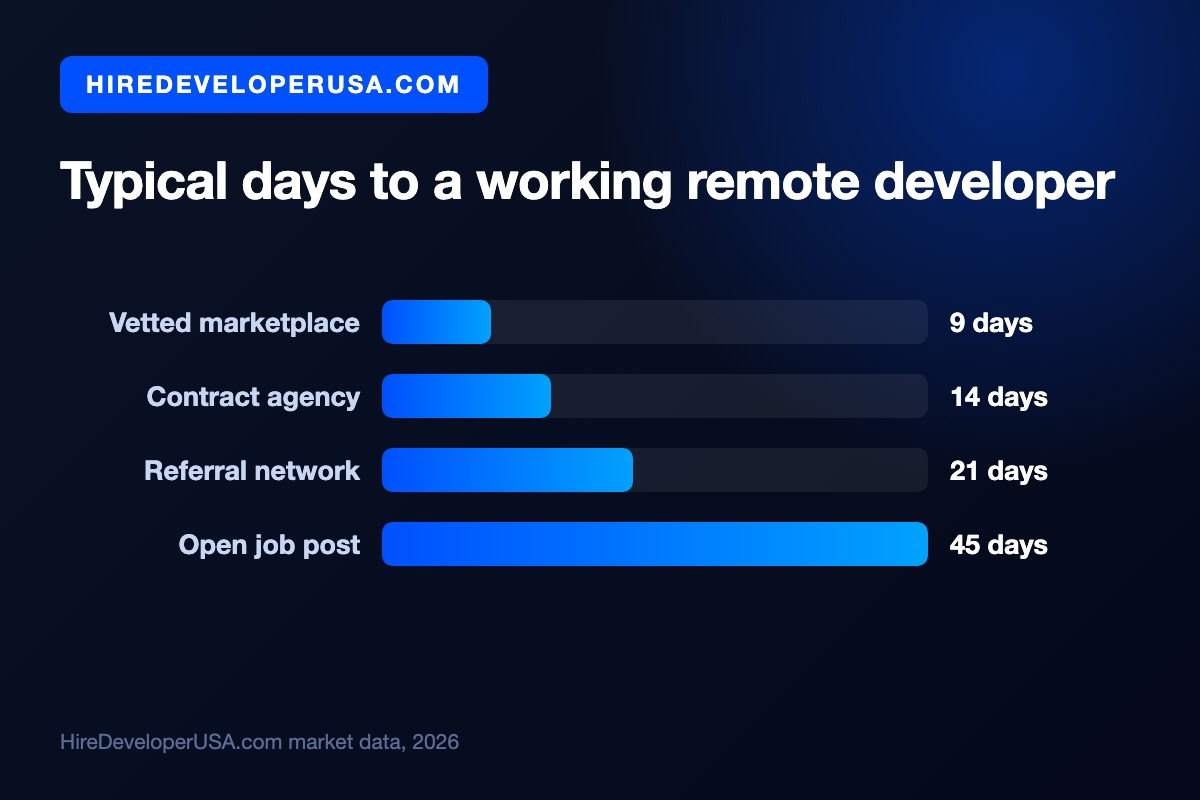
- →Pick the sourcing channel from your deadline: about 9 days to a working developer through a vetted marketplace, 14 through a contract agency, 21 through a referral and 45 through an open job post.
- →US costs by model: $45 to $120 an hour on a marketplace, $100 to $200 at an agency, $85,000 to $175,000 base salary in house, and $25 to $60 an hour offshore.
- →Four hours of daily overlap is the threshold where a live standup, one unblocking block and a same-day handover all still fit.
- →A paid 40-hour trial costs $3,200 at a mid-level rate, against $38,400 for the twelve weeks most teams take to admit a hire is not working.
- →Provision access before day one and merge a deliberately small pull request by day two. Silence in week one is the most common remote failure.
Hiring remote developers works when you run six strategies in order: write the scope down before you write the job post, pick the sourcing channel by your deadline instead of your budget, buy overlap hours rather than a time zone, screen against your own codebase, pay for one bounded week before you commit, and make the first ten days boring. Done that way, a US buyer typically has a working developer in about 9 days through a vetted marketplace and about 45 days through an open job post, at $45 to $120 an hour on a marketplace, $100 to $200 an hour through an agency, or an $85,000 to $175,000 base salary for a permanent hire.
Most remote hires do not fail because of talent. They fail because the buyer never decided what they were buying, waited six weeks for a shortlist needed in two, and learned in month three what a paid week in month one would have revealed. Below is each strategy, its cost, and the three habits that quietly burn a quarter.
Strategy 1: Buy a scope, not a seat
Decide which of three shapes your work really has before writing a single word of the job post. It is the shape, not the stack, that determines which contract you should sign.
A bounded project has a finish line you can describe in one sentence: move the billing service off the legacy API, ship the customer portal, get the mobile app through review. What you buy is a deliverable, payment follows milestones, and the engagement ends. Continuous product work has no finish line. A backlog exists, it keeps refilling, and someone has to hold the context of why the retry logic looks odd. Here you buy committed hours each week. A specialist burst is narrow and short: a performance audit, a security review, a Kubernetes migration. You are buying a named outcome from someone who has done it twenty times, and you pay an hourly premium because you need five days instead of five months.
Writing this down takes an afternoon and changes everything downstream. A bounded project screened like continuous work attracts people who want stability and will leave when the project ends. Continuous work scoped as a project produces a developer who disappears the week your roadmap gets interesting. If you are not sure which shape you have, count how much work is left after the thing you are currently panicking about ships. Under six weeks, it is a project. Over three months, it is a seat. If you need one person who can cover the whole stack rather than a specialist, start from the full stack developer pool and narrow from there.
Strategy 2: Pick the channel by your deadline, not your budget
Each sourcing channel comes with a price and a speed. Buyers nearly always optimize the price, even though the deadline is what actually hurts them. Four weeks of an unstaffed backlog costs more than any hourly gap between channels.
| Channel | Typical time to a working developer | Typical US cost | Best for | Main risk |
|---|---|---|---|---|
| Vetted marketplace | About 9 days | $45 to $120 per hour | Continuous work that needs to start now | You pay a platform margin on every hour |
| Contract agency | About 2 weeks | $100 to $200 per hour | Fixed-scope projects that need a manager attached | An account manager sits between you and the code |
| Referral network | About 3 weeks | Negotiated, usually marketplace rates | Senior or trust-critical work | Your network size caps the pool, and good people are busy |
| Open job post | About 45 days | $85,000 to $175,000 base salary | Permanent roles you expect to keep for years | Hundreds of applications land on whoever is least busy |
The honest way to use this table is to start from the date the work has to be moving and read backwards. If that date is inside three weeks, an open job post is not a plan, it is a hope. If the role is permanent and you can wait, the job post is the cheapest hour you will ever buy and the slowest one to arrive. Plenty of teams run both at once: a marketplace developer keeps the backlog moving while the permanent search runs on its own timeline.
Strategy 3: Pay for overlap hours, not for a time zone
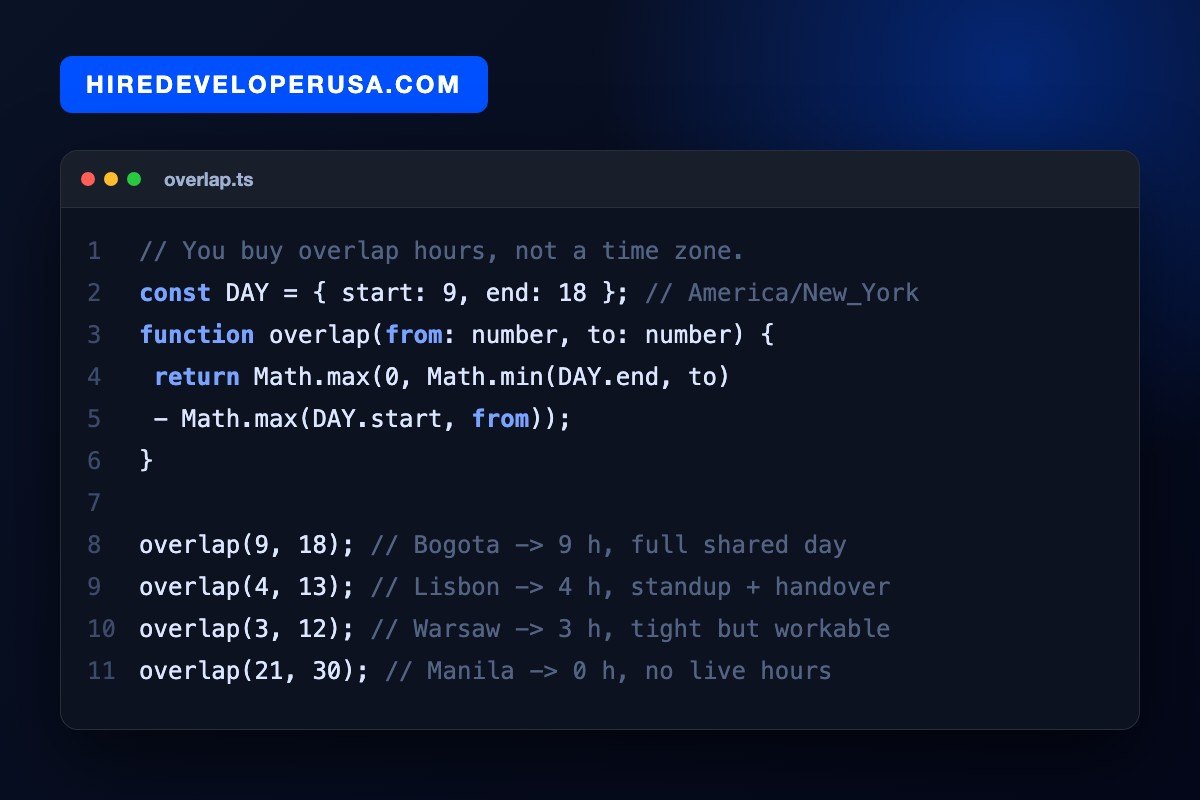
Remote hiring debates get stuck on countries when the only variable that affects your week is how many hours of your working day the developer is awake for. Four hours of reliable overlap is the threshold where a normal team rhythm survives: a live standup, one block for pairing or unblocking, and a handover that is still same-day. Below three hours, every question costs you a calendar day, and a two-question problem becomes a two-day problem.
In the job description, state the overlap requirement as a number of hours in your own time zone, never as a list of acceptable countries. A developer in Lisbon who moves their day to 11am until 8pm local overlaps a 9 to 6 New York day by six hours. Someone two states away who only takes calls after 3pm gives you three. The passport is not the variable.
Then pay for the overlap you requested by making it count for something. Three defaults carry most of the load: a written standup posted ahead of the overlap window, so live time goes to decisions instead of status; every decision logged in the ticket or the pull request instead of a call nobody minuted; and a demo recorded at the close of each week. Teams adopting those three stop worrying about the remaining hours, since those hours are productive rather than blocked.
Strategy 4: Screen against your own codebase
Algorithm puzzles tell you whether someone practiced algorithm puzzles. For remote work, where nobody is looking over a shoulder, you want evidence of judgment on code that looks like yours. A 90-minute screen does that better than three rounds of trivia.
Use the first 20 minutes to have the candidate restate your problem in their own words. Anyone who cannot do this will not manage to work from a written ticket, and that is the entire job when you are not in the same room. The next 40 minutes go to reviewing a real pull request from your repository, ideally one a junior wrote, with two defects you already know about. Ask what they would change, and why. You are listening for the gap between style opinions and consequences. Then give 20 minutes to a small debugging task in their own environment with the screen shared, since setup habits and tooling fluency surface within the first five minutes. Reserve the last 10 minutes for their questions. What a senior developer asks about ownership, deployment and on-call shows how many real systems they have run. If more than one interviewer will run this, our technical interview guide has the full script.
A warning that applies to remote hiring in 2026: assume an AI assistant helped with every take-home, because one did. That is fine, since it is also how the person will work for you. The test is whether they can defend the result line by line. Have them walk through a decision the assistant made on their behalf. Those who cannot are the ones you will be reviewing forever.
Strategy 5: Pay for one bounded week before you commit
Interviews measure how people talk about work. A paid week measures the work. Scope it tightly: one real ticket from your backlog, a written definition of done, access provisioned on day one, and a named person who answers questions within the overlap window. Agree the pass criteria before it starts, in writing, so the decision at the end is a reading rather than an argument.
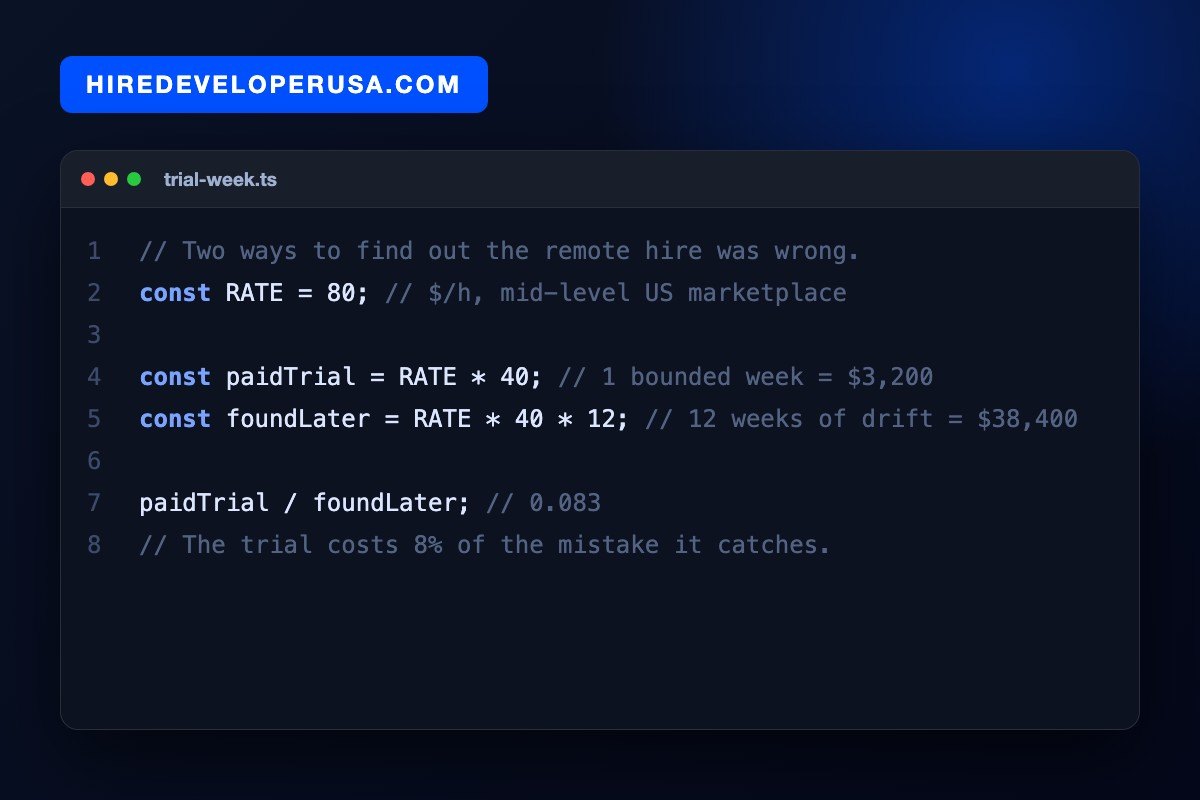
This item is the least negotiable on the list because of the arithmetic. At a mid-level US marketplace rate of $80 an hour, a 40-hour trial costs $3,200. Keeping a hire who is not working for twelve weeks (roughly how long most teams need to admit it) costs $38,400 in billed hours alone, before the delayed roadmap and the second search. The trial is 8 percent of the mistake it catches.
Pay the full rate for the trial week, and say so up front. Unpaid work filters out exactly the senior people you are trying to reach, because they have options and no spare weekends. Treat the week as a two-way test: the candidate is also deciding whether your tickets are legible, your environment runs, and your team answers questions. The ones who walk away after a paid week were going to walk away in month two anyway, having cost you eight times as much.
Strategy 6: Make the first ten days boring
Silence is how a remote start fails. A developer who cannot get the environment running, does not know whom to ask, and does not want to look slow on day three will spend a week quietly stuck. Nobody notices before the first check-in. By then the relationship has started badly.
Prevent it with a schedule rather than goodwill. Accounts, repository access and a running local environment on day one, prepared before they start rather than requested on the morning. A first pull request merged by day two, deliberately small: a copy change, a test, a config fix, anything that proves the pipeline from their laptop to production works. A named onboarding buddy who is explicitly allowed to be interrupted. A written answer to the three questions every new remote developer has and few ask: how do I deploy, who approves my work, and what does an emergency look like here. Our remote onboarding checklist turns this into a day-by-day plan.
The three strategies that waste a quarter
Opening a job post for six weeks of work. The post stays up for a month, screening consumes a week of a senior engineer's time, and the offer lands with someone who has to serve notice. Now the project starts in month three, when a contract developer could have finished it in month one. Fit the instrument to the duration.
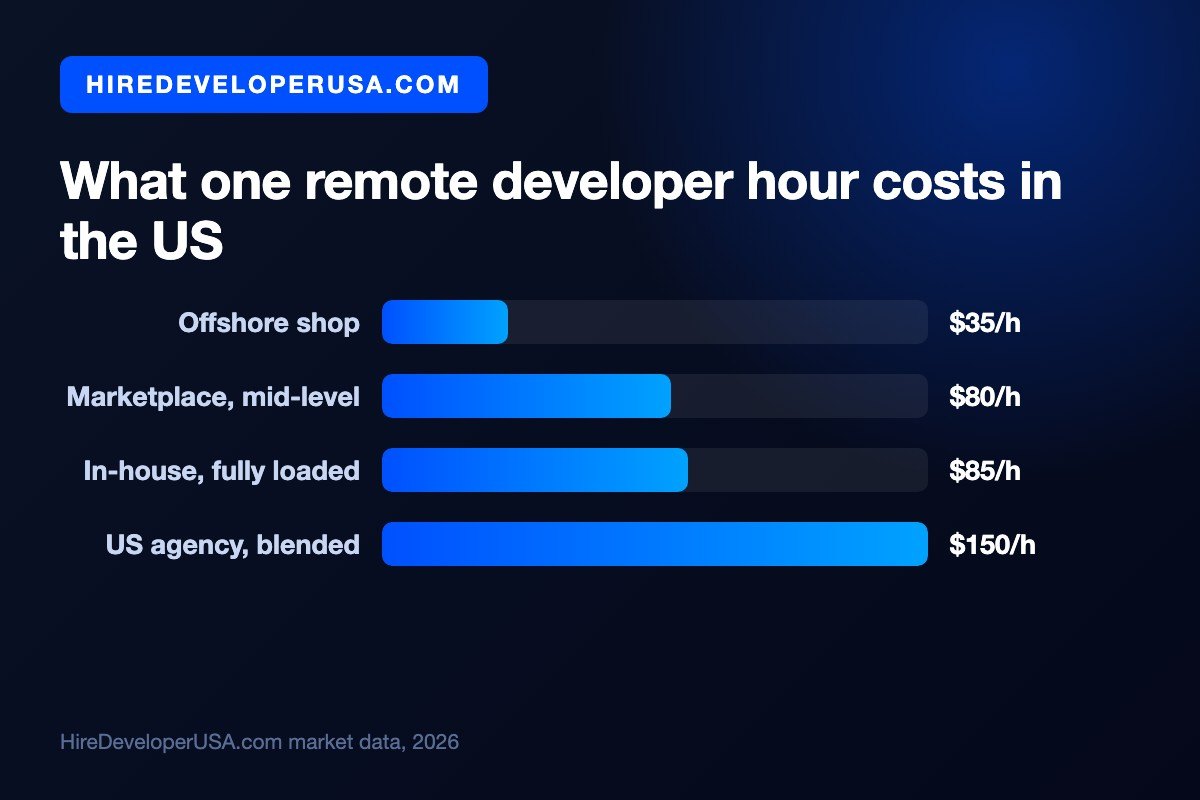
Hiring the hourly rate instead of the outcome. The cheapest hour is rarely the cheapest month. An offshore shop at $35 an hour that needs three rounds of rework per feature, plus your own time spent writing specifications for a timezone with no overlap, can cost more per shipped feature than an $80 an hour marketplace developer who gets it right the second time. Price the feature, not the hour, and use the rate bands below as the starting point for that calculation.
Running a multi-day unpaid take-home. It feels rigorous, yet it filters in the wrong direction: the people with the most options drop out first, leaving you to choose among the candidates with the most free time. Any request for more than 90 minutes of a candidate's work should be paid. Our breakdown of what it costs to hire a software developer gives the full picture of what each model costs over a year.
What to do this week
Take the afternoon and write two paragraphs: what the work is, and what has to be true in 90 days for the hire to have been worth it. Then pick the channel from the deadline, not the budget, and put a paid trial week in the plan before you talk to anyone. Those three decisions account for most of the difference between teams that hire remotely well and teams that keep starting over.
When you are ready to see candidates, browse the software development talent pool and shortlist against the scope you just wrote, not against the resumes that happen to arrive first.
Frequently asked questions
How long does it take to hire a remote developer?
Plan on about 9 days via a vetted marketplace, about two weeks via a contract agency, about three weeks via a referral network, and about 45 days for an open job post once screening, interviews, offer and notice period are added. It is the channel, far more than the role, that sets the clock. Choose it from the date the work has to be moving.
How much does it cost to hire a remote developer in the US?
Expect $45 to $120 an hour on a vetted marketplace depending on seniority, $100 to $200 an hour through a US agency, and $85,000 to $175,000 in base salary for a permanent hire, which loads to roughly $85 an hour once benefits, payroll taxes, equipment and management overhead are added to a $120,000 salary. Offshore shops quote $25 to $60 an hour, and that gap is only real if the work comes back needing one round of review rather than three.
How many hours of time zone overlap do I actually need?
Four hours of daily overlap is the practical floor for a developer who works inside your sprint. Three is workable when the team writes decisions down and runs an asynchronous standup. Zero overlap only works for genuinely separable, well-specified projects, because every clarification costs a full calendar day.
Should I pay for a trial week before hiring a remote developer?
Yes, and pay the full rate. A 40-hour trial on one real ticket costs about $3,200 at a mid-level US rate and tells you what three interview rounds cannot: whether the person works from a written ticket, ships inside your pipeline, and asks for help before they are stuck for a day. Unpaid trials filter out the senior candidates you most want.
Hire vetted talent