
Key takeaways
- →US developer base salaries run roughly $80,000 to $250,000 in 2026, and the federal median wage is $135,980.
- →Budget 1.25 times base for the annual loaded cost, and 1.38 times base per day actually worked.
- →Stack choice moves a senior band by about $50,000, driven by talent pool depth rather than skill.
- →The same senior role spans about $45,000 across US metros, and a remote US role prices at the national baseline.
- →A salaried senior developer costs about $118 per hour worked, which lands inside the senior contractor range.
If you are budgeting a US developer hire for 2026, plan on a base salary somewhere between $80,000 and $250,000 depending on seniority, and plan on the hire costing you roughly 1.25 times that number once payroll taxes, benefits and equipment land on the books. The national median wage for software developers is $135,980, according to the Bureau of Labor Statistics occupational wage survey published for May 2025, with the bottom tenth of the profession at $82,460 and the top tenth starting at $214,670.
Any honest salary report is built on those three figures. What follows refines them: how seniority moves the number, how your stack moves it, how your metro moves it, and what the offer actually costs after it clears payroll. Here, the bands are the ranges US employers budget to for full time base salary. Equity, signing bonuses and the big tech outliers that dominate social media are left out.
The 2026 developer salary report at a glance
Almost every hire a small or mid sized company makes fits one of four levels. In the loaded cost column, base is multiplied by 1.25, the planning number the next section explains.
| Level | Experience | Base salary band | Midpoint | Loaded cost |
|---|---|---|---|---|
| Junior | 0 to 2 years | $80,000 to $110,000 | $95,000 | about $119,000 |
| Mid level | 2 to 5 years | $115,000 to $155,000 | $135,000 | about $169,000 |
| Senior | 5 to 8 years | $155,000 to $200,000 | $178,000 | about $222,000 |
| Lead or staff | 8 years and up | $195,000 to $250,000 | $222,000 | about $278,000 |
Look at where the federal median lands. At $135,980 it falls almost exactly on the mid level midpoint, and that says something useful about the shape of the profession: the typical working developer in the United States is a mid level engineer, not a senior one and not a staff engineer at a famous company. A hiring plan that assumes you will routinely pay the top decile is planned around the exception.
The higher you go, the wider the bands get, and that is no accident. Market convention mostly sets the price of a junior hire. A staff hire, by contrast, is priced by what that specific person can do for your specific system, which explains why the top band is $55,000 wide and the bottom one $30,000 wide.
Base salary is the smallest number you will pay
The offer letter says $178,000. Your books show something else. Before anyone writes a line of code, employer side payroll taxes, the employer share of health coverage, a retirement match, a laptop and the software seats that go with it have all attached to that salary.
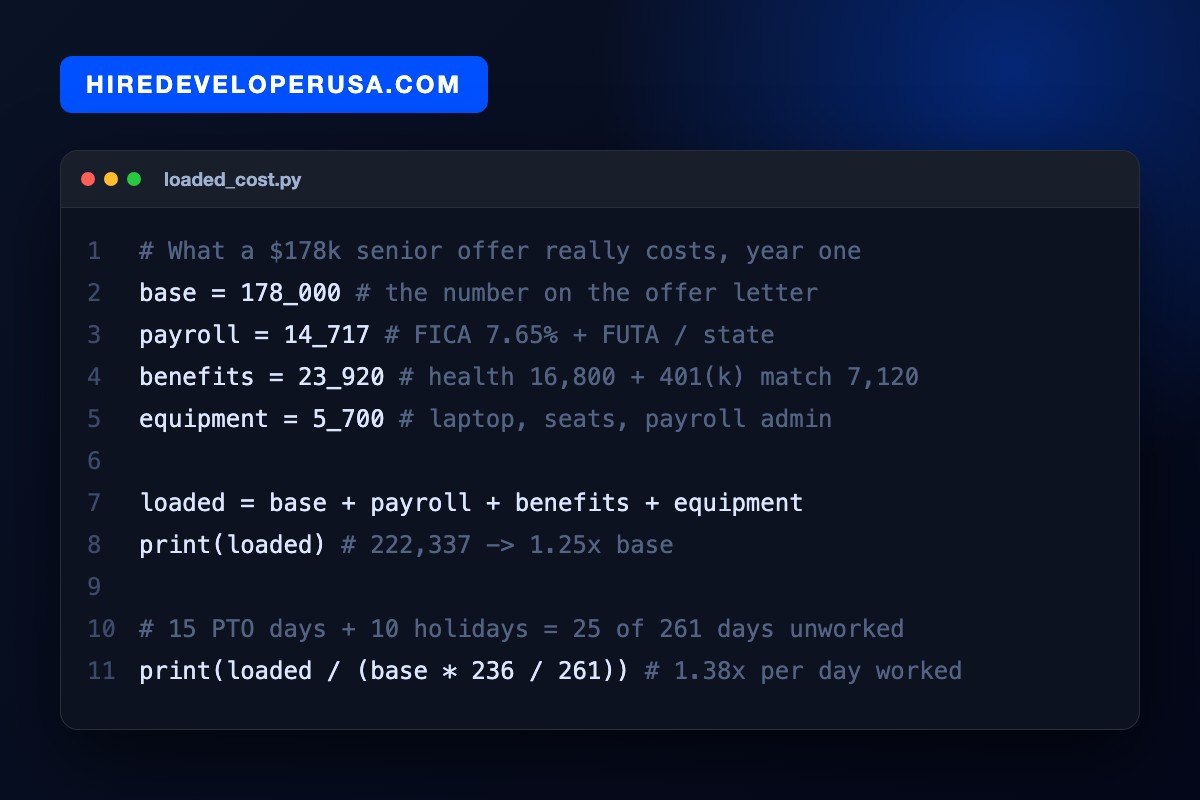
For a senior hire at the midpoint, the extras add up to about $44,300: roughly $13,600 in Social Security and Medicare at 7.65 percent, about $1,100 in federal and state unemployment, around $16,800 for the employer share of a family health plan, $7,120 for a 4 percent retirement match, and about $5,700 for hardware, software seats and payroll administration. That puts total loaded cost near $222,300, or 1.25 times base.
Most budgets miss the next part. Fifteen days of paid time off plus ten holidays is 25 of roughly 261 working days, which means you pay for 261 days and get 236. Per day actually worked, that $178,000 salary costs about 1.38 times base. Both numbers are right; they just answer different questions. For the annual budget use 1.25, and use 1.38 when comparing an employee against a contractor who bills only for days worked.
Your stack moves a senior band by $50,000
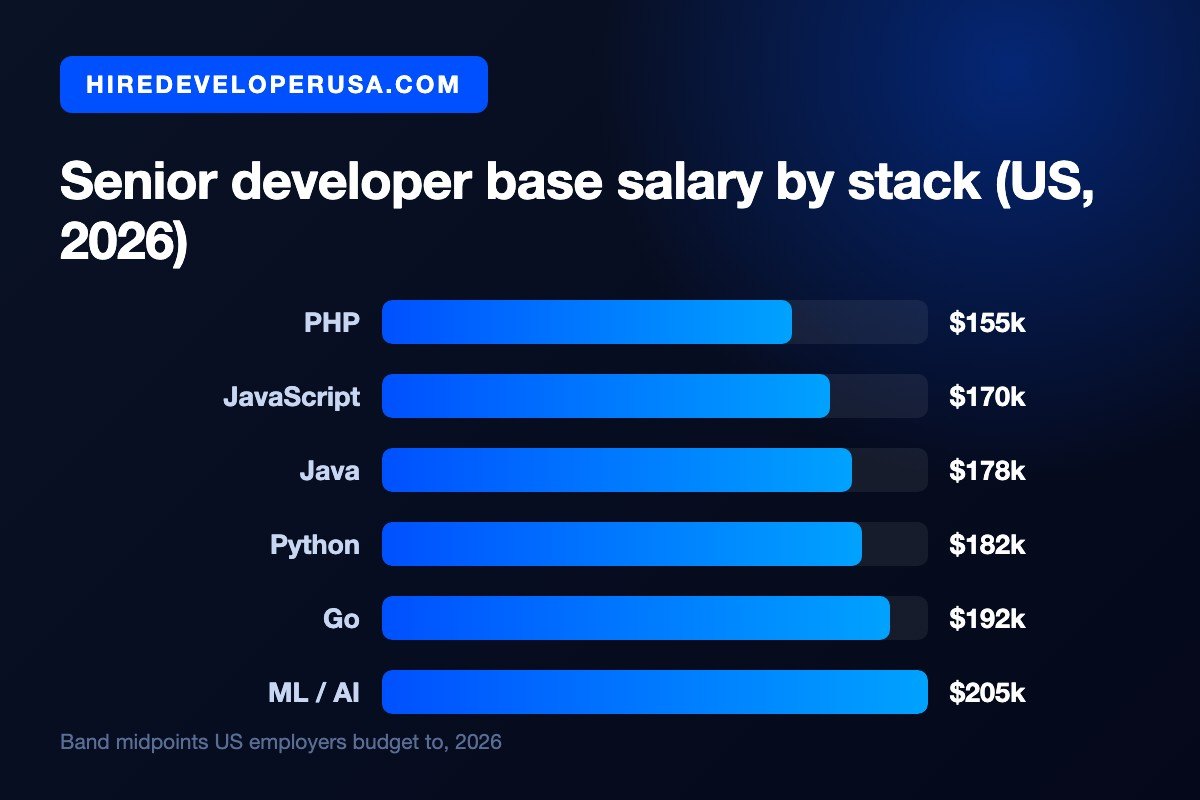
Seniority sets the shape of the band, and technology decides where inside it you land. At the same senior level, the cheapest and most expensive mainstream stacks sit about $50,000 of base salary apart.
Supply drives the pattern, not merit. Talent pools for PHP and mainstream JavaScript are deep and liquid, so a senior hire clears near the bottom of the senior band. With Go, Rust and anything touching machine learning, the pools are thinner and more bidders compete, which pushes the same title $30,000 to $50,000 higher. A senior Python engineer and a senior PHP engineer may do their jobs equally well, yet the market will still price them differently because of how many equally good candidates you can choose from.
This is the single easiest lever on a hiring budget, and it has to be pulled before the job description is written rather than after. If a service genuinely has to be written in Go, pay the Go band. If the stack choice is still open and the workload is ordinary CRUD and integrations, choosing a deeper talent pool is worth more to the budget than any amount of negotiation later.
Location still prices the offer, even when the role is remote
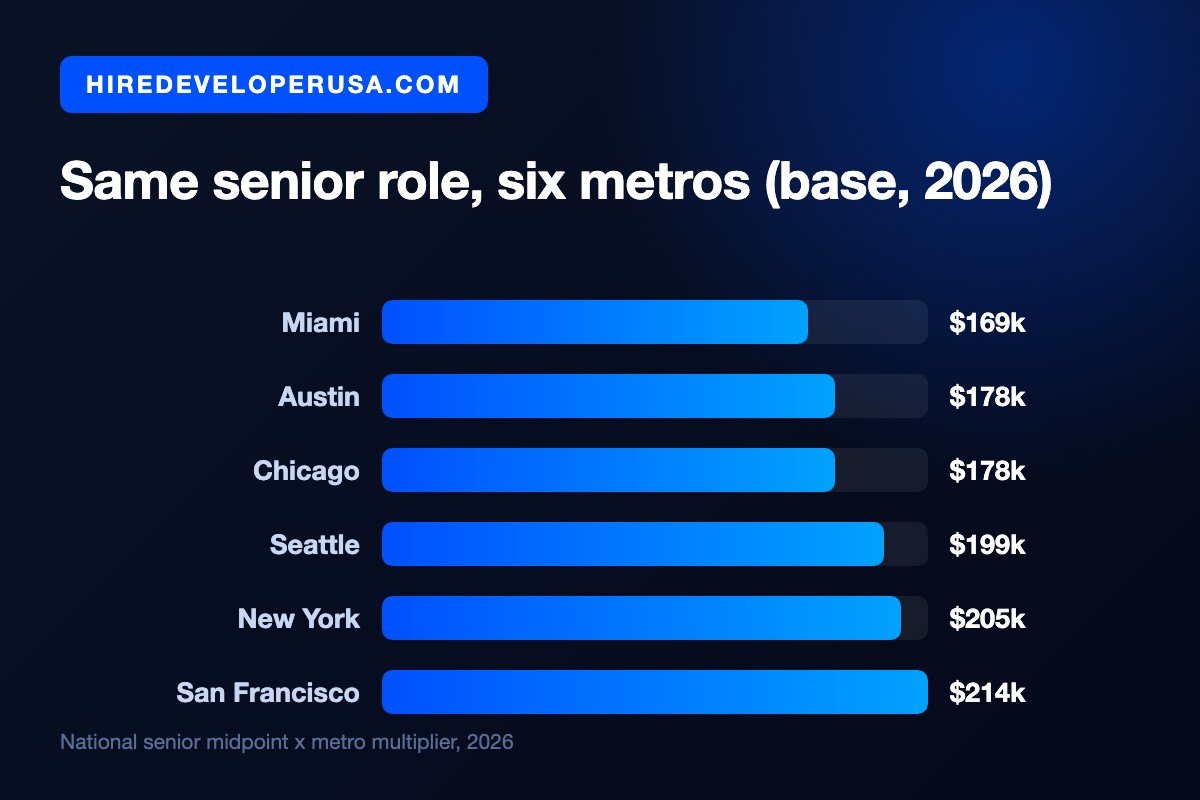
Remote work narrowed geographic pay differences. It did not erase them. Candidates still weigh your offer against what they could earn locally, and in the deepest markets that local alternative is expensive. Apply metro multipliers to the $178,000 senior midpoint and an identical role spreads about $45,000 between the cheapest and most expensive US metros.
San Francisco runs about 1.20 times the national band, New York about 1.15. Seattle is near 1.12. Austin and Chicago effectively are the national baseline at 1.00, while Miami comes in slightly under at 0.95. Fully remote US roles tend to price at the national baseline, and that is exactly why remote hiring works as a budget tool: you pay the Austin number for a candidate who would have cost the San Francisco number in an office.
Location adjusted pay comes with two cautions. First, state income tax alters what the candidate keeps without altering what you pay, so a $178,000 offer in Texas or Florida competes with a noticeably larger one in California. Second, cutting an offer because someone lives somewhere cheap gives them a standing reason to leave the moment a national payer calls. Hence the practical case for a single national band: it is simpler to defend, and it does not hand your best people a reason to answer the next recruiter.
Salary or contract: what the same budget actually buys
Once you know the loaded cost, the employee versus contractor question stops being ideological and becomes arithmetic. That senior hire costs about $222,300 a year and gives you roughly 1,888 working hours after paid time off and holidays. Divide one by the other and the employee costs about $118 per hour actually worked.
Carry that number into any contractor conversation, since $118 falls squarely inside the range US companies pay for vetted senior contract talent. Our breakdown of freelance developer hourly rates places vetted marketplace seniors in the $60 to $150 band, with agencies well above it. Put simply, a salaried senior developer and a good contract senior developer often cost about the same per hour of work delivered.
Price, then, is not what decides it. The question is what you need the money to buy. Salary gets you continuity, accumulated knowledge of your system and someone who is still around in year three. Contract gets you speed to start, a defined end date and no severance conversation. Choose salary for permanent work and contract for work that has a finish line. If you want to pressure test both sides against your own numbers, the salary calculator and the team cost calculator run the same math on your inputs, while our guide to the cost to hire a software developer sets the models side by side.
How to turn a band into an offer that gets accepted
A band is a budgeting instrument. An offer is a decision. Four habits turn a band into an offer the candidate says yes to.
Pick the point before you meet the candidate. Settle in advance that this role is a senior hire at $178,000, plus or minus $12,000 for exceptional depth. Making the call after you have fallen for someone is how companies end up paying the top of the band for a mid level outcome.
Publish the range. Several states now require pay ranges in job postings, and candidates increasingly filter out listings without one. A posted range also does free screening work: people who need $210,000 stop applying to a $155,000 to $180,000 role, which saves everyone four interviews.
Do not negotiate against the band you just set. When a candidate asks for $15,000 above the top, the honest options are to decline, or to hire them one level up with the responsibilities that justify it. Quietly stretching the band for one person is how you build pay compression and the resignation that follows.
Count the total, not the base. Someone choosing between $178,000 with a 4 percent match and strong health coverage and $190,000 with neither is looking at roughly the same money. Lay that comparison out plainly and you win offers without raising the base.
What to do next
For the role you are about to open, write down three numbers: the level, the band midpoint from the table above, and that midpoint times 1.25. That third number is what the hire costs your company. It is also the only one your runway cares about. Should it come out larger than you expected, your available fixes are the stack you choose, the metro you hire in, and whether the work is permanent enough to justify a salary at all.
Next, test your specific role against current market data with the salary calculator, or see what the same seniority costs on contract on our developer rates pages. If you would rather skip the benchmarking and go straight to real candidates inside your band, send us the level and the budget, and we will show you who is available at that number.
Frequently asked questions
What is the average software developer salary in the US in 2026?
The national median wage for software developers is $135,980, with the bottom tenth at $82,460 and the top tenth starting at $214,670, according to the Bureau of Labor Statistics occupational wage survey published for May 2025. In practice employers budget bands rather than averages: about $80,000 to $110,000 for a junior, $115,000 to $155,000 for a mid level engineer, $155,000 to $200,000 for a senior and $195,000 to $250,000 for a lead or staff engineer.
How much more than base salary should I budget for a developer hire?
Budget for about 1.25 times base. On a $178,000 senior hire, that means roughly $13,600 in Social Security and Medicare, $1,100 in unemployment insurance, about $16,800 for the employer share of family health coverage, $7,120 for a 4 percent retirement match and about $5,700 for equipment, software seats and payroll administration, for a loaded cost of around $222,300. When the comparison is against a contractor who bills only for days worked, use 1.38 times base instead: with paid time off and holidays, you buy 261 days and receive about 236.
Do remote developers get paid less than on-site developers?
Usually they are paid the national baseline rather than a discount. A fully remote US role tends to price where Austin and Chicago price, around 1.00 times the national band, while San Francisco runs about 1.20 and New York about 1.15. So remote hiring saves money relative to the most expensive metros rather than paying below market. Cutting an offer specifically because a candidate lives somewhere inexpensive tends to backfire, since any national payer can outbid you without effort.
Is it cheaper to hire a contractor or a salaried developer?
Per hour of work delivered they are closer than most budgets assume. A senior employee at $178,000 costs about $222,300 loaded and delivers roughly 1,888 working hours, which works out near $118 per hour worked, and that sits inside the band US companies pay vetted senior contractors. The real difference is what you are buying: salary buys continuity and accumulated knowledge of your system, while contract buys a fast start and a defined end date. Choose salary for permanent work and contract for work with a finish line.
Hire vetted talent