
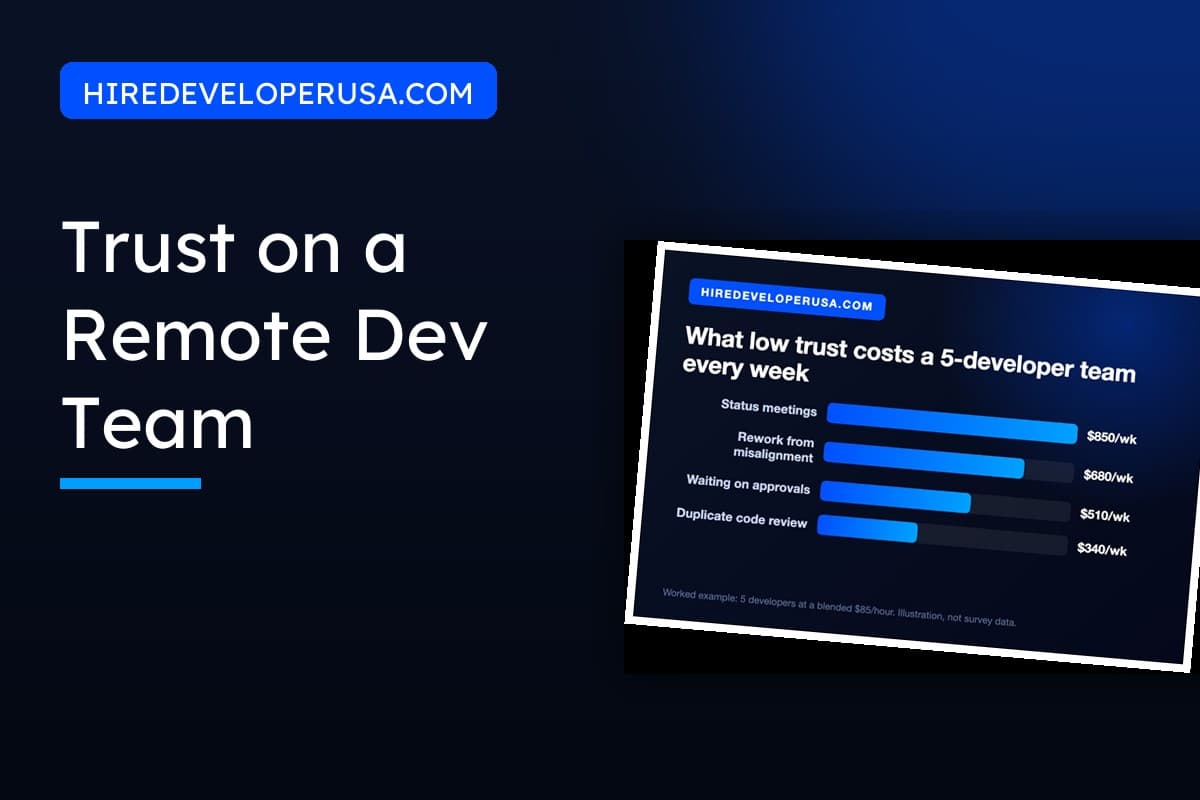
Key takeaways
- →Trust on a remote team is set by the leader's opening position, not earned over months. Start from the presumption that the people you hired are trustworthy, because expectations are self-fulfilling in both directions.
- →Swift trust, described by Meyerson, Weick and Kramer, has six conditions you can set deliberately: an earned place, assumed expertise, one shared goal, explicit roles, early tasks, and reciprocity on requests for help.
- →In the worked example here, low trust costs a five-person team 28 hours a week, about $2,380 at a blended $85 an hour, and none of it appears on an invoice.
- →Around four hours of daily overlap is enough when decisions are written down and handoffs end with a next action. More overlap does not fix an unwritten decision.
- →Recognize wins publicly and handle underperformance privately. Reversing those two channels undoes the rest of the work.
The fastest way to build trust on a remote developer team is to extend it before anyone has earned it, then make it cheap for people to prove you right. Give the work one shared goal, write down who decides what, and get something small into production in the first week. Teams that wait for trust to accumulate on its own spend a quarter getting there. Teams that set up the conditions for it get there in days.
That gap is the strategic advantage, and there is nothing soft about it. Trust prices everything else on the team: how long a decision takes, how many people must be in the room, how much of last sprint gets rebuilt. This guide puts a number on what low trust costs a five-person team. It then gives you the six conditions that create trust fast, plus the 30-day sequence for installing them.
Trust is a decision you make first, not a reward you release slowly
Most managers see trust as a balance the new developer pays into: do good work for a few months and the leash gets longer. That model is quietly expensive on a remote team, since distance strips out the usual ways of earning trust. Nobody sees you stay late, and nobody overhears you unblock a teammate. Because the evidence never arrives, the leash never loosens, and the developer concludes that output is not what is being measured.
The alternative is to presume from day one that the people you hired are trustworthy, and to act that way. It is less reckless than it sounds. Very few people join a team meaning to let it down, and expectations cut both ways. A manager who expects to be let down goes looking for instances and finds them; one who extends trust up front usually gets behavior that justifies it.
The trust has to run the other way too, because a remote team tells its lead nothing useful until it trusts that lead. Two things build that fast. The first is modeling the behavior you want: learn something real about each person, respect how they work, and push that understanding into the team's actual processes instead of keeping it as private goodwill. The second is creating small wins and then naming them in public. Once good work is reliably noticed, people stop managing their visibility and start managing the problem. That is also the point where a structured onboarding stops being paperwork and becomes the first deposit.
Swift trust: how strangers act like a team before they know each other
Some groups never get the slow version. Film crews, disaster response teams and consultancies put together for a single project must work at full speed with people they met that morning. Debra Meyerson, Karl Weick and Roderick Kramer called what happens in those groups swift trust: the team acts as though trust already exists, and the acting produces the thing. Remote developer teams are in exactly that position, with one difference in your favor. You can design the conditions on purpose.
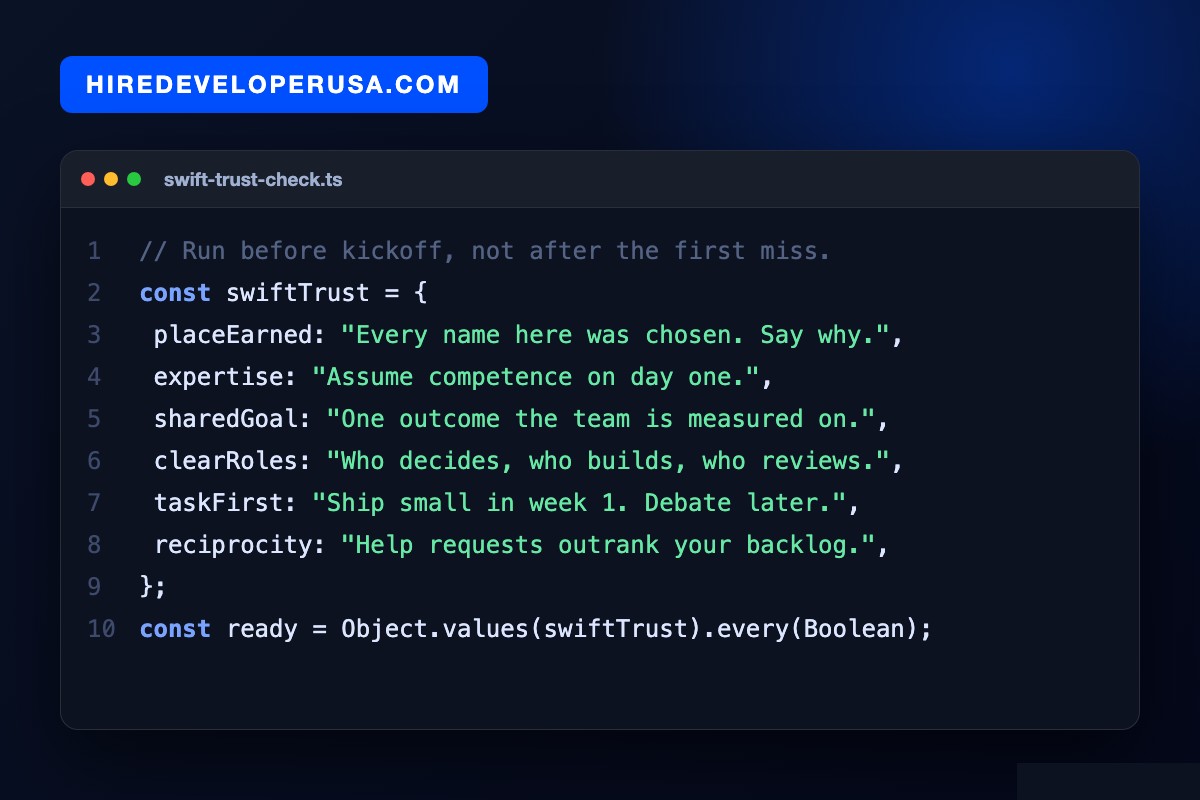
Six of them do the work:
- Everyone earned their place. State out loud why each person is on the team. A one-line introduction naming what someone was hired for is worth more than a week of watching them to find out.
- Expertise is assumed, not audited. Treat the knowledge people bring as real from the first call. You verify it through the work they ship, not through interrogation in meetings.
- One shared goal and one scoreboard. The team needs a single outcome that it is measured on together, along with a common way of recognizing success. Separate scoreboards produce separate teams.
- Roles are explicit. Who decides, who builds, who reviews, who talks to the customer. Any ambiguity here reads as politics, and politics is the quickest way to burn trust remotely.
- Tasks before theory. Move to real work fast. In three weeks, long opening discussions about responsibilities, process and authority build less trust than one shipped change does in three days.
- Reciprocity on requests for help. Each person owns their work and responds when a teammate asks for help. On distributed teams this is the condition that fails most often, since ignoring a request for help in a channel costs nothing.
Read that list as a pre-kickoff checklist rather than a culture statement. Five of the six are decisions you can make in a 45-minute call before the first ticket is written.
What low trust costs, in hours you are already paying for
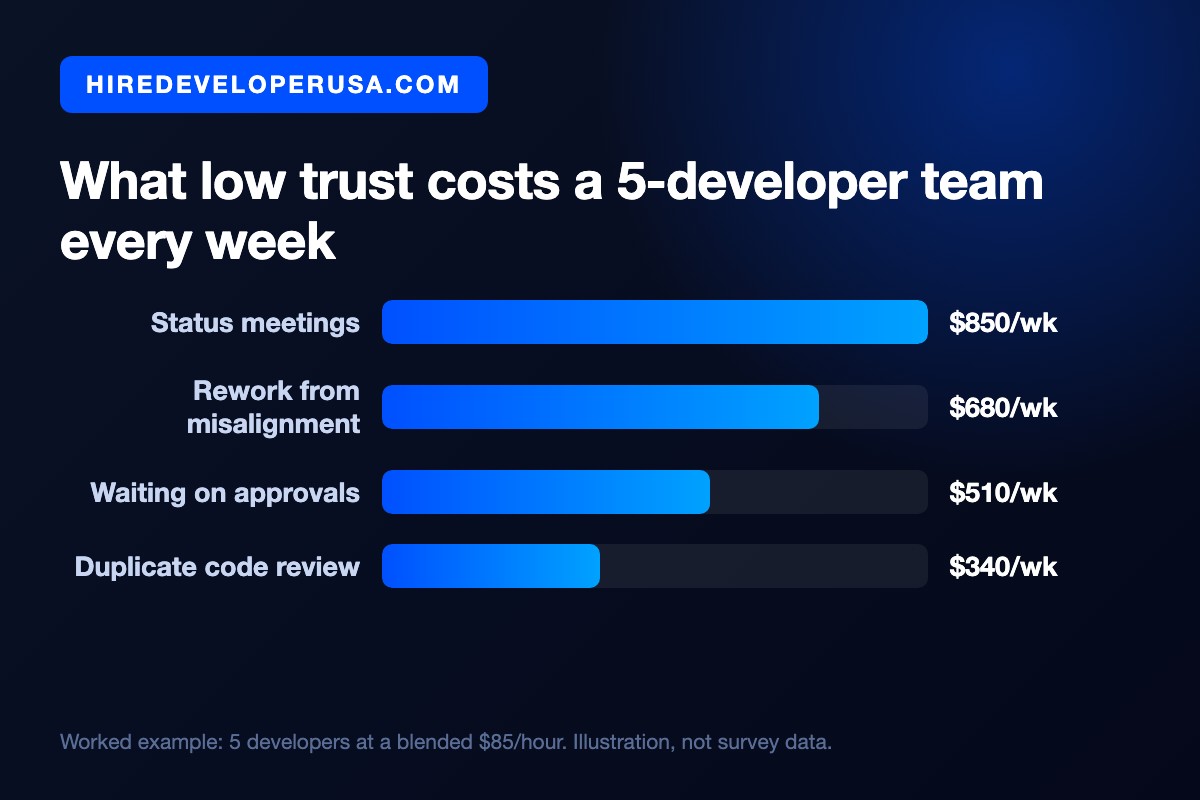
Low trust never appears as a line item. Instead it shows up as hours that feel like work. What follows is a worked example for a five-person remote development team, priced at a blended $85 an hour, a figure inside the usual US contract rate bands. Adjust the rate and the headcount to fit your team; the shape holds.
| Where the hours go | Hours per week, team of 5 | Cost at $85 an hour |
|---|---|---|
| Status meetings held to prove work is happening | 10 | $850 |
| Rework after assumptions nobody checked out loud | 8 | $680 |
| Waiting on approval for reversible decisions | 6 | $510 |
| Duplicate review passes driven by suspicion | 4 | $340 |
| Total | 28 | $2,380 |
Twenty-eight hours a week across five developers is 5.6 hours each, roughly one day in seven. At $85 an hour that is $2,380 a week, or about $124,000 over a year. These are assumptions you can argue with rather than a survey result, and arguing with them is the point: put your own numbers in the four rows and the total is still uncomfortable.
The high-trust version of the same team does not work harder. Because written updates are believed, it holds one shorter meeting; it also ships reversible decisions with no approval round and reviews code once. The money was never in the headcount but in the overhead that suspicion adds to every transaction.
Overlap is a design decision, not a culture problem
Teams blame time zones for problems that are really unwritten decisions. When a developer in another zone has to wait eight hours for an answer, the failure was the question, not the clock. For most product teams, around four hours of daily overlap is enough as long as three things are true: decisions get written where anyone can find them, handoffs end with a stated next action instead of a status, and nobody needs permission to make a call they can reverse.
Reserve the overlap window for what genuinely needs two people at once, a shorter list than most calendars suggest: pairing on something hard, unpicking a disagreement, and the occasional decision with real consequences. The rest belongs in writing. A team that defends four good hours and writes everything else down outperforms one that shares a full day yet still routes every question through one person.
The test is simple: ask what happens when the lead is offline for a day. On a high-trust team, the work continues and a few decisions wait. With low trust, everything waits, and you have just measured the cost of the approval row in the table above.

A 30-day sequence that builds trust on purpose
Trust-building usually fails because people treat it as a tone instead of a sequence. This is the order that works, with the swift trust conditions installed as you go.
Week 1: set the opening position. Introduce each person by what they were hired to own. Name the one outcome the team is measured on this quarter, and write the decision map: who decides, who builds, who reviews. Then push one trivial change into production. It proves the pipeline works and hands you a first win to recognize in public.
Week 2: build the individual relationships. One conversation per person, not about status. Find out how they prefer to work, what they are good at that the role does not use yet, and what would make them leave. Take what you learn and change something in the team's process, so people see that talking to you has consequences.
Weeks 3 and 4: handle the first problems correctly. Something will go wrong. How you handle it sets the pattern for the next year. Deal with it fast instead of letting it sit, and split the channel by type: handle underperformance and disagreements privately, one to one, and recognize wins and good calls where the whole team can see them. Reversing this (praising in private, correcting in public) undoes everything the first two weeks built.
Stay present through all four weeks. Remote leads underestimate how fast silence reads as disapproval. When nobody can see anyone's face, frequent, low-ceremony communication (between you and the team, and among team members) is what keeps the presumption of good faith alive.
Hiring for trust before anyone joins the team
Setting the conditions above is much harder after a wrong hire, so part of this work happens before day one. Three things deserve specific screening.
First comes whether someone works well from ambiguous input. A developer who needs a perfectly specified ticket will generate approval requests forever, and that is the row you are trying to delete. In the interview, hand candidates a vague problem and watch them narrow it. Our guide to running a technical interview explains how to structure that without turning it into a puzzle round.
The second is written communication, which on a remote team is not a nice-to-have but the main interface. Someone whose written explanation of a past decision is clear and honest about the trade-off will keep decisions findable. Someone who writes only status will create the meetings you were trying to avoid.
Third is how a candidate talks about work that went badly. The people who answer a help request at 4pm are those who own the part that was theirs, neither collapsing into blame nor polishing it into a success story. If you are hiring someone to run this for you instead of running it yourself, that signal matters more than any technology on the resume, and it sits at the core of what to look for in an engineering manager.
Start with one team and one week
You do not need a culture program. Pick one team, run the week-one list, and watch two numbers: how many meetings exist only to confirm that work is happening, and how long a reversible decision takes to get made. Both should move within a month, and both convert directly into the hours in the table above.
When you are assembling the team instead of fixing one, the same six conditions are easier to set at the start than to retrofit. See how we match and vet remote developers for US companies, and bring the decision map to the kickoff call rather than writing it after the first missed deadline.
Frequently asked questions
How long does it take to build trust on a remote developer team?
Days, if you set the conditions deliberately, and a quarter or more if you wait for it to accumulate. The slow version depends on signals that remote work deletes: being seen to stay late, being overheard helping someone. The fast version replaces those signals with structure, namely one shared goal, an explicit decision map, and a small change shipped to production in week one. Most of that fits in a single kickoff call.
What is swift trust?
Swift trust is the pattern that researchers Debra Meyerson, Karl Weick and Roderick Kramer described in temporary groups that must perform immediately, such as film crews and disaster response teams. Instead of building trust through shared history, the group acts as though trust already exists, and the behavior produces it. The idea transfers well to remote developer teams, since the starting conditions match: capable people, little shared history, and no time to wait.
How do you build trust with developers in a different time zone?
Treat it as a design problem rather than a culture problem. Around four hours of daily overlap is enough for most product teams if three things hold: decisions are written where anyone can find them, every handoff ends with a stated next action instead of a status update, and nobody needs permission for a decision they can reverse. Spend the overlap window on pairing and genuine disagreements, and put everything else in writing.
Should we use monitoring software to track remote developers?
It undermines the very thing you are trying to build. Activity tracking announces that you expect to be let down, so people adjust to the measurement instead of the work, and that is how you end up with busy screens and slow releases. When you need evidence of progress, use the artifacts the work already produces: merged pull requests, a staging environment anyone can open, and a weekly written update. These are harder to fake than mouse movement, and cheaper to read.
Hire vetted talent