
Key takeaways
- →Vetted AI agent developers bill $70 to $180 per hour in the US; agency pods run $150 to $280, and a full-time hire costs $135,000 to $220,000 in base salary.
- →Most of the role is backend engineering: tool contracts, retries, permission boundaries and logs, not prompt wording.
- →Score candidates zero to three across seven areas: system design, tool contracts, retrieval, reliability, security, evaluation and product thinking.
- →A paid four to six hour task with one deliberately planted failure reveals more than any portfolio demo.
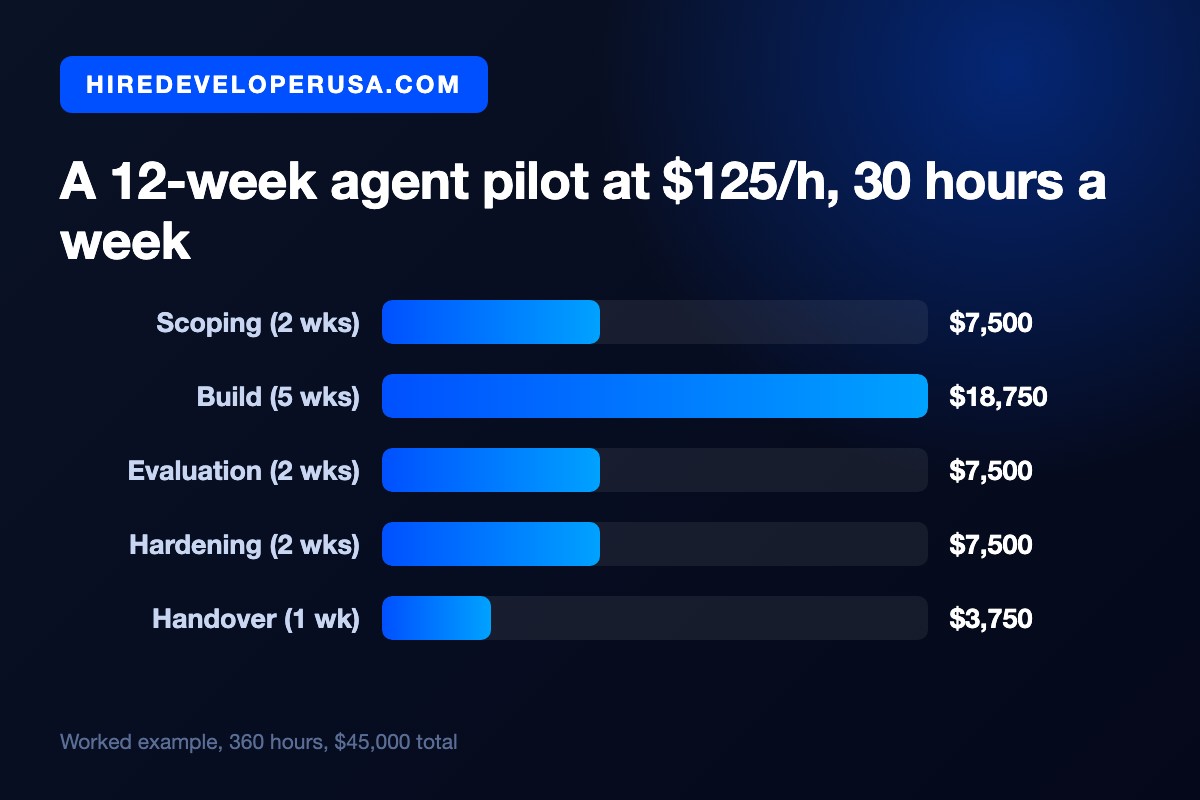
- →A twelve-week pilot at thirty hours a week costs about $45,000 and leaves you an evaluation harness you keep even if the match does not work out.
To hire AI agent developers in the US in 2026, budget $70 to $180 per hour through a vetted marketplace, $150 to $280 per hour for an agency pod, or $135,000 to $220,000 in base salary for a full-time hire. Sourcing is the easy half. The hard half is telling apart the engineer who has kept an agent alive in front of real users from the one with a very good demo, because on a resume those two people look identical. Here is where to source, what to pay, how to vet, and how to structure the first project so a bad match costs you weeks instead of quarters.
What an AI agent developer actually does
An agent is not a chatbot with a better prompt. It is a program that decides what to do next, calls real tools to do it, remembers what already happened, and recovers when a step fails. The model is one component inside that loop. Everything wrapped around it is ordinary software: schemas, queues, retries, permissions, logs.
That framing tells you who to hire. Most of the work in a production agent is backend work with an unusual failure mode. When a payment API times out, the agent has to notice rather than hang. When a customer asks for something outside its authority, it has to stop and hand off. When a retrieved document is irrelevant, the model will still answer confidently, so somebody has to measure that before a customer finds it. None of those are wording problems.
The job titles have not caught up. A prompt engineer optimizes instructions. A machine learning engineer trains and serves models. AI agent developers and agentic AI developers sit much closer to a senior backend engineer who happens to be fluent in how models misbehave. If every candidate on your shortlist leads with a prompt library, you are screening for the smaller half of the role.
What it costs to hire AI agent developers in 2026
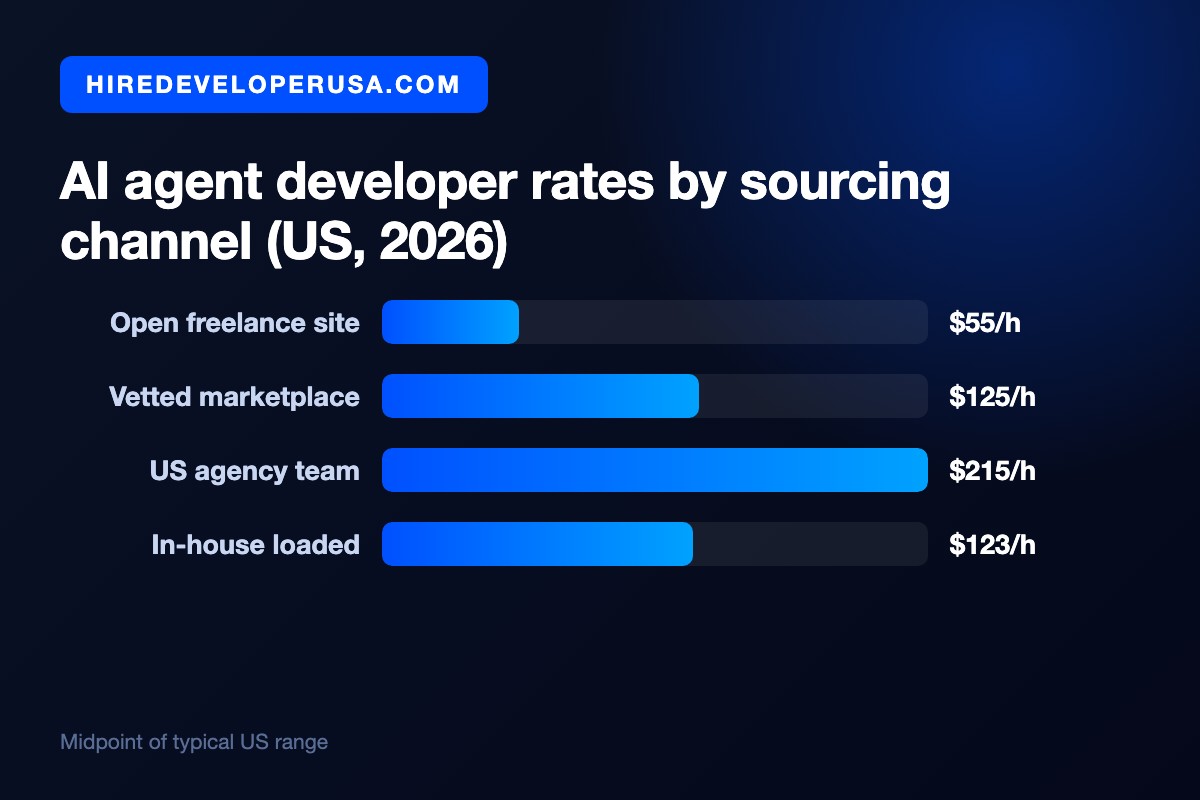
Agent work sits at the top of the software pay band because it bundles two scarce things in one person: production backend experience, and enough hands-on time with model behavior to predict how it breaks. Here is what each channel costs in the US.
| Hiring channel | Typical cost | Best for |
|---|---|---|
| Vetted marketplace | $70 to $180 per hour | Starting within days with someone already screened for production work |
| US development agency | $150 to $280 per hour | Handing over a whole workstream with project management and QA included |
| Open freelance platform | $30 to $80 per hour | Small scripted automations where a wrong answer is cheap to undo |
| Full-time in-house | $135,000 to $220,000 base | An agent platform you intend to keep extending for years |
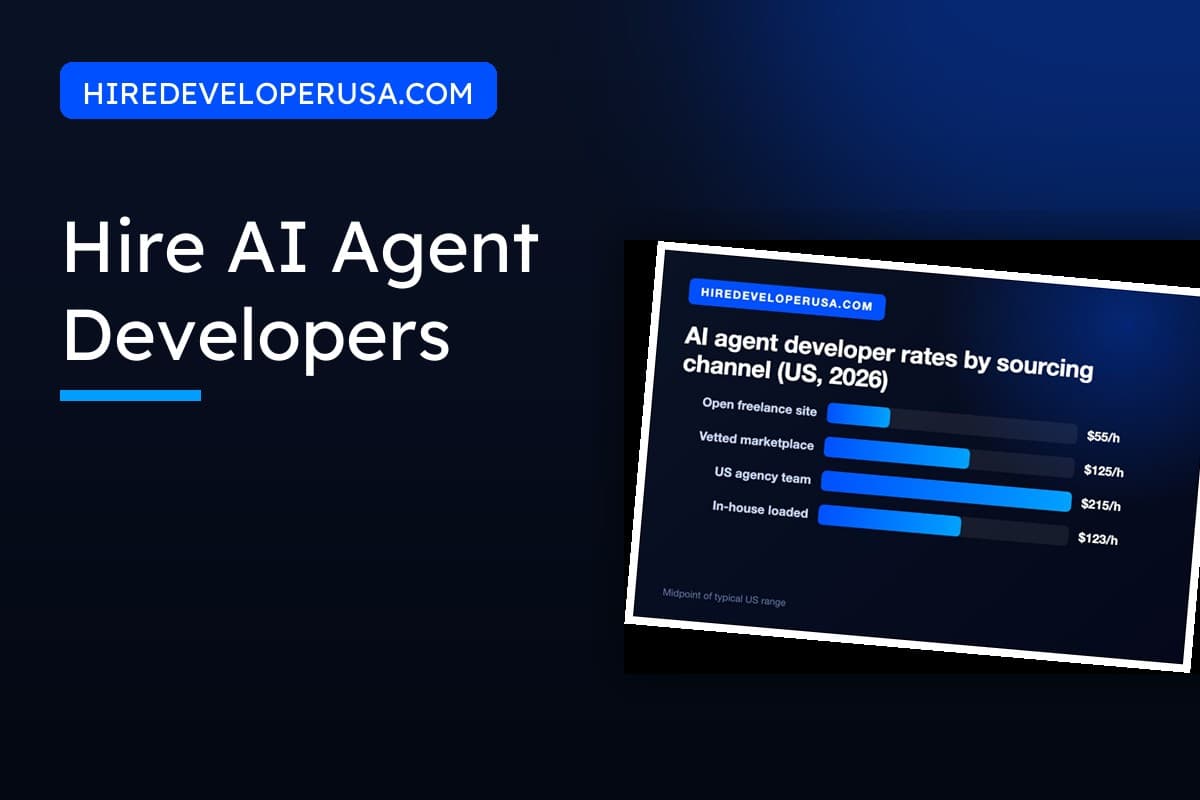
The in-house line is the one that catches people out. Take the midpoint of that salary band, around $177,500, add 25 to 40 percent for payroll taxes, benefits, equipment and tooling, and you are near $231,000. Spread across roughly 1,880 productive hours a year, that is about $123 an hour before you count the six to twelve weeks of recruiting it took to get there. Our full breakdown of what it costs to hire a software developer walks through the same loaded-cost math for general engineering roles.
What moves the rate
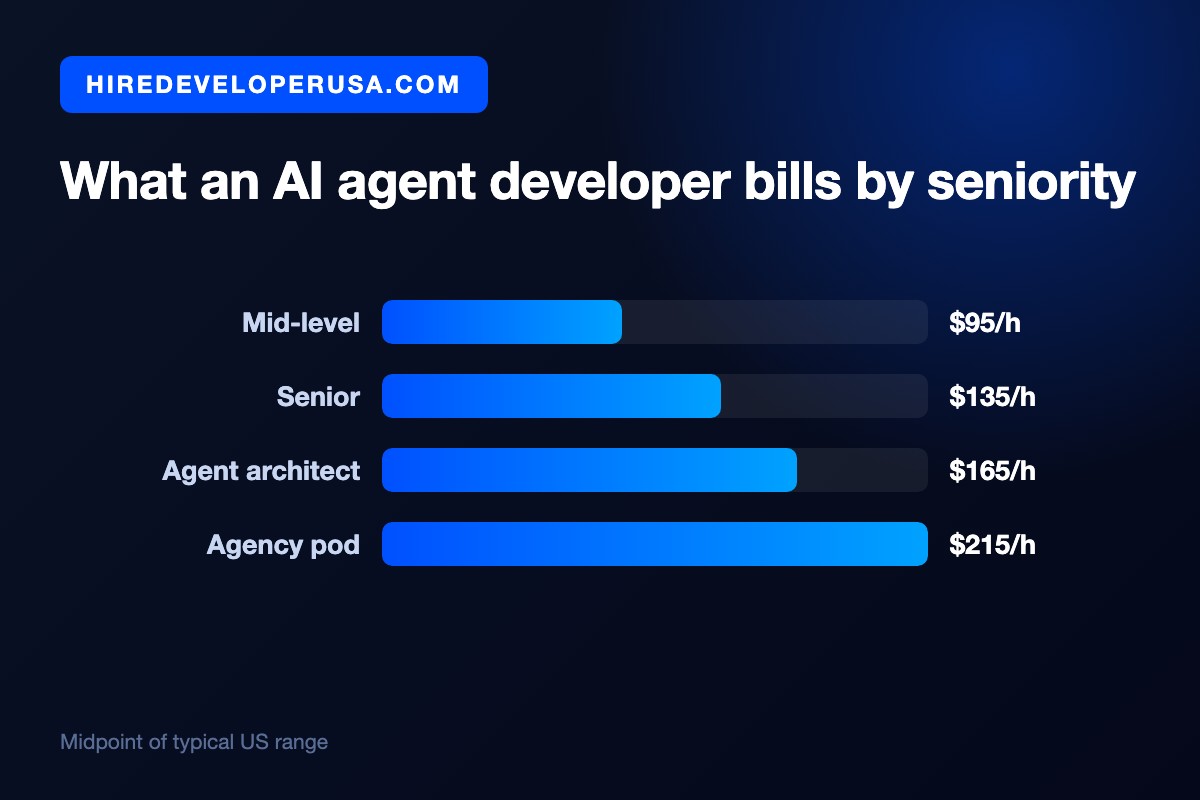
Within the marketplace band, seniority explains most of the spread, and it maps to responsibility rather than years.
- Mid-level, $70 to $120 per hour. Builds capably inside an architecture somebody else defined. Good value once the shape of the system is settled.
- Senior, $110 to $160 per hour. Owns the architecture, the evaluation harness and the failure paths. This is the default hire for a first agent, because the expensive mistakes all happen at this layer.
- Agent architect, $150 to $180 per hour. Multi-agent coordination, regulated data, or high-volume systems where cost per task decides whether the product is viable.
- Agency pod, $150 to $280 per hour. Several people and their overhead, billed as one rate.
Two other factors move the number. Domain constraints add a premium, because an engineer who has shipped inside healthcare or financial services has already argued with a compliance team and knows what an auditor will ask for. Scarcity of proof adds another: plenty of candidates have built agents, far fewer can show you what happened to one after six months of real traffic. For adjacent roles, our machine learning engineer rate guide covers the neighboring band.
Where to source AI agent developers
Vetted marketplaces are the fastest route when you need one or two people on a defined project. The screening is already done, the replacement path is short if the fit is wrong, and there is no recruitment fee sitting on top of the rate. This is the sensible default for a first agent build.
Agencies make sense when you want to hand over an outcome rather than manage a person. You pay for the project management and QA layer whether or not you need it, so the value depends on how much of that you already have in house.
Open freelance platforms are genuinely cheap and genuinely unscreened. For a scripted automation that a human reviews anyway, the risk is small. For anything that touches customer data or moves money, the cost of one bad hire will erase the savings in a single sprint.
Your own network and open source gives the highest signal and the slowest timeline. People who contribute to agent frameworks, publish evaluation write-ups, or give conference talks about what broke are self-documenting candidates. The catch is that they are usually not looking.
One sourcing mistake is worth calling out. Job posts for this role routinely list distributed systems, API design, MLOps, security engineering and product management under a single title. That is not one person, and posting it that way filters out the honest candidates while attracting the ones willing to claim anything. Pick the two or three areas your project actually stresses and screen hard on those.
The seven skills we vet for
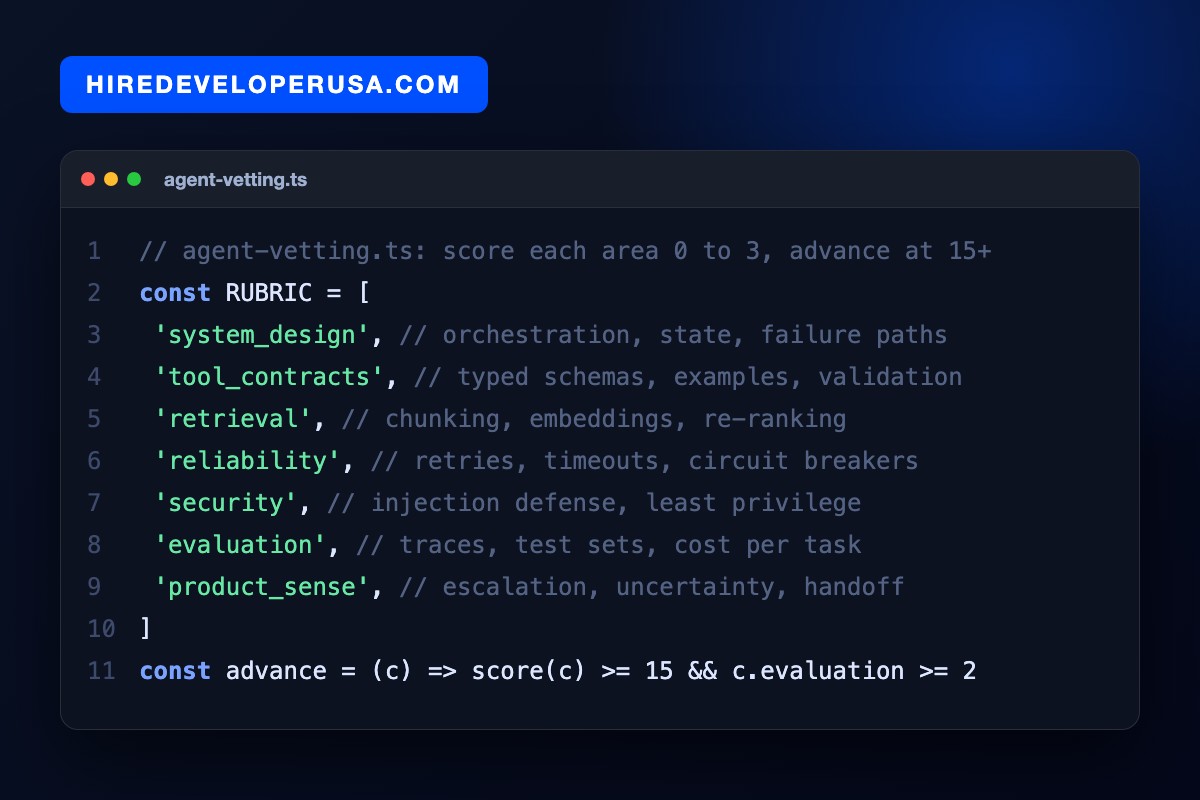
We score candidates across seven areas, zero to three in each, where zero is never done it and three is shipped it and can show the numbers. The list is deliberately boring, because production agents fail for boring reasons.
- System design. How data flows between the model, the tools and the datastore, and what happens when one of them is unavailable. Ask them to draw it. Backend experience shows up immediately here.
- Tool and contract design. Every tool the agent can call is an interface with a contract. A field described only as a string invites the model to invent a plausible value, which is exactly what you do not want in a refund flow. Strong candidates talk about strict types, examples in the schema, and validation on the way in.
- Retrieval engineering. Chunk size, embedding choice and re-ranking set the ceiling on how good the answers can be, and irrelevant context produces confident nonsense rather than an error. Depth here is its own discipline, which is why some teams hire dedicated RAG developers alongside the agent build.
- Reliability engineering. Retries with backoff, timeouts, fallback paths, circuit breakers. Decades-old backend practice applied to a system that calls a lot of flaky external services.
- Security and safety. Prompt injection is a live attack surface, and the defenses are input validation, output filtering and permission boundaries that limit what the agent can even attempt. Ask what write access their last agent had, and why.
- Evaluation and observability. Traces of every decision and tool call, a test set with known good answers, and metrics for success rate, latency and cost per task. If a candidate cannot tell you the cost per task of anything they built, they have not run one in production.
- Product thinking. When should the agent say it is unsure, when should it ask a clarifying question, and when should it escalate to a person. Designing an experience around a system that is right most of the time is a real skill and it is the one most often missing.
We advance candidates at fifteen out of twenty one, with a hard floor of two on evaluation. Someone who never measured cannot tell you whether their agent got better or just got different.
The take-home that separates demo builders from production engineers
Interviews reward fluency and portfolios reward the happy path. A short, paid, deliberately imperfect task rewards neither.
Give a bounded, real problem from your own domain, four to six hours, paid at the candidate's rate. Plant one broken dependency in it: an endpoint that times out on roughly one call in five, or a document set with two contradictory answers to the same question. Do not mention it.
Ask for five deliverables: a working agent, the tool schemas, an evaluation set of about twenty cases with expected outcomes, a trace of one failure with an explanation of the root cause, and a paragraph on what the agent should refuse to do. Then grade the evaluation set and the trace first. The demo is the least informative artifact in the package.
What separates the two groups is almost always the same. Production engineers notice the planted fault, handle it, and mention it unprompted. Demo builders either never hit it or quietly rerun until it passes. Treat these as red flags: no evaluation of any kind, root causes that are always fixed by rewording the prompt, a blank look at cost per task, every question answered with the name of a framework, and reluctance to talk about anything that broke.
How to structure the first engagement
Scope the first project as a twelve-week pilot on one workflow, not a platform. One senior developer at a blended $125 an hour, thirty hours a week, is 360 hours and about $45,000. Two weeks of scoping and data access, five weeks of building tools and retrieval, two weeks standing up the evaluation harness, two weeks of security hardening, and one week of handover and runbook.
Protect yourself on three fronts before work starts. Contractually: written IP assignment, data processing terms, and a named list of which model providers and vendors will see your data. Operationally: read-only credentials until the evaluation suite passes, then widen permissions one scope at a time, with a documented way to switch the agent off. Behaviorally: run the agent in draft mode first, where it proposes an action and a person approves it, and use the approval log as your first real evaluation set.
The reason to insist on the evaluation harness even in a pilot is that it is the one deliverable that keeps its value if the engagement ends early. Prompts get rewritten and frameworks get swapped, but a test set built from your own workflow tells the next engineer within an hour whether they are ahead of or behind the last one.
Your next step
Before you write a job description, write down one workflow you would hand to an agent and the number that would prove it worked: tickets resolved without escalation, minutes saved per case, cost per task under some ceiling. That single sentence does more screening work than any list of required technologies, because candidates who think in systems will immediately ask how you plan to measure it, and the rest will start naming tools.
Then hire against it. When you are ready to see profiles, our vetted AI agent developers are matched to briefs like that one, and you can start with the twelve-week pilot shape above rather than committing to a permanent headcount before you know the workflow is worth automating.
Frequently asked questions
How much does it cost to hire an AI agent developer in the US?
Expect $70 to $180 per hour through a vetted marketplace, with senior engineers who own the architecture clustering around $110 to $160. Agency pods bill $150 to $280 per hour, and a full-time hire costs $135,000 to $220,000 in base salary, which lands near $123 per hour once you load benefits, taxes and overhead.
What is the difference between an AI agent developer and a prompt engineer?
A prompt engineer improves the instructions given to a model. An AI agent developer builds the system around it: typed tool contracts, retrieval, retries and timeouts, permission boundaries, tracing and evaluation. The second job is mostly backend engineering, which is why senior backend developers often transition into it faster than people whose experience is only in prompting.
Do I need a machine learning background on the team to build agents?
Usually not. Most production agents call hosted models rather than training their own, so the scarce skill is systems engineering plus disciplined measurement. You do need someone who can build an evaluation set and read traces, otherwise nobody on the team can say whether a change made the agent better or just different.
How long does it take to get a first AI agent into production?
For one bounded workflow, eight to fourteen weeks is realistic: a couple of weeks on scoping and data access, five or so building, then evaluation and security hardening before anything is exposed to customers. Timelines slip when the scope is a platform rather than a single workflow, or when access to the underlying data has not been agreed before the engineer starts.
Hire vetted talent