
Key takeaways
- →Name the job first: building on AWS, running AWS, or owning the account and the bill. The three sit in different talent pools at different prices.
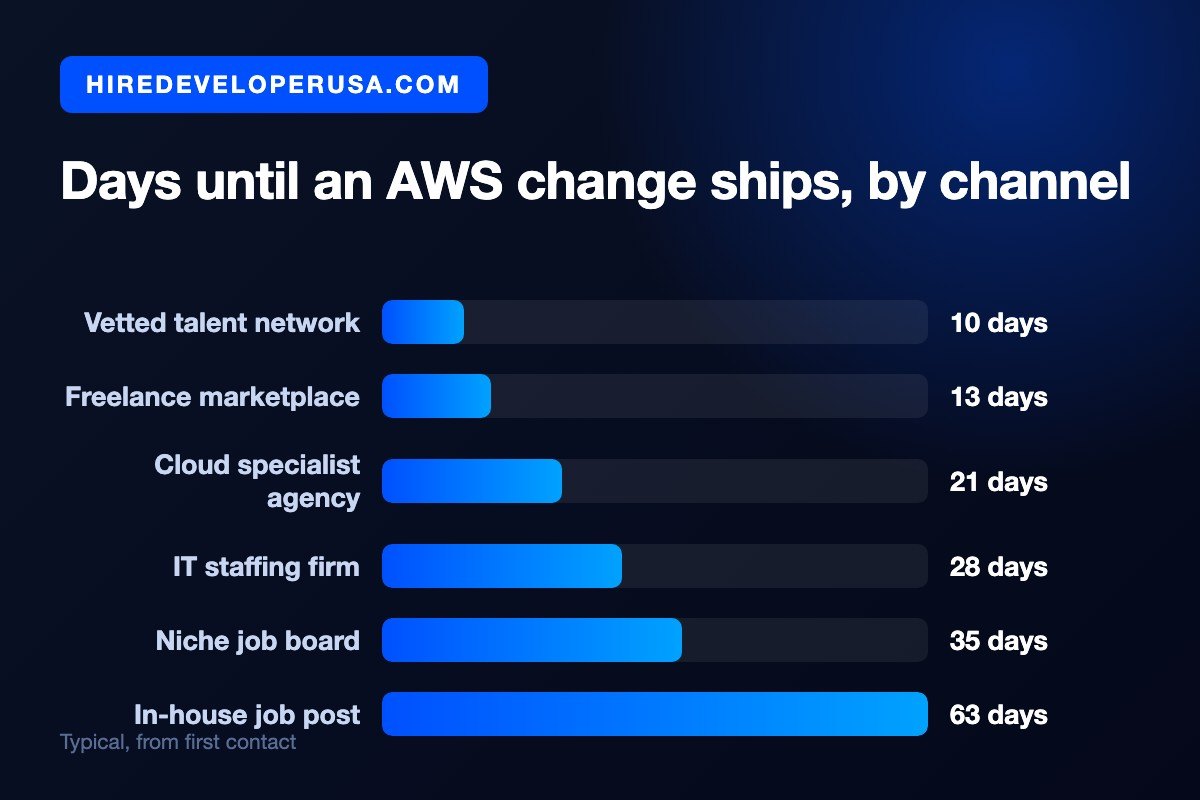
- →Pick the channel by your deadline: roughly 10 days to a first shipped change through a vetted network, 21 through a cloud specialist agency, 63 through an in-house job post.
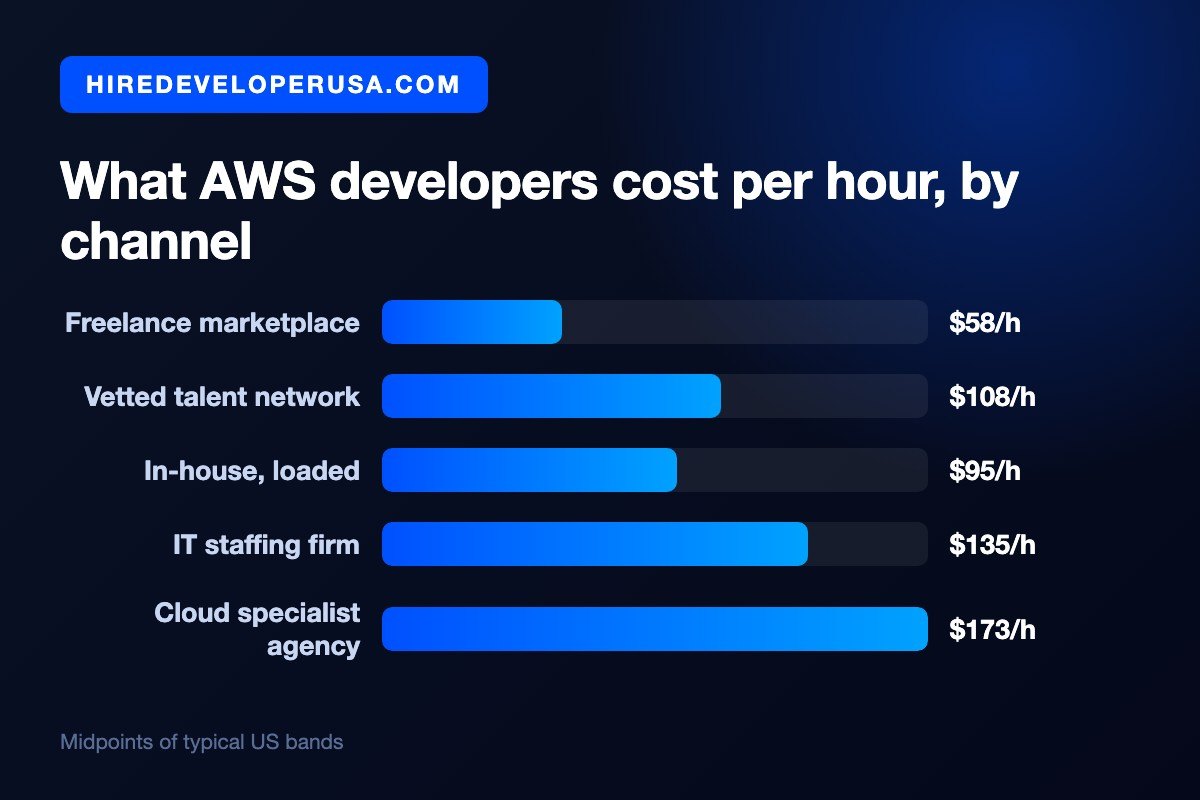
- →US AWS rates run $40 to $75 an hour on open marketplaces, $65 to $150 on vetted networks, and $125 to $220 at a specialist agency. A full-time hire is $115,000 to $190,000 base.
- →The hourly rate is the smaller number. The AWS bill your hire controls keeps charging every month, including after they leave.
- →Treat AWS certifications as shared vocabulary, not as judgment. Ask for an IAM policy they tightened and a bill line they cut.
The best sites to hire AWS developers sort themselves out once you answer a question most buyers skip: are you hiring someone to build on AWS, to run AWS, or to own the account and the bill? Answer it, and the channel chooses itself. A vetted talent network gets a screened engineer onto your account in roughly 10 days at $65 to $150 an hour, and charges no placement fee. An open freelance marketplace costs less, at $40 to $75 and about 13 days, but all the screening hours land on you. Expect a cloud specialist agency to start in about three weeks and bill $125 to $220 an hour. A full-time hire at $115,000 to $190,000 base sits roughly two months out.
Picking the wrong channel hurts more with AWS hiring than with most roles. A mediocre frontend contractor costs you their rate. With a mediocre AWS contractor, you pay that same rate, plus a monthly bill that keeps charging for whatever idle capacity they left behind, plus production credentials you gave to someone nobody screened. You negotiate the rate. They control the bill.
"AWS developer" is three jobs, and the channel follows the job
Before you open a single platform, sort your work into one of these three buckets. Those ten minutes are the cheapest in the whole process.
1. Building on AWS. Lambda functions, API Gateway routes, DynamoDB access patterns, S3 and SQS plumbing. Here the person writes application code, and AWS is just the runtime. The pool is the deepest and the rate the lowest; a strong backend developer with real serverless mileage usually qualifies. Most open marketplaces are crowded with this profile.
2. Running AWS. Terraform or CloudFormation, CI/CD pipelines, EKS, VPC networking, IAM, observability, on-call. It is a DevOps job with an AWS label on it, and its skills barely overlap with the first bucket's. However fluent they sound about AWS services, a developer who has only ever deployed into an account someone else built will not do this work.
3. Owning the account. Multi-account organization structure, landing zones, network topology, compliance boundaries, and the cost model. That is a cloud architect brief. The pool is the scarcest and the rate the highest, and these people are the least likely to be sitting idle on an open marketplace waiting for your post.
Post a job that says "AWS developer, five years experience" and all three profiles land in one inbox, where the applicants who interview best are not necessarily the ones matching your actual bucket. Put the bucket in the post's first line. The shortlist then fixes itself.
The six sites to hire AWS developers, side by side
Nearly every US AWS hire comes through one of six channels. We compare them by category rather than by logo, because the category decides who screens, what you pay, who holds your credentials and when the first change ships. Two platforms in the same category behave more alike than two you would group together by reputation. The day counts are typical spans from first contact to a merged, deployed change, not a measured benchmark.
| Where you look | Typical US rate | Who screens | Days to first change shipped | Best for | Where it fails |
|---|---|---|---|---|---|
| Open freelance marketplace | $40 to $75 per hour | You, entirely | About 13 | Small, fully specified AWS tickets | Account access goes to someone only you vetted, and cost discipline is rare at this price |
| Vetted talent network | $65 to $150 per hour, no placement fee | The network screens, you confirm | About 10 | A deadline, a budget ceiling, trying before committing | Architecture ownership still sits with you |
| Cloud or DevOps specialist agency | $125 to $220 per hour | The agency | About 21 | A migration or a landing zone delivered end to end | Bench swaps mid-project, junior hours billed at a blended rate |
| General IT staffing firm | $95 to $175 per hour | The firm, loosely | About 28 | Contract headcount that has to sit on a purchase order | Recruiters match the word AWS, not the job behind it |
| Cloud community and niche job boards | $100 to $170 per hour | Reputation does | About 35 | Rare problems: odd networking, deep cost work, regulated workloads | Slow, and silent if you have no standing in the community |
| In-house job post | $115,000 to $190,000 base | You and your team | About 63 | AWS that is core to a product you will run for years | Two months of lead time before anything ships |
Read the fourth column before the second. Over a quarter, the gap between 10 days and 63 days usually costs more than the gap between $58 and $173 an hour, and that is the one column you cannot buy back later.
What AWS developers cost, and the bill hiding behind the rate
US rates for AWS work fall into wide but predictable bands. The full span runs from about $40 an hour for a junior builder picking up defined serverless tickets to roughly $220 at a specialist agency staffing a migration. Adjacent DevOps rates track the same curve, which is a useful cross-check when a quote looks far off.
The in-house figure needs its own arithmetic. Take a $152,500 midpoint salary, load it with roughly 30 percent for payroll taxes, benefits and equipment, divide it across 2,080 working hours, and you land near $95 an hour. Per hour, that is cheaper than every contract channel except an open marketplace, which is exactly why teams with permanent AWS workloads end up hiring. The payoff only comes if the work outlasts the two months needed to fill the seat.
Then there is the number nobody puts in the comparison. Every month, your hire controls the AWS bill, and that includes the months after they leave. Over-provisioned instances nobody right-sizes, a staging environment left running since a launch, unattached EBS volumes, chatty cross-availability-zone traffic, data passing through a NAT gateway that never needed to exist: none of it appears in an hourly rate, and all of it recurs. Right-sizing an environment once, an engineer can save more per month than the whole hourly gap between two channels, which is the real reason to pay for screening on this particular role.
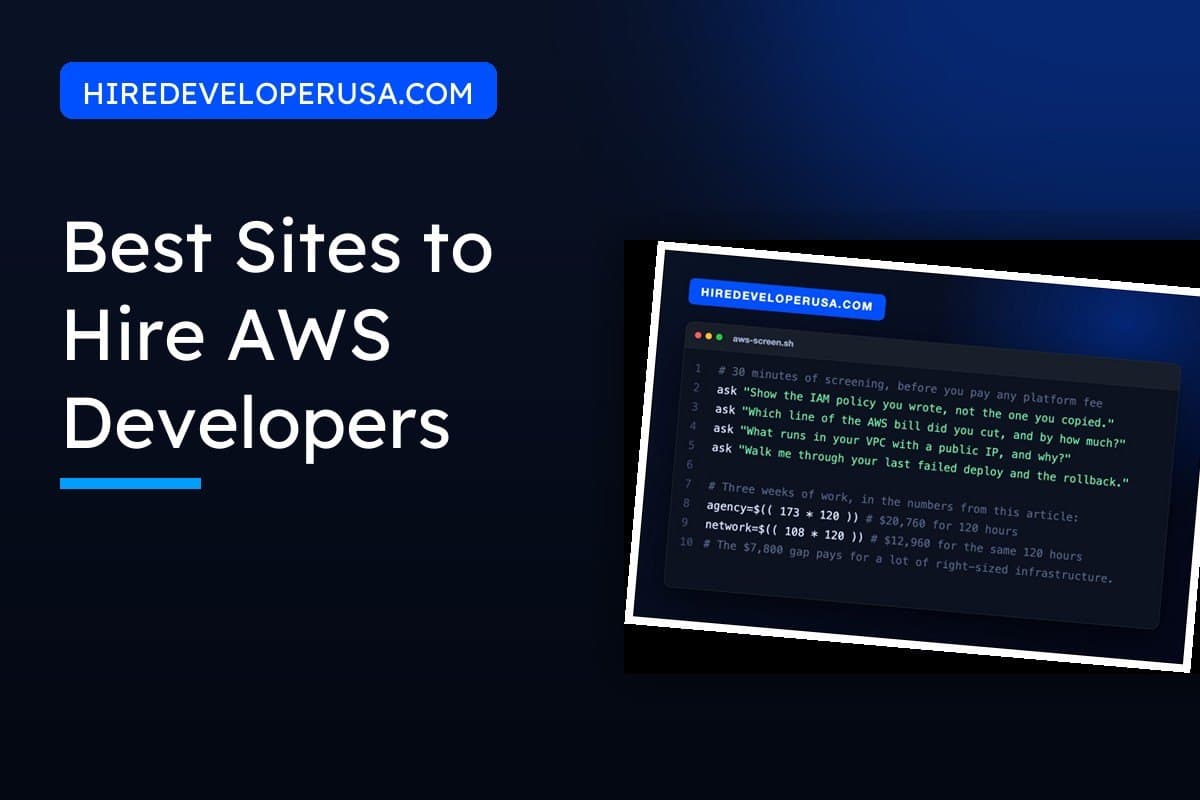
The AWS screen that works on whichever site you pick
Sooner or later every channel puts a person in front of you, and from there the platform stops helping. The four questions below separate someone who has operated an AWS account from someone who has read about one. No whiteboard is needed for any of them.
1. Show me an IAM policy you wrote, and tell me what you tightened after the first version. The real question is the second half. Pasting a policy is something anyone can do. What you are listening for is least privilege reached on purpose: a wildcard resource narrowed to specific ARNs, an added condition key, a permission dropped once it turned out nobody used it. If a candidate has never tightened a policy, they have never owned one.
2. Which line of your last AWS bill did you cut, and by how much? Good answers are boringly specific, which is the point. Right-sized a fleet. Deleted unattached volumes. Put a lifecycle policy on an S3 bucket full of old logs. Moved traffic off a NAT gateway path. Killed three dormant environments. Someone who has never looked at a bill will answer this one in generalities about best practices.
3. What in your VPC has a public IP, and why? Here is the security reflex in a single line. Expect a short, specific and slightly uncomfortable answer, since a real account always has something. You want to hear that they know what it is and can justify it, not that nothing is exposed.
4. Walk me through your last failed deploy and how you rolled back. Operational maturity shows up here or nowhere. Listen for blast radius: what broke, who noticed first, whether the rollback was a button or an improvisation, and what changed afterward so it could not repeat the same way.
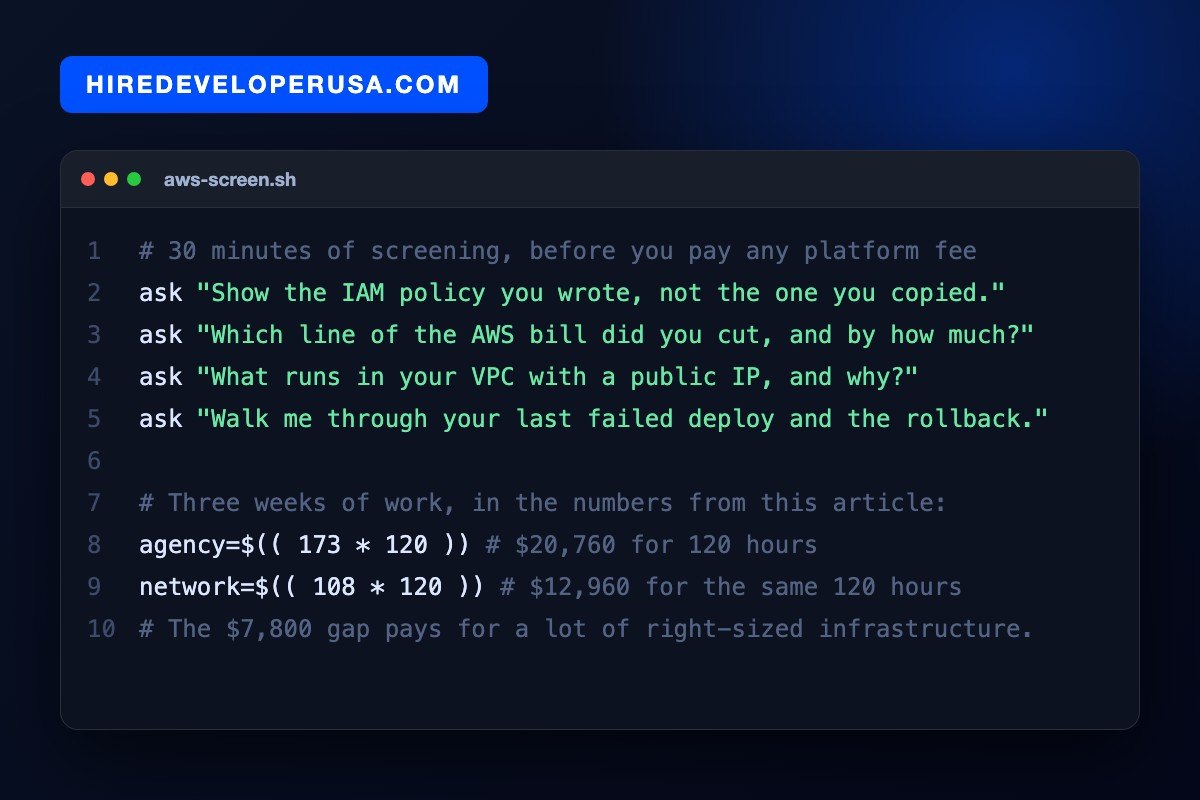
On all four, ask for evidence rather than a portfolio. An architecture diagram link proves a team shipped something, but it says nothing about which parts this person touched. Their own Terraform plan output, a pull request carrying review comments, or a postmortem they wrote shows what they personally did and how they think when things go wrong. That principle holds whichever site you hired through, and it is the part of running a technical interview AWS candidates are least often asked for.
The certification trap, and why it sends buyers to the wrong site
Of all signals, AWS certifications are the easiest to collect and among the weakest to act on. The exams are multiple choice, drawn from a large question bank, and since candidates practice against that bank, a determined studier with no production experience can pass. Engineers who have held the top-level certifications say so themselves: the questions they got right were mostly ones their day job had already taught them, and the badge did not make them better at the work afterward.
This matters for channel choice because certifications are the filter open marketplaces make easiest to apply. Sort by credential and you will shortlist the people best at studying for exams rather than the ones best at running accounts. Treat a certification as evidence of shared vocabulary, which is genuinely useful, then decide on judgment. A candidate who can explain why they chose a relational database over a key-value store for a specific access pattern, and what reversing that decision would cost, is worth more than a row of badges.
Five mistakes that send AWS buyers to the wrong site
Posting "AWS developer" with no job named. Application builders, platform engineers and architects all apply, and you spend interviews finding out which one you really needed.
Shopping on rate while the bill runs. The first month without a right-sizing pass erases a $50 hourly saving. Put the rate and the monthly spend the hire controls in the same sentence when you compare.
Handing production credentials before a scoped trial. Here lies the AWS-specific risk, and the strongest argument against the cheapest channel. Begin people in a sandbox account or on read-only access, then widen it after work has landed.
Using certifications as the filter rather than the tiebreaker. See above. It is the fastest way to fill a shortlist with the wrong strengths.
Matching the engagement to the wrong size of work. Put an agency retainer on a two-week ticket and you waste money; put an hourly freelancer on a multi-account migration with a compliance deadline and you waste the deadline. Size the work before picking the channel, not after.
What to do this week
Write one sentence that names which of the three AWS jobs you have, plus one date by which the first change has to be deployed. Those two facts pick your channel with no further debate. When the date falls inside a month and you want candidates screened before they reach you, begin with a vetted network and keep the first engagement small and scoped: a defined ticket, a sandbox account, a review of the work before access widens.
Then ask the four questions above on whoever you shortlist, whichever site they came from. Our AWS developers page lists profiles screened for the second and third buckets specifically, which are the two hardest to source and the two most expensive to get wrong. If your AWS work is really infrastructure work, start from the DevOps side instead.
Frequently asked questions
What is the best site to hire AWS developers?
Most US buyers with a scoped brief and a deadline inside a month are best served by a vetted talent network: candidates get screened before you see them, a first change usually ships in about 10 days, and rates run $65 to $150 an hour with no placement fee. On small, fully specified tickets, an open marketplace costs less at $40 to $75, provided you accept that screening and credential control are entirely on you. A cloud specialist agency at $125 to $220 an hour is the right shape for a migration or a landing zone delivered end to end.
How much does it cost to hire an AWS developer in the US?
Expect $40 to $75 an hour on an open freelance marketplace, $65 to $150 through a vetted network, $95 to $175 through an IT staffing firm, and $125 to $220 at a cloud or DevOps specialist agency. A full-time hire runs $115,000 to $190,000 base, which works out near $95 an hour once you load it with about 30 percent for taxes, benefits and equipment and spread it across 2,080 hours.
Do AWS certifications matter when hiring?
As a shortlisting signal they matter; as a decision, almost not at all. Because the exams are multiple choice drawn from a question bank, a focused studier with no production experience can pass one. Let a certification confirm shared vocabulary, and then decide on evidence: an IAM policy the candidate tightened, a bill line they cut, a failed deploy they rolled back and what they changed afterward.
Should I hire a freelance AWS developer or an agency?
Size the work first. A defined ticket inside an existing account suits a freelancer or a vetted network contractor and keeps the cost near $65 to $150 an hour. For a multi-account migration, a landing zone or anything with a compliance deadline, an agency is the fit: it brings a manager and shared responsibility for about $125 to $220 an hour. Three weeks of work comes to roughly $12,960 at a network midpoint versus $20,760 at an agency midpoint. The question, then, is whether you are buying hours or buying delivery.
Hire vetted talent